.svg)


.svg)
Outstanding checks represent one of the most commonly misunderstood areas of balance sheet presentation in financial accounting. For organizations processing high-volume disbursements, particularly class action settlements and mass tort distributions, the question of whether outstanding checks should appear as liabilities or as a reduction of cash carries significant implications for financial reporting accuracy, regulatory compliance, and stakeholder confidence.
Key Takeaways
- Outstanding checks should reduce cash balances, not create liabilities, despite widespread misapplication of this principle
- AICPA TIS Section 1100.08 states that cash should only include amounts within the entity's control, meaning issued checks must be deducted
- Book overdrafts (timing differences) differ fundamentally from bank overdrafts (actual financing) in both balance sheet and cash flow treatment
- GameStop Corp revised three years of financial statements after SEC scrutiny of improper outstanding check classification
- Uncashed checks trigger escheatment obligations after state-specific dormancy periods typically one to five years
- Digital payment methods reduce outstanding check complexity but create analogous timing differences requiring similar treatment
- Proper classification affects working capital ratios, liquidity metrics, and cash flow statement presentation
What Are Outstanding Checks?
An outstanding check is a check that a company has issued and recorded in its general ledger accounts, but the check has not yet cleared the bank account on which it is drawn. This timing gap between when a company records the payment and when the bank processes it creates the fundamental accounting question that confuses even experienced finance professionals.
For settlement administrators managing thousands of disbursements, outstanding checks accumulate rapidly. Consider a class action settlement distributing payments to 50,000 claimants if even 10% of recipients delay depositing their checks, the administrator faces 5,000 outstanding items requiring proper balance sheet treatment and ongoing monitoring.
The core issue centers on control. Once a check is mailed or delivered to the payee, it is out of the payor's control. The payee can deposit it immediately or wait months. This uncertainty about timing creates the accounting challenge that organizations must address systematically.
The Proper GAAP Treatment: Reduction of Cash, Not Liability
Despite intuitive assumptions that outstanding checks represent obligations (and thus liabilities), AICPA Technical Practice Aid Section 1100.08 provides clear guidance: outstanding checks should be accounted for as a reduction of cash, not classified as liabilities.
Why This Treatment Matters
The reasoning centers on what "cash" should represent on the balance sheet:
- Cash should reflect amounts within the entity's control specifically, cash in banks plus cash and checks on hand and deposits in transit, minus outstanding checks
- Once a check leaves the company's possession, the company cannot prevent the payee from cashing it
- The obligation was satisfied when the check was delivered the remaining timing difference is purely mechanical
Common Misapplication
Despite clear guidance, widespread confusion persists. Common practice presents outstanding checks as liabilities on financial statement balance sheets because they seem to represent amounts still owed to payees. This intuitive approach conflicts with AICPA guidance and can result in:
- Overstated assets: Cash remains inflated by the amount of outstanding checks
- Overstated liabilities: Accounts payable or accrued liabilities include checks already issued
- Distorted ratios: Working capital and current ratio calculations become unreliable
- Potential SEC scrutiny: For public companies, improper presentation may trigger regulatory questions
Proper Journal Entry Treatment
When a check is issued, the proper accounting treatment reduces the cash balance immediately:
- Debit: Accounts Payable (or appropriate expense account)
- Credit: Cash
The bank reconciliation process then accounts for the timing difference between book balance and bank balance by subtracting outstanding checks from the ending bank statement balance to arrive at the adjusted bank balance.
Book Overdrafts vs. Bank Overdrafts: A Critical Distinction
When outstanding checks exceed available cash balances, organizations face a more complex scenario requiring careful analysis. The distinction between book overdrafts and bank overdrafts fundamentally changes both balance sheet presentation and cash flow classification.
Book Overdrafts Defined
A book overdraft occurs when:
- Checks have been issued but not yet presented to the bank
- The sum of outstanding checks exceeds funds on deposit for a specific bank account
- The bank has not actually honored checks in excess of deposits
- No actual cash flow has occurred, only a timing difference exists
Balance sheet treatment: Book overdrafts should be reclassified to accounts payable or a separate current liability. They represent reinstated trade obligations, not financing arrangements.
Cash flow treatment: Changes in book overdrafts are classified as cash flows from operating activities because they represent timing differences in trade payables, not borrowing activity.
Bank Overdrafts Defined
A bank overdraft occurs when:
- The bank actually honors checks in excess of available deposits
- The bank extends credit to cover the shortfall
- A financing relationship exists between the company and bank
- Real cash has been advanced by the banking institution
Balance sheet treatment: Bank overdrafts should be presented as short-term debt or borrowings, reflecting the actual credit extension.
Cash flow treatment: Changes in bank overdrafts are classified as cash flows from financing activities because they represent borrowing and repayment of credit.
Zero-Balance Account Complications
Many organizations use zero-balance disbursement accounts with automated transfers from master accounts. This creates additional complexity:
- If accounts are at the same bank with a legal right of offset, only the net overdraft across all linked accounts should be presented as a liability
- Zero-balance arrangements that automatically fund presented checks may convert what appears to be a book overdraft into a bank overdraft in substance
- Careful analysis of banking agreements is required to determine the proper treatment
Real-World Consequences: The GameStop Case Study
The 2014 GameStop Corp SEC correspondence provides a cautionary example of how outstanding check misclassification can require financial statement revisions even at sophisticated public companies.
What Happened
GameStop historically presented outstanding checks as components of accounts payable or accrued liabilities rather than reducing cash. After discussions with the SEC and a new auditor review, the company determined this was an error in applying GAAP.
The Correction Required
GameStop revised three years of financial statements:
- Reduced cash by the aggregate outstanding check balance
- Reduced accounts payable and accrued liabilities by the same amounts
- Documented the change as a revision of prior periods
- Assessed materiality under SAB 99 quantitative and qualitative factors
Banking Arrangement Details
GameStop used zero-balance disbursement accounts with automated transfers from a master account at the same bank. The company determined that a legal right of offset existed between accounts, and only net overdrafts should be presented as liabilities.
Lessons for Settlement Administrators
This case demonstrates critical principles:
- Establish clear policies upfront rather than discovering errors years later
- Document banking arrangement analysis supporting offset determinations
- Maintain consistent treatment across reporting periods
- Consider materiality both quantitatively and qualitatively
Escheatment Obligations and Compliance Requirements
Outstanding checks that remain uncashed create ongoing compliance obligations that extend well beyond balance sheet presentation. Every state has unclaimed property laws requiring businesses to report and remit outstanding checks after specified dormancy periods.
Dormancy Period Variations
State escheatment laws vary significantly:
- Typical check "stale date" threshold: 6 months from issuance
- State dormancy periods: Range from typically one to five years depending on jurisdiction
- Determining state: Typically based on the payee's last known address
Compliance Process Requirements
Organizations must implement systematic processes for:
- Regular identification and tracking of outstanding items
- Due diligence efforts to contact payees before dormancy periods expire
- State-specific report preparation with required data elements
- Timely remittance of funds to appropriate state agencies
Penalties for Non-Compliance
Failure to comply with escheatment requirements can result in:
- Financial penalties and interest charges
- Audit findings and reputational damage
- Extended look-back periods in state examinations
- Legal liability for mishandled unclaimed property
Modern Payment Methods: Reducing Outstanding Check Complexity
While physical check volume continues declining, the underlying timing differences between payment initiation and settlement persist across all payment methods. Understanding how digital disbursement options affect outstanding item accounting helps organizations optimize both efficiency and compliance.
Digital Payment Timing Differences
Different payment methods create varying timing gaps:
- ACH Direct Deposit: 1-2 day settlement creates brief outstanding periods at significantly lower cost
- Prepaid Cards: Virtual delivery eliminates mailing delays; funds available within seconds of issuance
- Digital Wallets: Instant access for recipients with established accounts
- Wire Transfers: Same-day settlement minimizes outstanding item duration
- Paper Checks: Several weeks typical distribution timeline with higher outstanding rates
Reducing Outstanding Item Volume
Digital-first disbursement strategies offer multiple advantages:
- Higher redemption rates: Significantly higher redemption with digital payments compared to paper checks
- Faster settlement: 24-48 hour payment cycles versus weeks for checks
- Lower outstanding balances: Reduced float and timing differences
- Simplified reconciliation: Automated matching versus manual tracking
Applying Check Guidance to Digital Payments
The principles from AICPA TIS 1100.08 apply by analogy to modern payment instruments:
- Once a digital payment is initiated and confirmed, it should reduce the cash balance
- Timing differences between initiation and recipient access require reconciliation
- Book overdraft versus bank overdraft distinctions apply to digital payment platforms
- Proper audit trails document payment status throughout the lifecycle
Implementation Best Practices
Establishing Clear Accounting Policies
Organizations should document comprehensive policies addressing:
- Definition of outstanding checks and when items are considered issued
- Bank reconciliation procedures including timing and responsibility
- Book overdraft versus bank overdraft determination criteria
- Right-of-offset analysis for zero-balance and pooling arrangements
- Cash flow classification methodology and supporting documentation
Banking Arrangement Analysis
Before finalizing accounting treatment, analyze:
- Whether a legal right of offset exists between accounts
- How zero-balance arrangements function mechanically
- Whether credit facilities are triggered by presented checks
- The contractual terms governing multi-account relationships
Technology Infrastructure
Modern reconciliation systems should provide:
- Automated bank statement import and transaction matching
- Outstanding item identification and aging analysis
- Real-time visibility into payment status across all channels
- Escheatment tracking with dormancy period alerts
- Audit trail documentation for regulatory compliance
Monitoring and Review
Establish ongoing processes for:
- Monthly reconciliation of all disbursement accounts
- Aging analysis of long-outstanding items
- Quarterly escheatment compliance review
- Annual policy assessment for changing banking arrangements
Why Talli for Outstanding Check Management
Traditional paper check disbursement creates a cascade of complications: high outstanding balances, manual reconciliation burden, escheatment compliance complexity, and inflated processing costs. Modern digital disbursement platforms fundamentally restructure this equation.
Talli's settlement platform addresses outstanding check challenges through:
- Multi-channel payment options: ACH, prepaid cards, digital wallets, and checks as fallback giving claimants choice while reducing paper check volume
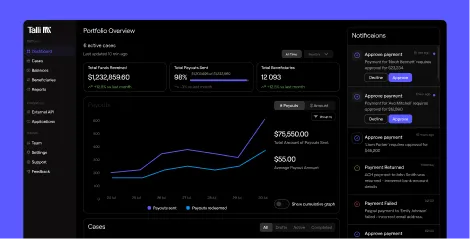
- Real-time tracking: Live visibility into payment status eliminates reconciliation guesswork and supports accurate balance sheet presentation
- Automated compliance: Built-in OFAC screening, W-9 collection, and audit trail documentation for court-ready reporting
- Fund segregation: Dedicated FBO accounts maintain Qualified Settlement Fund compliance while simplifying matter-level tracking
- Superior redemption: Digital-first approach achieves significantly higher redemption rates, reducing escheatment exposure and outstanding item volume
For claims administrators managing high-volume legal payouts, the operational and accounting benefits compound: fewer outstanding items, clearer reconciliation, lower compliance risk, and more accurate financial reporting. The platform's comprehensive reporting capabilities provide the documentation trail necessary for both audit requirements and proper GAAP treatment of outstanding items.
By minimizing outstanding check float through faster payment methods and automated reconciliation, Talli helps organizations maintain cleaner balance sheets, reduce liability exposure, and streamline escheatment compliance, all while improving the claimant experience.
Frequently Asked Questions
Can we continue presenting outstanding checks as liabilities if that's our historical practice?
While changing established accounting policies requires careful consideration, the AICPA TIS 1100.08 guidance is clear that outstanding checks should reduce cash, not create liabilities. If your historical practice differs, consult with your auditors about whether a change is necessary. The GameStop case demonstrates that SEC scrutiny can force revisions even years after the original treatment. Proactively addressing this issue, including assessing materiality of any prior period effects is preferable to reactive corrections under regulatory pressure.
How do we determine if a right of offset exists between bank accounts?
Right of offset depends on contractual terms, not just operational convenience. Simply having multiple accounts at the same bank doesn't automatically create offset rights. Review your banking agreements for explicit offset provisions, consult with legal counsel on enforceability, and document your analysis. Key factors include: whether offset is legally enforceable in your jurisdiction, whether the accounts are owned by the same legal entity, and whether the bank has contractually agreed to offset arrangements. When in doubt, conservative treatment (not assuming offset) is appropriate.
What happens to outstanding checks when a settlement fund closes?
Outstanding checks at fund closure require careful handling. Options include establishing reserves for anticipated claims, extending the claim period for documented outstanding items, applying escheatment procedures for items exceeding dormancy periods, and cy pres distribution for amounts that cannot be distributed to intended claimants. Courts typically require detailed accounting of outstanding items before approving final fund closure. Digital disbursement platforms that achieve higher redemption rates significantly simplify this process by reducing the volume of outstanding items requiring resolution.
How should we treat checks returned as undeliverable?
Checks returned as undeliverable have different accounting treatment than outstanding checks that simply haven't been cleared. For returned items: reverse the original cash reduction (reinstating cash), reinstate the accounts payable obligation, document due diligence efforts to locate the payee, and track against escheatment dormancy periods. The liability remains until successfully paid, returned to the original funding source, or escheated to the appropriate state. Systematic tracking of returned items is essential for both accurate financial reporting and regulatory compliance.
What documentation should we maintain for audit purposes?
Comprehensive documentation includes: written accounting policies for outstanding check treatment, bank reconciliations showing outstanding item details, aging analysis of long-outstanding items, banking agreement excerpts supporting offset determinations, escheatment compliance records including due diligence efforts, historical analysis supporting any changes in accounting treatment, and materiality assessments for identified errors. For settlement administrators, court-required reporting adds additional documentation layers including fund flow summaries, claimant status reports, and distribution completion certifications. Maintaining organized, contemporaneous records significantly reduces audit burden and regulatory risk.