.svg)


.svg)
Class action lawsuits commonly take two to five years from filing to final resolution, although straightforward cases may resolve sooner and complex litigation involving appeals can last much longer. Even after final approval, claim review and payment administration may add several weeks or months. Digital disbursement can accelerate the final delivery stage once funds are authorized, but it cannot eliminate court proceedings, appeals, liens, or eligibility reviews.
Key Takeaways
- Class action lawsuits commonly take two to five years from filing to final payout, with complex cases sometimes lasting a decade or longer.
- After final approval, payments may begin within several weeks to several months, but appeals and administrative disputes can extend the process beyond a year.
- An FTC study found an overall claims rate below 10% in its sample, with substantial variation among cases and notice methods.
- The largest class action and government enforcement settlements tracked by Duane Morris totaled more than $42 billion in 2024.
- Court orders control notice, objection, opt-out, claim, and payment deadlines.
- Digital payments may reach claimants within approximately 24-48 hours after authorization, depending on the payment method and settlement configuration.
- Some litigation connected to the 2010 Deepwater Horizon disaster remains unresolved more than 15 years later.
Understanding the Class Action Settlement Timeline
The journey from the initial complaint to claimant payment involves several legal and administrative stages. The duration depends on case complexity, the number of class members, discovery disputes, court schedules, settlement objections, appeals, and the structure of the distribution plan.
Initial Investigation and Filing
Before filing a complaint, plaintiffs’ attorneys investigate the alleged conduct, identify proposed class representatives, assess potential damages, and determine whether the claims may satisfy class-action requirements.
This preliminary work can take several weeks or months. Once the complaint is filed, the defendant may respond with a motion to dismiss, an answer, jurisdictional challenges, or other preliminary motions.
Class Certification
A proposed class is not automatically permitted to proceed as a class action. The court must determine whether the case satisfies Federal Rule 23, including requirements related to numerosity, commonality, typicality, and adequate representation.
Class certification may take months or years, particularly when the parties dispute whether common issues predominate over individual questions. Courts may also certify only part of a proposed class or deny certification entirely.
Discovery and Expert Review
During discovery, the parties exchange documents, take depositions, retain experts, and analyze evidence relevant to liability, damages, and class treatment.
Discovery may include:
- Corporate records and internal communications
- Transaction or purchase data
- Employment and payroll records
- Consumer account information
- Expert economic analysis
- Depositions of employees and class representatives
Large antitrust, securities, employment, and data breach cases may involve millions of records and several years of discovery.
Settlement Negotiations
Settlement discussions may occur before certification, during discovery, after major court rulings, or shortly before trial. Some negotiations are conducted directly, while others use an experienced mediator.
Reaching an agreement does not immediately end the case. A proposed class settlement generally requires court review, notice to class members, an opportunity to object or opt out, and final approval.
The Court Approval Process
Preliminary Approval
The parties submit the proposed agreement to the court and request preliminary approval. The court reviews the settlement structure, proposed class definition, release language, notice plan, claims process, attorney-fee request, and distribution method.
Preliminary approval may take several weeks or months. A court may request revisions before authorizing notice.
Notice and Claims Period
After preliminary approval, the settlement administrator distributes notice and opens the claims process. Depending on the case, notice may be sent through:
- Postal mail
- Text message
- Digital advertising
- Publication notice
- A settlement website
- Direct account notifications
The applicable court order establishes the deadlines. The Northern District of California’s procedural guidance recommends allowing class members sufficient time to review the settlement and exercise their rights, but the presiding judge’s order controls.
Claim periods commonly remain open for several months, although the exact schedule varies.
Final Approval Hearing
At the fairness hearing, the judge considers whether the proposed settlement is fair, reasonable, and adequate. The court may review objections, attorney fees, service awards, administration expenses, and the proposed plan for distributing funds.
Final approval does not always permit immediate payment. An objector may appeal, and settlement funds may remain undistributed until the appeal period expires or the appeal is resolved.
How Long Does Payment Take After Final Approval?
Payments may begin within approximately 30 to 120 days after final approval when:
- No appeal is filed
- Claims have already been reviewed
- The settlement fund is fully funded
- No major lien or allocation dispute remains
- Payment information is complete
More complicated settlements may require six months or longer. Appeals, deficient claims, duplicate submissions, tax documentation, healthcare liens, address problems, and disputed award calculations can extend the timeline beyond a year.
The final payment delivery step is only one portion of the process. A digital payment may reach an eligible claimant quickly after authorization, but the platform cannot authorize payment before the administrator and legal team complete the required reviews.
Examples of Extended Settlement Timelines
The Dial Complete soap litigation illustrates how long a consumer class action may take. The lawsuit was filed in 2010, and class members began receiving checks in September 2019, approximately nine years later.
The Deepwater Horizon disaster occurred in April 2010. BP paid billions through multiple settlements, but some health-related lawsuits involving cleanup workers and Gulf Coast residents remained unresolved more than 15 years later.
These cases are not representative of every class action, but they show why claimants should not assume that settlement negotiations or final approval guarantee an immediate payout.
Factors That Delay Class Action Payments
Settlement Objections and Appeals
Class members may object to the settlement, attorney fees, distribution formula, release terms, or proposed use of residual funds. Even after the court overrules an objection, the objector may appeal.
An appeal can delay payment for months or years because administrators generally cannot distribute funds while the settlement remains subject to reversal.
Complex Claim Review
Administrators must determine whether each claimant meets the class definition and submit the required information. Review becomes more difficult when claims involve:
- Multiple products or transactions
- Different award tiers
- Lost purchase records
- Employment histories
- Medical documentation
- Identity verification
- Duplicate or suspicious submissions
Automated validation can assist with high-volume review, but exceptions still require human evaluation.
Liens and Subrogation
Personal injury and mass tort distributions may require resolution of Medicare, Medicaid, private insurance, child-support, bankruptcy, or other liens before funds can be released.
These issues may affect individual claimants even when the broader settlement is ready for distribution.
Incorrect Contact Information
Class actions may last several years, giving claimants time to move, change email addresses, close bank accounts, or replace phone numbers.
Returned mail and failed payments create additional research, reissuance, and reporting work. Claims teams can reduce this risk through failed-payment recovery and automated contact updates.
Fraudulent Claims
One claims administrator reported receiving more than 80 million claims showing significant signs of fraud in 2023. Automated bots, fabricated identities, duplicate claims, and stolen claimant information can delay legitimate payments by increasing the amount of review required.
Purpose-built fraud detection can flag suspicious patterns, but administrators must balance fraud prevention with fair access for legitimate class members.
Claims Rates and Unclaimed Settlement Funds
An FTC study of consumer class action settlements found an overall claims rate below 10% in its sample. Participation varied substantially depending on the case, available claimant records, notice method, claim requirements, and value of the potential award.
A low claims rate does not necessarily mean the notice program failed. Some classes are difficult to identify, some awards are small, and some claimants do not recognize or trust settlement communications.
When funds remain unclaimed, the settlement agreement and court order may permit:
- A second distribution
- Increased payments to approved claimants
- Distribution to a cy pres beneficiary
- Reversion to the defendant
- Transfer under applicable unclaimed-property law
Administrators must follow the approved plan rather than choosing a residual-fund method independently.
How Digital Disbursement Affects the Timeline
Digital disbursement primarily improves the period after payment authorization. It does not shorten discovery, court approval, appeals, lien resolution, or substantive claim review.
Once a payment is authorized, a digital disbursement platform can reduce delays associated with printing, mailing, depositing, and reissuing paper checks.
Available methods may include:
- ACH transfers
- Prepaid cards
- PayPal
- Venmo
- Digital gift cards
- Paper checks as a fallback
Talli reports that authorized digital payments may reach claimants within approximately 24-48 hours, depending on the payment rail and recipient action. Actual timing varies by bank processing, claimant response, fraud review, and settlement configuration.
Reaching Unbanked Claimants
The FDIC reported that approximately 5.6 million U.S. households were unbanked in 2023. A settlement that offers only ACH may therefore exclude some eligible claimants.
Prepaid cards, digital wallets, gift cards, and check options can provide alternatives. A multi-channel payment strategy allows claimants to select a method appropriate to their circumstances.
Improving Redemption
Paper checks may be lost, discarded, returned, or left uncashed. Digital delivery can reduce these problems by sending payment instructions through email or SMS and allowing automated reminders.
Talli reports that some multi-channel programs achieve redemption rates of approximately 95-98%, compared with company benchmarks of 70-80% for check-based distributions. These figures are not guaranteed and may vary according to the settlement population, award size, notice program, payment methods, and follow-up strategy.
Compliance Requirements During Distribution
Identity and Sanctions Screening
Depending on the settlement and payment method, administrators may use identity verification, fraud screening, and OFAC screening.
These controls should be proportionate to the legal requirements and risks of the distribution. Not every claimant requires the same verification process.
Tax Documentation
Not every settlement claimant must provide a W-9. The required documentation depends on the tax character of the payment, the claimant’s status, and applicable information-reporting rules.
When a W-9 or other tax form is required, digital collection and reminders can reduce missing information. Administrators should also ensure that any required Forms 1099 or other information returns reflect the proper payment type.
Qualified Settlement Funds
A Qualified Settlement Fund may be established under IRC Section 468B and the applicable Treasury regulations. Its legal and tax treatment depends on satisfying the regulatory requirements, not simply on using a particular payment platform or bank account.
Administrators and trustees should preserve complete fund records, avoid unauthorized commingling, and maintain an auditable history of every disbursement. Talli supports QSF and trustee workflows through dedicated settlement-level tracking and payment records.
Post-Distribution Reporting
The Northern District of California recommends filing a Post-Distribution Accounting within 21 days after settlement checks become stale or, when no checks are used, after the approved distributions have been completed.
The accounting may include:
- Total settlement fund
- Number of notices delivered
- Number of claims submitted
- Number and value of approved claims
- Payments issued and redeemed
- Administrative expenses
- Remaining funds
- Proposed residual distribution
Other courts may impose different requirements, so the governing court order must be reviewed.
Common Types of Class Action Settlements
Class action settlements frequently involve:
- Consumer protection
- Data breaches and privacy
- Antitrust violations
- Employment and wage claims
- Securities litigation
- Product defects
- Environmental contamination
- Civil rights claims
Data breach litigation has grown particularly quickly. Legal industry reporting identified 1,488 data breach class actions filed in 2024, compared with 604 in 2022.
Class members should rely on court-authorized notices and official settlement websites rather than social media posts or third-party lists when determining eligibility.
No-Proof Settlements
Some consumer settlements allow claimants to submit a truthful attestation instead of a receipt. This approach may be appropriate when consumers would not reasonably retain documentation for low-cost purchases made several years earlier.
A no-proof claim is not an invitation to submit speculative or false information. Claimants must still:
- Satisfy the class definition
- Submit the claim before the deadline
- Provide accurate contact information
- Confirm the qualifying purchase or harm
- Follow household, transaction, or product limits
Settlements may offer lower payments for attestation-only claims and higher reimbursement for documented losses.
Best Practices for Claims Administrators
Claims teams can reduce avoidable delays by combining clear procedures with appropriate technology.
Validate Data Early
Review claimant records before the distribution date. Identify missing addresses, duplicate records, incomplete tax documentation, invalid bank details, and unresolved eligibility issues before funds are released.
Offer Multiple Payment Methods
A single payment option may not serve the entire class. A claimant payment program can include ACH, prepaid cards, digital wallets, gift cards, and checks where appropriate.
Use Automated Reminders
Email and SMS reminders can help claimants complete payment selection, submit missing information, and redeem digital awards before expiration.
Maintain Complete Audit Trails
Every payment attempt, return, reissue, cancellation, and redemption should be recorded. Court-ready audit trails help administrators demonstrate compliance with the approved distribution plan.
Plan for Exceptions
Claims teams should establish procedures for returned payments, deceased claimants, disputed identities, duplicate claims, lien issues, and claimants requiring non-digital alternatives.
Why Talli Streamlines Settlement Distribution
Court approval is only the beginning of the final distribution stage. Administrators still need to validate payment data, communicate with claimants, prevent fraud, issue funds, recover failed payments, reconcile transactions, and report results.
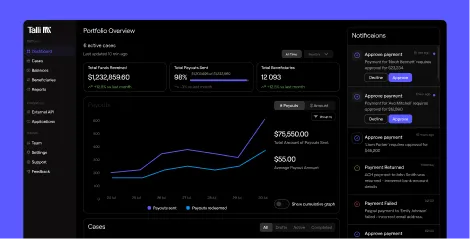
Talli provides purpose-built digital disbursement infrastructure for class actions, mass torts, bankruptcy matters, and other legal distributions. The platform supports multiple payment options, real-time tracking, KYC and OFAC workflows, fraud mitigation, tax-document collection when required, and settlement-level audit records.
Talli’s AB Data case study reports a 30% increase in claimant redemption rates and a 60% reduction in unresolved exceptions and manual reissuance work. These are company-reported case study results and should not be treated as guaranteed outcomes for every settlement.
By replacing fragmented check workflows with centralized settlement disbursement, Talli helps claims teams move from payment authorization to claimant delivery without losing visibility or compliance control.
Frequently Asked Questions
How Long Does a Class Action Take From Filing to Payout?
A class action commonly takes two to five years from the initial complaint to final payout. Straightforward cases may resolve sooner, while antitrust, securities, employment, and mass tort cases can take much longer. Discovery disputes, class certification, settlement objections, appeals, liens, and claim review all affect the final timeline.
How Soon Are Payments Sent After Final Approval?
Payments may begin within approximately 30 to 120 days after final approval when no appeal or major administrative issue exists. Complex claim calculations, unresolved liens, deficient submissions, fraud review, or an appeal can extend the process for six months, a year, or longer.
What Happens to Unclaimed Settlement Money?
The settlement agreement and court order determine what happens to remaining funds. The money may be redistributed to approved claimants, transferred to an approved cy pres beneficiary, returned to the defendant when permitted, or handled under applicable unclaimed-property laws. Administrators cannot choose a different method without legal authorization.
Can Digital Payments Eliminate Settlement Delays?
Digital payments can shorten the final delivery stage by avoiding check printing, mailing, depositing, and reissuance. They cannot eliminate court approval, appeals, claim verification, healthcare liens, award calculations, or fraud review. Payment speed begins to matter only after the administrator has approved and authorized the claimant’s distribution.
Do All Class Action Claims Require Proof of Purchase?
No. Some settlements accept a truthful attestation when consumers are unlikely to have retained receipts. Claimants must still satisfy the class definition and follow all settlement rules. Attestation-only claims may receive smaller awards than documented claims and remain subject to duplicate-claim checks, fraud review, and court-approved payment limits.