.svg)


.svg)
Qualified Settlement Funds provide valuable flexibility for legal settlements, but they also create distinct federal tax and reporting duties. A QSF is generally taxed at the highest individual rate on modified gross income, while qualifying transfers from defendants are excluded from that calculation. Trustees must coordinate Form 1120-SF filing, estimated taxes, recipient documentation, withholding, and payment-specific information reporting.
Key Takeaways
- A QSF generally pays federal income tax at 37% on modified gross income, not on qualifying settlement contributions.
- Every QSF must file Form 1120-SF annually, generally by April 15 for a calendar-year fund.
- Estimated tax payments are required when expected annual tax, after applicable credits, reaches $500 or more.
- Defendant transfers into a QSF generally are not reportable on Form 1099-MISC.
- Outbound distributions may require Form W-2, Form 1099-MISC, Form 1099-NEC, or another return based on the payment’s character.
- The 2026 $2,000 threshold applies to certain payments, but attorney gross proceeds reported in Box 10 retain a $600 threshold.
- The 24% backup-withholding rate applies only when the payment is subject to backup withholding and the recipient has not provided valid taxpayer information.
Understanding Qualified Settlement Funds
A Qualified Settlement Fund is a fund, account, or trust established to resolve or satisfy certain legal claims. It is governed primarily by Treasury Regulation Section 1.468B-1.
The QSF separates the defendant’s transfer of settlement money from the later processing and payment of claimant awards. This separation can give administrators time to:
- Validate claims and calculate individual awards
- Resolve Medicare, Medicaid, workers’ compensation, and other liens
- Process structured-settlement elections
- Establish Special Needs Trusts or other approved arrangements
- Collect payment and tax documentation
- Address returned or unsuccessful payments
- Complete court-required accounting
Defendants may satisfy economic-performance requirements for qualifying liabilities when money or property is transferred to the QSF. The actual timing of a defendant’s deduction still depends on the nature of the liability and other applicable tax provisions.
Claimants generally recognize taxable amounts when they receive or constructively receive payment. Establishing a QSF does not create unconditional tax deferral. Trustees and counsel must still consider constructive receipt, economic benefit, settlement terms, and the underlying character of each award.
Trustees handling high-volume cases can use QSF payment infrastructure to maintain settlement-level records and preserve visibility throughout the distribution process.
Requirements for Qualified Settlement Fund Status
A fund must satisfy three principal requirements.
Governmental Order or Approval
The fund must be established under an order of, or approved by, the United States, a state, a political subdivision, a governmental agency, or a court of law. It must remain subject to the continuing jurisdiction of that governmental authority.
The approving court does not necessarily need jurisdiction over the underlying legal claim. However, the order should clearly establish or approve the fund and retain continuing jurisdiction.
Eligible Claims
The fund must be established to resolve or satisfy one or more contested or uncontested claims arising from:
- A tort
- Breach of contract
- Violation of law
- Claims described in the environmental or CERCLA-related provisions of the regulations
The claims may be actual or potential. The fund cannot qualify merely because it holds money that might later be used for an unrelated commercial obligation.
Trust or Segregation Requirement
The fund must either:
- Be a trust under applicable state law, or
- Keep its assets segregated from the transferor’s other assets
This requirement prevents the arrangement from functioning merely as an unrestricted account controlled by the defendant. Trustees should follow the governing order, trust documents, settlement agreement, and applicable fiduciary rules when creating the account structure.
Useful formation records normally include:
- The court or governmental order
- Settlement agreement
- Trust or fund agreement
- Employer Identification Number
- Administrator designation
- Bank account and ownership records
- Investment policy, when applicable
- Approved distribution procedures
A documented QSF compliance process can help administrators maintain these records consistently.
How QSF Income Is Taxed
A QSF is treated as a United States person and is taxed under Treasury Regulation Section 1.468B-2.
The tax rate equals the highest rate under IRC Section 1(e). The current maximum individual rate is 37%.
Modified Gross Income
The QSF does not generally pay income tax on qualifying settlement contributions received from defendants or insurers. Instead, it pays tax on modified gross income, which may include:
- Interest earned on deposited settlement money
- Dividends
- Capital gains
- Certain payments compensating the fund for delayed transfers
- Other taxable investment or operating income
Suppose a QSF holds $1 million and earns $20,000 in taxable interest before deductions. At a 37% rate, the tax before allowable deductions would be $7,400.
Allowable Deductions
A QSF may deduct expenses permitted under the QSF regulations when calculating modified gross income. These may include qualifying administrative and incidental expenses, such as:
- Trustee or administrator fees
- Tax-return preparation expenses
- Accounting expenses
- Bank and investment-management charges
- Certain legal expenses incurred to administer the fund
- Qualifying state and local taxes
Not every cost connected with the settlement is automatically deductible. Expenses incurred primarily to resolve or satisfy claims must be distinguished from expenses incurred to operate or administer the QSF.
Accounting Period and Method
A QSF must generally:
- Use the calendar year
- Use an accrual method of accounting
- Obtain its own EIN
- Maintain records separate from the defendant, law firm, trustee, and administrator
Form 1120-SF Filing Requirements
Every QSF must file Form 1120-SF annually. This requirement applies even when the fund has no taxable income.
Under the current Form 1120-SF instructions, the return reports:
- Transfers received
- Income earned
- Deductions claimed
- Distributions made
- Tax payments and credits
- Federal income tax liability
Filing Deadline
A calendar-year QSF generally files by the 15th day of the fourth month after year-end, normally April 15. When the date falls on a Saturday, Sunday, or legal holiday, the deadline moves to the next business day.
A QSF may request an automatic extension by filing Form 7004 by the original filing deadline. An extension to file does not extend the deadline for paying tax.
Estimated Tax Payments
A QSF must generally make estimated tax installments when it expects its annual federal tax, after applicable credits, to equal or exceed $500.
For a calendar-year fund, installments are generally due on:
- April 15
- June 15
- September 15
- December 15
The payments must be made electronically. Form 2220 may be used to determine an underpayment penalty, although the IRS can often calculate the penalty.
Trustees should enroll the fund in the appropriate federal payment system early rather than waiting until the first installment becomes due.
Reporting Transfers Into a QSF
A qualifying transfer into a QSF is generally treated as a payment to a corporation for federal information-reporting purposes. As a result, the defendant or insurer generally does not issue Form 1099-MISC merely because it transferred settlement money to the QSF.
This treatment applies to the contribution into the fund. It does not determine how later claimants, attorney, vendor, or wage payments must be reported.
Although a Form W-9 may not be required solely to avoid a Form 1099-MISC on the contribution, a financial institution or payer may request the QSF’s EIN and taxpayer documentation for:
- Account opening
- Identity verification
- Internal vendor controls
- Anti-money-laundering procedures
- Payment authorization
- Other regulatory requirements
Trustees should explain the distinction rather than refusing every taxpayer-information request.
Reporting Distributions Out of a QSF
Outbound reporting depends on the underlying character of each payment. The QSF structure does not convert a taxable award into a tax-free payment or eliminate employment-tax obligations.
Wage and Employment Payments
Back pay, front pay, severance, and other wage-related awards may require:
- Form W-2
- Federal income-tax withholding
- Social Security and Medicare taxes
- Employer payroll-tax deposits and returns
Settlement documents should allocate wage and nonwage components clearly. Administrators should not report a wage award as Form 1099-MISC income merely because the payment passed through a QSF.
Taxable Nonwage Damages
Taxable nonwage damages may be reported on Form 1099-MISC, commonly in Box 3. Beginning with 2026 payments, the reporting threshold for certain other-income payments generally increases from $600 to $2,000.
Examples may include:
- Emotional distress damages unrelated to physical injury
- Certain contract damages
- Punitive damages
- Taxable reimbursement payments
- Other nonwage settlement income
Reporting can still be required regardless of the payment amount when federal income tax was withheld under applicable backup-withholding rules.
Attorney Payments
Attorney reporting requires careful separation of service fees and gross proceeds.
For 2026 payments:
- Attorney service fees of $2,000 or more are generally reported on Form 1099-NEC.
- Gross settlement proceeds of $600 or more paid to an attorney in connection with legal services remain reportable on Form 1099-MISC, Box 10.
- Reporting may apply even when the attorney is incorporated.
- A claimant may also receive a separate tax form when the payment is taxable to the claimant.
Trustees should maintain cumulative annual totals for each attorney and claimant. The applicable threshold generally applies to the total paid during the calendar year, not to each individual installment.
Administrators can use an automated reconciliation workflow to connect approved allocations, recipient records, and completed payments.
Claimant Tax Treatment
The claimant’s tax treatment depends on what the settlement payment replaces.
Physical Injury or Physical Sickness
Compensatory damages received on account of personal physical injury or physical sickness may be excluded under IRC Section 104(a)(2).
Potentially excludable components include:
- Medical expenses, except previously deducted expenses that produced a tax benefit
- Pain and suffering caused by the physical injury
- Lost income attributable to the physical injury
- Emotional distress directly resulting from the physical injury
The settlement agreement should identify the physical injury and explain the basis for the allocation.
Taxable Payments
Common taxable categories include:
- Punitive damages, subject to a narrow wrongful-death exception
- Interest
- Back pay and front pay
- Emotional distress unrelated to physical injury
- Contract damages
- Lost profits
- Certain attorney-fee amounts included in the claimant’s income
Trustees should not promise claimants that a distribution is tax-free merely because it originated from a legal settlement.
Backup Withholding and TIN Collection
The federal backup-withholding rate is 24%. It may apply when:
- The payment is subject to backup withholding
- The recipient fails to provide a TIN
- The IRS reports that the TIN is incorrect
- The recipient fails to make a required certification
- The IRS directs the payer to begin withholding
Backup withholding does not automatically apply to every person receiving money from a QSF. Wage payments follow payroll-withholding rules, while certain excludable or specially regulated payments may follow different requirements.
A structured tax-document collection process can help trustees identify missing or inconsistent recipient information before payments are authorized.
Penalties Trustees Should Monitor
Late Form 1120-SF Filing
The late-filing penalty is generally 5% of unpaid tax for each month or part of a month the return is late, up to 25%.
For a return more than 60 days late, a statutory minimum may apply. For returns required after 2025, the amount is generally the lesser of the unpaid tax or $525, subject to inflation adjustments.
A zero-tax return may not produce the same percentage-based penalty, but the annual filing obligation still exists.
Late Tax Payment
The late-payment penalty is generally 0.5% of unpaid tax per month or part of a month, up to 25%, unless reasonable-cause relief applies.
Information-Return Penalties
Incorrect or late Forms 1099 and recipient statements can generate separate penalties. The amount depends on:
- How late the correct form is filed
- Whether the payer qualifies for lower small-business maximums
- Whether the failure involved intentional disregard
- Whether both the IRS return and recipient statement were incorrect
Trustees should use current-year penalty tables rather than carrying forward a prior year’s per-form amount.
Fund Controls and Audit Documentation
QSF administration requires more than filing tax forms. Trustees must also maintain documentation showing that money was held, invested, and distributed according to the court order and settlement agreement.
Core controls include:
- Settlement-specific bank accounts
- Matter-level transaction ledgers
- Dual approval for fund movements
- Recipient identity and payment records
- Allocation records
- Tax-form status
- Returned-payment records
- Investment-income records
- Court reporting and reconciliation
Improper commingling can jeopardize qualification when segregation is required, violate fiduciary duties, and prevent the trustee from proving how settlement assets were used.
A complete distribution audit trail should connect each approved claimant amount to the corresponding payment instruction and final payment result.
Digital Disbursement Options
Digital distribution can reduce many operational problems associated with paper checks, including returned mail, stale checks, manual reissuance, and delayed reconciliation.
Common options include:
- ACH transfers
- Prepaid cards
- Digital wallets
- Gift cards, when permitted
- Wire transfers
- Paper checks as a fallback
Actual cost and delivery time depend on the provider, payment volume, banking relationship, claimant location, and support requirements. Trustees should avoid presenting estimated transaction costs as guaranteed pricing.
A multi-channel payment system also needs controls for identity verification, failed payments, recipient communications, and unclaimed-property obligations.
Why Talli Supports QSF Administration
Talli provides purpose-built digital disbursement infrastructure for legal settlement administrators, trustees, and claims teams. Its platform supports multiple payment methods, settlement-level tracking, claimant communications, tax-document collection, compliance workflows, and audit logging.
Relevant capabilities include:
- Digital W-9 collection
- KYC and OFAC workflows
- Payment-status tracking
- Dedicated settlement accounts
- Multi-channel claimant payments
- Fraud mitigation
- Automated email and SMS reminders
- Real-time dashboards
- Reconciliation records
- Court-ready audit trails
These capabilities can help trustees centralize the information needed by tax professionals, courts, and settlement counsel. They do not replace the legal and tax analysis required to characterize settlement payments, calculate QSF income, file Form 1120-SF, or determine whether withholding applies.
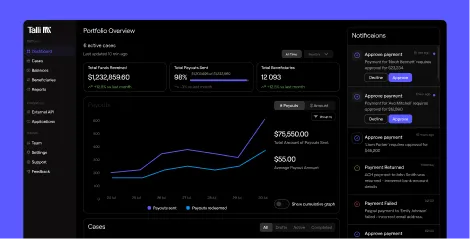
Through the Talli platform, claims teams can organize payment data and monitor distributions without relying exclusively on paper checks and disconnected spreadsheets. Its real-time reporting tools provide visibility into completed, pending, failed, and returned payments.
Talli Conclusion
QSF compliance depends on correctly separating three issues: taxation of the fund, reporting of defendant contributions, and reporting of claimant or attorney distributions. A trustee must file Form 1120-SF, track taxable investment income, make required estimated payments, and apply the proper reporting rule to every outbound payment.
Talli supports this process by centralizing claimant documentation, payment records, compliance checks, fund activity, and audit evidence. This infrastructure helps trustees reduce manual errors while preserving the visibility required for court-supervised distributions.
Frequently Asked Questions
What Is a Qualified Settlement Fund?
A QSF is a court-approved or government-approved fund established to resolve eligible legal claims. It separates the defendant’s settlement transfer from later claimant distributions, allowing time for claims review, lien resolution, payment elections, tax documentation, and court-approved administration.
Does a QSF Pay Tax on Settlement Contributions?
Generally, no. Qualifying contributions from defendants are excluded when calculating the QSF’s modified gross income. The fund is generally taxed at 37% on taxable income such as interest, dividends, capital gains, and certain other earnings, after allowable deductions.
When Is Form 1120-SF Due?
A calendar-year QSF generally files Form 1120-SF by April 15. The deadline moves to the next business day when it falls on a weekend or legal holiday. Form 7004 can extend the filing deadline, but it does not extend the payment deadline.
Does the 2026 $2,000 Threshold Cover Attorney Payments?
Only partly. Attorney service fees reported on Form 1099-NEC generally use the $2,000 threshold for 2026 payments. Gross settlement proceeds paid to an attorney remain reportable on Form 1099-MISC, Box 10, when payments total at least $600.
Does Every Claimant Need Backup Withholding?
No. The 24% backup-withholding rate applies only when the payment is covered by backup-withholding rules and the recipient has not provided valid taxpayer information or another triggering condition exists. Wage payments follow payroll-withholding rules instead.