.svg)


.svg)
Paying agent services form the operational backbone of corporate finance, supporting P&I entitlement allocations for securities valued at $87.1 trillion through DTC’s corporate action infrastructure. These specialized intermediaries handle everything from M&A consideration payments to shareholder dividends, ensuring accuracy, tax compliance, and regulatory adherence while 91% of M&A deals include escrow funds that require professional payment administration. Modern digital disbursement platforms compress payment timelines from weeks to 24 to 48 hours while reducing processing costs by 50% to 65% compared to traditional paper-based methods.
Key Takeaways
- Paying agents are neutral intermediaries that accept funds from issuers or transaction parties and distribute them to security holders, shareholders, claimants, or creditors according to approved instructions.
- DTC’s corporate action infrastructure services approximately 1.39 million active security issues, with P&I Cash Processing supporting entitlement allocations for securities valued at $87.1 trillion.
- M&A transactions often require escrow and paying agent coordination, especially when purchase price adjustments, indemnity holdbacks, earnouts, or shareholder payment instructions remain open after closing.
- Median indemnification escrow sizes commonly sit around 10% of transaction value for deals without Representations and Warranties Insurance, while insured deals may use smaller general indemnity escrows.
- Digital paying agent portals reduce payment processing to days instead of weeks while eliminating manual data entry errors and improving audit visibility.
- Principal paying agents, fiscal agents, trustees, escrow agents, and transfer agents perform related but distinct roles, so the right structure depends on whether the transaction requires administrative payment processing, conditional fund holding, or fiduciary representation.
Understanding Disbursement vs. Dispersement: Precision in Corporate Finance
The term “disbursement” refers to the formal release and distribution of funds from one party to designated recipients. “Dispersement” is commonly confused with disbursement, but it is not the correct term in financial, legal, or corporate payment contexts. Proper terminology matters because regulatory filings, court documents, and compliance records require precise language.
What is Disbursement in a Corporate Context?
Disbursement encompasses any authorized payment outflow from a corporate entity, settlement fund, trust, or transaction account. In practice, this includes:
- Settlement distributions to class members in litigation
- Dividend payments to registered shareholders
- Interest and principal payments to bondholders
- Merger consideration to selling shareholders
- Bankruptcy distributions to creditors
The paying agent serves as the intermediary between the funding party and the approved recipient population. Its job is to handle the mechanical aspects of fund transfer, validate recipient instructions, process tax documentation, maintain transaction records, and provide reporting that administrators, courts, issuers, trustees, or deal parties can rely on.
Why Accurate Terminology Matters for Compliance
Financial regulators, courts, auditors, and transaction counsel scrutinize disbursement documentation for consistency and accuracy. Using incorrect terminology can create ambiguity in legal proceedings, complicate tax reporting, and weaken audit trails. Proper disbursement records should include payment authorization, recipient verification, tax withholding calculations, delivery confirmation, exception handling, and final reconciliation.
For high-volume legal and corporate payments, the difference between a clean distribution file and an incomplete payment record can determine whether a transaction closes smoothly or creates months of follow-up work.
What is Loan Disbursement Meaning in Corporate Transactions?
Loan disbursement describes the process by which lenders release committed funds to borrowers after contractual conditions are satisfied. Unlike a simple wire transfer, corporate loan disbursements often involve multiple verification stages, compliance checkpoints, lender approvals, collateral requirements, and documentation reviews.
The Role of a Paying Agent in Loan Disbursements
Paying agents or loan agents in syndicated loan transactions coordinate between multiple lenders and the borrower. They help ensure funds move correctly according to commitment percentages, closing instructions, and repayment schedules. These functions can include calculating interest, managing cash flows, processing distributions, and maintaining records during closing, amortization, and repayment.
Key responsibilities include:
- Verifying satisfaction of funding conditions
- Calculating pro rata distributions among syndicate members
- Processing milestone-based releases
- Maintaining payment records for audit purposes
- Coordinating with escrow agents for conditional releases
In complex transactions, the paying agent may work alongside an administrative agent, collateral agent, escrow agent, or trustee. Each role should be clearly documented so parties know who holds funds, who authorizes release, who processes payments, and who owes duties to each stakeholder group.
The Role of Escrow Services in Securing Corporate Disbursements
Escrow arrangements provide a critical layer of protection in corporate transactions by holding funds with a neutral third party until specified conditions are met. Unlike paying agents who process authorized payments, escrow agents hold funds conditionally and release them only when contractual triggers occur.
How Escrow Protects Both Parties in Financial Transactions
M&A transactions show escrow’s protective function clearly. When buyers acquire target companies, indemnification escrows can secure post-closing obligations for 12 to 18 months after closing. If sellers breach representations or if working capital adjustments are owed, buyers may claim against escrowed funds rather than attempting to collect from dispersed former shareholders.
Escrow protection can support:
- Indemnification claims for undisclosed liabilities
- Working capital adjustments requiring post-closing true-ups
- Earnout disputes tied to performance milestones
- Regulatory approvals that may be delayed or denied
- Expense funds for post-closing administration
A paying agent and escrow agent may be part of the same transaction, but they are not interchangeable. The escrow agent controls conditional release. The paying agent distributes funds once the relevant release instructions have been approved.
Choosing the Right Escrow Service for Your Business
Selection criteria should emphasize regulatory authorization, account controls, technology capabilities, and fee transparency. For cross-border transactions, parties should confirm whether the provider can support local payment regulations, tax documentation, sanctions screening, currency conversion, and recipient verification.
Digital platforms offering real-time reporting and automated compliance checks outperform legacy providers that rely on manual spreadsheets, email-based payment instructions, and delayed status reports. For legal settlements and bankruptcy distributions, the right provider should also support fund segregation, claimant communications, payment reminders, and court-ready reporting.
Optimizing Disbursement Centers for Efficient Corporate Payouts
Disbursement centers serve as centralized hubs for processing high-volume payments, whether dividend distributions to shareholders or settlement payments to class members. Operational efficiency depends on technology infrastructure, compliance automation, and scalable processing capacity.
Building an Effective Disbursement Center for High-Volume Payments
Professional disbursement operations require:
- Automated validation of recipient information against approved distribution lists
- Multi-channel payment capabilities including ACH, wire, check, prepaid card, and digital wallet options
- Real-time compliance screening for OFAC sanctions and KYC requirements
- Exception management workflows for failed payments and returned items
- Comprehensive audit trails documenting every transaction decision
Organizations processing thousands of payments cannot rely on manual spreadsheet management. Modern settlement administration software automates these functions while maintaining compliance with court requirements, tax obligations, and stakeholder reporting needs.
Technology Solutions for Modern Disbursement Centers
Digital transformation has changed disbursement operations. Leading platforms provide real-time payment tracking, automated tax form collection, recipient self-service portals, and API connectivity to banking and case management systems. These capabilities reduce administrative burden while accelerating payment delivery from weeks to days.
For claims administrators, shareholder services teams, and bankruptcy trustees, the biggest advantage is not only speed. It is controlled. A centralized dashboard makes it easier to identify failed payments, track redemption rates, document fund movement, and generate reports without rebuilding the payment history manually.
Dividend Stocks and Corporate Payouts: How Disbursements Work
Dividend distributions represent one of the most common paying agent functions, requiring coordination between issuers, transfer agents, clearing systems, and individual shareholder accounts. The mechanics involve precise timing, accurate calculations, and proper tax treatment.
The Mechanics of Dividend Payments and Shareholder Disbursements
Corporate dividends flow through a structured timeline:
- Declaration date: The board authorizes the dividend amount and payment schedule
- Ex-dividend date: The stock trades without dividend entitlement
- Record date: The company determines which shareholders are eligible for payment
- Payment date: Funds are distributed to shareholders
Paying agents calculate payment amounts, coordinate with DTC for street-name holdings, and process direct payments to registered shareholders. For corporations with global shareholder bases, principal paying agents may coordinate sub-agents across jurisdictions to ensure timely delivery regardless of location.
For shareholder services, digital payment infrastructure can also reduce stale checks, returned mail, and escheatment exposure. Every undelivered check adds administrative cost and increases the risk that funds will eventually need to be reported as unclaimed property.
Ensuring Fiduciary Compliance in Complex Disbursement Scenarios
Legal settlements and bankruptcy distributions impose heightened compliance obligations on disbursement administrators. Courts and QSF trustees require demonstrable fund segregation, comprehensive audit trails, and strict adherence to approved distribution plans.
Maintaining QSF Integrity with Dedicated Fund Segregation
Qualified Settlement Funds under 26 CFR 1.468B-1 provide a recognized structure for holding and distributing certain settlement proceeds. Proper administration requires the fund to be established or approved by a governmental authority, connected to qualifying claims, and segregated from other assets.
Proper administration requires:
- FBO account structures to prevent commingling with operating funds
- Matter-level fund tracking documenting every dollar’s movement
- Complete separation between settlement funds and administrator capital
- Court-ready documentation proving fund segregation throughout distribution
Violations can trigger compliance findings, tax issues, reporting delays, and personal or professional exposure for administrators who fail to maintain proper separation.
The Importance of Banking Partnerships in Secure Funds Management
Institutional banking relationships provide regulated account structures, controlled fund movement, and FDIC insurance where applicable, subject to standard coverage limits and account ownership rules. Paying agents should document how settlement funds are titled, segregated, reconciled, and protected throughout the distribution lifecycle.
For bankruptcy distributions, this infrastructure matters because creditor confidence depends on transparent fund handling. Administrators need to show that approved recipients were paid, exceptions were handled, and remaining balances were reconciled against the distribution plan.
Real-Time Tracking and Transparency for Corporate Payouts
Payment visibility has become a baseline expectation for corporate disbursements. Stakeholders, whether courts overseeing settlements, boards monitoring dividend distributions, or creditors awaiting bankruptcy payments, demand real-time status updates and comprehensive reporting.
Leveraging Dashboards for Oversight of Major Disbursements
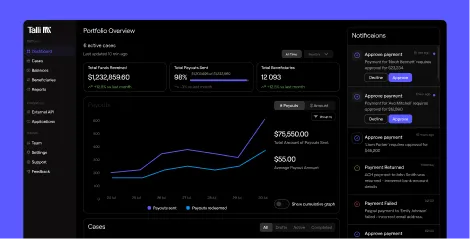
Modern disbursement platforms provide live visibility into:
- Completion rates showing percentage of successful payouts
- Payment method distribution across ACH, cards, wallets, wires, and checks
- Geographic concentration by region and jurisdiction
- Failure root cause analysis for returned payments
- Fraud flags requiring manual review
- Remaining fund balances for distribution planning
These dashboards eliminate the manual reporting burden that historically consumed days of administrator time. They also give courts, trustees, and corporate stakeholders on-demand access to current payment status.
Automating Reporting to Meet Court and Stakeholder Demands
Court-supervised distributions require detailed accounting reports documenting every payment attempt, success, failure, reissue, and unresolved exception. Automated settlement reconciliation generates these reports without manual preparation by matching approved claims, payment records, and bank confirmations.
This is especially important when payment populations are large, payment windows are short, or multiple payment methods are available. The more complex the distribution, the more important it becomes to maintain one reliable source of truth.
Cost-Effectiveness and Speed: The Future of Disbursement Management
Traditional paper-based disbursement methods impose substantial costs and delays that modern digital solutions can reduce. The economic case for platform adoption has become stronger as processing capabilities improve and recipient expectations shift toward digital payments.
Comparing Digital Versus Traditional Disbursement Costs
Paper check processing carries all-in costs of $7 to $20 per payment, including printing, postage, reconciliation, and reissuance for returned items. Digital alternatives reduce these costs dramatically:
Beyond per-transaction costs, digital methods can compress distribution timelines from 6 to 8 weeks to 24 to 48 hours, reducing float costs and accelerating fund access for recipients.
Reducing Unclaimed Funds and Escheatment with Modern Solutions
Traditional paper checks generate avoidable friction. Returned mail, stale addresses, expired checks, and manual reissuance all increase administrative cost. Digital disbursement platforms improve redemption rates by offering recipient-preferred payment methods and reducing the steps required to receive funds.
Higher redemption rates reduce escheatment exposure while ensuring intended recipients actually receive their funds. For administrators, that means fewer unresolved exceptions, cleaner final reporting, and less time spent managing check populations long after the initial distribution date.
Why Talli Streamlines Legal Settlement and Corporate Disbursements
While traditional paying agents serve M&A and bond markets effectively, legal settlement distributions and bankruptcy payouts require specialized capabilities that Talli’s platform delivers.
Talli’s AI-driven disbursement platform supports settlement administration through:
- Multi-channel payment options: ACH, prepaid Mastercard via Patriot Bank N.A., PayPal, Venmo, and gift cards through InComm, helping claimants receive funds through their preferred method
- Automated compliance infrastructure: Integrated KYC verification, OFAC sanctions screening, W-9 collection, and automated 1099 support
- QSF-compliant fund segregation: Dedicated FBO accounts preserving settlement fund separation with complete audit trails
- AI-powered fraud detection: Pattern recognition across device behavior, identity signals, and payment activity to help flag suspicious claims
- Real-time dashboard and reporting: Live visibility into redemption, payment status, exceptions, and court-ready accounting
The AB Data case study demonstrates Talli’s impact: a 30% increase in claimant redemption rates, a 60% reduction in unresolved exceptions and manual reissuance overhead, and 100% fiduciary compliance maintained across all distribution cycles.
For claims administrators, law firms, and bankruptcy trustees managing high-volume legal distributions, Talli provides regulated payout infrastructure to move faster, reduce unclaimed funds, and maintain court confidence in settlement fund distribution. Banking services provided by Patriot Bank, N.A., Member FDIC.
Talli Conclusion
Paying agent services are no longer just back-office payment mechanics. In corporate events, settlements, bankruptcy distributions, and shareholder services, the paying agent function determines how quickly funds move, how clearly every transaction is documented, and how much administrative risk remains after the first payment file is released.
Talli is purpose-built for the legal disbursement side of this challenge. The platform combines multi-channel payments, fund segregation, KYC, OFAC screening, W-9 collection, fraud mitigation, and real-time reporting in one workflow. For administrators handling court-supervised distributions, that combination turns disbursement from a manual risk center into controlled payment infrastructure. Talli’s positioning and capabilities are aligned with its documented focus on legal settlement disbursements, class action payouts, bankruptcy cases, shareholder services, and mass payment distribution.
Frequently Asked Questions
What is the primary difference between a paying agent and an escrow agent?
A paying agent processes authorized payments from issuers or transaction parties to approved recipients. An escrow agent holds funds conditionally and releases them only when contractual requirements are met. Paying agents handle distribution mechanics, while escrow agents provide conditional protection.
How do paying agent services facilitate accurate and timely corporate disbursements?
Professional paying agents verify entitlements, collect payment instructions and tax forms, determine withholding requirements, process payments across approved channels, and maintain audit trails. Digital platforms reduce manual work through automated validation, compliance screening, payment tracking, and reporting.
What role do escrow services play in mitigating risk during corporate transactions?
Escrow arrangements protect deal parties by holding funds until specified obligations are satisfied. In M&A transactions, escrow funds may secure indemnification claims, working capital adjustments, earnout obligations, expense funds, or other post-closing matters that require controlled release.
How does a digital disbursement platform improve efficiency over traditional check processing?
Digital platforms reduce reliance on paper checks, manual reissuance, returned mail workflows, and spreadsheet reconciliation. They can support ACH, prepaid cards, digital wallets, and other payment options while giving administrators real-time visibility into payment status and exceptions.
Why is proper fund segregation critical for compliant corporate and legal disbursements?
Fund segregation prevents commingling between settlement funds and operating capital. For Qualified Settlement Funds, dedicated account structures and audit trails help preserve compliance, simplify court reporting, and document every movement of funds throughout the distribution lifecycle.