TCPA class action settlements have become one of the most significant categories of consumer litigation payouts in the United States. With top TCPA settlements reaching nearly $250 million in 2023, these cases involve distributing funds to thousands of affected consumers who received unauthorized robocalls, text messages, or fax communications. For settlement administrators managing these complex distributions, modern class action disbursement platforms and payment processing solutions have become essential infrastructure for ensuring claimants actually receive their compensation.
Key Takeaways
- TCPA statutory damages range from $500 per non-willful violation to $1,500 for willful violations with no aggregate cap on class action damages
- Top 10 TCPA settlements totaled nearly $250 million in 2023, with individual cases reaching tens of millions
- Individual claimant payments typically range from $25 to $500 after deductions for attorney fees and administration costs
- Claims-made settlement structures produce less than 10% claim filing rates, leaving most eligible claimants without compensation
- The court approval process requires 4 to 8 months from preliminary approval through final distribution
- Digital disbursement platforms can achieve significantly higher redemption rates compared to traditional paper check methods
- Attorneys typically receive 25 to 33% of settlement funds, plus administration costs and service awards
Understanding TCPA Class Actions and Their Purpose
The Telephone Consumer Protection Act (TCPA) established strict liability for companies that make unauthorized robocalls, send unsolicited text messages, or transmit unwanted fax communications. Congress designed this statute to protect consumer privacy by creating substantial financial penalties for violations.
Defining TCPA and Its Protections
TCPA violations carry statutory damages of $500 per non-willful violation and up to $1,500 for willful violations. Unlike many consumer protection statutes, the TCPA contains no aggregate cap on damages. The Ninth Circuit confirmed in Wakefield v. ViSalus that Congress established a floor for statutory damages but imposed no ceiling for cumulative damages.
This uncapped liability structure creates significant exposure for companies with large-scale marketing operations. A single campaign reaching 10,000 accounts with even small consent gaps can generate substantial violation exposure.
Common TCPA Violations
The most frequent TCPA violations include:
- Autodialed calls to cell phones without prior express consent
- Prerecorded messages delivered without opt-in authorization
- Text messages sent using automated systems
- Fax advertisements transmitted without recipient permission
- Calls to reassigned numbers where consent from previous owner doesn't transfer
- Continued contact after consumers request cessation
Class actions multiply per-call damages across every person a campaign reaches, which is why these cases settle more often than they go to trial.
The Journey of a TCPA Class Action Lawsuit: From Filing to Settlement
TCPA class actions follow a structured legal process governed by Federal Rule of Civil Procedure 23, requiring multiple stages of court oversight before any funds reach claimants.
Key Stages of a Class Action
The typical timeline includes:
- Case initiation: Plaintiff files complaint alleging TCPA violations
- Class certification: Court determines whether case meets requirements for class treatment
- Discovery and negotiation: Parties exchange evidence and engage in settlement discussions
- Preliminary approval: Court reviews proposed settlement terms for initial fairness assessment
- Notice period: Class members receive notification (typically 60 to 120 days to respond)
- Objection period: Class members may challenge settlement terms
- Final approval hearing: Court evaluates whether settlement is "fair, reasonable, and adequate"
- Distribution: Settlement administrator processes claims and distributes funds
Achieving class certification is a critical hurdle in these lawsuits, and success is not guaranteed. Roughly half of TCPA cases that seek class treatment achieve that status.
Role of the Court and Legal Teams
Courts evaluate settlements to ensure class members receive meaningful opportunities to participate or opt out. Settlement agreements must specify:
- Class definition and eligibility criteria
- Fund structure and allocation methodology
- Release scope covering what claims are waived
- Opt-out provisions and deadlines
- Notice program requirements
Most defendants include denials of liability in settlement agreements even while agreeing to pay compensation. This protects companies from using the settlement as evidence of wrongdoing in future litigation.
Claimant's Guide: How to Submit a Claim in a TCPA Settlement
For eligible consumers, understanding the claim submission process determines whether they receive compensation or forfeit their share of the settlement fund.
Understanding the Settlement Notice
Settlement notices arrive through multiple channels:
- Direct mail to addresses associated with affected phone numbers
- Email when electronic contact information is available
- Publication in newspapers or online for difficult-to-locate class members
- Social media advertising targeting affected demographics
Notices include critical deadlines, typically providing 60 to 120 days to file claims. Missing these deadlines usually means forfeiting any right to payment.
Filling Out the Claim Form Correctly
Successful claim submission requires:
- Proof of class membership: Phone number that received unauthorized communications
- Attestation: Statement confirming eligibility under settlement terms
- Contact information: Current address for payment delivery
- Payment preference: Selection among available distribution methods
Some settlements require minimal documentation. In the Money Source Inc. settlement, no claim form was required. The administrator automatically qualified class members identified in the defendant's business records showing opt-out requests that weren't honored. Automated claim validation systems help streamline this process.
What Claimants Typically Receive in TCPA Class Action Settlements
Settlement payments vary dramatically based on class size, total fund amount, and individual violation frequency.
Types of Compensation
Payment calculations follow two primary models:
- Pro-rata distribution: Total fund divided equally among approved claims after deductions
- Tiered allocation: Payments based on number of violations each claimant experienced
Common fund deductions include attorney fees typically ranging from 25 to 33%, administration costs, and service awards to class representatives of $10,000 to $15,000.
Factors Influencing Individual Payment Amounts
In the Register.com $1.5 million settlement, 453 eligible claimants could receive approximately $2,130 each if all file claims. The Caribbean Cruise Line settlement provided class members $500 per call, with pro-rata reduction if the $76 million ceiling was reached.
For most TCPA settlements, individual payments range from $25 to $500 depending on class size and fund allocation. Larger classes dilute per-claimant recovery even when total settlement amounts reach millions.
Modern settlement disbursement platforms offer multiple payment options to maximize redemption:
- ACH direct deposit for fastest delivery
- Prepaid cards for unbanked claimants
- Digital wallets including PayPal and Venmo
- Paper checks as fallback option
Optimizing Settlement Payouts: The Role of Digital Disbursement Platforms
Traditional paper check distribution creates significant barriers to claimant recovery. Digital payment infrastructure addresses these challenges while reducing administrative costs.
Challenges of Traditional Paper Checks
Paper-based settlement distribution suffers from:
- Lower redemption rates: Traditional paper check methods typically achieve lower redemption compared to digital methods
- Costly reissuance: Each uncashed check requires tracking at approximately $150 per item
- Extended timelines: 6 to 8 weeks for distribution versus 24 to 48 hours with digital methods
- Escheatment risk: Unclaimed funds eventually transfer to state governments
Benefits of Digital Payment Solutions
Modern disbursement platforms transform settlement administration through:
- Multi-channel payment options: Six methods for claimants to receive funds including ACH, prepaid cards, digital wallets, and gift cards
- Automated compliance: Integrated KYC verification, OFAC screening, and tax form collection
- Real-time tracking: Live visibility into payment status for all stakeholders
- Cost reduction: Processing costs drop significantly for digital payments compared to paper checks
For settlement administrators managing TCPA distributions, these capabilities directly impact the percentage of funds that reach intended recipients rather than reverting to defendants or escheating to states.
Ensuring Compliance and Security in TCPA Settlement Distributions
Settlement fund management requires strict adherence to regulatory requirements and robust fraud prevention measures.
Meeting Legal and Tax Obligations
Compliance automation tools must address:
- KYC verification: Cross-referencing claimant information against identity databases
- OFAC screening: Automated compliance checking against U.S. Treasury sanctions lists
- W-9 collection: Digital forms with automated reminders achieving high completion rates
- 1099 generation: Automated tax reporting for payments exceeding thresholds
- 24% backup withholding: Required calculation for missing TIN numbers per IRS requirements
Qualified Settlement Fund (QSF) structures under IRC Section 468B require dedicated FBO account arrangements that maintain complete separation between settlement funds and operating capital.
Protecting Against Fraudulent Claims
AI-powered fraud detection systems identify suspicious patterns including:
- Device fingerprinting anomalies
- Behavioral analytics inconsistencies
- Identity verification failures
- Duplicate claim submissions
These systems have identified significant increases in fraudulent claim attempts in recent years. Effective fraud prevention protects settlement funds for legitimate claimants while maintaining fiduciary accountability.
The Future of Settlement Payments: Speed, Efficiency, and Claimant Satisfaction
Technology continues reshaping how settlement funds move from court approval to claimant accounts.
Evolving Expectations of Claimants
Modern consumers expect:
- Instant payment options through familiar platforms
- Real-time status updates on claim processing
- Mobile-friendly interfaces for claim submission and tracking
- Payment choice matching their preferred financial tools
How Technology Is Reshaping the Process
Emerging capabilities include:
- AI-powered claimant identification using public records and commercial data sources
- Automated eligibility verification reducing manual review burden
- Real-time payment rails enabling same-day fund delivery
- Integrated dashboards providing courts, counsel, and administrators unified visibility
These innovations address the fundamental problem that claims-made structures typically produce less than 10% claim filing rates, leaving most eligible claimants without compensation.
Navigating Common Challenges in TCPA Settlement Distributions
Settlement administrators face recurring obstacles that modern disbursement platforms help overcome.
Addressing Uncashed Checks and Reissues
The Eleventh Circuit's 2024 Drazen v. GoDaddy decision challenged a settlement where attorneys recovered $7 million while class members received only $1.7 million due to low claim filing rates. Courts now require more robust notice programs and consideration of common fund structures where distribution occurs automatically.
Digital disbursement addresses these concerns by increasing redemption rates significantly, ensuring more settlement funds reach intended recipients.
Data Accuracy and Validation
Common data challenges include:
- Outdated contact information for class members who moved
- Reassigned phone numbers creating verification complications
- Incomplete claim submissions requiring follow-up
- Duplicate filings from claimants submitting multiple times
Automated validation against identity databases and smart reminder systems help resolve these issues before they delay distribution.
TCPA class action activity remains robust, with 2,336 federal lawsuits filed in 2023. For settlement administrators managing these distributions, the combination of regulatory complexity, fraud risk, and claimant expectations demands sophisticated disbursement infrastructure that can scale across thousands of recipients while maintaining complete audit trails.
How Talli Transforms TCPA Settlement Distribution
For settlement administrators managing complex TCPA class actions, Talli's platform provides comprehensive infrastructure designed specifically for large-scale consumer settlements. The platform addresses the fundamental challenges that have historically prevented claimants from receiving their compensation.
Talli's automated compliance features handle KYC verification, OFAC screening, and tax document collection seamlessly, reducing administrative burden while maintaining strict regulatory adherence. The multi-channel payment options ensure claimants can receive funds through their preferred method, whether ACH transfer, prepaid card, digital wallet, or traditional check.
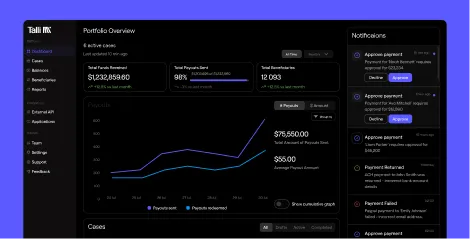
Real-time dashboards provide complete transparency to courts, counsel, and administrators throughout the distribution process. Advanced fraud detection protects settlement funds while automated reminder systems help maximize claim filing and payment redemption rates. By streamlining every stage from claim validation to final payment delivery, Talli helps ensure that settlement funds reach their intended recipients rather than reverting to defendants or escheating to states.
Frequently Asked Questions
What is the Telephone Consumer Protection Act (TCPA)?
The TCPA is a federal law enacted in 1991 that restricts telemarketing calls, autodialed calls, prerecorded voice messages, text messages, and unsolicited faxes. Violations carry statutory damages of $500 to $1,500 per occurrence, creating substantial exposure for companies engaged in high-volume communications.
How do claimants know if they are eligible for a TCPA settlement?
Eligibility depends on whether the phone number received communications covered by the specific settlement. Potential class members should receive a notice via mail, email, or publication if identified. Settlement notices specify exact criteria, including relevant time periods and communication types. Settlement administration websites allow verification using phone numbers.
How long does it take to receive payment after settlement approval?
The timeline from final court approval to payment delivery typically ranges from 30 to 90 days for properly submitted claims. Traditional paper check distribution can extend to 6 to 8 weeks, while digital payment methods can deliver funds within 24 to 48 hours of processing. Claim review complexity and class size affect overall timelines.
What should claimants do if settlement payment never arrives?
Contact the settlement administrator listed in notice documentation. Administrators maintain records of all payment attempts and can reissue funds to updated contact information. For check payments, stale-dated items (typically older than 90 to 180 days) may require formal reissuance requests. Digital payment options reduce lost payment issues significantly.
Are TCPA settlement payments taxable?
Tax treatment varies based on payment characterization. TCPA settlements typically compensate for statutory damages rather than physical injury, making most payments taxable income. Settlements exceeding $600 per claimant trigger 1099 reporting requirements. Consultation with a tax professional provides guidance specific to individual situations, as treatment depends on how the settlement agreement characterizes the payment.