.svg)


.svg)
The criteria for winning settlement administration work are shifting; for years, RFPs turned on price, capacity, and references. Now, instead, courts are examining how administrators get selected in the first place (CPT Group), counsel are asking about vendor economics before signing, and judges are ordering fee structures into the public record (Forbes, May 2026).
For administrators who run stand up operations, this is good news.
The scrutiny that makes headlines also creates a way to stand out to prove what competitors can only claim.
This piece covers what buyers now ask in selection processes, plus how to answer with evidence.
What the questions look like now
Selection conversations increasingly probe three areas.
- Economics. Who earns what across the distribution, including rebates, float, interchange, and unclaimed balances. After a year of reporting on undisclosed vendor payments (Forbes, May 2025), "our fees are on page four" no longer closes the topic.
- Outcomes. Redemption rates, and the record behind them. The FTC found median claims rates of 9% in consumer class actions (FTC, 2019), and Rule 23 commentary has raised tying part of an attorney fee award to the benefit the class received (American Bar Association), bidders who can show above benchmark redemption with documentation has a scarce asset.
- Accounting. How fast a complete, reconciled record can be produced.
Answering with proof
The strongest RFP responses are shifting from capability claims to artifacts. Instead of "we provide comprehensive reporting," a sample real-time dashboard from a live distribution. Instead of "we maximize redemption," method-level redemption data from comparable programs. Instead of "our fees are competitive," a fee schedule that lists every income stream and states which are credited to the fund.
Again, the three areas of importance:
- disclosed economics sheet. One page covering fees, float treatment, interest allocation, vendor rebate policy, and unclaimed funds handling. Producing this unprompted reframes the entire conversation, because it answers the question buyers are now afraid to skip.
- Redemption evidence pack. Claims rates by payment method from past programs, with the outreach record that produced them. This turns the industry's most uncomfortable statistic into your strongest exhibit.
- Live accounting demonstration. Showing a reconciled, per-claimant accounting produced during the meeting beats any description of reporting capability.
The infrastructure behind the answer
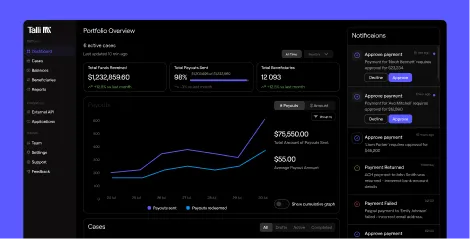
Artifacts like these are hard to fake and hard to assemble by hand, they fall out of infrastructure that segregates funds with clear ownership, tracks every payment in real time, and builds the audit trail as the distribution runs.
That is the layer Talli provides to administrators.
Talli’s platform's economics are built on delivery, redemption data is captured by method as programs run, and the full accounting exists as an export at any moment. Administrators using it walk into selection processes with the three artifacts ready, because the system produces them as a byproduct of doing the work.
Selection processes reward whoever reduces the buyer's uncertainty most.
Right now, uncertainty about vendor economics and distribution outcomes is at a high. The administrators who answer it with proof will win work their competitors lose.