.svg)


.svg)
Uncashed insurance claim checks create a compounding liability problem for carriers, TPAs, and claims administrators. With 20-30% of paper checks going unredeemed and Americans now owed over $70 billion in unclaimed property nationwide, the insurance industry faces mounting escheatment obligations, regulatory penalties, and operational inefficiencies. Modern digital disbursement platforms offer a proven solution, reducing unclaimed rates from 20-30% to 2-5% while automating the compliance burden that insurance carriers have traditionally managed through manual processes.
Key Takeaways
- Uncashed insurance checks represent $70+ billion in total unclaimed property held by states, with pandemic-era insurance refunds contributing significantly to this total
- Paper check non-redemption rates of 20-30% drop to 2-5% with digital payment options
- State dormancy periods typically range from 3-5 years before mandatory escheatment, with significant variation by jurisdiction
- Late-filing penalties reach 12-15% of property value plus 12% annual interest on late remittances
- Death-trigger provisions are expanding across states for specific property types, using mortality data to accelerate escheatment timelines
- The proposed SAFER Act 2026 would limit state escheatment of certain securities, digital assets, and investment accounts, but does not broadly govern ordinary insurance claim checks
- Digital disbursement achieves 95-98% redemption rates versus 70-80% for traditional paper methods
Understanding Unclaimed Property and Insurance Claim Checks
Unclaimed property in the insurance context encompasses any financial asset, including claim payments, premium refunds, annuity distributions, or dividend checks, that remains unredeemed by its rightful owner for a specified dormancy period. When checks go uncashed, the underlying liability doesn't disappear; it transfers from the insurer's books to state custody through the escheatment process.
What Constitutes Unclaimed Insurance Property?
Insurance companies handle multiple property types subject to escheatment laws:
- Uncashed claim checks: Payments issued but never deposited by claimants
- Life insurance benefits: Death benefits where beneficiaries cannot be located
- Premium refunds: Overpayments returned after policy cancellation
- Annuity payments: Matured contracts with no owner action
- Dividend distributions: Payments to policyholders that remain outstanding
The scope of unclaimed insurance funds continues expanding. Auto insurers provided more than $14 billion in discounts, rebates, and policyholder dividends nationwide during 2020. Any associated payments that remained unclaimed may now be subject to applicable state unclaimed property rules, depending on the property type, owner activity, and jurisdiction.
The Insurer's Initial Responsibilities
Before property can be escheated, insurance carriers must fulfill specific due diligence obligations. These requirements vary by state but typically include:
- Address verification at each policy renewal or claim initiation
- Proactive outreach via mail, email, or phone when checks remain uncashed
- Documentation of all contact attempts with timestamps
- Record retention for 10-15 years to support audit defense
The challenge intensifies because 2-5% of mailed insurance claim checks require follow-up due to non-cashing, compared to just 0.1-0.3% for ACH payments. This disparity highlights why traditional paper-based processes create ongoing compliance exposure.
The Liability of Insurers for Uncashed Claim Funds
Insurance companies retain payment and unclaimed-property obligations for amounts owed to claimants and policyholders, with additional fiduciary duties applying where required by the governing legal relationship or fund structure. The financial and regulatory exposure from uncashed checks compounds over time, affecting everything from balance sheet reporting to audit risk.
Legal Implications for Non-Compliance
Fiduciary obligations require insurers to:
- Exercise duty of care by handling funds prudently
- Maintain duty of loyalty without profiting from payment delays
- Preserve property by preventing loss or deterioration
- Make reasonable delivery efforts to return funds to rightful owners
- Provide accurate accounting with complete documentation
Breach of these duties can trigger liability when carriers fail to conduct reasonable owner searches, improperly reverse uncashed check liabilities to income, or mishandle funds during the escheatment process. Historical enforcement actions demonstrate the seriousness of these obligations.
Managing Financial Exposure
The direct costs of uncashed check management strain insurance operations. Transaction processing for paper checks ranges from approximately $2.01 to $20.00 per check, while digital alternatives cost between $0.25 and $2.00. Stale check reprocessing can exceed $2,000 monthly, while instant digital retry requires minimal intervention. Stop payment fees typically run $20-$35 per check, a cost eliminated entirely with digital methods. Manual reconciliation consumes over 40 hours weekly, compared to automated processing that handles the workload with minimal staff time. Escheatment compliance can require 100+ staff hours annually, significantly reduced through automated workflows.
Beyond direct costs, approximately 83% of claimants report they would switch carriers after a poor claims experience, making payment speed and reliability a retention issue, not just an operational one.
Stale-Dated Checks: Definition, Impact, and Management
A check becomes "stale-dated" after 180 days (6 months) from the date of issue under general banking practice. However, stale-dating doesn't eliminate the insurer's underlying liability; the funds remain owed to the payee regardless of check validity.
When Does a Check Become Stale-Dated?
Banking industry practice creates important distinctions:
- Banks may refuse to honor checks over 6 months old
- Banks are not required to refuse stale checks; decision varies by institution
- Issuers may print shorter validity periods such as "Void after 90 days," but bank treatment can vary, and UCC rules generally address checks presented more than six months after issuance
- Large-value or multi-party checks face greater scrutiny from banks
For insurance carriers, multi-party checks present particular challenges. Checks made out to multiple payees, such as an insured and mortgagee, require all parties' endorsements and face higher rejection rates when stale.
Proactive Strategies to Avoid Stale-Dating
Preventing stale-dated checks requires systematic monitoring and intervention:
Early Intervention Timeline:
- 30-60 days: Automated reminder to claimant via email/SMS
- 90 days: Phone outreach for high-value payments
- 120 days: Stop payment and reissue with updated verification
- 150 days: Offer alternative payment method (ACH, prepaid card)
Tax Treatment Considerations:
Federal tax treatment generally depends on when funds are actually or constructively received, not simply when a check is written. A valid check received or made available to the recipient can constitute constructive receipt even if it is not immediately cashed. When a payment is returned, never delivered, or later reissued, carriers should evaluate the specific facts and applicable Form 1099 reporting rules before making corrections.
Digital payment alternatives eliminate most stale-dating exposure entirely. Multi-channel payment distribution offers ACH, prepaid Mastercard, digital wallets, and virtual cards, none of which face stale-dating issues.
Navigating State Escheatment Laws and Processes
Escheatment, the legal process of transferring unclaimed property to state custody, represents the final compliance obligation for uncashed insurance checks. With 50 different state frameworks, carriers face significant complexity in tracking dormancy periods, due diligence requirements, and reporting deadlines.
Key Differences in State Regulations
Dormancy periods determine when uncashed checks must be reported as unclaimed property:
New York: 3-year dormancy period. Reporting deadline September 10. Certified mail required for property $1,000 or more.
Maryland: 3-year dormancy period. Insurance reporting deadline April 30. 15% automatic late penalty applies.
Minnesota: Applicable dormancy periods vary by property type. Life insurance companies report by October 1. Minnesota may assess 12% annual interest on property not delivered after written demand by the commissioner.
California: 3-year dormancy for most property types. Life insurers report before May 1; most other holders report before November 1. Separate notice and remit reporting cycles apply.
Emerging 2026 Regulatory Trends:
Some states use death-based triggers for specific property types, particularly life insurance benefits, annuities, and retained asset accounts. Requirements vary significantly by state and should not be applied broadly to all uncashed insurance claim checks.
The proposed SAFER Act of 2026 (H.R. 8338), introduced in the House in April 2026, would create federal escheatment protections for certain securities, digital assets, and investment accounts held by financial institutions. It does not generally apply to ordinary insurance claim checks or premium refunds, and carriers should continue following applicable state unclaimed property requirements for those payments.
The Steps of Escheatment for Insurers
Insurance carriers must follow a structured escheatment compliance process:
1. Identification Phase
- Run outstanding check reports monthly, minimum quarterly
- Flag payments approaching dormancy thresholds
- Cross-reference against Death Master File data
2. Due Diligence Phase (60-180 days before reporting)
- First-class mail notice to last known address
- Certified mail for high-value property ($1,000 or more in most states)
- Content must include property description, amount, claim instructions
3. Reporting Phase
- Prepare NAUPA-formatted electronic reports
- Include complete owner information and property codes
- Submit simultaneous remittance with report filing
4. Post-Escheatment
- Maintain records to assist claimants recovering from state
- Provide state unclaimed property website information when contacted
Free Searches for Unclaimed Insurance Money and Property
For beneficiaries and policyholders seeking unclaimed insurance funds, multiple government resources provide free search capabilities. Understanding these tools helps insurance professionals assist former claimants while reducing customer service burden.
How Beneficiaries Can Find Their Funds
The National Association of Unclaimed Property Administrators (NAUPA) maintains aggregated search databases, while individual state treasurers operate jurisdiction-specific portals:
Key Search Resources:
- NAUPA Database: Multi-state search aggregating unclaimed property records
- State Treasurer Websites: Direct access to state-held funds
- MissingMoney.com: Free search covering most U.S. states
State-Specific Portals:
- California unclaimed property: sco.ca.gov/upd
- Florida unclaimed property: fltreasurehunt.gov
- Texas unclaimed property: claimittexas.gov
- Maryland unclaimed property: claimitmd.gov
Claim Process:
- Search by name and/or Social Security Number
- Verify identity through documentation requirements
- Submit claim form with required supporting documents
- Receive funds (no time limit for claims in most states)
Insurance carriers can reduce escheatment-related customer service inquiries by proactively communicating these resources to policyholders whose checks remain uncashed after extended periods.
The Role of Digital Disbursement in Minimizing Uncashed Checks
Digital payment platforms have emerged as the primary solution for reducing uncashed check exposure. The data is compelling: paper check non-redemption rates of 20-30% drop to 2-5% with digital alternatives.
Boosting Claimant Redemption Rates
Digital disbursement addresses the root causes of uncashed checks:
Why Paper Checks Fail:
- Mail returned as undeliverable (recipient moved)
- Check mistaken for junk mail and discarded
- Lost in postal system or stolen
- Death of payee before cashing
- Recipient skeptical of unexpected checks
Why Digital Succeeds:
- Eliminates mail failure: No physical delivery required
- Instant notification: Recipients alerted immediately via email/SMS
- Claimant choice: Multiple redemption options increase acceptance
- Real-time tracking: Identify failed payments immediately for resolution
- Faster delivery: Funds available within minutes versus 7-10 days
Digital claims payment infrastructure supports the full spectrum of insurance payment scenarios, from individual auto claims to catastrophe events requiring mass disbursements.
Cost Savings Through Digital Channels
The financial case for digital disbursement extends beyond escheatment prevention:
ACH Transfer: Transaction costs $0.25 to $0.50, delivery in 1-3 days, failure rate 0.1-0.3%
Same-Day ACH: Transaction costs $1.00 to $5.00, same-day delivery, failure rate 0.1-0.3%
Virtual Card: Transaction costs $0.50 plus 2-3%, instant delivery, failure rate 2-5%
Digital Wallet: Transaction costs $0.50 to $1.00, instant delivery, failure rate 2-5%
Prepaid Card: Minimal fees, instant (virtual) or 5-7 days (physical), failure rate 2-5%
Paper Check: Transaction costs $2.01 to $20.00, delivery in 7-10 days, failure rate 20-30%
For carriers processing thousands of claims monthly, the operational savings compound rapidly. Monthly reconciliation time drops from approximately 15 hours to 4.5 hours, a 70% reduction, through automated three-way matching.
Compliance Automation for Unclaimed Property Management
Manual compliance processes create error risk and audit exposure. Automated solutions integrate verification, screening, and reporting into the payment workflow, ensuring consistency while reducing staff burden.
Streamlining Compliance Workflows
Compliance automation addresses the core requirements insurance carriers face:
Integrated Verification Infrastructure:
- KYC verification: Cross-references claimant information against identity databases
- OFAC screening: Automated sanctions checking with documented timestamps
- W-9 collection: Digital forms with smart reminders achieving approximately 90% completion rates versus 40% without automation
- 1099 generation: Automated IRS e-filing integration
Multi-Party Workflow Management:
Insurance payments often involve multiple parties: carriers, TPAs, medical providers, repair vendors, and claimants. Custom approval workflows ensure every payment is properly authorized with complete audit trails:
- Coordinated approvals across all network parties
- Auditable payment status and ownership records
- Automated reconciliation across the payment lifecycle
- Real-time visibility into fund flows
Reducing Manual Errors and Penalties
State penalties for escheatment non-compliance create material financial risk:
- Maryland: 15% automatic penalty on property value for late filing
- Minnesota: 12% annual interest from due date; willful failure constitutes misdemeanor
- California: 12% annual interest rate (waivable through Voluntary Compliance Program)
- Delaware: 90-day VDA response window before automatic audit escalation
Automated payment workflows can reduce manual compliance risk by maintaining payment status, approval, reconciliation, and audit records. Carriers should manage state-specific unclaimed property deadlines and due diligence requirements through their established compliance processes and applicable state reporting systems.
Secure and Transparent Fund Management for Insurance Payouts
Insurance claim funds require fiduciary-grade custody that maintains separation from operating capital while providing complete visibility for regulators and stakeholders.
Protecting Claimant Funds
Fund segregation architecture ensures proper handling of insurance payouts:
FBO (For Benefit Of) Account Structures:
- Dedicated accounts for each program or settlement
- Complete separation between claim funds and operating capital
- FDIC insurance through banking partners (Patriot Bank, N.A., Member FDIC)
- Matter-level fund tracking for simplified reporting
Banking Security Standards:
- SOC 2 Type I report for independently assessed security controls
- PCI DSS 4.0.1 compliance for payment card security
- Bank-grade infrastructure with BSA/AML controls
- OFAC screening integrated into payment workflows
Ensuring Fiduciary Compliance
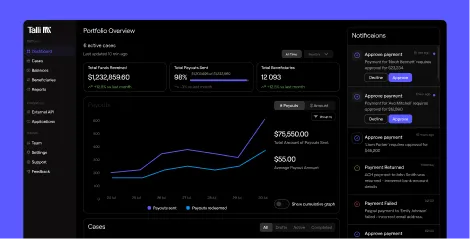
Real-time dashboard and analytics provide the visibility insurance carriers need for regulatory reporting:
Live Monitoring Capabilities:
- Payment completion rates by method and recipient type
- Geographic distribution of claims payments
- Failure root cause analysis with instant retry logic
- Fraud flags requiring review
- Remaining fund balances by program
Audit-Ready Documentation:
- Complete payment trail from authorization through settlement
- Timestamped compliance checks with OFAC verification records
- Owner communication records with delivery confirmation
- Court-defensible audit trails meeting regulatory examination standards
For catastrophe events requiring rapid mass disbursements, modern infrastructure scales to support high-volume daily claims payments while maintaining complete audit trails.
How Talli Solves Uncashed Check Challenges
Talli's digital disbursement platform directly addresses the core challenges insurance carriers face with uncashed checks. By offering multiple payment methods including ACH, prepaid cards, digital wallets, and virtual cards, Talli reduces non-redemption rates from 20-30% to 2-5%, effectively eliminating the majority of escheatment exposure.
The platform's integrated compliance features streamline the entire payment lifecycle. Automated verification, OFAC screening, tax-document workflows, and audit records can reduce manual compliance work and support carriers' established regulatory processes. Real-time tracking provides instant visibility into payment status, enabling proactive intervention before checks become stale-dated.
For carriers managing complex multi-party workflows, Talli's approval infrastructure coordinates payments across TPAs, medical providers, repair vendors, and claimants while maintaining complete audit trails. Fund segregation through FBO account structures ensures proper fiduciary custody, while SOC 2 Type I and PCI DSS 4.0.1 compliance provide additional security and compliance assurance.
The financial impact extends beyond escheatment prevention. Carriers typically reduce transaction costs from $2.01-$20.00 per paper check to $0.25-$2.00 for digital payments, while cutting monthly reconciliation time by approximately 70%. With instant notifications, claimants receive funds in minutes rather than days, improving satisfaction and retention rates.
Implementation Roadmap for Insurance Carriers
Transitioning from paper checks to digital disbursement requires systematic planning but delivers rapid ROI. Most carriers achieve measurable returns within 4-7 months through reduced processing costs and improved redemption rates.
Immediate Actions (0-3 months)
- Conduct internal uncashed check inventory
- Calculate current escheatment exposure by state
- Review existing policies and procedures for compliance gaps
- Assign fiduciary responsibility to specific roles
- Subscribe to state law change alerts
Short-Term Priorities (3-12 months)
- Implement digital payment options (ACH minimum)
- Upgrade address verification systems
- Automate outstanding check reporting (monthly cadence)
- Document due diligence procedures by state
- Train claims staff on escheatment obligations
Technology Investment Priorities
- Multi-channel payment distribution: Highest ROI through redemption improvement
- Compliance automation: Lowest audit risk through consistent processes
- Real-time tracking dashboards: Operational visibility for exception management
- Fraud prevention systems: Loss mitigation through AI detection
- API integration: Eliminate manual data entry between claims and payment systems
Modern platforms support no-code dashboard configuration and low-code API integration, enabling carriers to launch quickly without extensive IT investment.
Frequently Asked Questions
What's the difference between an uncashed check and unclaimed property?
An uncashed check becomes unclaimed property after the state-specific dormancy period expires (typically 3-5 years). During dormancy, the insurer retains the liability and must conduct due diligence to locate the owner. Once dormancy ends and required outreach is complete, the funds must be escheated to the state. The key distinction: uncashed checks are still within the carrier's control, while unclaimed property has transferred to state custody.
Can beneficiaries still claim insurance money after it's been escheated?
Yes. Most states have no time limit for claiming escheated property. Beneficiaries can search state unclaimed property databases, verify their identity through required documentation, and file claims to recover funds. The state acts as custodian indefinitely until the rightful owner claims the property. Insurance carriers should provide state unclaimed property website links when contacted by former claimants seeking escheated funds.
How do multi-party insurance checks affect escheatment obligations?
Multi-party checks, such as payments made jointly to an insured and mortgagee, create additional complexity. These checks require all parties' endorsements, face higher bank rejection rates when stale, and may involve different last known addresses for each payee. For escheatment purposes, the carrier must conduct due diligence for all named payees and report to the state of each payee's last known address. Digital payment alternatives can route separate payments to each party, eliminating multi-party check complications entirely.
What happens to unclaimed insurance funds if the carrier goes bankrupt?
Unclaimed obligations become part of the bankruptcy estate. State guaranty associations may assume responsibility for policy obligations, including unclaimed benefits, up to statutory limits (typically $300,000-$500,000 per policy). Claimants should file proofs of claim in bankruptcy proceedings and contact their state insurance guaranty association. Funds already escheated to states remain in state custody and can be claimed through normal unclaimed property procedures.
How does the proposed SAFER Act affect insurance claim checks?
The proposed SAFER Act of 2026 (H.R. 8338) would create federal escheatment protections for certain securities, digital assets, and investment accounts held by financial institutions. It does not generally apply to ordinary insurance claim checks or premium refunds. Insurance carriers should continue following applicable state unclaimed property requirements for claim payments while monitoring potential federal developments that could affect specific asset types.