.svg)


.svg)
Paying auto insurance claims digitally requires closing the gap between policyholders' expectations for fast, convenient service and the slower processes associated with legacy payment workflows. While many customers expect rapid payouts, traditional claims processes can still involve lengthy payment cycles. Poor claims experiences can significantly affect retention, with 80% of auto insurance customers who report a poor claims experience having already left or saying they plan to leave their carrier, making the claims experience a critical retention factor. Modern disbursement platforms for insurers can compress payment timelines from weeks to hours while reducing per-claim costs, transforming claims payments from an administrative burden into a customer retention advantage.
Key Takeaways
- Digital claims satisfaction reached 871 points on a 1,000-point scale in J.D. Power's 2024 study, up 17 points from 2023
- 40% of customers ranked "time to receive payment" as the top thing they would change about the claims experience.
- AI-assisted claims workflows can reduce manual processing time and administrative work when automation is applied to appropriate stages of the claims lifecycle
- AFP research places the median cost of issuing a paper check at $2.01-$4.00 per transaction, compared with approximately $0.26-$0.50 for ACH transactions
- Approximately 50% of claim disbursements go to businesses and vendors, creating virtual card revenue opportunities
- AI and automation can accelerate specific stages of auto claims processing by reducing manual review, routing, and data-entry requirements
Understanding the Shift to Digital Payments in Auto Insurance Claims
The insurance industry has reached an inflection point where digital payment capabilities directly determine customer loyalty and operational efficiency. Traditional paper-based disbursement methods create friction at the exact moment when policyholders need swift resolution: after an accident or vehicle damage.
The Evolution of Claims Payouts: From Checks to Digital Wallets
Paper check usage in B2B payments has declined from 81% in 2004 to just 25-26% in 2025, reflecting a fundamental shift in payment preferences. Auto insurance claims follow this trajectory as policyholders accustomed to instant Venmo transfers and same-day ACH deposits expect similar speed from their carriers.
The transformation encompasses multiple payment rails:
- ACH direct deposit: 1-2 day settlement for standard transfers
- Same-day ACH: Approximately 1.4 billion payments processed in 2025, up 16.7% year-over-year
- Push-to-debit: Instant delivery to existing debit cards
- Virtual cards: Immediate issuance for repair facility payments
- Digital wallets: PayPal, Venmo, and Apple Pay integration
Why Digital-First Claims Payment is No Longer Optional
Digital channels have surpassed phone-based communication as the most satisfying way for customers to submit claims. This preference extends naturally to payment receipt. The global digital insurance payment platforms market reached approximately $485 million in 2025 and is projected to grow to $1.13 billion by 2033, signaling irreversible industry adoption.
Carriers clinging to paper check infrastructure face compounding disadvantages:
- Customer attrition: Poor payment experiences drive policy cancellations
- Cost escalation: Manual processing consumes staff time and resources
- Competitive pressure: Digital-first carriers capture market share
- Fraud exposure: Paper checks are more vulnerable to interception and alteration
Streamlining Auto Insurance Claims: How Digital Solutions Reduce Costs and Time
Measuring the ROI of Digital Claims Payments
The financial case for digital disbursement is straightforward. Paper checks cost $2.01-$4.00 per transaction when factoring in printing, postage, reconciliation, and reissuance for undelivered or stale-dated items. Digital payment methods, particularly ACH, reduce this to approximately $0.26-$0.50 per claim, representing significant cost reduction.
ROI calculations must account for:
- Direct transaction costs: Per-payment fees across methods
- Administrative overhead: Staff time for manual processing
- Exception handling: Costs of researching and resolving payment failures
- Escheatment liability: Uncashed check compliance and reporting
- Customer service burden: Inquiries about payment status
The Impact of Automation on Claims Administration
Automation amplifies digital payment benefits beyond simple cost reduction. Insurers deploying AI-assisted workflows can see faster processing and lower administrative costs. Straight-through processing rates have improved significantly in AI-enabled operations, from baseline levels to much higher completion rates.
These gains come from eliminating manual touchpoints:
- Automated invoice matching: No manual data entry for repair facility payments
- Rules-based approval routing: Claims within parameters process without intervention
- Integrated compliance checks: KYC and OFAC screening happen automatically
- Real-time reconciliation: Payment status updates flow directly to accounting systems
Your automated claims processing infrastructure should handle these workflows without requiring dedicated staff for routine payments.
The Benefits of Instant Payouts for Auto Claims: Enhancing Customer Satisfaction
Meeting Policyholder Expectations with Faster Payments
The expectation-reality gap in claims payments creates immediate customer dissatisfaction. Many policyholders expect rapid payment, yet actual delivery can take considerably longer, creating a gap that directly erodes trust and loyalty.
A significant portion of insurance disbursement recipients select instant payment as their preferred method when available. This preference intensifies among younger policyholders accustomed to real-time financial transactions. Meeting these expectations requires multi-channel payout capabilities that let claimants choose their preferred receipt method.
The Competitive Advantage of Instant Claim Settlements
Fast payment creates differentiation in a commoditized market. When a substantial percentage of customers identify payment speed as their top improvement priority, ahead of communication consistency at 29%, carriers delivering rapid settlement gain measurable advantage.
Competitive benefits extend beyond retention:
- Net Promoter Score improvement: Satisfied claimants become policy advocates
- Reduced customer service load: Fewer "where's my payment?" calls
- Premium pricing power: Superior experience justifies competitive rates
- Agent satisfaction: Faster claims support easier policy renewals
Choosing the Right Digital Payment Methods for Auto Insurance Claims
Optimizing Payouts: Matching Payment Method to Claimant Needs
Different claim types and recipient preferences require flexible payment options. A totaled vehicle settlement differs from a minor fender-bender repair reimbursement in both amount and urgency. Effective platforms support multiple rails with intelligent routing.
Payment method options include:
ACH Direct Deposit: Lowest cost at $0.26-$0.50 per transaction with 1-2 day delivery. Best for standard policyholder payments where speed is less critical than cost efficiency.
Push-to-Debit (Instant Deposit): Real-time delivery to existing debit cards. Higher per-transaction cost but delivers immediate satisfaction for urgent claims.
Virtual Cards: Instant issuance for repair facility and vendor payments. Creates revenue opportunity through interchange rebates while accelerating the repair cycle.
Digital Wallets: PayPal and Venmo integration appeals to younger demographics. Instant access for users already on these platforms.
Prepaid Cards: Serves unbanked claimants without accounts who lack traditional bank accounts. Virtual cards delivered via SMS or email in seconds, physical cards within 5-7 days.
Addressing the Unbanked Population in Claims Settlements
Approximately 5.9 million U.S. households remain unbanked, creating a claims payment challenge that paper checks only partially solve. Digital alternatives like prepaid cards provide superior access while maintaining the speed advantages of electronic disbursement.
When comparing ACH and prepaid cards, consider claimant demographics and claim characteristics:
- Urban areas: Higher digital wallet adoption
- Rural regions: ACH and prepaid cards may have better acceptance
- Younger claimants: Strong preference for instant and digital methods
- Business payees: Virtual cards enable faster repair authorization
Ensuring Compliance and Security in Digital Auto Claims Disbursements
Regulatory Requirements for Digital Payments
Digital payment expansion increases regulatory complexity. State-specific mandates dictate payment methods, timelines, and settlement practices. Federal policy has accelerated the broader shift toward electronic payments, but private insurance carriers remain primarily subject to applicable state insurance laws, payment rules, and their own contractual obligations.
Key compliance considerations:
- State payment timing requirements: Varying deadlines for claim settlement
- Electronic payment standards: Industry best practices for digital adoption
- PCI DSS compliance: Required for organizations handling cardholder data
- Escheatment reporting: Unclaimed property laws vary by state
- Market conduct standards: Auditable processes demonstrating fair treatment
Your OFAC screening for settlements must operate automatically to ensure sanctions compliance without creating processing bottlenecks.
Protecting Claimant Data: Best Practices for Secure Payouts
Every digital access point increases cyber exposure. Claims data contains sensitive personal and financial information requiring robust protection. Fraud detection in disbursements has become essential as bad actors target insurance payment channels.
Security requirements include:
- Encryption: Data protection in transit and at rest
- Multifactor authentication: Verified access for administrators
- Role-based access controls: Limit system permissions appropriately
- Real-time monitoring: Detect anomalous payment patterns
- SOC 2 certification: Third-party verification of controls
- PCI DSS compliance: High standards for payment data security
AI-powered fraud detection has improved accuracy significantly compared to manual review methods. Modern platforms embed KYC verification processes directly into payment workflows, blocking suspicious activity before funds leave.
Implementing a Digital Claims Payment System: What Carriers Need to Know
Key Considerations for Digital Payment Platform Selection
Platform selection determines implementation success and long-term operational efficiency. Evaluate candidates against requirements specific to insurance disbursement:
- Multi-rail support: ACH, instant deposit, virtual cards, digital wallets
- Core system integration: Compatibility with existing claims management
- Compliance automation: Built-in KYC, OFAC, and tax reporting
- Scalability: Handle volume spikes during catastrophe events
- Security certifications: SOC 2 and PCI DSS compliance
- Vendor network: Pre-enrolled repair facilities and service providers
Implementation typically requires 2-6 weeks for vendor-assisted setup, with ROI realization within several months through reduced processing time and error rates.
Integrating Digital Disbursements with Existing Claims Systems
Seamless integration eliminates duplicate data entry and reconciliation errors that plague bolt-on solutions. Modern platforms provide API connectivity enabling real-time data synchronization between payment systems and claims management software.
Integration requirements:
- REST API access: Standard connectivity for custom integrations
- Webhook support: Real-time status updates to core systems
- Pre-built connectors: Direct links to major claims platforms
- Batch processing: Handle high-volume payment runs efficiently
- Automated reconciliation: Match payments with claims records
Real-Time Tracking and Reporting for Auto Insurance Claims Payments
Gaining Visibility into Your Claims Payment Workflow
Real-time payment tracking eliminates the information vacuum that generates customer service inquiries. When claimants and adjusters can see payment status instantly, "where's my money?" calls decline dramatically.
Dashboard capabilities should include:
- Payment status tracking: Pending, processing, delivered, failed
- Method distribution: Breakdown across ACH, cards, wallets
- Geographic concentration: Regional payment patterns
- Failure analysis: Root causes for unsuccessful payments
- Fund balances: Real-time accounting of settlement reserves
Automated Reporting for Enhanced Accountability
Manual report preparation consumes administrative resources while introducing error risk. Automated reporting generates required documentation without staff intervention.
Essential reports include:
- Regulatory compliance: State-mandated settlement timing
- Financial reconciliation: Payment-to-claim matching
- Fraud monitoring: Suspicious activity summaries
- Performance metrics: Processing speed and completion rates
- Audit documentation: Court-ready trails for disputed claims
The Impact of Digital Solutions on Auto Insurance Claim Redemptions
Digital payment adoption produces measurable improvements in claim completion rates. Talli's AB Data case study reports a 30% increase in redemption rates after a legal claims administrator replaced check-heavy settlement workflows with digital payment options, while also reducing stale-check reissuance and manual reconciliation work.
These gains result from addressing paper check failure points:
- Address accuracy: Digital payments reach claimants regardless of mail forwarding
- Speed to funds: Instant methods eliminate waiting periods that discourage redemption
- Method preference: Claimants choose their preferred receipt option
- Reduced friction: No trips to the bank to deposit checks
The hidden costs of settlements extend beyond escheatment liability to include customer dissatisfaction and regulatory scrutiny.
Preparing for the Future: AI and Automation in Auto Insurance Claims Processing
The Role of Artificial Intelligence in Modern Claims Management
AI has moved from experimental to essential in claims operations. AI and automation can accelerate specific stages of auto claims processing by reducing manual review, routing, and data-entry requirements. By 2025, predictions indicate more than 80% of claims will be processed virtually, with up to half of non-injury claims fully automated.
AI applications in claims payment:
- Fraud detection: Pattern recognition identifies suspicious claims before payment
- Payment routing: Intelligent selection of optimal disbursement method
- Exception prediction: Anticipate and prevent payment failures
- Customer communication: Automated status updates and resolution assistance
- Compliance monitoring: Real-time regulatory adherence verification
Staying Ahead: Future-Proofing Your Claims Payment Strategy
The payment infrastructure you build today must accommodate tomorrow's capabilities. Embedded payment partnerships are eliminating costly bespoke integrations while API-first architectures enable rapid adaptation to new payment methods and regulatory requirements.
Future-proofing considerations:
- Modular architecture: Add new payment rails without system replacement
- Network effects: Choose platforms with growing vendor enrollment
- Compliance automation: Regulatory changes should not require manual intervention
- AI integration: Infrastructure should accommodate machine learning enhancements
- Real-time capabilities: FedNow and RTP adoption will accelerate
Why Talli Simplifies Digital Auto Insurance Claims Payments
While the insurance industry has numerous payment options, Talli delivers comprehensive disbursement capabilities specifically designed for compliance-critical, high-volume payment operations.
Talli's platform addresses the core challenges claims administrators face:
- Multi-Channel Payment Distribution: ACH direct deposit, prepaid Mastercard (via Patriot Bank N.A., Member FDIC), digital wallets (PayPal, Venmo), and gift cards via InComm, all from a single platform
- Compliance Automation Suite: Integrated KYC verification, OFAC sanctions screening, and automated tax form collection with high completion rates through smart reminders
- Fraud Mitigation: Built-in controls help claims teams identify and manage suspicious payout activity while maintaining auditable payment records
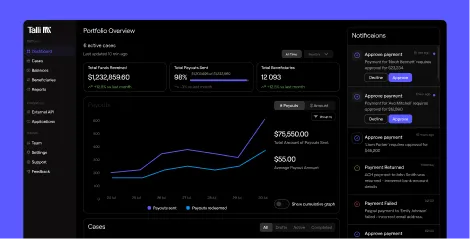
- Real-Time Dashboard and Reporting: Live monitoring of payment status, completion rates, and fund flows with audit-ready documentation
- Fund Segregation Architecture: Dedicated FBO account structures maintaining complete separation between claim reserves and operating capital
Unlike generic payment processors, Talli was purpose-built for regulated disbursement environments. The platform handles complex multi-party payments, maintains complete audit trails, and scales from thousands to hundreds of thousands of recipients without performance degradation.
For claims administrators and other organizations evaluating high-volume, compliance-sensitive digital disbursements, Talli's trust center currently lists a SOC 2 Type I Report for 2026 and PCI DSS 4.0.1 as part of its security and compliance program.
Frequently Asked Questions
What are the main advantages of using digital payments for auto insurance claims?
Digital payments can deliver faster processing and lower administrative costs compared to paper checks. Beyond efficiency gains, digital disbursement improves customer satisfaction, which is critical when a significant percentage of consumers will switch carriers after poor claims experiences. Additional benefits include improved redemption rates, reduced escheatment liability, and enhanced fraud detection capabilities.
How does a digital payment platform ensure the security and compliance of claims disbursements?
Enterprise-grade platforms incorporate multiple security layers including encryption, multifactor authentication, role-based access controls, and real-time monitoring. AI-powered fraud detection has improved accuracy significantly compared to manual review. Compliance automation handles KYC verification, OFAC screening, and state-specific payment regulations without manual intervention.
Can digital payment solutions cater to policyholders who prefer not to use traditional banks?
Yes. Modern platforms support prepaid cards that serve the approximately 5.9 million unbanked U.S. households. Virtual cards can be delivered via SMS or email within seconds, while physical cards arrive within 5-7 days. Digital wallet options like PayPal provide additional alternatives for claimants without traditional bank accounts.
What is the typical timeframe for implementing a digital claims payment system?
Implementation typically requires 2-6 weeks with vendor-assisted setup, depending on integration complexity with existing claims management systems. Most carriers achieve ROI within several months through reduced processing time, lower transaction costs, and decreased exception handling overhead.
What kind of reporting and analytics can I expect from a digital claims payment platform?
Modern platforms provide real-time dashboards showing payment status, method distribution, completion rates, failure analysis, and fund balances. Automated reporting generates regulatory compliance documentation, financial reconciliation records, fraud monitoring summaries, and audit trails without manual preparation, reducing monthly closing time significantly in many implementations.