.svg)


.svg)
Abandoned property laws create complex compliance obligations that can catch shareholder services teams off guard, with states collectively holding over $70 billion in unclaimed funds, even as state programs returned $4.49 billion to rightful owners in FY2024. When securities escheat to state custody, states often liquidate holdings, causing shareholders to lose subsequent market appreciation, dividends, and compound growth. For teams managing dividend distributions, bankruptcy payouts, and settlement funds, understanding these laws isn't just a compliance requirement, it's a fiduciary responsibility to protect shareholder wealth.
Key Takeaways
- States hold at least $70 billion in unclaimed property, while state programs returned $4.49 billion to owners in FY2024
- 54 U.S. jurisdictions (50 states plus DC, Puerto Rico, Virgin Islands, and Guam) each enforce unique dormancy periods and reporting requirements
- Delaware collects $449 million annually from unclaimed property its third-largest revenue source
- 33 jurisdictions use 3-year dormancy periods, with many states shortening timeframes in recent years
- Third-party audit firms conduct examinations with 10-15 year lookback periods
- Digital disbursement platforms achieve 95-98% redemption rates versus 70-80% for traditional paper checks
Understanding Escheatment: What Shareholder Services Must Know
Defining Escheatment: A Core Responsibility
Escheatment refers to the legal process by which unclaimed property transfers to state custody after a specified dormancy period. Under this framework, shareholder services teams act as "holders" of property belonging to shareholders, the rightful owners. When owners cannot be located or fail to claim their property within statutory timeframes, the state assumes custodial responsibility.
The legal foundation stems from the Supreme Court's decision in Texas v. New Jersey (1965), which established the core priority rules governing which state receives custody:
- First Priority Rule: Property reports to the state of the owner's last known address
- Second Priority Rule: If no address exists, property reports to the holder's state of incorporation
Money orders and traveler's checks follow separate federal rules that generally point to the state where the instrument was purchased.
These rules create significant implications for Delaware-incorporated companies, where 65% of Fortune 500 firms maintain incorporation status making unclaimed property Delaware's third-largest revenue source.
The Mechanics of the Escheatment Process
The escheatment process follows a predictable sequence that shareholder services teams must track meticulously:
- Dormancy trigger: Owner contact ceases or mail returns undeliverable
- Dormancy period begins: Clock starts ticking toward state-specific deadline
- Due diligence window: Holder must attempt to reunite owner with property
- Reporting deadline: File reports with appropriate state jurisdictions
- Remittance: Transfer property to state custody
For securities specifically, states often liquidate holdings after escheatment to support operating revenue. This creates serious consequences for shareholders who later attempt to reclaim their property.
Key Dates and Dormancy Periods for Different Asset Types
Dormancy periods vary dramatically by jurisdiction and property type. The current distribution shows 33 jurisdictions use 3-year periods, 18 use 5 years, and only 1 uses 7 years.
Common dormancy periods by property type:
- Wages and payroll: Typically 1 year
- Dividend checks: 3-5 years depending on state
- Vendor checks and accounts receivable: 3-5 years
- Securities and stock certificates: 3-5 years
- Virtual currency: 5 years in New York (effective November 2022)
The trend toward shorter dormancy periods has accelerated, with many jurisdictions shortening timeframes from 5-7 years to 3 years, compressing compliance timelines significantly.
Identifying Abandoned Property: From Uncashed Checks to Securities
Common Types of Abandoned Shareholder Assets
Shareholder services teams encounter several property categories subject to escheatment:
- Uncashed dividend checks from quarterly or annual distributions
- Stock certificates for shareholders who haven't communicated with the company
- Merger or acquisition proceeds payable to former shareholders
- Class action settlement payments that go unclaimed
- Bankruptcy distribution checks returned as undeliverable
- Account credits from overpayments or adjustments
Each category carries specific dormancy triggers and reporting requirements that complicate compliance efforts across multiple jurisdictions.
The Lifecycle of an Uncashed Dividend Check
The journey from issued check to escheated property illustrates why traditional paper-based distributions create compliance risk. Up to 12% of settlement checks are returned undeliverable due to address failures, while approximately 8% require reissuance.
The typical lifecycle proceeds as follows:
- Issuance: Company mails dividend check to shareholder's last known address
- Delivery attempt: USPS attempts delivery; check may return undeliverable
- Stale-dating: Check becomes void after 90-180 days (varies by state)
- Dormancy tracking: Uncashed amount enters dormancy period monitoring
- Due diligence: Holder sends required notices 60-120 days before deadline
- Escheatment: Property transfers to state if owner doesn't respond
Each uncashed check generates estimated administrative costs of $150 for tracking, reissuance attempts, and eventual escheatment reporting.
Proactive Identification of Dormant Accounts
Early detection of dormant accounts prevents costly escheatment proceedings. Effective identification strategies include:
- Returned mail monitoring: Flag accounts immediately when mail returns undeliverable
- Activity tracking: Document all shareholder-initiated contact to restart dormancy clocks
- Database cross-referencing: Match shareholder records against updated address databases
- Portal login monitoring: Count online account access as activity in states that allow it
- Automated alert systems: Generate warnings when accounts approach dormancy thresholds
SEC Rule 17Ad-17 mandates transfer agents conduct database searches within 3-12 months of accounts becoming "lost" (after returned mail), with follow-up searches 6-12 months later.
State Escheatment Laws: A Patchwork of Regulations
The Nuances of State-Specific Requirements
Managing compliance across 54 separate jurisdictions creates administrative challenges that overwhelm manual processes. Each state maintains unique filing deadlines, property type codes, exemption rules, and due diligence requirements.
Key state variations include:
- Delaware: generally 5-year dormancy, 3 years for securities, March 1 deadline
- New York: 3-year dormancy, March 10 deadline for corporations
- California: 3-year dormancy, November 1 deadline, 12% interest on late property
- Texas: Variable dormancy by type, July 1 deadline
New York exemplifies rigorous due diligence standards. Holders must send first-class mail to all owners at least 90 days before the March 10 filing deadline, followed by certified mail (return receipt requested) for property valued over $1,000 at least 60 days prior.
Understanding the Uniform Unclaimed Property Act
The 2016 Revised Uniform Unclaimed Property Act (RUUPA) provides a model framework that approximately 12 states adopted between 2017-2022. However, adoption has slowed since 2023 with states enacting non-uniform changes instead.
RUUPA establishes standard approaches for:
- Dormancy period calculations
- Due diligence notice requirements
- Holder reporting obligations
- Owner claim procedures
- State audit authority
Even states adopting RUUPA often customize provisions, requiring jurisdiction-specific compliance verification.
Consequences of Non-Compliance: Fines and Audits
States have dramatically escalated enforcement through multiple mechanisms. Third-party contingent-fee audit firms now conduct multistate examinations with 10-15 year lookback periods, creating substantial exposure for organizations with incomplete historical records.
Delaware issued approximately 1,000 verified report notices in November 2023 through four audit contractors, requiring companies to verify filing completeness and provide copies of written policies under officer signature.
The SEC has expanded oversight beyond traditional state enforcement. In August 2023, DST Asset Manager Solutions received a $500,000 civil penalty for violating Rule 17Ad-17 lost securityholder search requirements, resulting in 78 accounts totaling $651,000 being improperly escheated.
Best Practices for Proactive Unclaimed Property Management
Establishing Robust Due Diligence Processes
All states except Puerto Rico require holders to perform due diligence attempts to reunite owners with property before escheatment. Most states mandate first-class mail notices 90-120 days before reporting deadlines, with higher-value properties requiring certified mail 60-90 days prior.
Effective due diligence programs include:
- Automated mailing systems that track delivery status
- Multi-channel outreach via mail, email (where permitted), and phone
- Owner response portals enabling 24/7 address updates
- Documentation systems creating audit-ready trails
- Escalation procedures for high-value accounts
Emerging 2025 legislation shows states modernizing requirements. Maryland and Montana now permit email-based due diligence (with owner consent or mail fallback), while Washington reduced the threshold for mandatory notices from $75 to $50.
Leveraging Technology for Early Identification
Manual spreadsheet tracking cannot scale across 54 jurisdictions with varying requirements. Modern compliance systems offer:
- State-specific rule engines that update with legislative changes
- NAUPA-compliant reporting formats for standardized filing
- Integrated due diligence workflows with automated letter generation
- Real-time compliance dashboards showing exposure by jurisdiction
- CRM integration syncing payment status updates automatically
Database searches identify an estimated 30-40% of new addresses, making technology investment in proactive identification critical for reducing escheatment volumes.
Training Your Shareholder Services Team
Organizational dysfunction creates compliance gaps when no clear owner exists for unclaimed property functions. Training should address:
- Cross-departmental responsibilities spanning accounting, tax, and operations
- State-specific requirements for primary filing jurisdictions
- Documentation standards supporting audit defense
- Escalation protocols for complex situations
- Technology utilization for compliance automation
How Digital Disbursements Minimize Unclaimed Property Risk
Reducing Uncashed Checks with Multi-Channel Payments
Traditional paper checks create inherent escheatment risk through address failures, lost mail, and forgotten deposits. Digital payment platforms eliminate these failure points by offering multiple redemption channels:
- ACH direct deposit: Lowest cost at $0.25-$0.50 per transaction
- Prepaid cards: Virtual delivery via SMS/email in 30 seconds
- Digital wallets: PayPal and Venmo integration for instant access
- Gift cards: High redemption rates for small-value distributions
- Wire transfers: Same-day option for high-value payments
Paper check processing costs an estimated $7-20 per payment including printing, postage, reconciliation, and reissuance compared to $0.25-$5 for digital alternatives.
Achieving Higher Redemption Rates Electronically
The statistical case for digital disbursements is compelling. Digital platforms achieve 95-98% redemption rates versus 70-80% for traditional paper checks, a 25-28 percentage point improvement that directly prevents escheatment.
Higher redemption results from:
- Address independence: Email and SMS reach mobile populations
- Instant availability: Recipients can access funds immediately
- Recipient preference: Younger shareholders prefer digital options
- Automated reminders: Smart notification systems prompt action
- Self-service portals: 24/7 access for payment method selection
Real-Time Tracking and Reporting for Better Oversight
Modern digital disbursement platforms provide visibility that paper processes cannot match:
- Live completion rates showing percentage of successful payouts
- Payment method distribution across ACH, cards, and wallets
- Geographic concentration by region and jurisdiction
- Failure root cause analysis identifying systemic issues
- Fraud flags requiring review before processing
- Remaining fund balances for court reporting
This transparency enables shareholder services teams to address potential unclaimed funds proactively rather than reactively managing escheatment proceedings.
Claiming Unclaimed Property: Guidance for Stakeholders
Shareholder services teams frequently field inquiries about how shareholders can reclaim escheated property. Understanding the process helps manage stakeholder expectations.
Steps for Claiming Funds from State Agencies
The claim process varies by state but generally follows these steps:
- Search state databases: Most states maintain online portals for unclaimed property searches
- Submit claim form: Complete state-specific documentation
- Provide proof of ownership: Submit identity verification and ownership documentation
- Await review: States typically process claims within 90-180 days
- Receive payment: Funds distributed via check or electronic transfer
The National Association of Unclaimed Property Administrators (NAUPA) maintains a consolidated search portal, though direct state searches often yield more complete results.
Documentation Required: Proof of Identity and Ownership
Claimants must typically provide:
- Government-issued identification (driver's license, passport)
- Social Security number verification
- Proof of address history connecting to the claimed property
- Documentation establishing ownership (stock certificates, account statements)
- Death certificates and probate documents for heir claims
For securities, shareholders who successfully reclaim property receive only the cash value from the escheatment date forfeiting all subsequent appreciation and dividends the state captured after liquidation.
The Role of Shareholder Services in Unclaimed Property Compliance
Shareholder services teams bear direct responsibility for preventing unnecessary escheatment through systematic compliance management. This encompasses:
- Maintaining accurate records linking contact information to all accounts
- Tracking regulatory changes across all filing jurisdictions
- Executing timely due diligence within statutory windows
- Filing accurate reports by state-specific deadlines
- Preserving documentation supporting 10-15 year audit lookback periods
- Communicating with stakeholders about compliance status and risks
The fiduciary dimension cannot be overstated. When states liquidate escheated securities, shareholders suffer irreversible financial harm. The Idenix Pharmaceuticals case illustrates catastrophic losses: two scientists' $13.7 million stake was escheated by Delaware five years before they attempted to sell. The state had liquidated for $1.7 million a $12 million permanent loss from market appreciation.
Why Choose Talli for Unclaimed Property Risk Management
Talli delivers purpose-built solutions specifically designed for shareholder services teams managing high-volume distributions across bankruptcy, class action, and settlement contexts where escheatment risk runs highest.
Talli's digital disbursement platform directly addresses the root causes of escheatment:
Multi-Channel Payment Options enable recipients to choose from ACH direct deposit, prepaid Mastercard, PayPal, Venmo, and gift card delivery achieving the 95-98% redemption rates that drastically reduce unclaimed fund volumes before dormancy periods even begin.
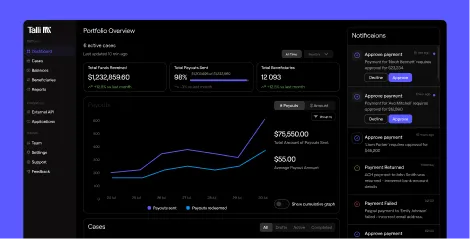
Real-Time Dashboard Visibility provides live tracking of completion rates, payment method distribution, and remaining balances, enabling your team to intervene proactively before accounts approach dormancy thresholds across multiple jurisdictions.
Automated Compliance Infrastructure includes built-in KYC verification, OFAC screening, and W-9 collection achieving 90% completion rates through smart reminders creating the documentation foundation needed to support 10-15 year audit lookback periods.
Complete Audit Trails deliver court-ready documentation of all payment attempts, notifications, and status updates, giving your team defensible records for state examinations and SEC oversight.
Fund Segregation Architecture maintains dedicated FBO accounts for each matter, simplifying jurisdiction-by-jurisdiction reporting while maintaining Qualified Settlement Fund compliance.
For shareholder services teams managing distributions to thousands of recipients across 54 jurisdictions, Talli eliminates the paper check dependencies that create escheatment exposure. Banking services provided by Patriot Bank, N.A., Member FDIC ensure institutional-grade security for all fund movements.
Frequently Asked Questions
What is the primary purpose of abandoned property laws for corporations?
Abandoned property laws serve a dual purpose: protecting property owners by requiring holders to attempt reunification before escheatment, and transferring custodial responsibility to states when owners cannot be located. For corporations, these laws create mandatory compliance obligations including dormancy tracking, due diligence outreach, and timely reporting to 54 separate jurisdictions with varying requirements. Failure to comply can trigger penalties, interest charges, and multi-year audits with lookback periods extending 10-15 years.
How does the dormancy period impact when funds become escheatable?
The dormancy period begins when owner-initiated contact ceases or mail returns undeliverable. 33 jurisdictions use 3-year dormancy periods, while 18 use 5 years. The specific period depends on property type and state wages typically have 1-year dormancy while securities range from 3-5 years. Many jurisdictions have shortened dormancy periods from 5-7 years to 3 years in recent years, compressing compliance timelines significantly.
Can digital payment methods truly reduce the risk of unclaimed property?
Yes, digital disbursement platforms achieve 95-98% redemption rates versus 70-80% for traditional paper checks, a 25-28 percentage point improvement. This dramatic increase directly prevents escheatment by ensuring funds reach intended recipients. Digital methods eliminate common failure points like outdated addresses, lost mail, and forgotten deposits while reducing per-transaction costs from an estimated $7-20 to $0.25-$5.
What are the consequences for companies that fail to comply with escheatment laws?
Non-compliance triggers multiple consequences: late deposits can incur interest charges (12% annually in California), willful failures can draw fines of $100 per day up to $10,000, and third-party audit firms conduct examinations with 10-15 year lookback periods. The SEC imposed a $500,000 civil penalty on DST Asset Manager Solutions for violating lost securityholder search requirements, demonstrating federal oversight expansion beyond traditional state enforcement.
Where can I search for unclaimed money free of charge?
Most states maintain free online portals for unclaimed property searches through their treasury or comptroller offices. The National Association of Unclaimed Property Administrators (NAUPA) offers a consolidated multi-state search at MissingMoney.com. States collectively hold over $70 billion in unclaimed funds, while state programs returned $4.49 billion to rightful owners in FY2024.