You processed 50,000 settlement notices through NCOA and CASS. Suppose your undeliverable rate dropped from 10% to 3%. Success? Not quite. Those remaining 1,500 pieces represent $1,350 in wasted postage plus class members who never received notice, and that's before counting reissuance costs, delayed distributions, and potential legal complications. For settlement administrators and fiduciaries managing high-volume disbursements, understanding both the capabilities and critical gaps of traditional address verification is essential. Modern digital disbursement platforms offer solutions that bypass many of these limitations entirely by eliminating reliance on physical mail addresses.
Key Takeaways
- NCOA and CASS are essential first steps for mail deliverability, but USPS NCOALink records only capture reported permanent address changes, leaving unreported moves as a significant blind spot
- Traditional address verification can significantly reduce undeliverable mail, but results depend on the original mailing list quality
- NCOALink covers 18 or 48 months of permanent move records, depending on the provider, and does not independently verify whether recipients are deceased
- USPS requires qualifying commercial mailers to meet the Move Update standard within 95 days before mailing using an approved method
- Digital payment methods reduce dependence on postal addresses for fund delivery, although claimant notification, identity verification, and tax reporting may still require accurate address information
- Settlement administrators achieving 95-98% redemption rates through digital disbursements versus 70-80% for paper check distributions
- For high-value distributions, NCOA should be treated as a "first line of defense," supplemented by skip-trace for critical recipients who don't match
Understanding the Fundamentals: NCOA and CASS for Address Verification
NCOA (National Change of Address) and CASS (Coding Accuracy Support System) work as a two-step quality filter before any bulk mailing. Understanding their distinct functions helps settlement administrators maximize deliverability while recognizing where additional measures are needed.
How CASS Improves Mail Deliverability
CASS standardizes address formatting to ensure postal automation can process your mail efficiently. The system corrects common errors including:
- Misspellings and typos in street names and cities
- Missing or incorrect ZIP+4 codes
- Improper abbreviations (Ave vs. Avenue, St vs. Street)
- City and state mismatches
CASS-certified software must meet USPS testing requirements, including at least 98.5% accuracy for specified address coding elements. Certification improves address standardization but does not guarantee that every submitted address is valid or deliverable. Without CASS processing, mail pieces may be delayed or returned due to format issues that have nothing to do with the address itself being wrong.
Delivery Point Validation (DPV), typically included with CASS processing, takes verification further by confirming that specific house or apartment numbers exist and can actually receive mail. This catches addresses where the street is valid but the unit number doesn't exist in the USPS delivery database.
CASS Certification for Postal Accuracy
Beyond accuracy, CASS certification is a financial requirement for bulk mailers. USPS commercial mailing rates depend on address quality, mail class, presort qualification, and other preparation requirements. CASS-certified processing can support eligibility for bulk discounts that directly offset processing costs on large settlement notice mailings.
NCOA's Role in Updating Moved Addresses
Once addresses are standardized through CASS, NCOA checks them against USPS's database of 160 million move records. When someone files an official change-of-address form with USPS, that forwarding information becomes available through NCOA processing.
NCOA provides several match types:
- Individual move: Specific person has relocated
- Family move: Entire household has moved to new address
- Business move: Commercial entity has changed locations
- Return codes: Close but not exact matches requiring manual review
For settlement administrators, NCOA processing typically yields estimated 4-8% match rates on lists that haven't been cleaned recently. A lower match rate (under 2%) often indicates the list was recently processed or contains primarily new addresses.
The Critical Role of Address Verification in Legal Settlements
For class action settlements and mass tort distributions, address accuracy isn't just about operational efficiency: it's a legal and fiduciary requirement. Courts expect administrators to demonstrate "reasonable efforts" to locate and notify class members, and NCOA/CASS processing provides documented proof of due diligence.
Minimizing Unclaimed Funds and Escheatment Risks
When settlement notices fail to reach claimants, several costly consequences follow:
- Unclaimed funds accumulate: Undelivered notices mean unfiled claims, leaving settlement money undistributed
- Escheatment timelines begin: State unclaimed property laws require administrators to turn over unclaimed funds after dormancy periods ranging from 1-5 years
- Administrative burden multiplies: Each uncashed check requires tracking, attempted reissuance, and eventual escheatment processing
Settlement administrators face the challenge of reaching recipients who may have moved multiple times during lengthy litigation processes. A mass tort case spanning 3-5 years will see significant address decay among its plaintiff population, making pre-mailing verification essential.
Ensuring Fiduciary Compliance with Accurate Data
Courts increasingly scrutinize settlement administration practices, particularly around fund distribution. Address verification documentation provides:
- Audit trail evidence: CASS reports and NCOA summaries demonstrate systematic address hygiene
- Defensibility in objections: When class members claim they never received notice, administrators can show verification efforts
- Regulatory compliance: Banking regulators and bar associations expect fiduciaries to maintain accurate beneficiary records
For mass tort distributions involving thousands of claimants with varying award amounts, undeliverable rates translate to millions in delayed or unreachable payments and corresponding fiduciary exposure.
Limitations of Traditional Address Verification Methods for High-Volume Payouts
Here's where the "what they miss" becomes critical. NCOA and CASS are necessary but insufficient for achieving true deliverability in legal settlement contexts. Understanding these gaps helps administrators plan appropriate supplemental measures.
Gaps in NCOA and CASS for Dynamic Claimant Data
The most significant limitation is simple: Some people who move do not submit a change-of-address request to USPS, leaving those relocations outside NCOALink's matching data. NCOA only captures voluntary filings.
Additional blind spots include:
- Limited time window: NCOALink covers 18 or 48 months of permanent move records, depending on the provider, problematic for long-duration litigation
- Deceased recipients: NCOA does not independently verify whether recipients are deceased, requiring separate deceased suppression files
- Temporary moves: College students, seasonal workers, and vacation forwarding aren't captured
- Business relocations: NCOALink includes business change-of-address filings, but relocations without a matching USPS record may remain undetected
- Incomplete data: Addresses missing apartment or suite numbers won't match even if the building address is correct
For bankruptcy distributions involving creditors who may have relocated or ceased operations, these gaps become particularly pronounced.
The High Cost of Undeliverable Paper Checks
When address verification fails and checks don't reach recipients, settlement administrators face cascading costs. Initial check processing averages $7-20 per piece when including printing, postage, and reconciliation. Returned mail handling adds another $2-5 for processing, research, and reissuance. Skip-trace services for non-matches cost approximately $0.50-2.00 per record. Second mailing attempts repeat the full cycle at $7-20. Finally, escheatment processing creates ongoing administrative burden plus state fees.
On a 50,000-piece distribution with an estimated 8% undeliverable rate (4,000 checks), these costs compound quickly:
- Initial waste: 4,000 × $0.90 average postage = $3,600
- Reissuance attempts: 2,000 × $15 average = $30,000
- Skip-trace on hard failures: 2,000 × $1.25 = $2,500
- Total additional cost: approximately $36,100 beyond the failed first mailing
This economic reality makes clear why reducing uncashed settlement checks is a priority for every claims administrator.
Beyond Postal: Holistic Identity and Address Verification for Digital Disbursements
Modern settlement administration increasingly recognizes that physical address verification is only one dimension of reaching the right recipients. Digital payment methods shift the verification focus from "where do they live?" to "who are they?", a more reliable foundation for compliant fund distribution.
Integrated KYC and OFAC for Enhanced Compliance
Know Your Customer verification confirms recipient identity through multiple data points that don't depend on postal accuracy:
- Social Security Number validation
- Date of birth matching
- Government ID verification
- Bank account ownership confirmation
This identity-centric approach catches fraudulent claims that would pass address verification entirely. A claimant with a valid mailing address can still be submitting a fraudulent claim. KYC screening identifies these discrepancies before funds are released.
OFAC screening adds another critical layer by checking recipients against U.S. Treasury sanctions lists. This compliance requirement applies regardless of payment method, but digital platforms automate the process with documented timestamps essential for audit trails.
Leveraging AI to Detect and Prevent Fraudulent Claims
Traditional address verification focuses on deliverability, not legitimacy. AI-powered fraud detection examines patterns that address checks cannot:
- Device fingerprinting: Multiple claims submitted from the same device
- Behavioral analytics: Unusual patterns in claim timing, data entry, or submission methods
- Identity correlation: Cross-referencing claimed identities against known fraud patterns
The settlement industry has seen significant increases in fraudulent claim attempts in recent years. Address verification alone cannot identify these bad actors; sophisticated identity and behavior analysis is required.
The Talli Advantage: Streamlining Disbursements with Digital Address Validation
Talli's digital disbursement platform fundamentally reframes the address verification challenge. Rather than trying to perfect postal delivery, the platform offers recipients multiple payment channels that eliminate physical address dependency.
Transforming Weeks into Hours: Talli's Processing Speed
Traditional paper check distributions require address verification processing (5-7 days), print and mail production (3-5 days), USPS delivery (3-10 days), and bank hold periods (2-5 days after deposit). Total time from distribution approval to claimant access: 2-4 weeks minimum.
Digital disbursements through Talli compress this timeline dramatically:
- ACH direct deposit: 1-2 day delivery
- Prepaid Mastercard (virtual): 30-second delivery via SMS/email
- Digital wallets (PayPal, Venmo): Instant access for existing users
For qualified settlement funds requiring timely distribution, this speed difference translates to faster case closure and reduced administrative burden.
Achieving Higher Redemption Rates with Digital Methods
The ultimate measure of settlement administration success isn't sending payments: its recipients actually receiving and using funds. Paper check distributions typically achieve 70-80% redemption rates, meaning 20-30% of settlement money never reaches intended beneficiaries.
Digital payment methods achieve 95-98% redemption rates through:
- Payment choice: Recipients select their preferred method (ACH, card, wallet, check fallback)
- Immediate availability: Funds accessible without bank visits or check deposits
- Reduced barriers: No physical mailbox required, no check cashing fees, no lost mail
- Proactive notifications: SMS and email alerts when payments are ready
For the approximately 5.6 million unbanked U.S. households, according to the FDIC's 2023 survey, who cannot easily deposit checks, prepaid cards provide account-free access to settlement funds, dramatically improving reach to underserved populations.
Ensuring Regulatory Compliance and Fund Security Through Advanced Verification
Legal settlement funds carry strict compliance requirements that extend well beyond address accuracy. Digital platforms must demonstrate complete fiduciary compliance across multiple regulatory frameworks.
Dedicated Fund Segregation for QSF Treatment
Qualified Settlement Funds under IRC Section 468B require absolute separation between settlement money and operating capital. Talli's FBO (For Benefit Of) account structures provide:
- Matter-level fund tracking for each settlement
- Complete separation preventing commingling
- Simplified court reporting with clear fund flows
- Audit-ready documentation throughout the disbursement lifecycle
This architecture supports segregation and documentation for qualified settlement funds while enabling digital payment methods. QSF tax treatment depends on satisfying applicable federal requirements, including governmental approval, qualifying claims, and asset segregation.
Maintaining Audit-Ready Documentation and Security Standards
Settlement administration demands institutional-grade security. Talli maintains:
- SOC 2 Type I: Independent assessment of security control design
- PCI DSS 4.0.1: Listed in Talli's Trust Center
- Banking services through Patriot Bank, N.A.: Member FDIC, providing deposit insurance protection
For courts, trustees, and regulators reviewing settlement distributions, comprehensive documentation of compliance measures far exceeds what paper check vendors typically offer.
Real-Time Visibility and Analytics for Proactive Payment Management
Traditional mail-based distributions operate largely in the dark. Once checks are mailed, administrators wait for returned mail, phone calls from confused recipients, or eventual bank clearing data, often weeks after the fact.
Gaining Insights with Live Payment Tracking
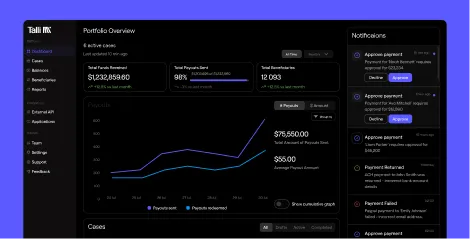
Talli's real-time dashboard provides immediate visibility into:
- Completion rates: Percentage of successful payouts versus pending/failed
- Payment method distribution: How recipients are choosing to receive funds
- Geographic concentration: Regional patterns in payment activity
- Failure root cause analysis: Specific reasons for rejected payments
- Fraud flags: Suspicious patterns requiring review
- Remaining fund balances: Real-time reconciliation with distributed amounts
This visibility enables proactive management rather than reactive problem-solving. When a payment fails, administrators know immediately, not after the check is returned weeks later.
Automating Court-Ready Reports and Stakeholder Access
Court-required accounting for settlement distributions traditionally requires manual preparation of reconciliation reports, fund flow summaries, and recipient status updates. Automated reporting generates these documents without manual effort:
- Distribution summaries by payment method
- Individual claimant payment status
- Fund reconciliation against court-approved allocations
- Exception reports for failed or pending payments
Stakeholder portals provide controlled access for courts, trustees, and legal teams to view real-time status without waiting for administrator reports.
Case Study: AB Data's Success with Talli's Digital Disbursement Infrastructure
AB Data, one of the leading claims administrators in the United States, manages settlements worth hundreds of millions of dollars involving hundreds of thousands of claimants. Their experience implementing Talli's platform demonstrates measurable improvements in both verification accuracy and payment delivery.
Achieving Higher Redemption and Reduced Exceptions
Within 12 months of implementation, AB Data achieved:
- 30% increase in claimant redemption rates across check-issued populations
- 60% reduction in unresolved exceptions and manual reissuance overhead
- Improved audit visibility through segregated banking infrastructure and transparent payment reporting
- Faster time to funds for claimants while lowering distribution and reissuance costs
These results came from systematically eliminating the check-issued population through digital payment alternatives, the same addresses that would have required NCOA verification, reissuance tracking, and eventual escheatment processing under traditional methods.
Maintaining Compliance and Lowering Costs
Thomas R. Glenn, President & CEO of AB Data, described the impact: "We don't think of digital disbursement as a feature; we think of it as infrastructure. Talli gave us the regulated payout rails we needed to move faster, reduce unclaimed funds, and give courts full confidence in how settlement money is being distributed."
The full case study details how AB Data's implementation addressed both the verification gaps inherent in postal-dependent distributions and the compliance requirements courts increasingly demand.
Future-Proofing Settlement Payouts: Why Digital is the New Standard
The settlement administration industry is moving decisively toward digital-first distribution infrastructure. This shift reflects both economic reality and changing recipient expectations.
Adapting to Evolving Claimant Needs and Payment Preferences
Demographic trends favor digital payment adoption:
- Millennials and Gen Z: Strong preference for PayPal, Venmo, and instant payment options
- Unbanked populations: Millions of households benefit from prepaid card access without bank account requirements
- Mobile-first users: Expect payment notifications via SMS/email, not postal mail
- Multi-generational households: Younger family members often manage finances for elderly relatives
Settlement administrators who offer payment choice see higher engagement across all demographic segments.
Economic Advantages of Digital Payments Over Traditional Checks
The cost comparison between paper and digital distributions is increasingly favorable to digital methods. Per-transaction costs for paper checks average $7-20, while digital payments range from $0.25-5. Undeliverable rates for paper mail run 8-10% baseline, while digital methods experience near-zero delivery failures. Reissuance rates for checks reach 5-8%, compared to under 1% for digital. Time to the recipient spans 2-4 weeks for paper, versus 24-48 hours for digital. Finally, redemption rates for checks achieve 70-80%, while digital methods reach 95-98%.
For settlement administrators processing thousands or hundreds of thousands of payments, the estimated 50-65% cost reduction from digital methods compounds with dramatically improved recipient outcomes.
Why Settlement Administrators Choose Talli
NCOA and CASS provide essential address verification, but they cannot eliminate the limitations of paper-based distributions. Talli helps settlement administrators accelerate payouts, improve redemption rates, and maintain complete compliance documentation.
How Talli Improves Settlement Distributions
- Flexible payment options: ACH, prepaid cards, digital wallets, and check fallbacks reduce reliance on postal addresses.
- Faster distributions: Digital delivery reduces weeks-long timelines to hours.
- Real-time tracking: Enables proactive payment monitoring and exception management.
- Automated compliance: Produces court-required documentation without manual reporting.
Talli delivers measurable results:
- 95-98% redemption rates versus 70-80% for paper checks.
- 60% fewer unresolved exceptions.
- 30% higher claimant redemption rates.
For class actions, mass torts, and bankruptcy distributions, Talli's identity-verified digital payments help administrators close cases faster, deliver more funds to claimants, and maintain fiduciary compliance throughout the process.
Frequently Asked Questions
How long does NCOA processing take, and what's the deadline for compliance?
NCOA batch processing typically takes 24-48 hours for files under 100,000 records, plus 2-3 days for setup if you haven't processed before. USPS requires qualifying commercial mailers to meet the Move Update standard within 95 days before mailing using an approved method. Plan processing at least 30 days before your mail deadline to allow time for manual review of flagged addresses.
What's the difference between a low NCOA match rate and a processing problem?
An estimated 4-8% match rate is typical for lists cleaned within the past 6-12 months. Match rates below 2% usually indicate the list was recently processed through NCOA or contains primarily new addresses. Match rates above 15% should raise questions. Request a detailed breakdown of match types (individual, family, business, return codes) to verify processing quality.
Can digital payments completely replace address verification for settlements?
Digital payment methods reduce dependence on postal addresses for fund delivery, although claimant notification, identity verification, and tax reporting may still require accurate address information. For recipients who select ACH, prepaid cards, or digital wallets, postal verification becomes unnecessary. However, recipients who choose paper checks as a fallback option still require traditional NCOA/CASS processing. The goal is minimizing the check-issued population, typically reducing postal dependence to around 5-15% of recipients.
How should settlement administrators handle recipients who don't match in NCOA?
For standard-value claims, "no match" addresses can typically proceed to mailing with the expectation that some will return undeliverable. For high-value distributions (claims exceeding $5,000-$10,000), supplement NCOA with third-party skip-trace services costing approximately $0.50-2.00 per record. Skip-trace providers access credit bureau data, utility records, and other sources that capture address changes USPS doesn't see. The cost is justified for high-value claims where failed delivery creates significant fund accumulation and potential escheatment exposure.
What documentation should administrators keep for court filings regarding address verification?
Maintain three key documents: (1) CASS certification report showing address standardization was performed with processing date and record counts, (2) NCOA summary report including total matches by type, return codes, and processing date, and (3) copy of the Processing Acknowledgement Form (PAF) proving authorization for NCOA access. These documents demonstrate "reasonable efforts" to locate class members and provide defensibility against objections claiming insufficient notice. Digital platforms that integrate compliance documentation into standard reporting simplify this requirement significantly.