.svg)


.svg)
Uncashed settlement checks create one of the most persistent compliance problems in legal disbursements. Every undelivered check, returned envelope, stale-dated payment, and dormant balance can create reissuance work, claimant frustration, audit exposure, and eventual unclaimed property reporting obligations. With class action settlement distributions reaching tens of billions of dollars annually and paper checks often costing far more than digital payments to print, mail, reconcile, reissue, and track, unclaimed funds can become a major operational burden for claims administrators, law firms, trustees, and fiduciary organizations.
Modern class action solutions reduce that burden by replacing check-first distribution with digital-first workflows. Instead of waiting weeks to discover that a payment was lost, ignored, or sent to an outdated address, administrators can use ACH, prepaid cards, digital wallets, gift cards, and automated reminders to confirm claimant engagement earlier. That earlier visibility matters because uncashed checks are not just a payment issue. They affect reconciliation, court reporting, tax documentation, owner outreach, stale-date handling, and eventual escheatment.
Key Takeaways
- Paper checks fail at meaningfully higher rates than electronic payments, with mailed checks often creating more returned mail, reissuance, and unclaimed property work than digital methods.
- States collectively hold roughly $70 billion in unclaimed property, while annual returns to owners represent only a fraction of the total amount held.
- Escheatment penalties vary by state, including Texas penalties of 5% plus an additional 5% after 30 days, while Iowa can impose 10% annual interest and a 25% civil penalty for willful failures.
- Digital disbursement can reduce total settlement administration costs by cutting printing, postage, reissuance, due diligence, reconciliation, and final reporting work.
- Paper settlement checks may fail because of outdated addresses, lost mail, deceased claimants, banking access barriers, or low claimant engagement.
- Administrators must manage 55+ jurisdictions with different dormancy periods, due diligence requirements, report formats, and filing deadlines.
- The Department of Labor's Field Assistance Bulletin 2025-01 creates a temporary enforcement policy for certain small retirement benefit payments owed to missing participants or beneficiaries that fiduciaries voluntarily transfer to state unclaimed property funds.
Understanding Unclaimed Property and Unclaimed Money
Unclaimed property is any financial asset that has gone without owner contact or activity for a state-defined period. In settlement administration, the most common examples are uncashed settlement checks, returned distribution payments, outstanding residual balances, stale-dated checks, and funds that cannot be delivered because the claimant cannot be located.
The rule is simple in concept but complicated in execution: if a holder owes money to an owner and cannot complete payment after the applicable dormancy period and required outreach, the holder may have to report and remit the funds to the proper state unclaimed property program. Once transferred, the state generally holds the property in custody until the owner or heir files a claim.
What Counts as Unclaimed Property?
Unclaimed property can include more than a simple check that was never deposited. Settlement teams should monitor:
- Outstanding checks that remain uncashed beyond the relevant dormancy period.
- Returned mail with no updated address on file.
- Digital payments that fail because account credentials are wrong or the claimant never completes redemption.
- Residual settlement balances after distribution.
- Refunds, dividends, or other cash obligations owed to owners.
- Payments owed to deceased claimants when heirs or beneficiaries have not been verified.
The operational challenge is that unclaimed property does not appear all at once. It accumulates slowly as checks age, emails bounce, claimants move, names change, estates remain unresolved, and administrators lose clear owner contact. By the time a final accounting is due, the remaining exceptions can require far more manual attention than the successful payments.
Understanding claimant abandonment helps administrators identify which populations are most likely to become unresolved before dormancy deadlines arrive.
How States Decide Who Receives Unclaimed Funds
State governments act as custodians, not owners, of unclaimed property. The primary priority rule sends unclaimed property to the state of the owner's last known address. If no address is available, the property generally goes to the holder's state of incorporation. Special rules apply to some instruments, including money orders and traveler's checks.
For settlement administrators, this creates a multi-state compliance problem. A single national settlement may include claimants in every state, Washington, D.C., Puerto Rico, Guam, the U.S. Virgin Islands, and other jurisdictions. Each may have its own dormancy rules, owner notice requirements, file format rules, payment instructions, and report due dates.
That is why unclaimed settlement checks should be tracked from the first distribution attempt, not only at the end of a settlement program.
What Happens When Checks Go Stale
A stale-dated check is one presented after the period when a bank is obligated to honor it. Under UCC §4-404, a bank is not obligated to pay a check, other than a certified check, when it is presented more than six months after its date. The bank may still pay the check in good faith, but it does not have to do so.
Settlement checks may also carry a printed validity period, such as “void after 90 days” or “void after 180 days.” That printed language can support the administrator's internal process, but it does not eliminate the need to manage the underlying obligation. If the claimant is still entitled to the money, a stale or voided check usually becomes a reissuance, outreach, reconciliation, or escheatment issue.
Why Stale-Dating Matters in Settlements
Stale-dating creates friction for both sides. Claimants may try to deposit a check and have it rejected. Administrators may need to confirm eligibility, void the old check, issue a replacement, update tax records, and refresh the audit trail. Banks may process some older checks and reject others, which creates uncertainty if controls are not clear.
The risk is especially high in legal distributions because administrators may be operating under court-approved timelines, fiduciary obligations, tax reporting rules, and final accounting deadlines. A check that sits uncashed for months is not just a customer service problem. It becomes evidence that funds remain unresolved.
Common Stale-Check Scenarios
Settlement teams typically see stale-dated checks when:
- The claimant moved after filing the claim.
- The check was mistaken for junk mail.
- The claimant is unbanked or underbanked.
- The claimant died before receiving or depositing the payment.
- The payment amount is small enough that the claimant ignores it.
- The claimant is confused about whether the check is legitimate.
- The check requires reissue because the name or address is wrong.
These issues are preventable when administrators combine better contact data, payment choice, automated reminders, and real-time payment tracking. Digital methods do not remove every exception, but they surface problems faster than paper checks.
Escheatment: Meaning and Process for Uncashed Funds
Escheatment, pronounced “es-CHEAT-ment,” is the process by which unclaimed property is transferred to state custody after the applicable dormancy period and owner outreach requirements are satisfied. The purpose is to prevent holders from retaining funds that belong to someone else while preserving the owner's ability to claim the funds later.
For legal settlements, escheatment often begins with a simple problem: a check was issued but never cashed. If the administrator cannot resolve the payment through reissue, address updates, digital conversion, or claimant outreach, the funds may eventually need to be reported and remitted to one or more state unclaimed property programs.
Dormancy Periods Vary by State and Property Type
Dormancy periods are not uniform. Payroll checks may have shorter periods than general checks. Securities, dividends, refunds, court deposits, and gift cards may have separate rules. General property commonly ranges from 3-5 years, including California at generally 3 years, Delaware at typically 5 years for many general property types, and New York at commonly 3 years for many check and cash obligations.
Traveler's checks and money orders often follow longer rules. Traveler's checks are commonly subject to a 15-year period, while money orders may follow a 7-year period depending on the applicable law and instrument type.
Settlement administrators should not rely on one national dormancy rule. They need property-type mapping, owner address mapping, and documented due diligence for every unresolved balance.
Key Stages of Escheatment
The escheatment process usually follows four stages.
Payment Becomes Unresolved
The original check is uncashed, returned, voided, or otherwise not completed. The administrator should record the payment status, owner information, issue date, payment method, and reason for failure.
Dormancy Period Runs
The clock typically starts from the date of last owner activity, last contact, or the date the obligation became payable, depending on state law and property type. Automated tracking is essential because different jurisdictions can mature at different times.
Due Diligence Outreach Occurs
Many states require written notice before reporting. The timing and content of notice vary, but outreach often occurs 60-120 days before the report deadline. Email, SMS, phone, and commercial database searches may supplement required mail notices.
Reporting and Remittance Are Completed
The holder submits a report, usually in NAUPA format, and remits the property to the appropriate state. The holder must retain records because audits can look back many years.
The DOL guidance is relevant for retirement plan contexts, but it should not be treated as a general settlement rule. It is a temporary enforcement policy for certain small retirement benefit payments owed to missing participants or beneficiaries.
Settlement Checks: Delivery, Tracking, and Timing
Settlement check distribution depends on court approval, final claimant data, lien resolution, tax documentation, funding, printing, mailing, and bank processing. Once a release is signed or a claim is approved, a paper check may still take weeks to reach the claimant and clear.
A typical paper process can include:
- Final eligibility confirmation.
- Payment file approval.
- Check printing and quality control.
- Mailing through standard or tracked mail.
- Claimant receipt and deposit.
- Bank clearing.
- Reconciliation against the trust, QSF, or settlement account.
Digital disbursement compresses many of these steps. Administrators can send payment invitations, collect payment preferences, validate account details, trigger reminders, and see whether a claimant has completed redemption. That is why time to cash is often much shorter when a settlement program uses digital-first distribution.
Factors That Affect Settlement Payment Success
Several variables determine whether a claimant receives funds quickly:
- Address quality: Outdated mailing addresses create returned checks and delayed reissue work.
- Claimant engagement: Low engagement causes payments to sit unopened or incomplete.
- Payment choice: ACH, prepaid cards, digital wallets, and gift cards give claimants more ways to receive funds.
- Banking access: Unbanked and underbanked claimants may struggle to deposit traditional checks.
- Estate issues: Deceased claimants require heir, estate, or beneficiary workflows.
- Fraud controls: Identity verification and sanctions screening can slow payment when exceptions need review.
The 2023 FDIC survey found that 5.6 million U.S. households lacked a bank or credit union account, which makes payment choice important for equitable settlement distribution. Administrators that only send checks may create avoidable barriers for people who cannot easily deposit them.
How Claimants Can Monitor Payment Status
Claimants should keep their mailing address, email, and phone number current with the settlement administrator. They should also respond quickly to requests for tax forms, identity verification, payment selection, or estate documentation.
For administrators, clear tracking systems reduce inbound support volume and prevent abandonment. When claimants can see payment status, they are less likely to ignore legitimate messages or assume the process has stalled.
The Cost and Risk of Uncashed Settlement Checks
Uncashed checks create direct costs and compliance risk. A single unresolved check may require support tickets, bank stop-payment actions, reissuance, address research, certified mail, tax review, and final reporting. Across thousands of claimants, those exceptions can become a major cost center.
Direct Financial Costs
Paper check programs can generate costs in several categories:
A 10,000-claimant settlement with a 5% uncashed rate creates 500 problem payments. Even when the dollar value of each payment is small, the administrative cost of resolving each exception can be disproportionate.
Compliance and Legal Exposure
Uncashed checks create risk because the administrator still controls money owed to someone else. If unresolved balances are not properly tracked, the holder may miss due diligence deadlines, file late reports, remit to the wrong jurisdiction, or fail to preserve adequate records.
Potential exposure includes:
- Multi-state unclaimed property audits.
- Late reporting penalties and interest.
- Fiduciary breach allegations.
- Delayed final accounting to courts.
- Incomplete claimant records.
- Reputational damage with class counsel, courts, and claimants.
The settlement reconciliation process becomes harder when paper checks remain outstanding for months or years. Each unresolved item must be tied back to a claimant, a payment attempt, a bank record, and a disposition path.
Reducing Unclaimed Funds with Digital Disbursement
Digital disbursement reduces escheatment exposure by addressing the root causes of uncashed checks. Instead of sending one paper instrument and waiting months to discover a failure, administrators can offer multiple rails, trigger reminders, and monitor claimant action in real time.
Digital Payment Options
Modern settlement platforms typically support:
- ACH direct deposit: Low-cost bank transfer for claimants with checking or savings accounts.
- Prepaid cards: Useful for claimants without traditional bank accounts.
- Digital wallets: Fast access through services such as PayPal and Venmo.
- Gift cards: Effective for small-value distributions where full redemption is important.
- Paper checks: Still useful as a fallback when digital options are not appropriate.
Payment choice matters because claimant populations are not uniform. Some claimants prefer bank deposits. Others prefer cards or wallets. Some need a physical option. A digital-first program does not have to eliminate paper entirely. It should make paper the exception rather than the default.
How Digital Platforms Improve Redemption
Digital systems improve redemption through earlier engagement and faster failure detection. If an ACH payment fails, the administrator can often see the failure quickly and ask the claimant to update information. If a claimant ignores a payment selection email, automated reminders can prompt action before dormancy risk grows. If a prepaid card is selected, the administrator can confirm activation and usage status.
Key benefits include:
- Faster payment delivery.
- Earlier detection of failed payments.
- Lower returned-mail volume.
- More payment choices for unbanked claimants.
- Automated reminders by email and SMS.
- Cleaner reconciliation and reporting.
- Better evidence for court and audit review.
Programs focused on claims redemption should prioritize claimant communication and payment choice before defaulting to paper checks.
Talli's Role in Minimizing Uncashed Settlement Checks
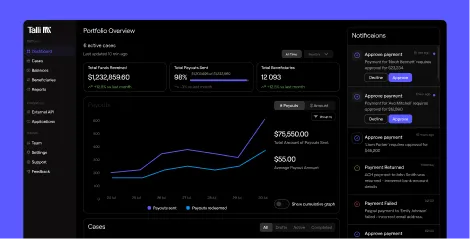
Talli is purpose-built for legal settlement disbursements, where payout speed, fund segregation, claimant experience, and compliance documentation all matter. The platform gives claims teams a single dashboard to upload claimant data, create distribution campaigns, track payment status, and reconcile fund movement across multiple payment methods.
Built-In Compliance Infrastructure
Talli supports settlement programs with:
- KYC identity verification.
- OFAC screening.
- W-9 collection.
- 1099 generation support.
- Fraud mitigation.
- Audit logging.
- Real-time payout tracking.
- Automated claimant reminders.
These features help administrators reduce the manual work that typically follows uncashed checks. Instead of managing spreadsheets, returned envelopes, disconnected bank reports, and separate tax workflows, claims teams can maintain a unified record of each payment attempt and claimant action.
Talli’s tax compliance workflows also help reduce errors when tax documentation and payment records need to stay aligned.
Fund Segregation and Audit Trails
Talli maintains dedicated accounts for each settlement, helping preserve Qualified Settlement Fund ownership and preventing commingling between settlement funds and operating capital. Complete fund segregation is especially important when administrators need to show courts, trustees, and counsel that settlement money remained separated and traceable throughout the disbursement lifecycle.
Court-ready audit trails document the payment journey from campaign launch through final reconciliation. That visibility makes unresolved balances easier to manage because every payment attempt, reminder, status change, and exception can be reviewed from one system.
Payment Choice for More Claimants
Talli offers claimants multiple redemption options, including ACH transfers, prepaid Mastercards, PayPal, Venmo, Amazon gift cards, and paper checks as needed. This flexibility helps administrators reach claimants who may not have traditional bank accounts or who are less likely to cash a mailed check.
For high-volume distributions, multi-channel payouts can reduce unclaimed funds by matching the payment method to claimant preferences instead of forcing every claimant into the same paper process.
Digital Payouts vs. Paper Checks
The financial case for digital disbursement becomes clearer when administrators measure the full lifecycle cost, not just the cost of issuing the first payment.
Paper Check Cost Drivers
Paper checks can create costs before, during, and after distribution:
Digital Disbursement Advantages
Digital disbursement reduces cost by moving more of the process into automated workflows. Claimants can select payment methods, receive reminders, correct errors, and complete redemption without waiting for physical mail. Administrators can track payment status in real time and resolve failures before they become dormant property.
Digital methods also simplify final reporting. Fewer outstanding checks mean fewer unresolved balances, cleaner ledgers, and more reliable court accounting. For administrators evaluating disbursement vendors, the key requirements are multi-rail payment support, fund segregation, audit trails, tax workflows, fraud controls, and unclaimed property visibility.
Why Talli for Settlement Disbursements
Uncashed checks are rarely just a mailing problem. They are a compliance, accounting, claimant experience, and court reporting problem. The longer a check sits unresolved, the more work it creates for administrators and the more likely it becomes part of an escheatment workflow.
Talli helps claims teams reduce that exposure with digital-first settlement distribution, built-in compliance, fund segregation, and real-time tracking. Administrators can launch campaigns, offer multiple payment rails, monitor claimant redemption, automate reminders, and maintain the audit evidence needed for courts and regulators. Paper checks can still be used when necessary, but they no longer need to carry the entire distribution program.
For legal settlements, the goal is not only to send money. The goal is to prove that money was delivered, tracked, reconciled, and handled in compliance with the governing settlement documents and applicable law. Talli gives administrators the infrastructure to do that at scale.
Frequently Asked Questions
What is the difference between unclaimed property and escheated funds?
Unclaimed property is money or another asset that remains in the holder's possession after the owner has had no contact or activity for the applicable dormancy period. Escheated funds are assets that have already been reported and transferred to a state unclaimed property program. Owners can generally still claim escheated funds from the state by proving ownership.
How long does a settlement check remain valid before becoming stale-dated?
Under UCC §4-404, a bank is generally not obligated to pay a check presented more than six months after its date, though it may still pay the check in good faith. Settlement checks may also include shorter printed validity periods, such as 90 or 180 days. After that period, claimants usually need to request reissue.
What are settlement administrators responsible for when checks go uncashed?
Administrators should maintain accurate claimant records, monitor outstanding checks, perform required due diligence, document outreach attempts, reissue payments when appropriate, reconcile bank records, file unclaimed property reports when required, remit funds to the proper states, and retain records for audit support.
Can claimants recover funds after escheatment?
Yes. State unclaimed property programs generally hold funds for the benefit of the owner until a valid claim is filed. Claimants usually need to provide proof of identity and proof that they were connected to the address, settlement, account, or payment involved.
What should claimants do to avoid missing settlement payments?
Claimants should keep their mailing address, email, and phone number current, respond quickly to administrator requests, choose a digital payment method when available, monitor spam folders for legitimate payment notices, and deposit or redeem payments promptly.
Do digital payments eliminate escheatment risk?
No. Digital payments reduce risk by improving delivery, tracking, and failure detection, but unresolved balances can still become unclaimed property. Administrators still need dormancy tracking, due diligence, reporting, and record retention controls.
Why are paper checks more likely to become unclaimed?
Paper checks depend on accurate addresses, physical delivery, claimant recognition, bank access, and timely deposit. They can be lost, ignored, stolen, returned, or left uncashed. Digital methods provide faster status visibility and more opportunities to correct failures before dormancy periods run.
How does Talli help reduce uncashed settlement checks?
Talli gives administrators multiple payment methods, automated reminders, real-time dashboards, KYC and OFAC workflows, W-9 collection, 1099 support, fraud controls, fund segregation, and audit trails. That infrastructure helps more claimants redeem funds while giving administrators clearer evidence for reconciliation and final reporting.