Mass payout platforms processing legal settlements, insurance claims, or gig economy payments face a compliance reality that demands attention: a single prohibited payment can trigger civil penalties reaching the greater of $377,700 or twice the transaction value under applicable IEEPA provisions. The question isn't whether to screen, it's how. Batch screening processes entire databases on a schedule, while real-time screening verifies each recipient at the moment of payment. For claims administrators and settlement teams managing thousands of disbursements, understanding when to deploy each approach, or both, determines the difference between compliant operations and costly enforcement actions. Talli's compliance automation suite embeds both screening modes directly into the disbursement workflow, eliminating the gap between verification and payment.
Key Takeaways
- OFAC violations carry civil penalties reaching the greater of $377,700 or twice the transaction value, a single missed match can exceed years of compliance software costs
- Batch screening suits initial database reviews and periodic rescreening, processing 100,000+ records in hours with subscription-based pricing
- Real-time API screening supports rapid verification before payment approval, with response times varying by provider, screening complexity, and system conditions
- Risk-based compliance programs benefit from combining both methods: real-time for transaction screening and batch for ongoing monitoring
- Properly configured fuzzy matching can reduce false positives, although results depend on data quality, screening thresholds, and review procedures
- OFAC updates sanctions lists as needed without a fixed schedule, platforms screening only at onboarding miss new designations
- Hybrid approaches combining batch and real-time screening represent the compliance standard for mass payout platforms
Understanding OFAC Sanctions and Their Importance for Mass Payouts
The Office of Foreign Assets Control administers and enforces U.S. economic and trade sanctions based on foreign policy and national security goals. For any organization disbursing funds, whether class action settlements, insurance claims, or contractor payments, OFAC compliance means verifying that no payment recipient appears on the Specially Designated Nationals list before releasing funds.
Why OFAC Screening Matters for Settlement Administrators
Mass payout platforms face unique exposure because of volume and velocity. Processing 10,000 payments creates 10,000 potential compliance failures. The penalties apply regardless of intent, even accidental payments to sanctioned parties trigger enforcement actions.
The stakes extend beyond fines:
- Banking relationship risk: Banks terminate accounts for platforms with inadequate screening
- Court scrutiny: Settlement administrators must demonstrate compliant fund distribution
- Reputational damage: Enforcement actions become public record
- Operational disruption: Investigations freeze payments during review
For class action settlements, where courts require detailed accounting of every disbursement, OFAC screening creates the documented compliance trail that satisfies judicial oversight.
The Mechanics of OFAC Screening: What Does it Entail?
OFAC screening compares payment recipient information against government-maintained sanctions lists. The process involves matching names, addresses, dates of birth, and business registration numbers against entries in the SDN list and related databases.
Core Screening Components
Effective screening programs include several key elements:
- Fuzzy matching algorithms: Catch name variations, misspellings, and transliterations (e.g., "Mohammed" vs "Muhammad") without requiring exact matches
- Multi-list coverage: Screen against OFAC SDN, EU Consolidated List, UN Security Council List, and thousands of global watchlists simultaneously
- Risk scoring: Assign confidence levels to prioritize human review of high-probability alerts
- Ownership screening: Check beneficial owners per OFAC's 50% Rule, entities majority-owned by sanctioned parties are themselves blocked
- Continuous monitoring: Automatically rescreen existing databases when OFAC updates lists
The screening process generates alerts requiring human review. Properly configured screening can reduce unnecessary alerts, but false-positive rates vary by dataset, matching thresholds, and verification procedures.
Batch OFAC Screening: Efficiency for High-Volume, Non-Urgent Payouts
Batch screening processes large datasets on a scheduled basis, nightly, weekly, or on-demand. This approach suits situations where immediate verification isn't required and cost efficiency matters.
When Batch Screening Makes Sense
- Initial database cleansing: Before launching a new settlement, screen all claimants in a single overnight run
- Periodic rescreening: When OFAC adds new designations, batch-rescreen your entire payee database
- Low-volume operations: Platforms processing fewer than 100 monthly payments may not need real-time infrastructure
- Historical compliance audits: Review legacy payee records to identify past exposure
Batch Screening Economics
The cost structure favors high-volume, scheduled processing:
- Subscription-based pricing: Batch screening costs depend on record volume, monitoring frequency, watchlist coverage, and vendor contract terms
- Volume-dependent pricing: Batch screening may use subscription fees, per-record charges, or negotiated volume tiers depending on the provider
- Lower infrastructure requirements: File uploads replace API integration
- Staff efficiency: Compliance teams review alerts in batches rather than one-at-a-time
For a law firm distributing a $50 million settlement to 15,000 claimants, batch screening can process all records in an overnight run, generating a manageable queue of alerts for morning review.
Batch Screening Limitations
The scheduled nature creates compliance gaps:
- Delayed detection: New designations between batch runs go unscreened
- Payment workflow friction: Cannot gate individual payments on screening results
- Stale data risk: Payee information may change between screening and payment
Real-Time OFAC Screening: Instant Compliance for Time-Sensitive Transactions
Real-time screening verifies recipients at the moment of payment through API integration. The screening call occurs between payment approval and fund release, blocking disbursements to flagged recipients before money moves.
When Real-Time Screening Is Essential
- Payment approval workflows: Every disbursement verified before release
- High-risk jurisdictions: International payments requiring immediate verification
- Regulatory expectation: Industries where examiners expect transaction-level screening
- Dynamic payee populations: Gig platforms adding new contractors daily
Real-Time Screening Performance
Modern screening APIs can deliver rapid verification suitable for payment workflows, although response times vary by provider, screening complexity, and network conditions. The per-transaction cost structure works differently:
- Per-check pricing: Screening API costs vary by provider, screening volume, watchlist coverage, and contract terms
- Volume tiers: High-volume platforms negotiate lower rates
- Predictable scaling: Costs grow linearly with payment volume
- Immediate audit trail: Each transaction generates timestamped compliance documentation
Real-Time Integration Considerations
Implementing real-time screening requires technical investment:
- API integration: 2-4 weeks of development time for custom integration
- Webhook configuration: Receive alerts when list updates affect existing payees
- Latency management: Design user interfaces to accommodate verification delays
- Failure handling: Define fallback procedures when API is unavailable
Choosing Your Strategy: Batch vs. Real-Time for Mass Payout Compliance
The choice between batch and real-time screening isn't binary. Most compliance programs require both approaches for different lifecycle stages.
Decision Framework
Batch Screening works best for database reviews and periodic monitoring, processing datasets in hours with subscription-based pricing models. File upload integration keeps complexity low.
Real-Time Screening supports automated OFAC verification during payment workflows, helping administrators identify potential sanctions matches before transaction approval and fund release. API integration requires medium complexity but provides immediate compliance decisions. Per-transaction pricing suits high-volume operations.
The Hybrid Approach: Industry Standard
A combination of batch and real-time screening can strengthen a risk-based sanctions compliance program. Although OFAC does not universally mandate specific screening technologies, organizations must maintain appropriate controls to prevent prohibited transactions and respond to changes in sanctions restrictions.
A defensible compliance architecture includes:
- Onboarding: Batch screen new payee databases before first disbursement
- Transactions: Real-time verification before each payment release
- Monitoring: Automated batch rescreening when OFAC updates lists
- Alerts: Immediate notification when existing payees match new designations
This layered approach closes the gap where platforms screening only at onboarding miss subsequent designations, the compliance failure behind many enforcement actions.
Enhancing Compliance: The Role of AML Programs and KYC Verification
OFAC screening operates within a broader compliance framework. Anti-money laundering (AML) programs and Know Your Customer (KYC) verification complement sanctions screening to create comprehensive financial crime prevention.
KYC Integration with OFAC Screening
Identity verification before payment reduces both fraud and compliance risk:
- Data quality improvement: Verified identities reduce false positive rates in OFAC screening
- Additional screening triggers: KYC flags prompt enhanced due diligence including deeper sanctions review
- Audit trail completeness: Documented identity verification supports compliance examinations
Talli's platform integrates KYC identity verification with OFAC screening, cross-referencing claimant information against identity databases while simultaneously checking sanctions lists. This dual verification catches both fraudulent claims and sanctioned recipients.
AML Program Requirements
Money Services Businesses subject to FinCEN's requirements generally must maintain risk-based BSA/AML programs. OFAC sanctions compliance is a separate legal obligation that can be coordinated with AML controls, particularly through identity verification, transaction monitoring, and documented escalation procedures.
State licensing examinations review OFAC screening capabilities during MSB audits. The consequences of inadequate programs extend beyond OFAC penalties. BSA/AML enforcement resulted in billions in penalties in recent years, reflecting intensified regulatory focus on payment compliance.
Leveraging AI for OFAC and AML Compliance in Mass Payouts
Artificial intelligence transforms screening efficiency by reducing false positives while maintaining detection accuracy. Machine learning algorithms analyze patterns across millions of transactions to distinguish true matches from coincidental name similarities.
AI-Powered Screening Benefits
- False positive reduction: AI-assisted matching can reduce unnecessary alerts compared with basic rules-based screening, although results depend on data quality, matching thresholds, and the effectiveness of human review
- Pattern recognition: Identify suspicious behaviors that indicate sanctions evasion attempts
- Continuous learning: Models improve accuracy based on analyst decisions
- Scalability: Process high volumes without proportional compliance staff increases
Talli's AI-powered fraud detection achieves high accuracy while identifying fraud faster than manual review. This capability complements OFAC screening by flagging suspicious patterns that may indicate sanctions circumvention, multiple payments to similar entities, rapid address changes, or unusual payment method selections.
AI Limitations and Human Oversight
AI enhances but doesn't replace human judgment:
- Final decisions: Analysts must review AI recommendations before blocking payments
- Escalation paths: Complex matches require experienced compliance review
- Documentation: Human decisions create the audit trail regulators examine
- Edge cases: Novel sanctions evasion techniques may evade pattern recognition
Talli's Digital-First Approach to OFAC Screening and Mass Payouts
Mass payout platforms face a choice: bolt on screening tools from separate vendors, or select a disbursement platform with compliance embedded from the foundation. Talli takes the integrated approach, building OFAC screening into payment workflows.
Embedded Compliance Architecture
Talli's platform includes:
- Automated OFAC screening: Verification occurs automatically before payment release, with documented timestamps
- Real-time list synchronization: When OFAC updates designations, the platform automatically rescreens affected payees
- Alert management workflow: Flagged payments route to compliance review with full context
- Court-ready audit trails: Every screening decision documented for regulatory examination
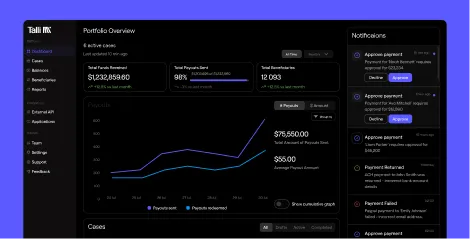
This integration eliminates the gap day risk where separate systems allow payments between list updates and next batch screening. The platform's real-time dashboard provides live visibility into screening status, flagged alerts requiring review, and compliance metrics across the entire settlement.
Compliance Within Settlement Workflows
For claims administrators managing legal settlement disbursements, Talli's compliance suite integrates with the broader distribution workflow:
- Pre-distribution: Batch screen approved claimant list before funding
- Payment approval: Real-time verification gates each disbursement
- Ongoing monitoring: Automatic rescreening throughout the distribution period
- Reporting: Generate compliance documentation for court reporting requirements
The platform supports multiple payment methods, ACH, prepaid cards, digital wallets, with consistent OFAC screening regardless of disbursement channel. Banking services are provided by Patriot Bank, N.A., Member FDIC. Talli combines these banking relationships with embedded compliance checks, payment controls, and documented disbursement workflows.
Processing Speed Without Compliance Compromise
Settlement administrators often face pressure to distribute funds quickly while maintaining fiduciary compliance. Talli's embedded screening achieves both objectives:
- 24-48 hour payment cycles versus 6-8 weeks for manual processes
- Sub-second screening that doesn't delay payment approval workflows
- 95-98% redemption rates compared to 70-80% for paper check distributions
- Automated three-way reconciliation reducing monthly closing from 15 hours to 4.5 hours
For handling OFAC-flagged claimants, the platform provides structured workflows for compliance review, documentation, and resolution, ensuring legitimate claimants receive funds while confirmed matches remain blocked.
Why Talli for OFAC-Compliant Mass Payouts
Choosing a mass disbursement platform with native OFAC compliance delivers operational advantages beyond regulatory adherence. Talli's integrated approach means settlement administrators, insurance claims processors, and payment platforms access enterprise-grade sanctions screening without managing separate vendor relationships or reconciling disconnected systems.
The platform's compliance automation handles both batch and real-time screening requirements within a single workflow. When OFAC updates sanctions lists, automated rescreening occurs immediately across your entire payee population, eliminating manual monitoring and reducing the window of compliance exposure.
For organizations managing mass payouts, compliance shouldn't slow down legitimate disbursements or create administrative burden. Talli's embedded architecture verifies recipients without introducing delays, maintains complete audit documentation automatically, and scales seamlessly whether you're processing 500 payments or 50,000. The result is faster distributions, lower operational costs, and defensible compliance that satisfies both regulatory examiners and judicial oversight.
Frequently Asked Questions
What happens if my platform accidentally pays a sanctioned entity?
OFAC violations trigger civil penalties regardless of intent. The penalty framework includes a base amount up to the greater of $377,700 or twice the transaction value, though OFAC considers factors like voluntary self-disclosure, cooperation with investigations, and compliance program quality when determining final amounts. Required reports of blocked property and rejected transactions generally must be submitted within 10 business days of the blocking or rejection. Platforms may face banking relationship termination, reputational damage, and operational disruptions during investigation periods.
How often does OFAC update the sanctions list?
OFAC updates the SDN list and related sanctions databases as needed, without a fixed schedule. Changes can occur on consecutive days or after longer intervals, making timely list synchronization and risk-based rescreening important. Platforms screening only at onboarding or on extended schedules miss these interim updates. Continuous monitoring, automatically rescreening existing payees when lists change, addresses this risk.
Can small-volume platforms skip real-time screening and use only a batch?
While technically possible, batch-only approaches create compliance gaps that regulators increasingly scrutinize. Even platforms processing 50-100 monthly payments benefit from real-time screening at the transaction level, with batch rescreening for ongoing monitoring. The cost difference is modest, basic real-time API access runs as low as a few dollars monthly for low-volume platforms, while the penalty exposure remains substantial regardless of platform size.
How do fuzzy matching algorithms handle international names?
Quality screening tools use transliteration engines that recognize equivalent names across writing systems, Arabic, Cyrillic, Chinese characters, and Latin alphabets. The algorithms account for cultural naming conventions, common misspellings, and known aliases from OFAC's published data. Collecting additional identifiers (passport numbers, tax IDs, dates of birth) beyond names significantly improves match accuracy for international payees.
What audit documentation do courts and regulators expect?
OFAC regulations generally require relevant sanctions transaction records to be retained for at least 10 years showing who was screened, against which lists, when screening occurred, what alerts generated, who reviewed alerts, and the documented rationale for clearing false positives or blocking true matches. Platforms using manual processes or disconnected tools struggle to reconstruct this documentation. Integrated platforms with built-in case management automatically generate court-ready audit trails.