.svg)


.svg)
The best class action disbursement platform APIs in 2026 do more than move funds. They help claims teams automate payment initiation, claimant redemption, sanctions screening, identity verification, tax documentation, fund tracking, exception handling, and court-ready reporting inside one controlled workflow.
Talli is a purpose-built digital disbursement platform for legal settlement payouts, including class action, mass tort, bankruptcy, and shareholder service distributions. It supports high-volume recipient populations with digital payment options, compliance workflows, real-time tracking, and dedicated settlement account structures designed for legal distribution use cases.
Getting API selection right matters because the cost of getting it wrong falls on the distribution. Compliance gaps surface during court review. Redemption failures compound across large claimant populations. Audit trail deficiencies create post-distribution reporting work that can take weeks to reconstruct manually.
A class action disbursement platform API is the integration layer that connects a claims administration system directly to settlement payment infrastructure. It enables automated payment initiation, claimant status tracking, compliance workflow routing, exception handling, reconciliation, and reporting without manual data entry at every step.
Claims teams increasingly treat API capability as a first-tier evaluation criterion, alongside compliance controls, payment method coverage, redemption performance, and reporting quality. A platform with strong payment rails but weak API architecture still forces administrators into manual workarounds that defeat the purpose of digital disbursement.
This guide covers what claims teams should evaluate when assessing a class action disbursement platform API in 2026, including authentication architecture, bulk processing, webhook coverage, audit trail design, tax documentation support, OFAC controls, and integration patterns.
For class action disbursement, the API must support compliance and reporting, not just transactions. Non-negotiables include OFAC screening before fund release, identity and tax documentation workflows, per-settlement fund segregation, webhook-driven status tracking, and self-service reporting that produces court-ready data without vendor intervention.
Key Takeaways
- A class action disbursement API should support OFAC screening, identity verification, W-9 collection, payment tracking, and audit logging inside the distribution workflow.
- Bulk initiation endpoints must support variable award amounts per claimant, not just uniform payouts.
- Webhooks are essential for real-time handling of failed payments, returned ACH transactions, OFAC reviews, verification holds, and completed payments.
- Audit logs should be immutable, timestamped, claimant-level, and exportable without a support request.
- SOC 2 Type II, PCI DSS controls where card data is handled, TLS 1.2 or higher, and encryption at rest should be treated as baseline security expectations.
- Generic payment APIs usually lack settlement-specific data models, claimant redemption portals, QSF-aware fund tracking, and court-ready reporting workflows.
What Is a Class Action Disbursement Platform API?
A class action disbursement platform API is a programmatic interface that connects claims administration software to settlement payment infrastructure. It allows approved claimant data to move directly from the administrator’s system into a disbursement platform, where payments, verification checks, claimant notices, redemption status, and reporting can be managed through structured endpoints.
Instead of exporting claimant data, formatting spreadsheets, uploading files, and manually monitoring exceptions, an API connection creates system-to-system communication. The claims platform sends a signed request, and the disbursement platform responds with batch IDs, validation results, payment statuses, exception events, compliance holds, and reporting data.
The operational difference becomes significant at scale. A distribution of 50,000 claimants can involve variable awards, different payment method preferences, returned payments, failed verification, duplicate claimant records, W-9 collection, unclaimed funds, and final accounting. Manual handling multiplies the risk of errors. API integration reduces handoffs and keeps the disbursement record tied to the administrator’s source of truth.
For class actions, the API must do more than initiate payments. It should support settlement-specific workflows: OFAC sanctions screening, identity verification where appropriate, W-9 collection, 1099 support, claimant payment selection, reminder logic, fund segregation, and court-ready exports. Those features distinguish a legal disbursement platform from a general payment processor.
Talli is built for these legal distribution workflows. Its platform supports claims teams that need to upload claimant data, create distribution campaigns, offer multiple payment methods, track every payment in real time, preserve fund segregation, and produce auditable proof of compliant distribution.
Why Generic Payment APIs Fall Short
General payment APIs can process high-volume transactions efficiently, but class action distributions require a broader operating model. A claims team needs to know who was paid, which verification steps were completed, which payments failed, which funds remain unclaimed, and how the distribution will be documented for court reporting.
Generic APIs usually start with the transaction. Legal disbursement platforms start with the settlement, the claimant, the distribution rules, and the audit trail.
No Settlement-Specific Fund Model
Generic payment APIs are usually organized around merchant accounts, payment methods, and transaction IDs. Class action administrators need settlement-level fund tracking. Each case may require separate accounting, matter-level reporting, and preservation of Qualified Settlement Fund ownership where applicable. A generic payment API can sometimes be configured around those needs, but the workflow is usually a workaround rather than a native structure.
Compliance Triggers Are Often External
A general payment API typically processes a payment when instructed. It does not necessarily decide whether a claimant needs sanctions review, identity verification, tax documentation, fraud review, or payment hold resolution. If the claims team must maintain that logic outside the platform, every integration update becomes a compliance risk surface.
A purpose-built disbursement API should treat compliance checks as part of the payment workflow. OFAC review, identity verification, W-9 collection, payment holds, and exception resolution should be visible through the API and reflected in the audit trail.
Audit Trails Are Not Court-Ready
Generic payment logs are designed for financial reconciliation. Courts and settlement stakeholders need a fuller distribution record: claimant amount, payment method, payment initiation, completion status, failed payment handling, verification outcomes, fund balance movement, and unclaimed fund accounting. Producing that narrative from generic transaction exports often requires heavy post-processing.
Redemption Workflows Are Missing
A class action payout is not complete when a transaction is initiated. The claimant still needs to receive the notice, access the portal, select a payment method, complete any required verification, and redeem funds. Purpose-built systems include claimant portals, reminders, and alternative payment options. Generic APIs usually stop at transaction execution.
Technical Criteria for API Evaluation
1. RESTful Architecture and JSON Payloads
A modern disbursement API should use standard HTTP methods and JSON payloads. Claims systems, CRMs, and case management platforms are generally built around REST-based integrations, so nonstandard protocols create avoidable implementation friction.
Ask whether the vendor publishes OpenAPI or Swagger documentation. Confirm that request and response payloads use consistent field naming, predictable error structures, and stable endpoint behavior. Developers should be able to understand authentication, payment initiation, batch creation, webhook handling, and reporting endpoints before contract execution.
2. Bulk Initiation with Variable Awards
Class action awards often vary by claimant because of tiered recovery formulas, pro-rata calculations, documentation status, lien offsets, or claim category. The API must accept bulk initiation requests with per-claimant award amounts.
During evaluation, test a batch with varied amounts. Document response latency, validation errors, partial failures, and retry behavior. A platform that requires one API call per claimant may create bottlenecks for large distributions.
Bulk initiation should also support metadata fields that matter to claims teams, such as matter ID, claimant ID, award category, payment deadline, tax documentation status, and administrator notes.
3. Webhook Support
Payment status changes should reach the administrator’s system without constant polling. Webhooks allow the disbursement platform to push events when payments are initiated, completed, failed, returned, held for review, or remediated.
Evaluate which events trigger webhooks. Look for payment completion, payment failure, OFAC review, KYC escalation, W-9 completion, claimant portal activity, and fund close-out events. Also confirm webhook signature verification so incoming events can be authenticated.
For more detail on event-driven payout operations, see Talli’s webhook disbursement guide.
4. Error Handling and Partial Failures
Large claimant files often include isolated data issues. A useful API should not fail an entire batch because one claimant record has a formatting error. It should identify which records succeeded, which failed, and why.
Look for record-level status responses, actionable error codes, and resubmission logic for failed records. Generic 400 errors are not enough for legal distributions where administrators must remediate quickly.
5. Rate Limits and Throughput
Class action distributions may require payment initiation for tens of thousands or hundreds of thousands of claimants within a court-approved timeline. Claims teams should understand rate limits, batch size limits, throughput tiers, and queue behavior before launch.
Ask how many records the platform can process per batch, how quickly status updates appear, and whether large distributions receive dedicated support. Confirm these details in writing.
6. Idempotency Keys
Payment initiation carries duplicate submission risk. Network timeouts, retry logic, and integration errors can send the same payment request more than once. Idempotency keys allow the platform to recognize duplicate requests and process the payment only once.
Confirm idempotency support directly. Missing idempotency controls create operational and fiduciary risk.
7. Sandbox Fidelity
A sandbox must behave like production. It should allow the administrator’s technical team to test bulk initiation, failed payments, webhook events, OFAC review scenarios, identity verification flows, and tax documentation paths.
A sandbox that only simulates successful payments does not prove production readiness. Ask for realistic test cases before contract execution.
8. Versioning and Deprecation Policy
Disbursement integrations are long-lived. A claims administrator may use one integration across many settlements over several years. The vendor should provide a documented versioning policy, clear changelogs, and reasonable notice before breaking changes.
A minimum twelve-month notice period for breaking changes is a practical expectation for production integrations.
Compliance Automation the API Should Support
The defining characteristic of a purpose-built class action disbursement platform is that compliance workflows are built into the distribution process. They should not depend solely on an administrator remembering to run separate checks before initiating payment.
OFAC Screening
OFAC rules prohibit U.S. persons from transacting with Specially Designated Nationals and require blocked property to be blocked. Because of that, disbursement workflows should screen recipients against OFAC sanctions lists before funds are released. The platform should hold potential matches and produce a clear review event in the audit trail.
Claims teams can review current sanctions resources through the OFAC sanctions lists.
Identity Verification
Identity verification should be risk-based and workflow-driven. Some distributions may require additional verification because of award size, claimant risk, fraud indicators, tax reporting obligations, or administrator policy. The API should route claimants into the appropriate verification path and hold payment until required steps are completed.
The key evaluation question is not whether identity verification exists somewhere in the vendor’s stack. It is whether the verification status is connected to payment release, exception handling, and audit reporting.
W-9 and 1099 Support
Tax documentation should not become a year-end scramble. The platform should support W-9 collection, TIN validation workflows where applicable, backup withholding logic, and 1099 data export or generation.
- For payments made after 2025, IRS guidance raises the reporting threshold for certain Form 1099-MISC and Form 1099-NEC payments from $600 to $2,000.
- Some card or third-party network payments may be reported under Form 1099-K instead.
- Claims teams should confirm the correct reporting path with tax counsel and the settlement administrator.
See the IRS guidance on IRS reporting thresholds.
Fraud Controls
High-volume legal distributions can attract duplicate claims, synthetic identities, phishing attempts, and account takeover risk. API-level workflows should support fraud flags, review queues, identity mismatch handling, and payment holds.
Fraud review should not disappear from the reporting record. If a claimant is held, cleared, rejected, or remediated, the audit trail should show what happened and when.
Security and Data Governance Standards
Settlement disbursement platforms handle claimant PII, tax information, payment details, and fund records. Security evaluation should be formal and documented.
SOC 2 Type II
SOC 2 Type II reporting documents whether a vendor’s controls operated effectively over an observation period, commonly three to twelve months. Claims teams should request the current report and review exceptions, subservice organizations, and management responses.
PCI DSS
If the platform handles cardholder data or prepaid card workflows, confirm how PCI DSS responsibilities are managed. PCI DSS standards are maintained by the PCI standards. The relevant requirement depends on the vendor’s role, transaction volume, and handling of card data.
Encryption and Access Control
All API traffic should use TLS 1.2 or higher. Claimant PII, tax data, and payment account information should be encrypted at rest. API credentials should support scoped permissions, least-privilege access, rotation, and separation between production and sandbox environments.
Evaluate whether the platform supports role-based access control at the API key level. For example, a reporting integration should not use the same credential that can initiate payments.
Data Residency
For distributions involving international claimants or regulated jurisdictions, confirm where data is stored and processed. GDPR, CCPA, and contractual data handling obligations may require specific terms.
Audit Trails and Court-Ready Reporting
The audit trail is one of the most important outputs of a class action disbursement platform. It becomes the evidentiary record showing how funds moved, which claimants were paid, what exceptions occurred, and what remained unclaimed.
A strong audit trail should include claimant ID, award amount, payment method, initiation timestamp, completion timestamp, failed payment reason, remediation history, OFAC and identity verification outcomes, W-9 status, fund balance movement, and close-out totals.
Three qualities matter most.
- Immutability. Logs should be write-once and protected from unauthorized alteration.
- Completeness. Logs should cover the full distribution lifecycle, not only successful payments.
- Self-service export. Administrators should be able to export PDF and CSV reports without waiting for vendor support.
Talli supports real-time dashboards, court-ready audit trails, CRM synchronization, and matter-level reporting for settlement workflows. More detail is available in Talli’s guide to legal audit trails.
Integration Patterns for Claims Systems
Claims teams usually adopt one of three integration patterns.
Direct Integration
The case management system calls the disbursement API directly for payment initiation, status retrieval, exception handling, and reporting. This approach offers maximum control and is best for administrators with engineering resources and recurring high-volume distributions.
Batch with API Confirmation
The claims system assembles claimant data and sends it through a structured batch endpoint. The platform returns a batch ID, validates records, processes payments, and returns statuses through polling or webhooks. This pattern is practical for teams moving from file uploads toward API-level control.
Webhook-Driven Exception Handling
The administrator may still use the disbursement portal for setup, but webhook events route failed payments, verification holds, and OFAC reviews back into the case management system. This is a lower-effort starting point for teams that want better exception visibility before building a full integration.
For teams comparing implementation paths, Talli’s integration planning guide provides a useful framework.
How to Evaluate Documentation and Support
Documentation quality is a reliable proxy for API maturity. Before signing, request access to full API documentation, authentication instructions, endpoint references, sample payloads, webhook schemas, sandbox setup, changelog history, and support procedures.
The best documentation answers both technical and operational questions. Developers need request schemas. Claims teams need to understand how exceptions appear, how claimants are routed, how reports are generated, and how support escalations work.
Confirm developer support channels and response expectations. Email-only support with slow response windows may not be enough for time-sensitive distributions. Production payment issues require clear escalation paths.
Ask whether the vendor provides implementation support, test data templates, pre-launch validation, webhook troubleshooting, and post-launch monitoring during the first production distribution.
Talli’s API for Class Action Disbursements
Talli is built for legal settlement disbursement, not generic merchant payments. Its platform supports class action, mass tort, bankruptcy, and shareholder service distributions through digital-first payment infrastructure, compliance workflows, claimant redemption, and real-time reporting.
Talli offers multiple payment options, including ACH, prepaid Mastercard, PayPal, Venmo, Amazon gift cards, and paper checks as fallback. Its platform uses dedicated settlement account structures, supports QSF ownership preservation, and provides built-in compliance tools for KYC, OFAC, W-9 collection, fraud mitigation, and audit logging.
For claimants, the experience is designed around choice and speed. Recipients can redeem through digital payment methods instead of waiting for paper checks. Smart reminders through SMS and email help reduce abandonment and manual follow-up.
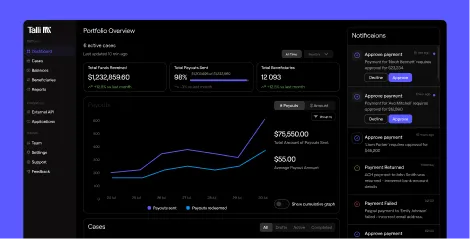
For administrators, the value is visibility. Claims teams can track payment completion, payment method selection, failed payment reasons, exception status, and fund balances through dashboards and reporting workflows. API and webhook support help synchronize payment status with CRM and case management systems.
Talli also works with regulated financial and payment partners, including Patriot Bank, N.A., Member FDIC, Lithic, PayPal, Mastercard, and InComm, to support compliant payout rails.
Key Features
- Digital disbursement workflows for class action, mass tort, bankruptcy, and shareholder distributions
- Multi-method payouts, including ACH, prepaid Mastercard, PayPal, Venmo, gift cards, and paper check fallback
- Built-in KYC verification, OFAC screening, W-9 collection, fraud mitigation, and audit logging
- Dedicated settlement account structures that support fund segregation and QSF workflows
- Real-time dashboard visibility into completion rates, exceptions, payment methods, and fund balances
- Webhook and API support for CRM synchronization and claims system integration
- Court-ready reporting and audit trails designed for legal distribution review
Best For
Talli is best for claims administrators, settlement administrators, bankruptcy trustees, class action law firms, and shareholder services teams that need to distribute funds to large claimant populations while maintaining visibility, compliance control, and court-ready reporting.
It is especially well suited for teams moving away from paper checks, teams managing distributions with variable award amounts, and teams that need digital payout options for both banked and unbanked recipients.
Pricing
Talli pricing is custom and depends on distribution scope, payment methods, recipient volume, support needs, and integration complexity. Claims teams should contact Talli directly to review architecture and pricing.
Common Mistakes in API Evaluations
Testing only successful payments. Successful payment tests are not enough. Claims teams should test returned ACH payments, expired digital wallet links, failed card activations, duplicate records, missing tax documentation, and OFAC review scenarios.
Treating compliance as an external checklist. Compliance should be reflected in the platform’s workflow and audit logs. If administrators must manually track every verification step outside the disbursement system, the integration creates avoidable risk.
Ignoring partial failure behavior. Large claimant files will contain bad records. The API must identify record-level failures and support clean resubmission.
Accepting vague uptime promises. Uptime and support expectations should appear in the contract. Review SLA terms, remedies, and incident response procedures.
Underestimating data mapping. Claimant records, award calculations, settlement categories, payment preferences, and tax documentation do not always map cleanly into a vendor schema. Build time for validation and reconciliation.
Skipping versioning review. API deprecation policies matter because integrations often remain in place for years. Ask for version history and notice periods before building.
Talli Conclusion
A class action disbursement platform API is a compliance, reporting, and claimant experience decision, not just a payment infrastructure choice. The right platform should help claims teams initiate payments, enforce required review steps, track every claimant-level status change, support tax documentation, and produce court-ready reporting without manual reconstruction.
Generic payment APIs can move funds, but they usually do not provide settlement-specific fund structures, claimant redemption flows, legal audit trails, or compliance workflows built around class action administration.
Talli is designed for the operational requirements of legal distributions. For claims teams that need digital payout options, compliance workflows, real-time tracking, and audit-ready reporting in one platform, request a demo to review the API, sandbox environment, and integration architecture.
Frequently Asked Questions
What is a class action disbursement platform API?
A class action disbursement platform API is a programmatic interface that connects claims administration software to settlement payout infrastructure. It can initiate payments, track statuses, trigger verification workflows, manage exceptions, and export reporting data.
How does a disbursement API support OFAC compliance?
The API should screen recipients against OFAC sanctions lists before funds are released, hold potential matches for review, and log the review event in the audit trail. This helps administrators avoid prohibited transactions with blocked persons.
How is a disbursement platform different from a payment processor?
A disbursement platform is built around settlement workflows, including claimant portals, fund segregation, tax documentation, compliance review, audit trails, and court-ready reporting. A payment processor primarily moves money and may not support the full legal distribution lifecycle.
What security standards should claims teams evaluate?
Claims teams should review SOC 2 Type II reporting, PCI DSS responsibilities where card data is involved, TLS encryption, encryption at rest, access controls, API credential scoping, and data residency practices.
How long does API integration usually take?
Integration timelines vary by claims system complexity, data mapping, payment methods, and support requirements. Simple batch integrations may move faster, while direct integrations with custom workflows require more testing.
What should audit logs include?
Audit logs should include claimant payment records, timestamps, payment method, completion status, failed payment reasons, remediation activity, verification outcomes, tax documentation status, fund balance movement, and unclaimed fund totals.