.svg)


.svg)
Collecting required taxpayer information before releasing a reportable claim payment can prevent 24% backup withholding when the payee has not furnished a required TIN and eliminates penalty exposure reaching $60-$680 per form for missing or incorrect taxpayer information. Settlement administrators, claims managers, and digital disbursement platforms should collect required tax documentation before releasing payments that are subject to information reporting or backup withholding, because collecting missing taxpayer information after funds clear can be significantly more difficult. Modern compliance automation can achieve approximately 90% W-9 completion rates through smart reminders, compared to approximately 40% with manual processes, transforming a compliance headache into a streamlined workflow.
Key Takeaways
- For payments subject to information reporting and backup withholding, obtaining the required TIN before payment helps avoid complications
- If a required TIN has not been furnished, certain reportable payments may become subject to 24% backup withholding, with the payer liable for this amount if they fail to withhold
- IRS penalties range from $60 if corrected within 30 days to $680 per form for intentional disregard
- For 2026, the reporting threshold for certain Form 1099-NEC and Form 1099-MISC payments increases from $600 to $2,000. Separate thresholds still apply to other categories, including the $600 threshold for gross proceeds paid to attorneys
- TIN validation through IRS Match e-Service prevents estimated 5-10% error rates from name/TIN mismatches that trigger costly B-Notices
- Settlement administrators face unique challenges since once the money is gone, collecting proper forms becomes significantly more difficult
Understanding the W-9 Form: What It Is and Why It's Crucial for Claim Payments
The W-9 form serves as the IRS-sanctioned method to collect taxpayer identification numbers (TINs) with certification under penalty of perjury. For claim payments, this form becomes the foundation of your entire tax compliance framework.
What Information Does a W-9 Collect?
The official IRS Form W-9 captures essential taxpayer data:
- Legal name as shown on tax return
- Business name if different from legal name
- Federal tax classification (individual, corporation, partnership, LLC)
- Exemption codes for backup withholding and FATCA reporting
- Address for information return mailing
- Taxpayer Identification Number (SSN, ITIN, or EIN)
- Certification signature under penalty of perjury
The certification portion is critical: payees attest they've provided correct TINs, aren't subject to backup withholding, and are U.S. persons for tax purposes.
Consequences of Not Collecting a W-9
Failing to collect W-9s before payment creates cascading compliance failures:
- Backup withholding liability: You may owe IRS the 24% withholding amount plus interest and penalties if you fail to withhold when required
- Information return penalties: Filing 1099s with missing or incorrect TINs triggers $60-$680 per form penalties
- B-Notice remediation costs: IRS CP2100 notices arrive 6-12 months post-filing, requiring expensive claimant outreach
- Audit exposure: Missing documentation creates red flags during tax authority reviews
For mass tort distributions involving thousands of claimants, these penalties compound rapidly into substantial exposure.
Navigating W-9 Requirements for Businesses and Individuals
W-9 collection and reporting requirements vary by payee type and payment category. Business entity classification, exemptions, foreign status, and the nature of the payment determine whether taxpayer information and Form 1099 reporting are required.
Specific Scenarios for Business W-9 Collection
Different business structures require attention to specific form fields:
- Sole proprietors: Must provide SSN or EIN; report payments on 1099-NEC/MISC
- Single-member LLCs: Treated as disregarded entities; use owner's SSN or LLC's EIN
- Corporations: Generally exempt from 1099 reporting except for attorneys and medical payments
- Partnerships: Require EIN; subject to standard reporting thresholds
The form itself doesn't change between individuals and businesses, it's one universal document. However, the tax classification box determines your downstream reporting obligations.
Anticipating Changes in W-9 Regulations
The One Big Beautiful Bill Act introduces significant threshold changes affecting 2026 payments:
- Current (2025): $600 threshold for non-employee compensation triggers 1099 reporting
- 2026 forward: $2,000 threshold for certain non-employee compensation, indexed for inflation thereafter
Note that gross proceeds paid to attorneys remain reportable at $600 or more. Many small-payment claim distributions that previously required 1099 reporting may no longer trigger filing requirements under the new thresholds. However, best practice remains: collect W-9s from all U.S. person payees regardless of anticipated payment amount, since mid-year changes to settlement allocations can push individual payments above thresholds unexpectedly.
When is a W-9 Absolutely Required Before Releasing Funds?
For reportable claim payments, collecting the required TIN before payment helps avoid backup withholding, reporting errors, and later remediation. The IRS requires payers to obtain taxpayer information when needed for information reporting and backup withholding.
Identifying Reportable Payments Subject to W-9 Collection
Reportable payments triggering W-9 requirements include:
- Settlement proceeds paid to attorneys (always reportable regardless of corporate status)
- Interest payments exceeding $10 annually
- Gross proceeds paid to attorneys exceeding $600
- Non-employee compensation for services exceeding $600 (through 2025)
- Punitive damages and taxable portions of personal injury settlements
- Taxable damages and other settlement amounts subject to Form 1099 reporting (noting that amounts representing wages may instead require Form W-2 reporting and payroll tax withholding)
Physical injury compensation directly to claimants may be tax-exempt, but documentation must still support this treatment. When in doubt, collect the W-9.
Avoiding Backup Withholding Penalties
IRC Section 3406 mandates 24% backup withholding when:
- Payee fails to furnish TIN for a reportable payment
- IRS notifies payer that TIN is incorrect (B-Notice)
- Payee fails to certify they're not subject to backup withholding
- IRS notifies payer to begin withholding
This isn't optional. If a payment is subject to backup withholding and the payee has not furnished the required TIN, the payer generally must withhold 24% and remit it to the IRS or may become liable for the amount that should have been withheld. This means you may owe IRS $24,000 on a $100,000 settlement payment if proper documentation wasn't collected.
Streamlining W-9 Collection: Downloadable and Fillable Forms
Efficient W-9 collection balances compliance requirements with claimant experience. The method you choose directly impacts completion rates and administrative burden.
Accessing the Most Current W-9 Form
The IRS maintains the official Form W-9 (PDF) on its website. Key considerations when using forms:
- Version currency: Verify you're using the most recent revision (current version dated March 2024)
- Fillable capability: IRS provides both standard and fillable PDF versions
- Retention requirements: Store completed forms for at least four years after the tax year of the related return
Use the current IRS Form W-9 or a compliant substitute Form W-9 that contains the required taxpayer information and certifications.
Best Practices for Digital W-9 Collection
Digital collection methods can dramatically improve completion rates:
- Mobile-responsive web forms with progress bars reduce abandonment rates
- Electronic signature integration captures compliant certifications
- Pre-population of known claimant data reduces friction
- Multi-channel delivery via email plus SMS ensures form requests reach claimants
- Automated reminders at regular intervals drive completion
Automated W-9 collection with smart reminders can achieve approximately 90% completion rates compared to approximately 40% with manual processes, more than doubling your compliance success.
The Link Between W-9s and 1099 Forms: What Claim Payers Need to Know
W-9 collection directly enables accurate 1099 reporting. The information captured on Form W-9 populates the recipient boxes on year-end information returns, making collection timing and accuracy critical.
Understanding Different 1099 Forms (MISC vs. NEC)
Settlement payments require understanding which form applies:
- 1099-NEC: Non-employee compensation (services rendered exceeding applicable thresholds)
- 1099-MISC: Gross proceeds to attorneys, punitive damages, other reportable payments
- Other information returns: The appropriate form depends on the nature of the settlement payment
Attorney payments are particularly complex. Payments to attorneys must be reported on 1099-MISC in Box 10 (gross proceeds) regardless of whether the attorney is incorporated, while payments for legal services go on 1099-NEC.
Key Dates for 1099 Filing
Meeting filing deadlines prevents additional penalties:
- January 31: Deadline to furnish recipient copies of 1099-NEC and 1099-MISC (when Box 8 or 10 amounts reported)
- February 28: Paper filing deadline for 1099-MISC (all other boxes)
- March 31: Electronic filing deadline for 1099-MISC
Late filing triggers escalating penalties: $60 if corrected within 30 days, $130 if corrected by August 1, $340 if corrected after August 1, and $680 per form for intentional disregard with no maximum cap.
Compliance and Fraud Prevention: The Role of W-9 in Secure Claim Payments
W-9 collection serves dual purposes: tax compliance and fraud prevention. Proper verification workflows create multiple checkpoints that protect settlement funds.
W-9 as a Fraud Deterrent
Requiring W-9 completion before payment release creates natural friction that deters fraudulent claims:
- Identity verification: TIN/name combinations can be validated against IRS records
- Address confirmation: Physical addresses create accountability trails
- Certification requirements: Penalty of perjury language discourages false submissions
- Documentation chain: Complete records support investigation of suspicious activity
The W-9 itself won't catch sophisticated fraud, but it's a foundational layer in comprehensive fraud detection systems.
Integrating W-9 Collection with Broader Compliance Efforts
W-9 collection should connect with your complete compliance infrastructure:
- KYC verification: Cross-reference W-9 data against identity verification databases
- OFAC screening: Run payee names against Treasury Department sanctions lists
- TIN matching: Validate name/TIN combinations before payment release
- Audit logging: Timestamp every form submission, validation, and payment decision
Modern compliance platforms integrate these checks automatically, eliminating manual review for routine cases while flagging exceptions for human attention.
Best Practices for Requesting and Managing W-9 Forms for Claim Payouts
Effective W-9 collection requires systematic processes that balance compliance urgency with claimant experience.
Effective Communication for W-9 Requests
Your W-9 request communication directly impacts completion rates:
- Clear subject lines: "Action Required: Tax Form Needed for Your Settlement Payment"
- Concise explanations: Explain why the form is required and what happens without it
- Explicit consequences: "Payment cannot be released until this form is received"
- Simple instructions: Step-by-step guidance with screenshots or video tutorials
- Support access: Phone numbers or email for questions
Avoid legal jargon. Most claimants have never completed a W-9 and need plain-language guidance.
Maintaining Secure W-9 Records
W-9 forms contain sensitive PII requiring proper security:
- Encryption: Store forms with strong encryption at rest
- Access controls: Limit visibility to compliance personnel who need the data
- Retention policies: Maintain forms for at least four years after related 1099 filing
- Audit trails: Log every access to W-9 data
- Disposal procedures: Secure destruction after retention period expires
For settlement administrators managing high volumes, automated platforms with SOC 2 certification handle these requirements systematically.
Common Mistakes and How to Avoid Them in W-9 Collection for Settlements
Settlement-specific W-9 collection carries unique pitfalls that differ from standard vendor management.
Verifying W-9 Information Accuracy
TIN mismatches occur in an estimated 5-10% of submissions without validation:
- Name variations: Married name vs. legal name, business name vs. owner name
- Data entry errors: Transposed digits, illegible handwriting on paper forms
- Recent changes: New EIN issued, name legally changed
Use IRS TIN Matching e-Service for real-time validation before accepting submissions. This service prevents B-Notices that arrive months later requiring expensive remediation.
Establishing a Clear W-9 Collection Timeline
The biggest mistake in settlement disbursements: waiting too long to collect. Once the money is gone, collecting proper forms becomes significantly more difficult.
Optimal timing for W-9 collection:
- Lien identification stage: Request W-9 when third parties (medical providers, co-counsel, experts) are identified
- Claim approval: Gate eligibility determination on W-9 submission
- Settlement statement draft: Every non-client payee line must have W-9 on file
- Before funds clear: No new payees added to settlement statement without documentation
- Payment release: System blocks disbursement until W-9 status equals "validated"
Never plan to collect W-9s at year-end before filing 1099s. By December, claimants have moved, changed contact information, or simply ignored requests not tied to pending payments.
How Talli Supports Compliant Claim Payments
While tax-document requirements depend on the payment type, Talli provides regulated payment infrastructure for carriers, TPAs, claims administrators, and other high-volume disbursement teams.
Talli's Compliance Automation Suite addresses the unique challenges of settlement W-9 collection:
- Automated W-9 Collection: Digital forms with electronic signature integration achieving high completion rates through smart reminders
- Compliance Controls: Centralized workflows help claims teams manage required payment and compliance information before funds are released
- Configurable Payment Controls: Claims teams can use structured approval workflows to ensure required information and authorizations are completed before payment release
- Audit-Ready Records: Payment status, approvals, and reconciliation remain documented throughout the payment lifecycle
- 1099 Generation: Automated 1099-MISC/1099-NEC generation with IRS e-filing integration
Unlike generic payment processors, Talli is built for legal settlements with complete QSF compliance embedded. The platform handles class actions, mass torts, bankruptcy distributions, and shareholder services with the same compliance infrastructure.
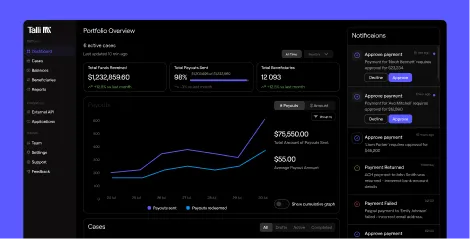
For settlement administrators managing distributions to thousands of claimants, Talli's Real-Time Dashboard provides live visibility into W-9 completion rates, payment status, and compliance exceptions, all with court-ready audit trails. The platform processes settlements from 1,000 to 100,000+ recipients backed by SOC 2 Type II certification and banking services through Patriot Bank, N.A., Member FDIC.
Frequently Asked Questions
What is the primary purpose of collecting a W-9 form for a claim payment?
The primary purpose is enabling accurate 1099 reporting while avoiding backup withholding on reportable payments. The W-9 collects the payee's taxpayer identification number (TIN) with certification under penalty of perjury, which then populates year-end information returns. If a payment is subject to backup withholding and the payee has not furnished the required TIN, the payer generally must withhold 24% and remit it to the IRS or may become liable for the amount that should have been withheld.
Are there different W-9 forms for businesses versus individuals?
No, the IRS Form W-9 is a universal document used for both individuals and business entities. However, the tax classification box (Line 3) captures whether the payee is an individual, C corporation, S corporation, partnership, trust, LLC, or other entity type. This classification determines your downstream 1099 reporting obligations, with corporations generally exempt from 1099 reporting except for attorneys and medical payments.
What happens if a recipient refuses to provide a W-9 form for a reportable payment?
If a payee refuses to provide required taxpayer information and the payment is subject to backup withholding, you generally must apply the 24% backup withholding rate and remit the withheld amount to the IRS. You still report the payment on Form 1099 using available information, which may trigger penalties for missing TIN. For settlement disbursements, this creates practical challenges with claimant expectations, making pre-payment W-9 collection far preferable.
How does a W-9 form relate to the 1099 forms received at year-end?
The W-9 provides the data that populates 1099 recipient information. The TIN, legal name, and address from the W-9 appear on 1099-NEC (non-employee compensation), 1099-MISC (gross proceeds, punitive damages), or other applicable information returns. When W-9 information is incorrect or missing, your 1099s contain errors that trigger IRS penalties ranging from $60 to $680 per form depending on when corrections are made.
Can W-9 forms be collected electronically, and is this method secure?
Yes, W-9 forms can be collected electronically following IRS guidelines for electronic submissions. Digital W-9 collection with proper security controls (TLS encryption in transit, strong encryption at rest, SOC 2 compliance) offers enhanced security compared to paper forms that can be lost, stolen, or improperly stored. Electronic collection also enables real-time TIN validation, automated compliance checks, and complete audit trails, capabilities impossible with paper processes.