.svg)


.svg)
Insurance carriers continue relying on paper checks for roughly 55% of insurance-industry payments, compared to about 22% across other industries, despite mounting evidence that this approach drains operational budgets, frustrates policyholders, and exposes organizations to fraud. With digital disbursement platforms now offering same-day payment capabilities at substantially lower costs, the gap between check-based legacy systems and modern payment infrastructure represents one of the most significant inefficiency opportunities in insurance operations today.
Key Takeaways
- Paper checks can cost $7.78 to $20+ per transaction when accounting for processing and administrative costs, compared with substantially lower costs for many digital payment methods, creating a cost differential that can reach several times to dozens of times per transaction
- Historical industry data shows checks accounting for roughly 55% of insurance-industry payments, compared with about 22% across other industries, illustrating insurance's slower shift away from paper payments
- 63% of organizations experienced check fraud in 2024, making checks the payment method most vulnerable to fraud attacks
- Check settlement takes 10 to 14 days versus same-day digital options, creating customer satisfaction crises at the moment policyholders need funds most urgently
- 58% of dissatisfied claimants cite delayed payments as a key frustration, and 48% would pay more for faster claim disbursements
- State regulations impose strict timelines: Florida residential property insurers generally must acknowledge claim communications within 7 calendar days and pay or deny claims within 60 days, making check processing increasingly incompatible with compliance requirements
- Digital payment platforms eliminate physical check fraud vectors such as interception, alteration, and check washing while providing encryption, tokenization, and real-time audit trails
Understanding the Traditional Costs of Insurance Claims Processing by Check
The true cost of paying insurance claims by check extends far beyond the obvious expenses of printing and postage. When carriers calculate the full financial burden, the numbers reveal a substantial drain on operational efficiency that compounds with every claim processed.
The Hidden Fees: Beyond Printing and Postage
The median per-transaction cost of a commercial check ranges from $2.01 to $4.00 for basic issuance alone. However, comprehensive cost analyses reveal total expenses of $7.78 to over $20 when including all associated costs:
- Printing and materials: Check stock, envelopes, security features
- Mailing and postage: First-class mail costs continue rising annually
- Reconciliation labor: Staff time to match payments to claims
- Stop payment fees: $15 to $35 per request when checks are lost or stolen
- Reissuance processing: Duplicate effort for returned or expired checks
- Stale-dated check handling: Administrative burden for checks not cashed within 90 to 180 days
- Customer service overhead: Responding to "where's my check?" inquiries
By comparison, digital payment methods can cost substantially less per transaction, with actual savings varying by payment rail, transaction volume, vendor pricing, and the administrative costs included in the comparison.
The Escalating Problem of Unclaimed Funds and Escheatment
Unclaimed settlement checks create cascading compliance burdens that few carriers fully account for in their cost calculations. When policyholders fail to cash checks, whether due to incorrect addresses, lost mail, or simple oversight, insurers face:
- Due diligence requirements: Mandatory outreach attempts before escheatment
- State reporting obligations: Compliance with varying escheatment laws across 50 jurisdictions
- Interest and penalties: Late reporting can trigger regulatory fines
- Audit exposure: Unclaimed property audits can review 10+ years of records
The administrative burden of tracking stale-dated checks and managing escheatment compliance often exceeds the original payment processing cost multiple times over.
The Operational Bottlenecks: Why Checks Slow Down Claims Payouts
Beyond direct costs, paper check processes create operational drag that impacts every stage of claims administration. The inefficiencies compound across thousands of claims, diverting staff from higher-value activities and extending cycle times unnecessarily.
From Weeks to Days: The Need for Speed in Claims Disbursement
Paper check claim payments take 10 to 14 days to clear, with the average property claim cycle from filing to completed repairs reaching 32.4 days in 2025, while the average time from first notice of loss to final payment exceeded 44 days. This timeline breakdown reveals where time disappears:
- Check generation: 1 to 2 days for batch processing and printing
- Mail delivery: 3 to 5 days for USPS first-class mail
- Recipient deposit: Variable delay while policyholder visits bank
- Bank clearing: 2 to 5 business days for funds availability
- Exception handling: Additional weeks for returned or reissued checks
Digital alternatives compress this entire timeline dramatically. Same-day ACH payments, instant push-to-card transactions, and real-time payment rails can deliver funds within hours rather than weeks.
Minimizing Errors and Exceptions with Modern Claims Management
Manual check processes introduce error points at every stage that require expensive human intervention to resolve:
- Data entry mistakes: Incorrect payee names, wrong addresses, transposed amounts
- Lost or stolen checks: Requiring stop payments and reissuance
- Address changes: Checks returned when policyholders relocate during claim processing
- Endorsement issues: Multi-party checks requiring mortgage lender signatures
- Reconciliation delays: Matching cleared checks to claims records weeks after issuance
Automated reconciliation through digital platforms eliminates these friction points by maintaining real-time visibility into payment status and enabling instant exception handling.
Beyond Processing: The Compliance and Fraud Risks of Paper Payments
The security vulnerabilities inherent in paper check payments have reached critical levels, with fraud attacks accelerating even as digital alternatives offer dramatically improved protection. For insurers managing fiduciary obligations, check-based systems now represent unacceptable risk exposure.
The Rising Tide of Fraud and the Need for Advanced Detection
The 2025 AFP Payments Fraud and Control Survey found that 63% of organizations experienced attempted or actual check fraud in 2024, making checks the payment method most subject to fraud. Check fraud includes multiple attack vectors:
- Forgery: Unauthorized signatures on stolen or counterfeit checks
- Alteration: Changing payee names or amounts after issuance
- Interception: Theft from mailboxes or during postal processing
- Counterfeit checks: Sophisticated reproduction of legitimate check stock
- Check washing: Chemical removal of ink to alter check details
Many businesses are being misled into thinking checks are safer than digital alternatives when data shows the opposite. Digital payments provide encryption, tokenization, multi-factor authentication, and real-time monitoring that fundamentally eliminate physical check fraud vectors.
Payment fraud prevention through digital platforms achieves fraud detection rates significantly higher than manual review processes while identifying suspicious activity faster than human analysts can respond.
Regulatory Complexities Requiring Digital Solutions
State lawmakers are implementing strict claim payment deadlines with significant penalties for non-compliance. Under Florida's current property claim rules:
- Insurers generally must acknowledge claim communications within 7 calendar days
- A necessary investigation generally must begin within 7 days after receipt of proof of loss
- Initial, reopened, or supplemental property claims generally must be paid or denied within 60 days
- Certain late payments may accrue statutory interest
California mandates 40-day decision deadlines with strong consumer protection enforcement. These regulatory requirements make paper check processing timelines increasingly incompatible with compliance obligations: a 10 to 14 day check clearing window consumes nearly the entire regulatory timeline before funds even reach the policyholder.
Digital payment platforms enable regulatory compliance by design, helping insurers meet mandated timelines while maintaining complete audit trails for regulatory examinations.
Embracing Digital: The Future of Insurance Claim Payouts with Electronic Payments
The gap between consumer payment expectations and insurance industry delivery has created a significant friction point. While 92% of U.S. consumers now use digital payment methods in their daily lives, insurance carriers continue defaulting to paper checks that feel increasingly outdated to policyholders.
The Shift to Digital: Benefits for Insurers and Claimants
Digital-first distribution infrastructure transforms claims payments from a back-office administrative function into a competitive differentiator. The benefits cascade across multiple stakeholders:
For Insurance Carriers:
- Substantial cost reduction compared to paper checks
- Compressed distribution timelines from weeks to hours
- Reduced exposure to physical check theft, alteration, and interception
- Automated compliance documentation and reporting
- Reduced customer service burden from payment inquiries
For Policyholders:
- Immediate access to funds when needed most
- Payment method choice matching personal preferences
- Real-time visibility into payment status
- No trips to the bank to deposit checks
- Reduced risk of lost or stolen payments
Maximizing Redemption: Why Digital Leads the Way
Recent consumer research found that 58% of respondents preferred direct deposit for insurance claim payments, making it the most popular option in that survey. Giving policyholders access to preferred digital payment methods can help carriers better align the claims experience with consumer expectations.
Digital payment methods consistently achieve higher redemption rates than paper checks:
- ACH direct deposit: Automatic deposit with no recipient action required
- Push-to-card: Instant delivery to existing debit cards
- Digital wallets: Immediate access via PayPal, Venmo, or similar platforms
- Prepaid cards: No bank account required, instant virtual card delivery
The hidden cost of uncashed checks extends beyond escheatment compliance: every unredeemed payment represents a policyholder who didn't receive the benefit they were entitled to, potentially damaging retention and referral rates.
Unlocking Efficiency: How Electronic Payment Methods Streamline Disbursements
Modern digital disbursement platforms transform claims payment operations from manual, error-prone processes into automated workflows that scale efficiently across high volumes.
Real-Time Visibility: Monitoring Payments from Start to Finish
Legacy check-based systems operate largely blind between issuance and reconciliation: carriers don't know if payments were delivered, deposited, or lost until weeks later when cleared checks return or customer service calls begin. Digital platforms provide:
- Live status tracking: Real-time visibility into every payment's progress
- Proactive exception alerts: Instant notification of failed or returned payments
- Completion rate dashboards: Aggregate metrics across all disbursements
- Audit-ready reporting: Automated documentation for regulatory compliance
Real-time payment tracking eliminates the information gap that creates customer service burden and delays exception handling.
From Manual to Automated: The Power of End-to-End Processing
Automated disbursement engines process claim payments end-to-end from approval through final reconciliation:
- Batch upload integration: Direct connection to claims management systems
- Automated validation: Cross-reference against approved payment amounts
- Multi-party approval workflows: Coordinated authorization across carriers, TPAs, and vendors
- Payment method routing: Automatic selection based on claimant preferences
- Automated reconciliation workflows: Real-time payment visibility and matching
Claims administrators using automated platforms report significant reductions in processing time and manual intervention requirements, freeing staff for higher-value claim resolution activities.
Cost Savings and Compliance: The Financial Advantages of Digital Over Paper
The financial case for digital payment adoption becomes compelling when comparing true total costs across payment methods. The per-transaction differential alone justifies implementation, but compliance advantages compound the ROI.
Significant Cost Reductions: Digital's Economic Edge
Digital payment methods can cost substantially less than paper checks. For a carrier processing 50,000 claims annually, the illustrative cost comparison shows significant potential savings:
At an illustrative average of $12.50 per paper check transaction versus $1.50 for digital payments, annual processing costs would be approximately $625,000 for checks versus $75,000 for digital methods, representing an illustrative difference of $550,000. Actual savings depend on payment method, vendor pricing, reissuance rates, customer-service workload, reconciliation costs, and whether those expenses are already included in the per-transaction estimate.
Additional savings come from:
- Reduced reissuance costs: Lower rates of lost or uncashed payments
- Decreased customer service burden: Fewer "where's my payment?" inquiries
- Lower reconciliation labor: Automated matching versus manual processes
- Minimized escheatment exposure: Higher redemption rates reduce unclaimed property obligations
Implementation typically achieves ROI within several months through reduced processing time and error rates, with savings scaling directly with claims volume.
Maintaining Fiduciary Compliance in a Digital Age
Digital platforms embed compliance capabilities that paper-based processes require expensive manual intervention to achieve:
- KYC verification: Automated identity validation against authoritative databases
- OFAC screening: Real-time sanctions list checking with documented timestamps
- 1099 reporting capabilities: Streamlined tax documentation
- Fund segregation: Dedicated account structures maintaining regulatory compliance
- Audit trails: Immutable records of every payment action
SOC 2 Type II and PCI DSS compliant platforms provide institutional-grade security that paper check processes cannot match.
Solving for the Unbanked: Expanding Access with Modern Payment Rails
Paper checks assume all recipients have bank accounts and can easily deposit payments, an assumption that excludes millions of Americans and creates barriers to successful claim resolution.
Bridging the Gap: Financial Inclusion Through Digital Payments
Approximately 5.6 million U.S. households were unbanked in 2023, according to the FDIC, lacking access to traditional banking services. For these policyholders, receiving a paper check creates immediate friction:
- Check cashing fees consuming 1 to 3% of payment value
- Limited access to check cashing locations
- Identification requirements that may be difficult to meet
- Delayed access to funds while navigating alternatives
Digital payment options serve unbanked populations more effectively:
- Prepaid cards: Virtual cards delivered via SMS/email in 30 seconds, physical cards within 5 to 7 days, no bank account required
- Digital wallets: PayPal and Venmo accounts accessible without traditional banking
- Gift cards: Retail options for smaller claim amounts with highest redemption rates
- Payroll cards: Reloadable cards familiar to gig economy workers
Tailoring Payment Options for Diverse Claimant Needs
Modern insurance payment platforms can offer multiple payment options to meet policyholders where they are:
- ACH: Direct electronic payment to eligible bank accounts
- Virtual debit cards: Digital card-based payment option
- Digital wallets: PayPal and Venmo options
- Paper checks: Maintained as a fallback for policyholders who prefer traditional payments
Letting claimants choose their preferred payment method dramatically increases redemption rates while improving satisfaction scores.
Real-World Impact: Lessons From Digital Disbursements
The theoretical benefits of digital payments translate into measurable results when implemented effectively. Leading claims administrators have documented significant improvements across key performance indicators.
Lessons From High-Volume Digital Distributions
AB Data, one of the leading U.S. claims administrators managing settlements worth hundreds of millions of dollars involving hundreds of thousands of claimants, achieved remarkable results after implementing digital disbursement:
- 30% increase in claimant redemption rates across check-issued populations
- 60% reduction in unresolved exceptions and manual reissuance overhead within 12 months
- 100% fiduciary compliance record maintained across all distribution cycles
- Faster time to funds for claimants while lowering distribution costs
"We don't think of digital disbursement as a feature: we think of it as infrastructure," noted Thomas R Glenn, President & CEO of AB Data. "Talli gave us the regulated payout rails we needed to move faster, reduce unclaimed funds, and give courts full confidence in how settlement money is being distributed."
Measurable Outcomes: The ROI of Digital for Claims Management
Across insurance and claims administration use cases, digital payment platforms consistently deliver:
- Weeks eliminated from payment cycles through same-day disbursement
- Lower payment leakage through reduced reissues, stale checks, and exceptions
- Better customer experience via payment choice and real-time status visibility
- Lower operating costs through automated payment and reconciliation workflows
J.D. Power found that homeowners claims using a fully digital claims process, including digital first notice of loss and digital damage estimation, reached payment up to 5.5 days faster than claims that did not use the same digital workflow, directly addressing the number one driver of claimant dissatisfaction.
Making the Transition: Implementation Considerations
For carriers ready to modernize claims payments, successful implementation requires strategic planning across technology, process, and change management dimensions.
Technology Infrastructure Requirements
Modern digital disbursement demands:
- API integration: Connection to existing claims management systems
- Multi-rail support: ACH, virtual debit cards, PayPal, Venmo, and paper checks
- Automated reconciliation: Real-time payment visibility and reconciliation workflows
- Compliance controls: SOC 2, OFAC controls, BSA/AML controls, and bank-grade payment infrastructure
- Scalability: Support for daily claims volumes and catastrophe surge events
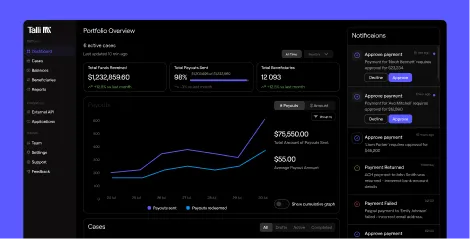
Talli's platform provides configurable claims payment workflows through no-code dashboards and low-code API integration, supporting rapid implementation without extensive IT projects.
Building the Case for Stakeholders
CFOs, claims operations leaders, and technology executives each evaluate digital payment adoption through different lenses:
Financial Decision-Makers Focus On:
- Per-transaction cost reduction and total cost of ownership
- ROI timeline and implementation investment requirements
- Fraud loss reduction and liability exposure mitigation
Operations Leaders Prioritize:
- Processing efficiency and staff productivity gains
- Exception handling and customer service burden reduction
- Regulatory compliance and audit trail capabilities
Technology Teams Evaluate:
- Integration complexity with existing claims systems
- Security architecture and compliance certifications
- Scalability and reliability for high-volume processing
Addressing all stakeholder concerns with quantified benefits accelerates approval and ensures sustained executive support through implementation.
Why Talli for Insurance Claims Payments
Talli gives insurance carriers and claims administrators the infrastructure to modernize insurance claims payments while maintaining regulatory compliance.
The platform supports high-volume disbursements with:
- Multi-party approval workflows
- Automated reconciliation and real-time payment tracking
- ACH, virtual debit cards, PayPal, Venmo, and paper checks
- SOC 2 security, OFAC controls, and BSA/AML controls
- No-code dashboards and low-code API integration with existing claims systems
Talli's configurable workflows can handle routine claims and catastrophe-driven surges while giving policyholders greater payment choice and speed. Built-in compliance controls and complete audit trails also help reduce administrative burden.
The result is higher payment completion, lower administrative costs, reduced compliance workload, and a better customer experience when claimants need their funds.
Frequently Asked Questions
How Much More Expensive Are Paper Checks for Insurance Claims Compared to Digital Payments?
Paper checks can cost $7.78 to $20+ per transaction when including printing, mailing, reconciliation, stop payments, reissuances, and escheatment processing. Digital payment methods can cost substantially less, with actual savings varying by payment rail, transaction volume, vendor pricing, and the administrative costs included in the comparison. For a carrier processing 50,000 claims annually, the cost differential can represent hundreds of thousands of dollars in potential annual savings.
What Happens to Insurance Claim Checks That Go Uncashed?
Uncashed checks trigger escalating compliance obligations. Insurers must conduct due diligence outreach attempts, then report unclaimed funds to state unclaimed property programs per statutory timeframes, typically 3 to 5 years depending on state. The administrative burden of tracking stale-dated items, conducting required notifications, and filing escheatment reports often exceeds the original processing cost. Digital payments with higher redemption rates significantly reduce this compliance exposure.
How Quickly Can Insurance Claims Be Disbursed Using Digital Methods Compared to Paper Checks?
Paper check payments take 10 to 14 days to clear after accounting for printing, mailing, recipient deposit, and bank clearing. Digital alternatives compress this timeline dramatically: same-day ACH delivers funds within 24 hours, push-to-card transactions arrive instantly on existing debit cards, and digital wallet payments are accessible immediately. This speed differential matters most during catastrophe events when policyholders need funds urgently for emergency repairs and temporary housing.
Can Digital Payment Platforms Help Reduce Fraud in Insurance Claims?
Digital payments eliminate physical check fraud vectors such as interception, alteration, and check washing. Modern platforms add encryption, tokenization, multi-factor authentication, and real-time fraud monitoring that dramatically exceed paper check security capabilities. With 63% of organizations experiencing check fraud in 2024, the security case for digital adoption has become compelling from a risk management perspective.
How Do State Regulations Affect Insurance Claim Payment Timelines?
State insurance departments increasingly mandate specific timeframes for claim acknowledgment and resolution. Florida residential property insurers generally must acknowledge claim communications within 7 calendar days and pay or deny initial, reopened, or supplemental claims within 60 days, subject to statutory exceptions. California mandates 40-day decision deadlines. When check clearing alone consumes 10 to 14 days, paper-based processes leave little margin for compliance. Digital payment platforms enable carriers to meet regulatory timelines while maintaining complete audit documentation for examinations.