.svg)


.svg)
Digital dividend distribution helps corporate issuers increase shareholder redemption rates, reduce paper-check overhead, and automate the compliance work tied to shareholder payments. Instead of relying on mailed checks alone, issuers can offer ACH, prepaid cards, digital wallets, and paper fallback options while collecting tax forms, screening recipients, tracking payment status, and producing audit-ready records in one workflow.
Most corporate issuers measure dividend distribution by what gets issued, not by what gets collected. That creates a blind spot: uncashed checks, stale addresses, forgotten payments, and shareholders who received a notice but never completed the payment process. In paper-based programs, even a modest uncashed-check rate can create a large exception queue across quarterly or annual cycles.
Digital dividend distribution closes that gap by replacing paper-first workflows with electronic payout infrastructure. For corporate issuers, transfer agents, and shareholder services teams, the result is a more measurable program: faster payment delivery, fewer reissues, clearer compliance documentation, and better visibility into which shareholders have actually received funds.
This guide explains what digital dividend distribution is, why issuers are moving away from check-only programs, the compliance requirements that matter most, and how to evaluate purpose-built disbursement infrastructure for the next dividend cycle.
Key Takeaways
- Digital dividend distribution uses ACH, prepaid cards, digital wallets, and paper fallback options to make shareholder payments easier to claim.
- Electronic payments generally cost less than check programs, especially once printing, postage, tracking, reissuance, and exception handling are included.
- Corporate issuers need workflows for W-9 and W-8 collection, backup withholding, 1099-DIV reporting, OFAC screening, audit trails, and unclaimed property monitoring.
- SEC Rule 17Ad-17 creates specific notice requirements for unresponsive payees when dividend checks of $25 or more remain unnegotiated.
- Purpose-built platforms such as Talli help claims, settlement, bankruptcy, and shareholder services teams distribute funds with compliance controls built into the payout workflow.
What Is Digital Dividend Distribution?
Digital dividend distribution is the process of delivering shareholder dividend payments through electronic payout rails such as ACH transfers, prepaid cards, and digital wallets, rather than relying primarily on paper checks. A complete workflow also supports tax documentation, sanctions screening, payment tracking, and reporting.
The goal is not simply to replace a check with an ACH file. A strong digital dividend program gives each shareholder a clear path to select a payment method, verify required information, receive reminders, and confirm payment status. It also gives the issuer a complete record of what happened: when the shareholder was contacted, which payment rail was selected, whether compliance checks were completed, and whether the payment was delivered.
For issuers managing large shareholder populations, shareholder services infrastructure can reduce manual work and make each cycle easier to reconcile. Instead of waiting months to identify uncashed checks, teams can see completion status in real time.
Why Corporate Issuers Are Modernizing Dividend Distribution
Paper checks were once the default because they were familiar and broadly accepted. Today, that familiarity comes with measurable cost and compliance pressure.
- Uncashed checks create follow-up obligations. Under SEC Rule 17Ad-17, a payee becomes an unresponsive payee if a check is not negotiated before the earlier of the next regularly scheduled check or 180 days after the check is sent. Paying agents must send written notice no later than seven months after the not-yet-negotiated check is sent, unless the amount is under $25. That makes payment tracking and outreach a compliance function, not just an operational preference.
- Paper costs add up quickly. NACHA’s summary of the AFP Payments Cost Benchmarking Survey reports median paper check issuance costs of $2.01 to $4.00 before every internal exception cost is included, while ACH is generally far cheaper at scale. When printing, postage, returned mail, stop payments, reissuance, staff time, and unclaimed property reporting are added, the all-in cost of check programs can be much higher.
- Shareholder expectations have changed. Recipients already receive payroll, government benefits, brokerage transfers, and reimbursements digitally. A dividend program that requires paper handling adds friction for shareholders and extra work for treasury or investor relations teams.
Why Paper Checks Fail Dividend Programs
Paper checks fail because they require the recipient to notice, retain, endorse, deposit, and wait for the instrument to clear. Every step creates a point of failure.
The Uncashed Check Problem
An uncashed dividend check is not just an incomplete payment. It can trigger notice obligations, reissuance requests, stale-date handling, and state unclaimed property workflows. If the shareholder remains inactive, the issuer or paying agent may eventually need to report and remit the funds under state escheatment rules.
Digital distribution reduces this risk by turning payment delivery into an active workflow. Instead of mailing once and waiting, issuers can send email or SMS reminders, offer multiple payment options, monitor status, and intervene before payments become dormant.
Processing Costs and Delays
Paper checks also slow the payment experience. Mail delivery, deposit timing, and clearing delays can stretch the cycle. ACH usually settles in one to three business days, while digital wallets and virtual cards can provide faster access depending on program configuration.
Compliance Requirements for Dividend Payments
Digital distribution does not remove compliance obligations. It makes them easier to manage consistently.
W-9, W-8, and TIN Collection
Corporate issuers need accurate taxpayer information before making reportable payments. U.S. recipients generally provide Form W-9, while foreign recipients may require an applicable Form W-8. A digital portal can prompt shareholders to submit or update tax information before payment release, reducing last-minute exceptions.
Backup Withholding
The IRS backup withholding rate is 24% for reportable payments when backup withholding applies, such as when a payee fails to provide a correct taxpayer identification number. Automated workflows can flag missing or invalid TINs and calculate withholding before funds are released.
1099-DIV Reporting
Form 1099-DIV is used to report dividends and distributions to taxpayers and the IRS. In general, corporate issuers must report dividend payments when the recipient meets the applicable reporting threshold, commonly $10 or more in dividends or distributions for the year, subject to exceptions in the IRS instructions. Digital platforms help by maintaining payment-level records that can be exported for tax reporting.
OFAC Screening
Corporate issuers and their payment partners need controls to avoid releasing funds to sanctioned individuals or entities. OFAC maintains the SDN List and other sanctions lists through its Sanctions List. Screening at payment release helps reduce gaps caused by stale data.
State Escheatment
State unclaimed property laws vary, but dividend payments that remain uncollected past the applicable dormancy period may need to be reported and remitted. NAUPA has estimated that states hold about $70 billion in unclaimed property nationwide, showing why issuers need proactive monitoring rather than end-of-cycle cleanup.
How Digital Dividend Distribution Works
A modern dividend workflow follows the same corporate timeline but replaces manual steps with structured automation.
Step 1: Shareholder List Ingestion
After the board declares a dividend and the record date is established, the platform ingests shareholder data from the issuer or transfer agent. The system validates core fields, identifies incomplete records, and prepares the campaign for outreach.
Step 2: Compliance Onboarding
Before payment release, shareholders complete required tax and identity steps through a secure portal. The platform can collect W-9 or W-8 information, run OFAC screening, flag missing TINs, and create exception queues for records that need review.
Step 3: Payment Selection
Shareholders receive a notification directing them to choose a payment method. A flexible program may include ACH, prepaid card, digital wallet, and paper check fallback options. This gives banked, unbanked, mobile-first, and paper-preferring shareholders a practical path to claim funds.
Step 4: Payment Delivery
The platform routes each payment through the selected rail. ACH is typically best for high-volume, banked recipients. Prepaid cards can support unbanked shareholders. Digital wallets can reduce friction for mobile-first recipients. Paper checks remain available for shareholders who require or prefer them.
Step 5: Reporting and Audit Trail
Every action is logged: outreach, tax form completion, payment method selection, sanctions screening, payment release, delivery status, and exceptions. This gives treasury, legal, investor relations, and auditors a single source of truth for the distribution cycle.
Payment Rails for Shareholder Dividend Delivery
ACH is usually the core rail for large dividend programs because it is efficient and widely supported. Prepaid cards and wallets expand coverage to shareholders who do not want to provide bank details or who prefer alternative payout channels. Paper checks should remain available as a fallback, but check-only distribution creates unnecessary friction.
How Digital Distribution Increases Redemption Rates
Digital distribution improves redemption rates by reducing the number of steps between notification and payment completion.
- Multi-method payment options increase completion. Shareholders are more likely to complete the process when they can choose a familiar channel. Talli’s company materials describe digital-first programs reaching 95% to 98% redemption rates compared with 70% to 80% for traditional paper methods, with ACH, prepaid Mastercard, PayPal, Venmo, and gift-card options available through the platform.
- Automated reminders replace passive mailing. A check is often a one-time communication. Digital programs can send scheduled reminders by email or SMS, helping recipients who missed the first notice or need to complete tax information before release.
- Self-service portals reduce inbound work. A shareholder portal lets recipients confirm status, update payment details, and complete required forms without calling the issuer. For treasury and investor relations teams, that means fewer manual inquiries and a cleaner audit trail.
How to Evaluate Digital Dividend Distribution Platforms
Corporate issuers should evaluate platforms using five criteria.
- Compliance automation. The platform should support W-9 and W-8 collection, backup withholding flags, OFAC screening, 1099-DIV data exports, and audit logging.
- Payment rail breadth. A strong program should support ACH, prepaid cards, digital wallets, wires when needed, and paper fallback.
- Shareholder experience. The claim flow should be simple, mobile-accessible, and designed to reduce abandonment.
- Audit transparency. Teams should be able to export cycle-level reporting without reconstructing data from spreadsheets.
- Banking infrastructure. Issuers should understand where funds are held, how accounts are segregated, and whether the program supports fiduciary or QSF-style requirements when relevant.
For broader vendor selection, issuers can review disbursement vendors and comparison criteria before choosing a platform.
Talli for Corporate Dividend Distribution
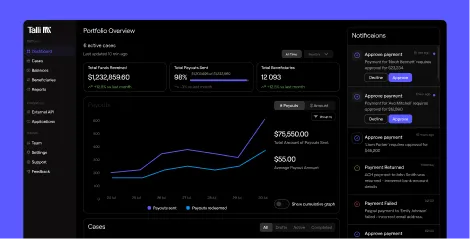
Talli is an AI-driven digital payments platform built for compliance-critical distributions, including legal settlements, class action payouts, bankruptcy matters, and shareholder services. The platform gives teams a single dashboard to upload recipient data, launch campaigns, track payments, and manage compliance documentation.
Talli supports ACH transfers, prepaid Mastercard, PayPal, Venmo, Amazon gift cards, and checks as a fallback. Its workflow includes KYC verification, OFAC screening, W-9 collection, fraud controls, automated reminders, and real-time audit logging. Banking services are provided through Patriot Bank, N.A., Member FDIC, with fund segregation designed for compliant distribution programs.
For corporate issuers, Talli is strongest where dividend distribution looks like a high-volume, compliance-sensitive claims workflow: many recipients, multiple payment preferences, tax documentation requirements, exception handling, and a need for board-ready reporting. Talli’s materials describe 500,000+ recipients processed and 95% to 98% redemption rates for digital-first payment programs.
Learn more through Talli’s digital payouts, audit trails, OFAC screening, and tax compliance resources.
Best Practices for Digital Dividend Distribution
Collect tax information before the payment window opens. W-9 and W-8 collection is easier when it is part of routine shareholder maintenance, not a last-minute blocker.
Offer at least three payment methods. ACH, prepaid card, and digital wallet coverage gives most shareholders a usable option while preserving checks as a fallback.
Automate reminder cadences. Email and SMS reminders on defined intervals help reduce abandoned claims without increasing staff workload.
Maintain clear fund segregation. Separate accounts and documented fund flows make audits, reconciliation, and fiduciary review easier.
Export reports after each cycle. Do not wait until year-end tax filing or an audit request to assemble documentation.
Test the portal before launch. A full test claim helps catch broken links, authentication issues, missing tax prompts, and confusing language before shareholders enter the workflow.
Common Mistakes to Avoid
- Waiting until payment date to collect tax forms. This creates avoidable backup withholding, delayed payments, and manual exception work.
- Keeping checks as the default. Paper fallback is useful. Paper-first distribution creates more reissues, returned mail, tracking work, and unclaimed property exposure.
- Using general payment tools. Dividend programs need tax, compliance, audit, and shareholder-service workflows that generic payment platforms may not support natively.
- Ignoring dormancy timelines. Escheatment obligations vary by state. Issuers need proactive tracking long before funds become reportable as unclaimed property.
- Treating payment release as the finish line. The real measure is completed payment, documented compliance, and a clean reconciliation record.
Talli Conclusion
Digital dividend distribution is now a practical way for corporate issuers to reduce paper dependency, improve shareholder completion, and simplify compliance-heavy workflows. The strongest programs combine multi-rail payment delivery with tax documentation, OFAC screening, reminder automation, fund tracking, and exportable audit records.
Talli is a strong fit for issuers and shareholder services teams that need a compliant, digital-first distribution process rather than a basic payment processor. Its platform is built around high-volume disbursement, real-time tracking, fund segregation, KYC and OFAC controls, W-9 collection, and flexible payment options. For teams still managing dividend checks manually, that combination can turn a slow and exception-heavy process into a measurable distribution workflow.
Conclusion and Next Steps
Digital dividend distribution is not just a payment upgrade. It is a better operating model for shareholder payments: fewer uncashed checks, faster delivery, clearer compliance records, and lower manual overhead.
For corporate issuers preparing the next dividend cycle, the priority should be a platform that combines payment choice with compliance automation. That means ACH, prepaid card, digital wallet, and paper fallback options, plus W-9 and W-8 collection, OFAC screening, backup withholding controls, 1099-DIV reporting support, and real-time audit trails.
Talli brings those capabilities into one workflow for teams managing high-volume, compliance-critical distributions. For issuers that want higher completion rates and cleaner reporting without adding staff, digital-first dividend distribution is the clear next step.
Frequently Asked Questions
What is digital dividend distribution?
Digital dividend distribution is the delivery of shareholder dividend payments through electronic rails such as ACH, prepaid cards, and digital wallets, with compliance steps such as tax form collection, OFAC screening, and audit logging built into the workflow.
What compliance requirements apply to dividend payments?
Common requirements include W-9 or W-8 collection, backup withholding when required, 1099-DIV reporting, OFAC screening, payment documentation, and state unclaimed property monitoring.
What is the SEC rule for uncashed dividend checks?
SEC Rule 17Ad-17 treats a payee as unresponsive when a check remains unnegotiated before the earlier of the next regularly scheduled check or 180 days after sending. Paying agents must send written notice no later than seven months after the unnegotiated check was sent, unless the value is less than $25.
Which payment methods should issuers support?
A strong program should support ACH, prepaid cards, digital wallets, and paper checks as a fallback. Wires may also be useful for special high-value or international cases.
How does digital distribution improve redemption rates?
It gives shareholders more ways to claim payment, sends reminders automatically, reduces form and mailing friction, and gives issuers real-time visibility into incomplete payments.
Do issuers need to file 1099-DIV for every shareholder?
Not always. Form 1099-DIV reporting generally applies when a recipient receives reportable dividends or distributions at or above the applicable threshold, commonly $10 or more for the year, subject to IRS exceptions.