.svg)


.svg)
A digital disbursement vendor is a payments platform that sends settlement funds to claimants electronically via ACH, push-to-debit, prepaid cards, RTP, and digital wallets. The best digital disbursement vendor for claims administrators in 2026 is one that is purpose-built for legal settlement workflows — with native QSF custody, KYC/OFAC automation, 1099 reporting, and proven scale at 100,000+ concurrent claimants.
Picking the wrong digital disbursement vendor is one of the most expensive mistakes a claims administrator can make. A platform that demos cleanly at 10,000 claimants can buckle at 100,000. A vendor without QSF-compliant custody can expose counsel to fiduciary questions mid-distribution. And hidden per-transaction fees can quietly erode class recovery by six figures before a single check clears.
With the 10 largest class action settlements totaling $42 billion in 2024 — the third consecutive year those top settlements exceeded $40 billion — the margin for error has never been smaller. This guide gives claims administrators and class counsel a structured framework to evaluate a digital disbursement vendor in 2026: the eight criteria that matter, a scoring template you can use in your next RFP, red flags to watch in demos, and the reference-call questions that surface real performance.
Key Takeaways
- The right digital disbursement vendor is purpose-built for legal settlement workflows — not repurposed AP, payroll, or marketplace payout infrastructure.
- Compliance automation is the single biggest cost driver. KYC, OFAC screening, QSF segregation, and 1099 reporting should be native — not bolted on.
- Scalability at peak load matters more than launch-day performance. Ask every vendor how their platform handles 100,000+ concurrent redemptions.
- Total cost of ownership rarely matches list pricing. Hidden fees on returns, reissues, escheatment, and cross-border routing can add 15–30% to the quoted rate.
- Use a weighted scorecard, not a feature checklist. Your settlement's risk profile should drive which criteria get the most weight.
Why Claims Administrators Re-evaluate Their Disbursement Vendor
Most administrators don't start a vendor search because they want to — they start one because something on the last distribution didn't hold up. The patterns are consistent:
- Peak-load failures. A portal that performed fine in UAT buckled when the reminder email landed and 80,000 claimants hit it in an hour.
- Compliance gaps exposed at the fairness hearing. Missing OFAC logs, incomplete 1099 reporting, or a post-distribution accounting that couldn't be reconciled cleanly.
- Hidden fees that quietly ate into class recovery. Reissue charges, escheatment handling, returned-ACH fees, and FX margins that weren't on the original quote.
- Support that disappeared during the distribution window. Email-only support at 2 a.m. on day 3 of a $20M distribution is a governance problem, not an inconvenience.
- A workflow built for AP or marketplaces, not legal settlements. QSF segregation retrofitted onto a corporate payouts stack rarely survives a serious audit.
If any of the above sounds familiar, the criteria in this guide are the ones that surface the root cause before the next RFP, not after the next distribution.
What Is a Digital Disbursement Vendor?
A digital disbursement vendor is a specialized payments platform that helps claims administrators, law firms, and settlement administrators distribute funds to claimants using electronic methods — ACH, prepaid cards, digital wallets, and virtual accounts — while managing the compliance, reporting, and claimant experience end to end.
Unlike a general accounts payable tool or a consumer payments app, a legal-native disbursement vendor handles the things that matter in court-supervised distributions: QSF-compliant fund segregation, OFAC sanctions screening, 1099 tax reporting, claimant identity verification, and audit trails that will survive fairness-hearing scrutiny.
Why Vendor Selection Matters More in 2026
Three forces have made vendor selection higher-stakes than it was even two years ago.
Scale. Class action distributions crossed $42 billion in 2024, with 88 securities class action settlements carrying a median value of $14 million (Cornerstone Research, 2024). Per-claimant payouts in consumer classes typically run $20–$500, which means a single settlement can generate tens or hundreds of thousands of individual transactions — each one a compliance and audit event.
Claimant expectations. Claimants now expect the same payout experience they get from Venmo, Cash App, or a rideshare driver fare. A meaningful share of paper checks still go uncashed — especially at lower per-claimant amounts — while digital methods can cut per-transaction costs by up to 80% compared to checks and materially lift redemption rates.
Regulatory pressure. Sanctions screening requirements have tightened, state escheatment rules have diverged, and courts are scrutinizing post-distribution accounting more aggressively. A vendor that cannot produce a clean, real-time audit trail at any point in the distribution is no longer viable for a serious administrator.
The upshot: the gap between a vendor that demos well and a vendor that actually holds up in a $10 million distribution has widened, and the cost of picking wrong has grown with it.
The 8 Core Evaluation Criteria for a Digital Disbursement Vendor
These are the eight criteria every claims administrator should weigh before signing a vendor agreement. They are listed in the order most administrators should prioritize them for a typical mid-size settlement; adjust the weights based on your class profile.
1. Compliance Automation (KYC / OFAC / QSF / 1099)
Compliance is the single biggest cost driver in settlement disbursement, and it is the place where corner-cutting shows up first in a fairness hearing. A court-ready platform has to handle automated claimant KYC, real-time OFAC screening against an up-to-date SDN list, QSF-compliant fund segregation, ideally with FDIC-insured custody, and automated W-9 collection and 1099 generation. All of it should live inside one workflow — not three different screens and a spreadsheet.
2. Payment Method Flexibility
Modern claimant demographics do not fit into one payout rail. A vendor that only does ACH will strand unbanked claimants. A vendor that only does checks will carry a 30% uncashed rate. The minimum bar for a 2026 distribution is ACH plus prepaid card plus at least one digital wallet, with paper check as a fallback and international rails available for cross-border classes. Claimants should be able to pick the rail themselves in the portal.
3. Scalability and Peak-Load Performance
A distribution window is not an average week. When the reminder email lands, traffic can spike 50–100x the baseline in an hour. The platform has to hold up under that load without degrading, queuing payments indefinitely, or locking out the administrator. Ask every vendor for the largest single batch they have run — in both dollars and claimants — and documented uptime during the associated distribution windows.
4. Fraud Prevention
A well-publicized class action draws bot-driven fraudulent claims, and the administrator is on the hook to catch them before the money moves. A modern platform layers device fingerprinting, duplicate-claim detection, velocity rules, identity-document checks, and a manual-review queue for ambiguous cases. "We have fraud controls" is not an answer; ask to see the fraud dashboard on a real (redacted) distribution.
5. Claimant Experience and Portal UX
The claimant portal is the product most of your class will actually use, and its design drives both redemption rate and support volume. Walk through the portal on mobile during every demo. Look for mobile-first layout, WCAG 2.1 AA accessibility, multi-language support, self-service address updates, and clear status messaging when a payment is initiated, delivered, returned, or re-issued. A portal that buries the payment status is a support-ticket generator.
6. Audit Trail and Court-Ready Reporting
Every action a disbursement platform takes needs to be captured in an immutable, user-attributed log and rendered into reports a judge will read without translation. That means a live dashboard during the distribution window, an exportable court-ready final report that ties the bank ledger to the claim determinations and the payout events, and granular filtering by claimant, date range, and payment method. If the vendor cannot produce a sample report on the demo call, they will not produce one for your judge either.
7. SLAs and Distribution-Window Support
A distribution is a multi-week sprint, not a 9-to-5 project. The platform's support SLA has to match that reality — named account contact, documented response times, escalation paths, and coverage that spans the critical 72 hours after the payment run begins. Email-only support with a 24-hour SLA is a fail for any settlement with real volume.
8. Total Cost of Ownership
List pricing and actual all-in cost are rarely the same number. TCO has to capture per-claimant fees, returned-payment fees, re-issuance fees, escheatment handling, cross-border routing margins, portal hosting, implementation, and any minimums. Require a worked TCO example built against your actual class size and method mix. Vendors who can produce one in the first week understand their own pricing; vendors who cannot are hiding something.
The Vendor Evaluation Scorecard
Use this scorecard as the backbone of your RFP. Weight each criterion according to your settlement's risk profile, score each vendor on a 1–5 scale, then multiply to get a weighted total. Anything below 3.5 out of 5 on weighted average should be treated as a hard no.
Red Flags to Watch For in Vendor Demos
Every demo is rehearsed. These are the signals that a rehearsed demo is hiding something.
- The demo uses a sandbox with 500 fake claimants. Ask to see a real distribution dashboard (with redacted PII) from a recent comparable engagement.
- Compliance features are shown as separate tools. Native integration is the point. If KYC, OFAC, and 1099 live in three different screens, the workflow is a stitch-up.
- The sales team deflects peak-load questions. "We scale elastically in the cloud" is not an answer. Throughput numbers and batch sizes are.
- The vendor cannot name a QSF-compliant bank custody partner. For legal settlement work, segregated FDIC-insured custody is table stakes.
- Pricing is quoted "per claimant" with no mention of reissues or returns. Ask for the full fee schedule in writing before you move past the demo.
- Support responsiveness is described in marketing language. Ask for the actual SLA document and a sample escalation path.
Questions to Ask Vendor References
A reference call is only useful if you ask the right questions — treat it as a core step in vendor due diligence. These are the ones that surface real performance.
- What was the size and type of your distribution? (dollar value, claimant count, class type)
- Did the vendor hit their committed go-live date?
- What percentage of claimants completed the payout election without support intervention?
- What was the portal abandonment rate between verification and payout election?
- Did you encounter any peak-load performance issues during the redemption window?
- How did the vendor handle edge cases — deceased claimants, address mismatches, OFAC hits?
- Were there any fees that weren't in the original quote?
- How responsive was support during the first 72 hours of distribution?
- If you had to pick again, would you pick this vendor? For the same type of case?
- Is there anything you wish you had asked before signing?
How Talli Handles the 8 Criteria
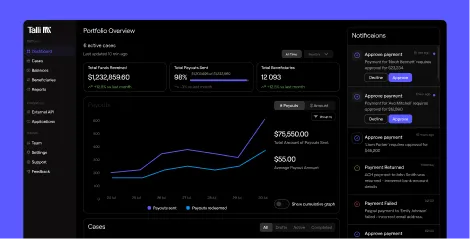
Talli is a digital claims disbursement platform purpose-built for legal settlement workflows, and every one of the eight criteria above was a design input, not an afterthought.
- Compliance automation. Automated KYC and OFAC screening on every claimant, QSF-compliant fund segregation with FDIC-insured custody through Patriot Bank, N.A., and native W-9 collection and 1099 generation aligned with the updated $2,000 federal threshold under IRC 6041 for applicable payments beginning January 1, 2026.
- Payment method flexibility. ACH, prepaid Mastercard, PayPal, gift cards, and paper checks from day one, with per-claimant rail selection in the claimant portal.
- Scalability. Distribution-window architecture designed for concurrent-claimant spikes, with documented performance on large class action and shareholder disbursements.
- Fraud prevention. Device fingerprinting, duplicate-claim detection, and a reviewable manual queue wired into the claimant onboarding flow.
- Claimant experience. A mobile-first, multi-language portal with self-service address updates, rail selection, and live payment-status visibility.
- Audit trail and reporting. A real-time dashboard and court-ready post-distribution accounting export that ties every payment event back to a court-approved allocation bucket.
- SLAs and support. Named distribution-window support with documented escalation paths and coverage that matches the actual cadence of a class action disbursement.
- Total cost of ownership. Transparent, worked TCO examples built against your class size and method mix before the contract is signed — no per-return surprises.
If you want to see how a purpose-built legal settlement disbursement platform handles the full workflow — from QSF deposit to claimant redemption to post-distribution accounting — Book a Demo → with Talli.
Best Practices for the Evaluation Process
- Start with a written evaluation scorecard before the first vendor call. Weights chosen under sales pressure are not real weights.
- Walk through the claimant portal on mobile. Most abandonment happens there.
- Require a worked TCO example based on your actual class size and method mix. Vendors who can produce one quickly are the ones who understand their own pricing.
- Ask for references from distributions of similar size AND type. A workforce payout reference tells you nothing about a securities class.
- Put peak-load performance in the contract. Uptime SLAs should apply to the distribution window, not the annual average.
- Tests support responsiveness during the evaluation. If sales slows down before the contract is signed, support will be slower after.
Common Mistakes to Avoid
- Treating the demo as the product. Rehearsed demos hide nothing until go-live.
- Ignoring post-distribution accounting. The hardest work often comes after the last claim is paid.
- Underweighting compliance automation. Manual compliance scales badly and reviews badly.
- Picking the cheapest per-transaction quote. TCO is where the real cost lives.
- Skipping reference calls. A single 30-minute reference call catches more issues than a full procurement cycle.
- Assuming a vendor's enterprise logos translate to legal settlement experience. They often do not.
Next Steps
The best vendor evaluation is the one you start before you need it. Build your scorecard, weight the criteria against your next distribution's risk profile, and put peak-load and compliance performance into the contract — not the marketing deck.
If you want to see how a purpose-built legal settlement disbursement platform compares against the criteria in this guide, Request a Demo → with Talli.
Frequently Asked Questions
What should claims administrators look for in a digital disbursement vendor?
Claims administrators should prioritize compliance automation (KYC, OFAC, QSF segregation), payment method flexibility, proven peak-load scalability, layered fraud prevention, claimant portal UX, real-time audit trails, distribution-window SLAs, and a transparent total cost of ownership.
How do you evaluate a settlement disbursement platform?
Use a weighted scorecard with 8 core criteria, require a worked TCO example on your actual class size, walk through the claimant portal yourself on mobile, ask for references from similar-sized distributions, and put peak-load performance commitments directly into the contract.
What compliance requirements apply to class action disbursement vendors?
At minimum: claimant KYC verification, OFAC sanctions screening on every transaction, QSF-compliant fund segregation (ideally FDIC-insured), W-9 collection and 1099 tax reporting for taxable payouts, and state-by-state escheatment handling for unclaimed funds.
What is QSF compliance in settlement disbursement?
A Qualified Settlement Fund (QSF) is a court-established fund under U.S. Treasury regulations used to hold settlement proceeds. QSF compliance for a disbursement vendor means keeping fund assets segregated from operating funds, ideally in FDIC-insured custody, with clean accounting and reporting at every step.
How much does digital disbursement cost versus paper checks?
Digital payment methods can reduce per-transaction disbursement costs by up to 80% compared to paper checks, and settlement administrators commonly report 40–60% overall cost reductions when claimants opt for electronic payment over mailed checks.
What payment methods should a disbursement vendor support?
A modern digital disbursement vendor should natively support ACH / direct deposit, prepaid debit cards, digital wallets (PayPal, Venmo, Zelle), virtual cards, paper checks as a fallback, and international wire or cross-border rails where the class requires it.
How do I stress-test a vendor's peak-load capacity?
Ask for the largest single batch they have processed (dollars and claimants), documented uptime during recent distribution windows, behavior under doubled batch size, and a reference from a distribution of similar size AND class type. Put the resulting numbers into the contract as SLAs.