.svg)


.svg)
The best disbursement platform for class action settlements automates KYC verification, OFAC screening, and multi-channel payments (ACH, prepaid cards, digital wallets) while maintaining QSF-compliant fund segregation in FDIC-insured accounts. Class action settlements totaled roughly $42 billion in 2024, yet paper-check redemption in class actions varies widely, and uncashed checks remain a persistent administrative problem. For settlement administrators managing thousands of claimants, the choice of disbursement platform directly impacts redemption rates, compliance posture, and operational costs. This guide covers the seven critical evaluation criteria for choosing a disbursement platform for class action settlements — from regulatory requirements to total cost of ownership.
Key Takeaways
- Settlement administrators choosing a disbursement platform should prioritize compliance automation (KYC, OFAC, QSF), multi-channel payment flexibility, and real-time audit trail capabilities.
- Digital disbursement platforms increase redemption rates by 15-25% over traditional check methods.
- Per-payment costs drop from $7-20 to as low as $0.25-$3 per transaction with digital disbursement
- QSF-compliant fund segregation in FDIC-insured accounts is essential for protecting settlement funds, meeting fiduciary obligations, and satisfying court oversight requirements.
- Claimant experience directly affects payout completion — platforms with mobile-friendly portals, multiple payment options, and automated reminders consistently achieve higher redemption rates.
- Total cost of ownership matters more than headline transaction fees, because automation reduces failed-payment recovery, manual compliance work, support volume, and court-reporting labor.
What Is a Disbursement Platform for Class Action Settlements?
A disbursement platform for class action settlements is specialized infrastructure that automates the distribution of settlement funds to verified claimants through multiple payment channels. These platforms are the most effective way for settlement administrators to increase redemption rates, reduce per-payment costs, and maintain regulatory compliance at scale.
Unlike general-purpose payment processors, a disbursement platform for class action settlements is purpose-built for the legal settlement lifecycle — handling identity verification, regulatory screening, tax documentation, and court-mandated reporting within a single workflow.
Modern disbursement platforms process thousands of payments simultaneously, compressing distribution timelines from six weeks to two days while maintaining full compliance with federal and state regulations. They replace the manual check-cutting, address verification, and reconciliation processes that have historically made settlement administration labor-intensive and error-prone.
The core distinction between a disbursement platform and a standard payment gateway is fiduciary responsibility. Settlement funds are held in trust, subject to court oversight, and governed by IRC Section 468B requirements for Qualified Settlement Funds. A platform built for this context handles fund segregation, audit trails, and regulatory reporting natively — not as afterthoughts bolted onto general payment infrastructure.
Why Settlement Administrators Need a Dedicated Disbursement Platform
Settlement administrators face a unique set of challenges that general payment tools were never designed to address. Court-approved settlement agreements carry specific disbursement requirements: verified identity matching, sanctions screening, tax withholding, and detailed reconciliation reporting back to the court.
Traditional check-based disbursement carries an average failure rate of ~30%. The drivers are well-documented: outdated mailing addresses (the Census says 11.8% of people moved in 2024), expired checks with 90 or 180-day windows, and check-cashing fees of 5-8% that discourage redemption among lower-income claimants.
These failures create administrative burden, extend settlement timelines, and ultimately reduce the funds that reach intended recipients.
A dedicated disbursement platform for class action settlements addresses these problems structurally. Automated address verification, multi-channel payment options, and real-time tracking reduce failure rates and increase the percentage of funds that actually reach claimants.
For administrators managing settlements across data breach, product liability, antitrust, or employment class actions, the operational difference between a purpose-built platform and a patchwork of payment tools is measured in months of administrative overhead. Understanding antitrust settlement trends helps administrators anticipate volume requirements when selecting a platform.
7 Critical Criteria for Evaluating Disbursement Platforms
Before diving into individual requirements, administrators selecting a disbursement platform for class action settlements should evaluate platforms across these seven dimensions. Each criterion reflects a real operational pain point that distinguishes effective disbursement infrastructure from inadequate solutions.
Compliance and Regulatory Requirements: KYC, OFAC, and QSF
Compliance is the non-negotiable foundation of any settlement disbursement platform. Settlement administrators carry fiduciary responsibility for every dollar distributed, and regulatory failures can result in personal liability, court sanctions, and civil penalties that can reach the greater of $377,700 or twice the value of the underlying transaction.
KYC Verification
Know Your Customer verification in settlement disbursement answers three questions: Is the government ID valid? Does the person presenting the ID match the document? Is that person the actual entitled claimant? Automated KYC in digital claim distributions reduce staff hours by up to 75% while improving accuracy compared to manual document review.
Look for platforms that support tiered verification — lighter checks for small-dollar claims (under $100) and full document verification for high-value payments. This prevents legitimate claimants from abandoning the process due to excessive friction on low-value claims.
OFAC Screening
Every settlement payment must be screened against the Office of Foreign Assets Control (OFAC) Specially Designated Nationals (SDN) list. This is not optional. Claims administrators must verify that settlement funds do not reach prohibited individuals, entities, or countries subject to U.S. sanctions.
Effective platforms run automated OFAC screening at the point of payment authorization, flag matches for manual review, and maintain a complete audit log of every screening decision. Manual OFAC screening becomes operationally impossible at scale — a settlement with 10,000 claimants cannot be manually screened against lists containing over 13,000 entries.
QSF Compliance and Fund Segregation
Under 26 CFR Section 1.468B-1, a Qualified Settlement Fund must be established or approved by a governmental authority, resolve specified claims, and keep its assets segregated from the transferor’s other assets. The platform you choose must support FDIC-insured fund segregation through a qualified banking partner, with the court retaining continuing jurisdiction over fund administration.
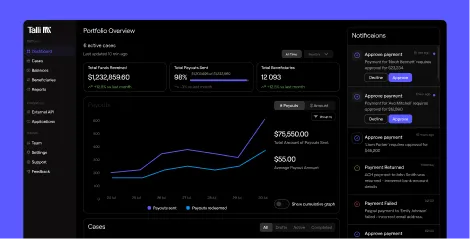
Platforms like Talli provide segregated QSF-compliant accounts through FDIC-insured banking via Patriot Bank, N.A., with automated tax compliance including W-9 collection and 1099 generation. This combination of fund segregation and tax automation is critical — the IRS treats QSFs as taxable entities requiring annual filings and quarterly estimated payments.
How Digital Disbursements Compare to Traditional Check Methods
The shift from paper checks to digital disbursement is not just a technology upgrade — it fundamentally changes settlement economics and claimant outcomes.
Settlement administrators using digital platforms have compressed timelines to two days while achieving redemption rates of 91% when offering diverse payment methods. On a $10 million settlement, the operational savings can exceed $2.35 million when accounting for reduced check printing, mailing, reissuance, and reconciliation costs.
The remaining argument for checks — that some claimants lack bank accounts — is addressed by modern platforms through prepaid card options. With 22% of low-income adults unbanked, platforms that offer prepaid card and digital options ensure no claimant is excluded from settlement participation.
Payment Method Flexibility and Claimant Experience
Offering three to four payment options typically increases redemption rates by 20-30% compared to single-method distribution. The reason is straightforward: claimants have different banking situations, technology comfort levels, and preferences. A one-size-fits-all approach leaves money on the table.
Payment Methods to Evaluate
- ACH Direct Deposit — Lowest cost, fastest processing, preferred by banked claimants. Most platforms support same-day ACH.
- Prepaid Debit Cards — Critical for unbanked claimants. Cards branded with Mastercard or Visa work at ATMs and retailers without requiring a bank account.
- Digital Wallets — PayPal, Venmo, and similar services offer instant delivery. Particularly effective for younger demographics and tech-savvy claimants.
- Gift Cards — Useful for small-dollar settlements (under $25) where ACH setup costs would be disproportionate.
- Paper Checks — Still necessary as a fallback for claimants who explicitly prefer or require physical payment.
Claimant Portal Design
Beyond payment methods, evaluate the claimant-facing experience. A well-designed claimant portal reduces support tickets and abandonment. Look for:
- Mobile-responsive design (over 80% prefer digital options)
- Payment method selection with clear explanations
- Real-time status tracking for each claimant
- Multi-language support for settlements with diverse class membership
- Smart payment reminders that improve take-up rates through automated follow-up
Scalability: Can the Platform Handle Your Settlement Size?
Settlement sizes range from hundreds of claimants in niche product liability cases to hundreds of thousands in data breach or consumer class actions. The platform you select must handle your current settlement volume and your largest projected case without architectural limitations.
Questions to Ask Vendors
- Maximum concurrent payments — Can the platform handle high-volume transaction loads and process 100,000+ payments in a single batch without degradation?
- Peak load performance — What happens during initial distribution when all claimants redeem simultaneously?
- Historical performance — How many payments has the platform processed in a single settlement? Request specific case references.
- Failover and retry — How does the system handle failed payments? Automatic retry with alternative methods reduces manual intervention.
Platforms built for settlement administration typically handle 1,000 to 100,000+ recipients without architectural changes. However, scalability is not just about throughput — it includes maintaining compliance checks, audit logging, and reporting accuracy at volume. A platform that processes payments quickly but drops OFAC screening under load creates more risk than a slower, fully compliant alternative.
Security, Fraud Prevention, and Audit Trails
Settlement funds are high-value targets for fraud. In 2024, digital disbursement platforms collectively blocked 723M+ fraudulent claims. Security evaluation should cover three layers: fund protection, identity fraud prevention, and operational audit capabilities.
Fund Protection
- FDIC-insured accounts — Settlement funds must be held in FDIC-insured accounts, preferably through a regulated banking partner with statutory trust powers.
- Segregated accounts — Each settlement fund should be held separately, not commingled with operating funds or other settlement pools.
- Encryption — PCI DSS Level 1 compliance for all payment data. End-to-end encryption for claimant personal information.
Fraud Prevention
- Duplicate claim detection — Automated matching against name, address, SSN, and device fingerprint to identify duplicate submissions.
- AI-powered pattern recognition — Systems that identify coordinated fraud rings attempting to submit manufactured claims at scale.
- Velocity checks — Flagging unusual patterns such as multiple claims from the same IP address or device within short timeframes.
Modern platforms achieve 40%+ fraud reduction through automated detection compared to manual review processes. This protects settlement funds for legitimate claimants while reducing administrator liability.
Court-Ready Audit Trails
Every disbursement action — payment authorization, compliance screening, payment delivery, and claimant interaction — must be logged with full audit trail transparency with timestamps and user attribution. Courts require detailed distribution reports, and regulators expect complete audit trails. Evaluate whether the platform generates court-ready reports natively or requires manual compilation from raw data exports.
Integration Capabilities: APIs, Case Management, and Court Systems
A disbursement platform that operates in isolation creates data silos and manual reconciliation work. Modern settlement administration requires integration between disbursement infrastructure, case management systems, claims processing platforms, and accounting software.
API Access
RESTful APIs with webhook support allow settlement administrators to automate the flow of data between systems. Key integration points include:
- Claims verification to payment trigger — When a claim is approved, the payment is automatically queued
- Real-time status updates — Webhooks notify case management systems when payments are delivered, failed, or returned
- Bulk import/export — CSV and API-based bulk operations for initial claimant data loading and reporting
Case Management Connectors
Evaluate whether the platform offers pre-built connectors for common settlement administration tools, or whether custom integration work is required. Pre-built integrations reduce implementation timelines from months to days — some platforms enable settlement launches in 2-7 days when data can be imported directly from existing systems.
Cost Analysis: Total Cost of Ownership for Disbursement Platforms
Per-transaction pricing is only one component of total cost. Settlement administrators should evaluate the full economic picture when comparing platforms.
Cost Components to Compare
Law firms and settlement administrators report 40-60% cost reductions when claimants choose electronic payment options. On a $10 million settlement with 50,000 claimants, the difference between $15 per check and $1 per digital payment represents $700,000 in direct disbursement savings alone.
Hidden Costs to Watch
- Setup and onboarding fees — Some platforms charge significant implementation fees
- Currency conversion markups — International settlements may incur 2-4% conversion fees
- Minimum volume commitments — Contracts that penalize smaller settlements
- Data migration costs — Moving claimant data from legacy systems
- Custom reporting fees — Court-specific report formats charged as add-ons
Decision Framework: Matching Platform Features to Settlement Needs
Not every disbursement platform for class action settlements offers the same capabilities, and not every settlement requires the same features. Use this framework to match your specific settlement characteristics to the features that matter most.
This framework prevents over-buying features you do not need while ensuring you do not underinvest in capabilities critical to your specific settlement type.
Common Mistakes When Selecting a Disbursement Platform
1. Choosing Based on Per-Transaction Price Alone
The cheapest per-transaction rate often comes with hidden costs: manual compliance work, limited payment options that reduce redemption, and basic reporting that requires supplemental tools. Total cost of ownership — including failed payment recovery, support costs, and administrative labor — is a more accurate comparison metric.
2. Ignoring Fund Segregation Requirements
General payment platforms often commingle funds in pooled accounts. For settlement administrators, this creates fiduciary risk. Every dollar of settlement funds must be held in segregated, FDIC-insured accounts with full audit trails. Verify this capability before signing any contract.
3. Underestimating Claimant Experience Impact
A confusing claimant portal or limited payment options directly reduces redemption rates. The difference between a 70% and 90% redemption rate on a $20 million settlement is $4 million in unclaimed funds. Platform usability is not a nice-to-have — it is a core performance metric.
4. Skipping Reference Checks for Similar Settlement Types
A platform that excels at small-dollar consumer refunds may struggle with high-value mass tort distributions. Request references from settlements similar in size, type, and complexity to your case. Verify actual redemption rates and distribution timelines achieved, not just marketing claims.
5. Overlooking Ongoing Support and SLAs
Settlement administration spans months or years, as detailed in settlement processing time research. Evaluate vendor responsiveness, escalation paths, and service level agreements for uptime and issue resolution. A platform that launches smoothly but lacks responsive support during the critical distribution window creates operational risk.
Conclusion: Choosing the Right Disbursement Partner
Choosing the right disbursement platform for class action settlements is a decision that directly impacts how much of a settlement fund reaches the people it was intended for. The criteria outlined in this guide — compliance automation, payment flexibility, scalability, security, integration, and total cost — provide a practical framework for evaluating vendors against your specific settlement needs.
The settlement administration industry is moving decisively toward digital disbursement. With 80% of claimants preferring digital and most major administration firms planning FedNow integration by late 2025, the question is not whether to adopt a digital platform but which one matches your compliance requirements and operational workflow.
For settlement administrators evaluating digital disbursement infrastructure with built-in compliance automation, QSF-compliant fund segregation, and multi-channel payment delivery, Talli offers a purpose-built platform designed specifically for legal settlement workflows. Book a Demo to see how it handles your settlement type.
Frequently Asked Questions
What is a class action settlement disbursement platform?
A class action settlement disbursement platform is a specialized payment infrastructure that automates the distribution of court-approved settlement funds to verified claimants through multiple payment channels while maintaining regulatory compliance. These platforms handle identity verification, OFAC sanctions screening, tax documentation (W-9/1099), and court-mandated distribution reporting — replacing the manual, check-based processes traditionally used by settlement administrators.
How do digital disbursements improve settlement redemption rates?
Digital disbursements improve redemption rates by offering claimants multiple payment options matched to their preferences and banking situations. Platforms offering three to four payment methods (ACH, prepaid cards, digital wallets, checks) typically achieve 20-30% higher redemption compared to check-only distribution. Digital delivery also eliminates address-dependent failures — with 12% of Americans moving annually, mailed checks frequently miss intended recipients.
How much does a digital disbursement platform cost compared to checks?
Digital disbursement platforms typically cost $0.25-$3 per transaction compared to $7-20 per paper check when accounting for printing, mailing, and reconciliation costs. Failed check reissuance adds approximately $150 per instance. On aggregate, settlement administrators report 40-60% total cost reductions after switching to digital disbursement, with the savings increasing proportionally with settlement size and claimant count.
What is a Qualified Settlement Fund (QSF) and why does it matter for disbursement?
A Qualified Settlement Fund under IRC Section 468B is a court-ordered trust that holds settlement proceeds in a segregated, FDIC-insured account. QSFs allow defendants to claim immediate tax deductions while claimant payments are processed. The disbursement platform must support QSF administration including fund segregation, annual tax filings, quarterly estimated payments, and continuing court jurisdiction over the fund.
Can a disbursement platform handle international class action settlements?
Yes, modern platforms support cross-border disbursements across 150+ currencies and 190+ countries through multiple payment rails including international ACH, wire transfers, and digital wallets. Key considerations include OFAC screening for international recipients, currency conversion costs (typically 2-4% markup), and compliance with local data protection regulations like GDPR in the European Union.
What happens when a digital payment fails or is returned?
Effective platforms automatically retry failed payments using alternative methods. If an ACH transfer fails due to incorrect account details, the system can offer the claimant a prepaid card or digital wallet option instead. This automatic failover eliminates the $150-per-instance reissuance cost associated with traditional check replacement methods and keeps redemption rates high.
How do disbursement platforms handle tax reporting for settlements?
Settlement disbursement platforms automate the entire tax compliance workflow: collecting W-9 forms from claimants, validating TIN information against IRS records, calculating applicable withholding, generating 1099 forms for reportable payments, and filing with the IRS. For QSFs, the platform also manages the fund's own tax obligations as a separate taxable entity.
What is the difference between a disbursement platform and a settlement administrator?
A settlement administrator manages the entire claims process — notice, claims intake, eligibility verification, allocation calculations, and distribution. A disbursement platform handles specifically the payment execution layer: moving approved funds from the settlement account to individual claimants through their chosen payment method. Some administrators use third-party disbursement platforms, while others have proprietary disbursement technology built in.
How do you evaluate a disbursement platform's fraud prevention capabilities?
Evaluate fraud prevention across three layers: identity verification (document validation, biometric matching, knowledge-based authentication), transaction monitoring (velocity checks, duplicate detection, device fingerprinting), and pattern analysis (AI-powered detection of coordinated fraud rings). Request specific metrics from vendors — the best platforms block fraudulent claims at rates exceeding 40% improvement over manual review processes.