.svg)


.svg)
Every settlement has a line item nobody wants to talk about: the money that never reaches a claimant. Unclaimed settlement funds look like a rounding error on the final accounting, but the real cost shows up everywhere else — in extended hearings, escheatment filings, re-issuance runs, cy pres petitions, and the fiduciary exposure that follows a distribution that never actually distributed. Claims administrators who treat unclaimed balances as a back-office cleanup task routinely understate what the problem is really costing them and, more importantly, their courts and class members.
This guide takes the disbursement-platform view of unclaimed settlement funds: what they are, why they accumulate, what they cost in real dollars and real judicial patience, and how a modern claims disbursements workflow converts "unclaimed" from an inevitable outcome into a measurable — and shrinkable — metric. If you administer QSF payouts, class action distributions, or mass tort disbursements, the gaps below are the ones we see most often when administrators hand us a post-distribution file and ask what went wrong.
Key Takeaways
- Traditional check-based settlements leave roughly 30% of funds uncashed, while modern digital payouts routinely achieve payment success rates near 98% — a gap that directly maps to unclaimed settlement funds.
- The "hidden cost" of unclaimed funds is not just the dollar value. It is re-issuance labor, escheatment filings, cy pres petitions, extended court supervision, and reputational risk with the judge.
- Median consumer class action claims rates hover around 9%, so a high percentage of eligible funds never move at all unless the disbursement workflow actively reaches claimants on the rails they trust.
- Claims administrators most commonly get four things wrong: stale contact data, single-rail payouts, weak re-issuance workflows, and audit trails that cannot survive a fiduciary challenge.
- Reducing unclaimed balances is an infrastructure problem, not a PR problem. The fix lives inside the settlement disbursement costs stack — identity, rails, tracking, reconciliation, and reporting.
Who This Guide Is For
This guide is for claims administrators, settlement trustees, class counsel operations leads, and the finance teams inside law firms who sign off on disbursement vendors. If you are responsible for moving money out of a QSF or directly from a defendant escrow to class members, and you have ever had to explain a large unclaimed balance to a judge, this is written for you.
What Counts as an Unclaimed Settlement Fund
"Unclaimed" is a messier category than most administrators admit on paper. In practice, a claims administrator settlement funds report usually contains at least five different kinds of "unclaimed" dollars, and each one has a different fix.
- Never-claimed funds — allocations sitting against class members who never filed a claim in a claims-made settlement.
- Unreachable claimants — claimants who filed but whose address, phone, or email is stale, so the payment was never delivered.
- Returned payments — checks returned by the post office, ACH reversals, failed prepaid card activations, and bounced digital wallets.
- Uncashed checks — paper checks that arrived but were never cashed within the stale-date window.
- Claimed-but-not-onboarded funds — claimants who responded but never completed KYC, W-9 collection, or portal enrollment, so the platform could not safely pay them.
Each bucket shows up in the post-distribution accounting under unclaimed settlement funds, but they get solved by different parts of the disbursement workflow. Treating them as one number is the first mistake.
The Real Hidden Cost of Unclaimed Funds
When a judge asks a claims administrator what the unclaimed balance cost, most answers focus on the principal dollars. That number is the smallest component. A full cost picture includes all of the following, and most administrators underbill or absorb most of it.
1. Reissuance Labor
Every returned check, failed ACH, or expired card triggers a re-issuance cycle: address research, OFAC re-screen, KYC refresh, payment re-run, and reconciliation. When this work is manual — and it usually is — the loaded cost per re-issuance often exceeds the per-payment fee the administrator originally quoted the court. Our explainer on how to eliminate manual reissuance overhead walks through the unit economics in detail, and the pattern is consistent across settlement types: the administrators who carry large unclaimed balances are almost always the ones still running re-issuance from a spreadsheet.
2. Escheatment Filings
When funds remain unclaimed past the dormancy period set by state unclaimed property law, the administrator must file escheatment reports and remit the funds to the relevant state. Escheatment is state-by-state, with different dormancy periods, filing formats, and due diligence requirements, and most administrators discover too late that their platform exports do not actually line up with state schemas. That turns a quiet compliance task into a multi-week reformatting sprint every reporting cycle.
3. Cy Pres and Residual Motions
On class action settlements, residual unclaimed funds often require a cy pres distribution — a petition to redirect the money to a charity or second-distribution pool aligned with the original class. Cy pres is judge-approved, which means another hearing, another brief, and another round of objections. The higher your unclaimed balance, the more frequently you are back in front of the court explaining why.
4. Extended Court Supervision
Settlement disbursement costs are not just the per-payment fees. They include every additional status conference, every supplemental declaration, and every "final" accounting that turns out not to be final because the unclaimed bucket is still moving. Courts are increasingly impatient with administrators who cannot wrap up a distribution inside a reasonable window. Judges have started asking the question directly: why are there still unclaimed funds a year after the order was entered?
5. Fiduciary and Reputational Exposure
An unexplained unclaimed balance is a red flag to the court, to class counsel, and to the defendant who funded the settlement. It suggests the administrator could not locate class members, did not try hard enough, or cannot prove what it did try. That is the fiduciary risk layer, and it is the one administrators should care about most. A defensible record of the steps taken to reach each claimant — the court-defensible audit trail — is how you shut that conversation down.
6. Claimant Trust Erosion
Every returned check is a class member who never got paid and now tells their network that settlements do not work. The hidden cost of unclaimed settlement funds includes the slow erosion of faith in the claims process itself — and that is the cost that lands on the next case, not this one.
What Claims Administrators Get Wrong
Across the files we see, four specific workflow gaps drive the overwhelming majority of unclaimed balances.
Mistake 1: Treating Address Data as Static
The claimant file the defendant hands over is a snapshot, not ground truth. People move, change phones, switch email providers, and change names. If the administrator runs payments against that snapshot without refreshing contact data — and without giving claimants a claimant portal where they can update their own record — a predictable slice of the distribution is going to fail on day one. The best administrators run an address verification pass immediately before the payment run, not at intake, and expose a self-service update flow during the claims window. That alone typically moves the unclaimed number by several points.
Mistake 2: Defaulting to a Single Payout Rail
Paper checks still dominate the default for many class action distributions, and paper checks still leave roughly 30% of funds uncashed. Administrators that default to check because "the judge expects it" are reading the room wrong. Courts increasingly expect a digital option alongside check, because digital payouts achieve payment success rates near 98%. A court-ready platform should offer at least three of ACH, prepaid Mastercard, PayPal, and gift cards, so claimants can self-select the rail they trust. More options means fewer returned payments means a smaller unclaimed bucket at closing. Talli, for example, operates as a modern claims disbursements platform that lets the administrator flip rails per claimant without re-uploading the whole file.
Mistake 3: Weak Re-Issuance Workflows
A returned check that sits in a spreadsheet for three weeks is a returned check that will probably still be unclaimed at closing. The platform needs to detect the return, log it, re-verify the claimant, and trigger a re-issuance candidate in hours — not at the next batch cycle. Our guide on how to handle returned and undelivered shareholder checks at scale walks through the workflow; the same mechanics apply to class action distributions and QSF payouts.
Mistake 4: Audit Trails That Cannot Explain the Balance
When a judge asks "why is this balance unclaimed," the administrator has to be able to answer at the individual-claimant level: what was attempted, when, on which rail, with what result, and what happens next. A good disbursement platform captures every action — initiated, approved, KYC verified, OFAC cleared, payment sent, payment returned, re-issued, escheated — in an immutable log tied to the user who performed it. That log is the fiduciary exhibit. Administrators who manage this inside spreadsheets discover, at the worst possible time, that the record is not defensible.
The Real Numbers Behind Unclaimed Settlement Funds
It helps to ground the conversation in the industry data administrators can actually cite in front of a judge.
- Paper check redemption: Roughly 70% of claim checks are cashed, leaving ~30% uncashed and destined for the unclaimed bucket absent intervention.
- Digital payout success: Modern digital rails routinely deliver payment success near 98%, a delta that translates almost directly into redemption-rate lift.
- Median consumer class action claims rate: Around 9%, meaning a large share of the eligible class never files at all — which is a separate, upstream driver of unclaimed balances.
- Cost to issue a commercial check: Averages around $7.78 all-in, a cost that compounds every time the check has to be reissued.
- Redemption lift from multi-rail payouts: Offering three to four payout rails typically lifts redemption 20-30% versus single-rail check-only distributions.
These numbers are not marketing copy. They are the backdrop any claims administrator settlement funds analysis has to sit on top of, and they explain why the "hidden cost" is large enough to fund the infrastructure that would eliminate it.
How a Modern Disbursement Platform Shrinks the Unclaimed Bucket
A court-ready platform attacks unclaimed funds at every stage of the disbursement lifecycle, not only at re-issuance time.
- Segregated, QSF-compliant accounts. Talli, for example, holds settlement funds in segregated QSF-compliant accounts through Patriot Bank, N.A., with per-case reconciliation that ties every dollar back to the originating court order. That is the clean banking base the audit trail sits on.
- Automated KYC and OFAC screening. Onboarding that catches identity and sanctions issues before payment day, so the money does not get stuck in a post-send hold.
- Multi-rail payout orchestration. ACH, prepaid Mastercard, PayPal, and gift cards available from day one, with per-claimant rail selection in the claimant portal.
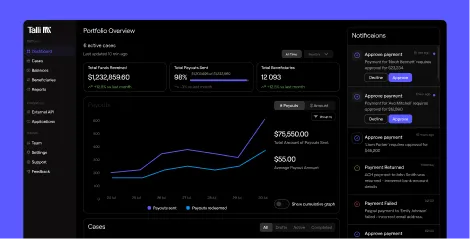
- Real-time payment tracking. A live view of initiated, delivered, returned, and reissued payments, so administrators do not discover the unclaimed bucket at the post-distribution accounting.
- Automated re-issuance workflows. Returned payments flow into a standing re-issuance queue with refreshed address data and updated rails, not a spreadsheet.
- Court-ready reporting exports. Post-distribution accountings that tie back to the QSF bank statement and to the plan of allocation, so the judge can see the unclaimed number explained line by line.
- Tamper-evident audit trail. An immutable log that documents every "reasonable effort" taken to locate and pay each claimant — the exhibit a fiduciary challenge turns on.
This is what regulated payout rails look like in practice, and it is the reason administrators running on modern digital disbursement infrastructure consistently report smaller unclaimed balances, faster closing hearings, and less chasing, more redemptions at final accounting.
Common Mistakes to Avoid
- Counting "unclaimed" as one number. Split it into the five buckets above so each gets a distinct fix.
- Waiting for the stale-date to investigate. By then, address data has moved further out of date and the claimant is harder to reach.
- Running OFAC once at intake. Sanctions lists update constantly. Re-screen before every payment run and before every re-issuance.
- Skipping the claimant portal. Self-service address updates and rail selection are the cheapest redemption lift available.
- Hoping cy pres will clean it up. Cy pres is a last resort, not a disbursement strategy, and every judge can tell the difference.
Advanced Tips for Reducing Unclaimed Balances
- Run a dry-run payment on a small cohort before the full distribution to catch address, KYC, and rail-selection issues while there is time to fix them.
- Pre-stage OFAC screening in the claimant portal so any hits are worked out before the payment run starts and do not block a scheduled disbursement.
- Export the audit trail weekly during active distribution, not only at the end — a weekly export is a cheap insurance policy against last-minute export failures or platform outages.
- Publish redemption metrics to class counsel and the court on a fixed cadence so nobody is surprised at the closing hearing. Transparency compounds trust.
- Align re-issuance SLAs with the stale-date schedule so no returned payment sits idle long enough to default into escheatment.
Next Steps
Unclaimed settlement funds are not an accident of the claims process; they are an output of the disbursement workflow. Every point of redemption lift comes from a specific infrastructure decision — segregated banking, multi-rail payouts, automated re-issuance, a real audit trail, and a claimant portal that treats the class member like the user they are. Start by pulling your last three distributions, splitting the unclaimed bucket into the five categories above, and attaching a root cause to each slice. Then build the fix into the next case, not the post-mortem of this one. That is what full audit transparency looks like, and it is why compliance critical workflows belong on digital disbursement infrastructure rather than in a spreadsheet.
For a broader view of the redemption data behind this guide, see the American Bar Association's overview of qualified settlement funds and the IRS guidance on information returns that shapes how distributions get reported. For the core QSF rule set often cited in this context, see 26 CFR 1.468B-1, which requires the fund to be subject to continuing court or governmental jurisdiction in order to qualify as a QSF.
Frequently Asked Questions
What are unclaimed settlement funds?
Unclaimed settlement funds are the portion of a class action, QSF, or mass tort distribution that never reaches a claimant — whether because the claimant did not file, could not be reached, returned the payment, did not cash a check, or did not complete onboarding. The phrase covers several different operational problems, each with a different fix.
Why do so many settlement funds go unclaimed?
The biggest drivers are stale contact data, single-rail payouts (usually paper checks), weak re-issuance workflows, and claimants who never complete KYC or W-9 collection. Low claims rates in consumer class actions — often around 9% — amplify the problem upstream.
What happens to unclaimed class action funds?
Depending on the settlement agreement and the court order, unclaimed class action funds typically go to a second distribution pool, a cy pres recipient, or escheatment to the relevant state under unclaimed property law. The judge approves the path.
How much do unclaimed settlement funds actually cost?
The hidden cost includes re-issuance labor, escheatment filings, cy pres motions, extended court supervision, fiduciary and reputational exposure, and the loss of claimant trust on future matters. The principal dollar figure on the accounting is usually the smallest part.
How do digital payouts reduce unclaimed balances?
Digital rails like ACH, prepaid cards, PayPal, and gift cards achieve payment success rates near 98%, versus roughly 70% for paper checks. Offering three to four rails also lifts redemption 20-30% compared with check-only distributions.
Does the $2,000 1099 threshold affect unclaimed funds?
Indirectly. The IRC 6041 information-reporting threshold rose from $600 to $2,000 on January 1, 2026 under the One Big Beautiful Bill Act. It does not change what counts as unclaimed, but it simplifies the 1099 workload on smaller distributions so administrators can focus resources on the re-issuance queue.
What should a claims administrator ask a disbursement platform about unclaimed funds?
Ask to see the unclaimed-balance report, the re-issuance queue, the audit trail export, and the cy pres or escheatment workflow — live, not in a slide deck. If the vendor cannot walk through all four, they are not ready for a modern distribution.