.svg)


.svg)
Insurance carriers and third-party administrators face hidden compliance exposure in every claim payment they process. With information-return penalties ranging from $60 per form for certain timely corrections to at least $690 per form for intentional disregard on returns due in 2027, high-volume payers can accumulate significant penalty exposure without proper 1099 reporting systems. The recent threshold changes under the One Big Beautiful Bill Act add complexity, requiring dual compliance for 2025 and 2026 tax years. Modern claims payment platforms with integrated compliance automation help carriers and TPAs manage these requirements while reducing manual workload and error rates.
Key Takeaways
- Medical and healthcare payments to providers require Form 1099-MISC Box 6 reporting at $2,000+ threshold for tax year 2026 and beyond
- Settlement payments to attorneys must be reported on Form 1099-MISC Box 10 at $600+ threshold (unchanged by recent legislation)
- Property and casualty claim reimbursements to policyholders are generally NOT reportable as they restore the insured to pre-loss condition
- E-filing is mandatory for businesses filing 10 or more information returns (aggregated across all return types)
- Form 1099-NEC has no automatic filing extension. Both paper and electronic filings are generally due January 31, although a qualifying filer may request one nonautomatic 30-day extension using Form 8809.
- Corporate exemption does NOT apply to medical or legal services: these payments require reporting regardless of entity type
- Credit card and third-party network payments trigger 1099-K reporting by the payment processor, NOT 1099-MISC/NEC by the payer
Understanding 1099 Reporting Requirements for Insurance Claim Payments
The IRS requires insurance companies and TPAs to report specific payment types on Forms 1099-MISC, 1099-NEC, and 1099-R. Understanding which payments trigger reporting obligations prevents compliance failures and penalty exposure.
The Basics of IRS Form 1099
Form 1099 serves as an information return that reports payments made to non-employees during the tax year. For insurance operations, three primary forms apply:
- Form 1099-MISC: Reports medical payments (Box 6), gross proceeds to attorneys (Box 10), crop insurance proceeds (Box 9), and other income types
- Form 1099-NEC: Reports nonemployee compensation, including payments to independent contractors like auto repair shops
- Form 1099-R: Reports distributions from pensions, annuities, and reportable death benefits under section 6050Y
Key Thresholds for Current Reporting Years
The One Big Beautiful Bill Act (OBBBA) enacted July 4, 2025, significantly changed reporting thresholds effective for tax year 2026. Understanding these threshold changes is critical for dual compliance systems during the transition period.
For Tax Year 2025 (Forms Filed in Early 2026):
- Medical and Healthcare Payments (Box 6): $600 threshold
- Rents, Prizes, Other Income: $600 threshold
- Crop Insurance Proceeds (Box 9): $600 threshold
- Nonemployee Compensation (1099-NEC): $600 threshold
- Gross Proceeds to Attorney (Box 10): $600 threshold
For Tax Year 2026 and Beyond (Forms Filed in 2027+):
- Medical and Healthcare Payments (Box 6): $2,000 threshold
- Rents, Prizes, Other Income: $2,000 threshold
- Crop Insurance Proceeds (Box 9): $2,000 threshold
- Nonemployee Compensation (1099-NEC): $2,000 threshold
- Gross Proceeds to Attorney (Box 10): $600 threshold (unchanged)
The threshold increase means substantially fewer 1099 forms for 2026 filings, but carriers and TPAs must maintain dual compliance workflows during the transition period.
When to Issue a 1099: Insurance Claim Examples and Exemptions
Not all insurance payments require 1099 reporting. The distinction between reportable and non-reportable payments often creates confusion for compliance teams.
Common Scenarios Requiring 1099 Reporting
Medical and Healthcare Payments (Form 1099-MISC Box 6)
Payments made by health insurers to physicians, hospitals, and healthcare providers require reporting at $2,000 or more for 2026. The IRS specifically states that the entire payment must be reported, including both service and supply components such as injections, drugs, dentures, and medical equipment.
Settlement Payments to Attorneys (Form 1099-MISC Box 10)
When an insurance company pays a claimant's attorney to settle a claim, the gross proceeds must be reported at $600 or more. For example, if an insurance company pays $100,000 to settle a claim through the claimant's attorney, the full $100,000 is reported in Box 10 as gross proceeds.
Auto Repair Shop Payments (Form 1099-NEC)
Insurance company payments to non-corporate auto repair shops are reportable when the total exceeds threshold amounts. This includes the entire payment for labor and parts when furnishing parts was incidental to repairing the vehicle.
Life Insurance Death Benefits (Form 1099-R)
Reportable death benefits under section 6050Y must be reported on Form 1099-R when death benefits are paid in connection with a life insurance contract transferred after December 31, 2018, in a reportable policy sale.
Distinguishing Taxable vs. Non-Taxable Payments
Property and Casualty Claim Reimbursements
Standard claim reimbursements for property damage or loss are generally not reportable. These payments restore the policyholder to their pre-loss condition and are not considered income unless proceeds exceed the adjusted basis of the property.
Payments to Pharmacies
The IRS specifically exempts payments to pharmacies for prescription drugs from 1099 reporting requirements. Pharmacies are treated as retail establishments selling goods rather than medical service providers.
Payments to Tax-Exempt Hospitals
Payments made to tax-exempt hospitals or extended care facilities owned and operated by federal, state, or local governments are exempt from reporting requirements.
Navigating 1099-MISC vs. 1099-NEC for Carriers and TPAs
The IRS separated nonemployee compensation from Form 1099-MISC in 2020, creating Form 1099-NEC. Understanding which form applies prevents filing errors and duplicate reporting.
Understanding the Shift to 1099-NEC
Form 1099-NEC reports payments for services performed by non-employees. For insurance operations, this typically includes:
- Independent adjusters and appraisers
- Auto body shops (non-corporate)
- Independent contractors providing claims-related services
Specific Box Reporting for Insurance-Related Payments
Form 1099-MISC Boxes for Insurance:
- Box 3: Other income, including taxable damages paid to claimants
- Box 6: Medical and health care payments to providers
- Box 9: Crop insurance proceeds
- Box 10: Gross proceeds paid to attorneys
Critical Exception: The general corporate exemption does not apply to payments for medical or health care services provided by corporations, including professional corporations. Medical payments to incorporated physician practices still require 1099-MISC reporting.
Best Practices for 1099 Filing and Compliance
Meeting 1099 filing requirements demands structured workflows and consistent processes throughout the year.
Key Dates and Deadlines for Upcoming Tax Years
Understanding filing deadlines is essential to avoid penalties. For tax year 2025 payments filed in early 2026:
Form 1099-NEC:
- Recipient Copy Due: January 31
- Paper Filing Due: January 31
- E-Filing Due: January 31
Form 1099-MISC:
- Recipient Copy Due: January 31 generally; February 15 for statements reporting Box 8 or Box 10 amounts
- Paper Filing Due: February 28
- E-Filing Due: March 31
Form 1099-R:
- Recipient Copy Due: January 31
- Paper Filing Due: February 28
- E-Filing Due: March 31
Form 1099-NEC has no automatic filing extension. Both paper and electronic filings are generally due January 31, although a qualifying filer may request one nonautomatic 30-day extension using Form 8809.
Mitigating Risks of Non-Compliance
The penalty structure for information return failures is based on correction timing:
- Correct within 30 days: $60 per form
- Correct 31 days through August 1: $130 per form
- Correct after August 1 or not filed: $340 per form
- Intentional disregard: at least $690 per form for returns due in 2027, with no maximum cap
TIN Validation Best Practices:
- Use the IRS TIN Matching Program before filing
- Collect W-9 forms before the first payment, not at year-end
- Maintain W-9 documentation for four or more years
How Third-Party Administrators (TPAs) Manage 1099 Reporting
TPAs face unique compliance challenges because they handle claims administration without being the actual insurance carrier, creating questions about reporting responsibility.
The TPA's Role in Insurance Claim Payments
The IRS provides guidance on payments made on behalf of another person. A TPA may be responsible for 1099 filing if it:
- Maintains the claims payment account
- Performs management or oversight functions in connection with payments
- Has a significant economic interest in the payment
Ensuring Accurate 1099 Reporting through TPA Partnerships
Clear contractual agreements between carriers and TPAs should specify:
- Who collects W-9s from payees
- Who performs TIN matching and validation
- Who files Forms 1099 with the IRS
- Who handles B-Notices and backup withholding
- Who bears liability for penalties
Talli's digital disbursement platform helps TPAs eliminate payment bottlenecks with coordinated approvals, centralized controls, automated reconciliation, and support for compliance-critical payment workflows.
Issuing 1099s to Individuals: A Guide for Payer Organizations
Proper payee data collection before payment prevents year-end scrambles and B-Notice problems.
Gathering Necessary Information from Payees
Required data elements include:
- Legal name (exactly as shown on federal tax return)
- Taxpayer Identification Number (SSN or EIN)
- Address for recipient copy mailing
- Entity type (individual, corporation, partnership, LLC)
Step-by-Step Process for Issuing 1099s
- Before First Payment: Request Form W-9 from payees whose payments may be subject to information reporting, including corporations when medical, health care, or attorney-payment exceptions apply
- Validate TIN: Use IRS TIN Matching, when eligible, to verify name and TIN combinations before filing reportable information returns
- Track Payments: Aggregate all payments by payee throughout the calendar year
- Generate Forms: Prepare 1099s for payees exceeding thresholds
- Deliver Recipient Copies: Mail or electronically deliver by January 31
- File with IRS: Submit by applicable deadline (paper or electronic)
- Retain Records: Keep copies and W-9s for four or more years
Platforms with automated W-9 collection achieve high completion rates through smart reminders versus manual processes, reducing year-end data gaps and backup withholding requirements.
Electronic Filing of 1099s with the IRS: Benefits and Procedures
Electronic filing is no longer optional for most insurance operations.
Advantages of E-Filing Your 1099 Forms
Businesses filing 10 or more information returns (aggregated across ALL return types) must file electronically under Treasury Decision 9972, effective January 1, 2024. The previous threshold was 250 returns.
Benefits of e-filing include:
- Faster processing and confirmation
- Reduced transcription errors
- Automatic formatting validation
- Electronic acknowledgment of receipt
Choosing the Right Electronic Filing Method
IRS IRIS (Information Returns Intake System)
- Free online portal at IRS.gov/IRIS
- Available to all filers regardless of volume
- Preferred method for new filers
IRS-Approved Third-Party Software
- Integrates with carrier and TPA claims systems
- Supports bulk upload capabilities
- Provides automatic error checking
Talli's tax compliance automation includes automated 1099 generation with IRS electronic filing, streamlining the electronic filing process for high-volume insurance payers.
The Role of Technology in Streamlining 1099 Reporting for Insurance Payouts
Manual 1099 compliance processes create significant error and penalty exposure at scale. Modern payment platforms address these challenges through automation.
Automating W-9 and 1099 Processes
Essential system features for insurance 1099 compliance include:
- Real-time payment aggregation by TIN across all claims
- Automated threshold alerts when payees approach $600/$2,000 limits
- Payment method segregation distinguishing direct payments from card transactions
- Entity type classification to apply correct exemption rules
- Backup withholding calculation for missing TINs per IRS requirements
Real-Time Compliance Monitoring
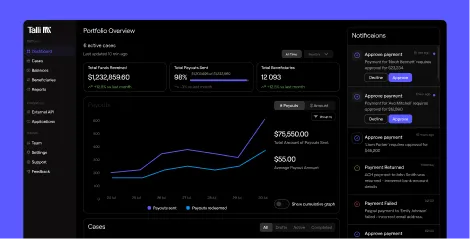
Talli's real-time dashboard provides live visibility into:
- Payment status across all claims and payees
- 1099 reporting readiness by payee
- TIN validation status and B-Notice tracking
- Audit-ready documentation for compliance reviews
For carriers and TPAs processing thousands of claim payments annually, integrated compliance technology reduces manual workload while maintaining complete audit trails from payment initiation through 1099 delivery.
Simplify 1099 Compliance with Talli
Talli's integrated payment platform combines insurance disbursements with automated 1099 compliance, replacing spreadsheets and year-end manual tracking.
Key capabilities include:
- Automated W-9 collection before the first payment
- Real-time payment aggregation by payee and claim type
- Automatic threshold alerts and TIN validation through IRS matching protocols
- Correct 2025 and 2026 reporting rules based on payment date and type
- Classification of medical payments, attorney settlements, and non-reportable property reimbursements
- Generation of 1099-MISC, 1099-NEC, and supporting documentation
- Integrated IRS e-filing and automated recipient delivery for January 31 deadlines
Centralized controls, coordinated approvals, and complete audit trails help high-volume carriers and TPAs reduce penalty exposure while managing complex claim portfolios across jurisdictions and payment types.
Frequently Asked Questions
Do all insurance claim payments require a 1099?
No. Property and casualty claim reimbursements that restore policyholders to their pre-loss condition are generally not reportable. However, medical payments to providers, settlement payments to attorneys, and payments to non-corporate service providers exceeding thresholds do require 1099 reporting.
What happens if I don't provide a W-9 for an insurance payment?
Payees who fail to provide a valid TIN may be subject to 24% backup withholding on future payments. Additionally, if the payer cannot verify the TIN, they may face IRS B-Notices requiring documented solicitation efforts before applying backup withholding.
Are personal injury settlements typically 1099 reportable?
Damages received because of physical injuries or physical sickness are generally excludable from the claimant's income and may not require Form 1099-MISC reporting to the claimant. However, separate reporting may still apply to gross proceeds paid to an attorney, while taxable components such as punitive damages and certain non-physical injury damages may require information reporting.
What is the difference between a 1099-MISC and a 1099-NEC for insurance claims?
Form 1099-NEC reports nonemployee compensation for services, such as payments to independent adjusters or auto repair shops. Form 1099-MISC reports other payment types specific to insurance, including medical payments (Box 6), attorney gross proceeds (Box 10), and other income like taxable settlement damages (Box 3).
What is the deadline for filing 1099 forms with the IRS for 2025 payments?
For tax year 2025 payments filed in early 2026: Form 1099-NEC is due January 31 (both recipient copies and IRS filing). Form 1099-MISC recipient copies are generally due January 31, but statements reporting gross proceeds to attorneys in Box 10 are due February 15. IRS filing is generally due February 28 on paper or March 31 electronically.