.svg)


.svg)
The best disbursement platform for insurance carriers is one that automates OFAC and KYC compliance screening, supports multiple payout rails (ACH, push-to-debit, digital wallets), manages delegated authority fund flows for MGAs and TPAs, and integrates directly with your policy administration and claims management systems. Choosing the wrong disbursement platform for insurance carriers locks you into slow payouts, compliance gaps, and reconciliation headaches that compound across every line of business. The right platform accelerates claim resolution, reduces operational overhead, and keeps regulators satisfied. This guide walks through the evaluation criteria that matter most for carriers, managing general agents (MGAs), and third-party administrators (TPAs) — from compliance automation and delegated authority support to payout speed and integration requirements.
Key Takeaways
- Generic payment processors lack the fund segregation, sanctions screening, and bordereaux reconciliation that insurance disbursements demand.
- Delegated authority models create unique challenges: MGAs and TPAs operating with stale reporting can drive 20–40% capital over-reservation for carriers.
- The eight must-have capabilities span compliance automation, multi-rail payouts, real-time dashboards, and policy admin system integration.
- Digital disbursements reduce average payment timelines by up to 5.5 days compared to paper checks — and 85% of satisfied claimants renew their policies.
- Speed matters beyond operations: Faster digital claim payouts improve claimant experience at the moment of loss, which can strengthen retention and reduce service-call volume.
- Integration determines ROI: A disbursement platform only delivers full value when it connects directly to claims, policy, and finance systems so payments, approvals, and reconciliation happen in one workflow.
What Is a Disbursement Platform for Insurance Carriers — and Why Do Generic Processors Fail?
A disbursement platform for insurance carriers is purpose-built financial infrastructure designed specifically to manage every outbound payment a carrier, MGA, or TPA makes: claims settlements, policyholder refunds, agent commissions, vendor payments, and reinsurance recoveries. It handles fund segregation, regulatory screening, multi-party coordination, and reconciliation back to the originating claim, policy, and reserve account.
Generic payment processors were designed for inbound e-commerce transactions. They lack the architecture for segregated fund structures, bordereaux reconciliation, or the multi-party fund flows that define how carriers, MGAs, and TPAs actually move claims money.
A single claims payment must satisfy four requirements at once: regulated fund safeguarding, multi-currency settlement rules, delegated authority governance controls, and automated reconciliation.
That gap between general-purpose payments and insurance-specific disbursement is where carriers encounter the most expensive operational failures: failed OFAC screens caught after payment release, manual reconciliation consuming 15–25% of claims team capacity, and claimant dissatisfaction from slow payouts driving policy churn. Understanding digital disbursement workflow solutions is the first step toward fixing these problems.
Why Insurance Carriers, MGAs, and TPAs Need Purpose-Built Disbursement Infrastructure
The insurance disbursement problem is structurally different from standard B2B or consumer payments. A disbursement platform for insurance carriers must address three factors that make these payments unique:
- Regulatory complexity — OFAC, KYC, AML, NAIC, and state-level prompt-pay rules all apply simultaneously
- Delegated authority fund flows — MGAs and TPAs pay claims from pre-funded carrier accounts with complex reconciliation
- High-stakes reconciliation — every payment must map to a specific claim, policy, reserve line, and GL code
Regulatory complexity across jurisdictions. Insurance disbursements must comply with OFAC sanctions screening at the point of claim payment — not just at policy issuance. State prompt-pay requirements vary by jurisdiction, while NAIC Model #900 provides the broader unfair-claims-settlement framework that many states build on. PCI-DSS governs payment data security. SOC 2 audits verify operational controls. International carriers face additional frameworks: UK CASS 5 client money rules, EU Solvency II capital requirements, and Lloyd's-specific fund flow protocols.
Delegated authority fund flows. When carriers delegate claims authority to MGAs and TPAs, capital moves through pre-funded accounts, periodic cash calls, and multi-party structures that no standard payment API handles natively. The carrier cannot see live balances in delegated accounts. Fund positions arrive monthly or quarterly via bordereaux, and by the time reporting surfaces, the data is already stale.
High-volume, high-stakes reconciliation. Every disbursement must reconcile against a specific claim number, policy, reserve line, and general ledger code. A single reconciliation error can trigger regulatory scrutiny, audit findings, or reserve misstatements that affect financial reporting.
8 Must-Have Features in a Disbursement Platform for Insurance Carriers
When evaluating a disbursement platform for insurance carriers, these eight capabilities separate purpose-built solutions from generic alternatives:
1. Multi-Rail Payout Options
The platform must support ACH, push-to-debit, wire transfers, prepaid cards, digital wallets (PayPal, Venmo, Apple Pay), and paper checks as a fallback. Claimant preferences vary widely — direct deposit, instant payments, and digital wallets each serve different populations. Offering payee choice drives higher redemption rates and faster settlements.
2. Automated Compliance Screening
Every payment must pass OFAC sanctions screening, KYC verification, and AML checks before release. OFAC requires screening not just at policy issuance but at claim submission, claim payment, policy renewal, and whenever sanctions lists are updated (OFAC FAQ). The platform must automate these checks with configurable rules and exception workflows.
3. Fund Segregation and Safeguarding
Insurance funds — especially QSF-compliant settlement accounts — require strict segregation from operating capital. The platform must maintain separate ledgers per trust, per claim pool, and per delegated authority arrangement. FDIC-insured banking partnerships (such as through Patriot Bank, N.A.) add an additional layer of protection that fiduciary-minded organizations require.
4. Real-Time Dashboards and Audit Trails
Claims teams frequently spend significant capacity fielding payment status inquiries. A platform with real-time dashboards showing payment status, fund positions, and full audit trails eliminates most of these inquiries. Court-ready reporting and exportable audit logs are non-negotiable for carriers operating in regulated environments.
5. Delegated Authority Account Management
For carriers working with MGAs and TPAs, the platform must support pre-funded delegated accounts with real-time balance visibility. Without this, carriers systematically over-fund delegated accounts as a conservative buffer against stale bordereaux data. The platform should provide live fund positions rather than monthly snapshots to release trapped capital.
6. Policy Admin System Integration
Disbursement platforms must integrate with your existing claims management software, policy administration systems, and general ledger. Look for pre-built connectors to major platforms (Guidewire, Duck Creek, Majesco) and open APIs for custom integrations. A platform that requires manual data entry between systems defeats the purpose of automation. Review settlement workflow API mapping for integration planning guidance.
7. Configurable Payment Rules and Approval Workflows
Different lines of business, claim types, and dollar thresholds require different approval chains. The platform must support configurable rules: auto-approve claims under a defined threshold, require dual approval above it, route high-value payments through compliance review, and enforce payment limits by role and authority level.
8. Scalable Transaction Processing
Whether you process 500 claims per month or 50,000, the platform must handle volume spikes — catastrophe events, class action settlements, or open enrollment periods — without degradation. Look for benchmarked throughput data and SLA guarantees for transaction processing times.
How Do Delegated Authority Models Create Unique Disbursement Challenges?
Delegated authority is the single most complex challenge any disbursement platform for insurance carriers must solve. When a carrier grants an MGA or TPA the authority to adjudicate and pay claims, the financial infrastructure must handle:
Pre-funding and cash calls. The carrier deposits funds into a delegated account. The MGA or TPA draws down against it. When the account runs low, a cash call triggers replenishment. Without real-time visibility into drawdown rates, carriers either over-fund (tying up capital) or under-fund (delaying claimant payments).
Bordereaux reconciliation. MGAs and TPAs report their claims activity back to carriers via bordereaux — often monthly or quarterly. This creates a reporting lag where the carrier's view of fund positions is systematically stale. Purpose-built platforms solve this with real-time reconciliation that updates fund positions as each payment processes, not weeks later.
Authority governance. The platform must enforce payment limits, coverage restrictions, and approval thresholds defined in the delegated authority agreement. If an MGA is authorized to pay claims up to $50,000, the platform should block any payment above that threshold and route it back to the carrier for approval.
Industry data shows carriers have recovered over $100 million in previously trapped capital by replacing monthly bordereaux reporting with real-time fund visibility.
What Compliance Requirements Must Every Insurance Disbursement Platform Meet?
Compliance is the single most important capability in any disbursement platform for insurance carriers — it is the foundation, not a feature. Any platform you evaluate must demonstrate compliance across these areas:
For carriers operating internationally, add UK CASS 5 client money rules, EU Solvency II capital adequacy requirements, and Lloyd's FCP (Faster Claims Payment) protocols to the evaluation checklist.
Check fraud remains a material risk for paper-based payouts; FinCEN said financial institutions reported more than $688 million in suspicious activity tied to mail-theft-related check fraud in the six months following its 2023 alert. Digital disbursement platforms with automated screening dramatically reduce this exposure compared to paper-based methods. For deeper analysis, see disbursement fraud prevention strategies.
Speed Benchmarks: How a Disbursement Platform for Insurance Carriers Compares Payment Rails
Payout speed directly affects claimant satisfaction, policy retention, and operational costs. Here is how the major disbursement rails compare:
Digital disbursements reduce average payment timelines by up to 5.5 days compared to paper checks. For catastrophe events — hurricanes, wildfires, floods — that speed difference is the gap between a displaced family waiting two weeks for a check versus receiving funds within minutes. Learn more about how multi-channel payouts work in practice.
Currently, 74% of insurance firms plan to upgrade to instant payout capabilities, signaling that real-time rails are moving from competitive advantage to table stakes.
How Should You Evaluate Disbursement Vendors? A Decision Framework
Use this weighted framework to compare disbursement platforms based on what matters most for your organization:
If you need full delegated authority support with real-time fund visibility, prioritize platforms built specifically for the carrier-MGA-TPA relationship. If your primary concern is multi-rail claimant choice, look for platforms with the broadest payout method coverage. If compliance is your biggest risk area, weight automated screening and audit trail capabilities highest.
Common Mistakes When Choosing a Disbursement Platform for Insurance Carriers
Choosing a general-purpose payment processor. General-purpose payment platforms handle inbound payments well but lack fund segregation, sanctions screening, and insurance-specific reconciliation. The cost of retrofitting compliance and reporting onto a generic platform typically exceeds the cost of choosing a purpose-built solution from the start.
Evaluating only on transaction fees. The cheapest per-transaction cost often comes with the highest operational overhead. A platform charging $0.10 more per transaction but eliminating 15–25% of claims team payment inquiries delivers far better ROI.
Ignoring delegated authority requirements. If you work with MGAs or TPAs today — or plan to — selecting a platform that cannot manage pre-funded accounts and real-time bordereaux reconciliation creates an expensive migration later.
Failing to test integration depth. API documentation does not equal production-ready integration. Require a proof-of-concept with your actual claims management system before committing. Ask for reference customers running a similar tech stack. For a broader framework, see evaluating disbursement vendor criteria.
Overlooking claimant experience. A platform that only supports ACH and checks ignores the 43% of claimants who prefer instant or digital wallet payments. Claimant satisfaction directly impacts retention: 85% of satisfied claimants renew their policies and recommend their carrier
Tools and Solutions: Top Disbursement Platform for Insurance Carriers Options
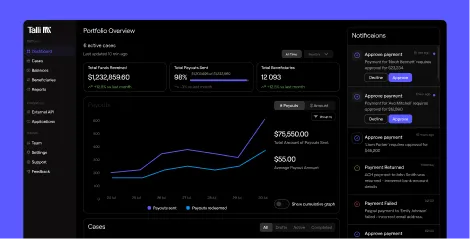
The insurance disbursement market includes both purpose-built insurance platforms and adapted fintech solutions. Here is where the major players fit: Talli is a strong option for compliance-heavy, high-volume digital disbursements where ACH, prepaid cards, PayPal, and related recipient-choice workflows matter most. It specializes in digital claims disbursement infrastructure with a focus on compliance-critical payouts. The platform supports ACH, prepaid Mastercard, PayPal, and gift card disbursements with automated KYC verification, OFAC screening, W-9 collection, and 1099 generation. Talli maintains segregated QSF-compliant accounts through FDIC-insured banking with Patriot Bank, N.A., and provides real-time dashboards with court-ready reporting. For carriers and TPAs handling high-volume settlement distributions, Talli's automated compliance stack and claimant portal address the operational bottlenecks that drive both cost and risk. Book a Demo →
When evaluating platforms, match the solution to your primary operational need — compliance-heavy settlement distributions require automated KYC, OFAC screening, and QSF-compliant accounts as non-negotiable capabilities.
Final Verdict: Which Disbursement Platform Fits Your Organization?
The best disbursement platform for insurance carriers depends on your most pressing operational challenge. For carriers and TPAs managing compliance-critical settlement distributions with high-volume payouts, Talli's automated KYC/OFAC screening, QSF-compliant fund segregation, and real-time audit trails address the core bottlenecks.
The most expensive mistake is choosing a platform based on today's volume while ignoring tomorrow's complexity. Build your evaluation around the decision framework above, weigh the criteria that match your risk profile, and require a proof-of-concept before committing.
Conclusion: Match the Platform to Your Disbursement Reality
Choosing the right disbursement platform for insurance carriers, MGAs, and TPAs means matching the platform to your actual operational complexity — not the one with the longest feature list. Start with your hardest problem. If delegated authority reconciliation consumes your team's time, prioritize real-time fund visibility. If compliance gaps keep you up at night, weight automated screening and audit trails. If claimant churn is your biggest business risk, invest in a multi-rail payout choice.
Whatever your starting point, the direction is clear: 73% of insurance companies have already moved to digital disbursements, and 74% plan to add instant payout capabilities. The carriers and TPAs that modernize their disbursement infrastructure now will operate with lower costs, faster payouts, and stronger regulatory standing than those still printing checks.
Frequently Asked Questions
What is the difference between a claims payment and a disbursement?
A claims payment is the amount owed to a policyholder or claimant based on the adjudicated claim. A disbursement is the actual transfer of those funds through a specific payment rail — ACH, push-to-debit, check, or digital wallet. The claims payment is the obligation; the disbursement is the execution. A strong disbursement platform handles both the compliance checks before release and the multi-rail delivery to the payee.
How long does insurance disbursement typically take?
Disbursement timelines range from under 30 seconds (real-time rails like RTP or FedNow) to 10–14 days (paper checks). Standard ACH transfers settle in 2–3 business days. Same-day ACH and push-to-debit options settle within hours or minutes. The disbursement method and the platform's processing speed both affect the timeline, independent of how quickly the claim itself was adjudicated.
How do MGAs and TPAs handle claims disbursements differently from carriers?
MGAs and TPAs operate under delegated authority from a carrier, meaning they adjudicate and pay claims using pre-funded accounts provided by the carrier. This creates additional complexity: the TPA must operate within authority limits, reconcile every payment back to the carrier, and report activity via bordereaux. Unlike a carrier disbursing from its own reserves, an MGA or TPA must manage the relationship between its delegated fund balance and the carrier's capital requirements.
What compliance requirements apply to insurance disbursements?
Insurance disbursements must comply with OFAC sanctions screening (at multiple lifecycle points), KYC and AML verification, NAIC Model Act #900 prompt payment rules, state-level prompt-pay statutes, PCI-DSS for payment data security, and SOC 2 for operational controls. International carriers also face UK CASS 5, EU Solvency II, and Lloyd's-specific requirements. Failure to screen payees against OFAC lists at the point of disbursement — not just at policy issuance — can result in federal enforcement action.
What is the cheapest way for insurers to pay claims?
Standard ACH transfers typically cost $0.20–$1.50 per transaction, making them the lowest per-transaction option. However, total cost of ownership includes operational overhead: paper checks cost $4–$15 each when you factor in postage, administrative processing, stop-payment fees, and check fraud losses ($225 million industry-wide in 2024). Digital rails with higher per-transaction fees often deliver lower total costs by eliminating manual reconciliation work and reducing payment inquiries.
Can a disbursement platform handle both insurance claims and settlement payouts?
Yes — platforms built for insurance disbursements can typically handle both standard claims payouts (homeowners, auto, workers' comp) and large-scale settlement distributions (class actions, mass torts). The key difference is volume and compliance complexity. Settlement payouts may involve thousands of claimants, require W-9 collection and 1099 issuance, and demand segregated QSF-compliant accounts. Verify that the platform supports both your day-to-day claims volume and periodic high-volume settlement campaigns.