Your settlement just cleared. Where does the money sit, and who's liable if something goes wrong? For law firms and settlement administrators, the answer increasingly depends on scale, complexity, and compliance requirements. Traditional IOLTA accounts serve essential functions for ongoing client relationships, but high-volume settlement distributions demand specialized infrastructure that purpose-built digital disbursement platforms now provide.
Key Takeaways
- IOLTA accounts are state-mandated for nominal or short-term client funds, with interest funding legal aid programs, not designed for mass settlement distributions
- Trust account violations can result in serious disciplinary action, including suspension or disbarment, making accurate fund tracking and reconciliation essential
- Manual IOLTA reconciliation can consume significant staff time each month, with costs depending on transaction volume, accounting complexity, and staffing rates
- Third-party platforms reduce processing time from 6-8 weeks to 24-48 hours while cutting costs by 50-65%
- Paper check distributions see 20-30% of funds go unclaimed, requiring additional tracking costs
- Digital disbursement achieves 95-98% redemption rates versus 70-80% for traditional paper methods
- AI-powered fraud detection reduces fraudulent claims by 40% while identifying suspicious activity faster than manual review
- A hybrid approach can work well: use appropriate attorney trust accounts for routine client funds and specialized third-party infrastructure for complex settlement distributions
Understanding the IOLTA Account: Purpose and Rules
What is an IOLTA Account?
IOLTA, Interest on Lawyers Trust Accounts, represents a state-mandated framework for holding client funds that are either nominal in amount or held for short durations. These pooled, interest-bearing accounts segregate client money completely from firm operating funds, with generated interest directed to state-designated legal aid foundations rather than attorneys or clients.
The fundamental purpose serves two objectives: protecting client assets through enforced segregation and funding access-to-justice programs through aggregate interest. Attorneys handling client funds must follow applicable state trust-account rules. IOLTA generally applies to nominal or short-term funds, while substantial funds held for longer periods may require separate interest-bearing trust accounts.
Key IOLTA Rules for Attorneys
State bars enforce strict requirements governing IOLTA administration:
- Complete segregation: Client funds never mix with firm operating accounts
- Matter-level tracking: Separate ledger entries for each client and case
- Prompt notification: Clients must receive notice of fund receipt within 14 days in California, with similar requirements across states
- Disbursement timelines: Undisputed client funds must be distributed promptly once available, subject to applicable state rules, settlement terms, and legitimate third-party claims
- Record retention: Minimum 5-7 years depending on jurisdiction
The Role of Interest in IOLTA
Unlike standard trust accounts where interest accrues to the depositor, IOLTA programs capture interest on pooled nominal amounts that would otherwise generate no individual benefit. These funds support legal aid organizations, pro bono programs, and access-to-justice initiatives statewide.
Navigating IOLTA Compliance: Challenges and Pitfalls
Maintaining IOLTA Compliance
The monthly three-way reconciliation requirement forms the backbone of IOLTA compliance: bank statements must match the trust ledger, which must match individual client sub-ledgers. This process can consume significant staff time each month, with labor costs depending on transaction volume, accounting complexity, staffing rates, and the firm's level of automation.
Compliance infrastructure typically includes:
- Trust accounting software ($49-350 per attorney monthly)
- Dedicated accounting staff or bookkeeper with trust expertise
- Annual compliance certification on state bar dues statements
- Audit-ready documentation for potential bar reviews
Common IOLTA Violations
Trust account mismanagement can result in serious disciplinary consequences. Common violations include:
- Commingling: Depositing earned fees too late or paying bank fees from trust accounts
- Premature disbursement: Writing checks before funds clear creates overdraft risk and compliance violations
- Missing documentation: Failure to maintain separate ledgers for each client leads to audit failures
- Negative balances: Disbursing more than a client's available balance
Consequences vary by jurisdiction and severity, ranging from corrective action and disciplinary proceedings to suspension or disbarment in serious cases.
Best Practices for IOLTA Management
Firms maintaining IOLTA compliance should:
- Open accounts at state-approved "Leadership Banks" offering waived fees and higher interest rates
- Use legal-specific software rather than generic accounting tools
- Complete reconciliation by the 5th of every month without exception
- Transfer earned fees to operating accounts within days of earning
- Maintain both digital and physical backup records
Traditional Settlement Disbursement: The Challenges of Paper Checks
The Cost of Paper Checks
Paper check distribution creates a substantial operational burden. All-in costs including printing, postage, reconciliation, and reissuance can reach $7-20 per check, expenses that compound dramatically at scale. A 1,000-claimant settlement faces $7,000-20,000 in check processing costs before accounting for staff time, fraud exposure, or reissuance needs.
Additional hidden costs include:
- Manual data entry and address verification
- Check printing and secure storage
- Postage and mailing logistics
- Stop-payment fees for lost or stolen checks
- Staff time handling payment inquiries
High Unclaimed Fund Rates
The most significant failure of paper-based distribution appears in redemption rates. Traditional check methods achieve only 70-80% redemption, leaving substantial settlement funds unredeemed. Uncashed checks can generate additional tracking, outreach, and reissuance costs. Remaining funds must be handled according to the settlement agreement, court orders, and applicable unclaimed-property requirements, which may include escheatment.
Security Concerns with Traditional Mail
Check fraud affects the legal industry at alarming rates. According to the Association for Financial Professionals, 63% of surveyed organizations experienced attempted or actual check fraud in 2024. This organization-level finding highlights risks that can also affect settlement payments, including:
- Mail theft before recipient delivery
- Check washing and alteration
- Forged endorsements
- Duplicate negotiation schemes
These risks multiply for settlement distributions involving thousands of mailed checks across diverse geographic areas.
Third-Party Digital Disbursement Platforms for Legal Settlements
What is a Digital Disbursement Platform?
Third-party disbursement platforms handle the entire settlement distribution lifecycle externally, from Qualified Settlement Fund establishment through final payment and tax reporting. Funds reside in segregated accounts maintained by the platform's banking partners, not in law firm IOLTA accounts.
These platforms transform week-long settlement processes into 24-48 hour payment cycles while automating compliance requirements that would otherwise consume substantial staff resources.
Benefits of Modern Settlement Administration
Digital platforms address every limitation of traditional check-based distribution:
- Speed: Settlement reconciliation reduces from weeks to hours through automated three-way matching
- Cost: Processing costs drop significantly for digital payments compared to paper check distribution
- Redemption: Digital options achieve 95-98% redemption rates versus 70-80% for paper
- Compliance: Built-in KYC, OFAC screening, and tax reporting eliminate manual compliance burden
- Visibility: Real-time dashboards provide instant status updates for all stakeholders
Key Features to Look for in a Third-Party Platform
Settlement administrators evaluating platforms should prioritize:
- Complete fund segregation with dedicated accounts per settlement
- Multi-channel payment options (ACH, prepaid cards, digital wallets)
- Automated compliance infrastructure (KYC/OFAC/W-9)
- FDIC-insured banking partnerships
- Court-ready audit trails and reporting
- Scalability from hundreds to 100,000+ recipients
Enhanced Compliance and Fund Segregation with Digital Platforms
Automated Compliance: Beyond Manual Checks
Talli's Compliance Automation Suite eliminates the manual burden plaguing traditional settlement administration. Integrated KYC verification cross-references claimant information against identity databases automatically, while OFAC sanctions screening achieves compliance checking with documented timestamps for every transaction.
Automated W-9 collection via digital forms with DocuSign integration achieves high completion rates through smart reminders, compared to significantly lower completion without automation. The platform supports tax documentation and applicable 1099 reporting workflows, including 24% backup withholding calculations where required for reportable payments involving missing or incorrect taxpayer identification numbers.
Ensuring QSF Integrity with Digital Tools
Talli supports dedicated FBO account structures that segregate settlement funds and help administrators maintain the records needed for Qualified Settlement Fund compliance. QSF tax treatment depends on meeting the applicable requirements under Treasury Regulation Section 1.468B-1, not account structure alone. This structure provides:
- Complete separation between settlement funds and operating capital
- Prevention of commingling that triggers bar association violations
- Simplified court reporting with matter-level fund tracking
- Audit-ready documentation proving fund separation throughout the disbursement lifecycle
Banking services provided through Patriot Bank, N.A., Member FDIC, support regulated settlement fund custody. FDIC deposit insurance applies subject to applicable coverage limits, ownership rules, and account-record requirements.
Streamlined Reporting for Legal Teams
Automated reporting generates court-required accounting without manual preparation. Stakeholder portals provide controlled access for courts, trustees, and legal teams, while CRM integration via webhooks syncs payment status updates automatically to case management systems.
Cost-Efficiency and Speed: The Talli Advantage
Reducing Disbursement Costs by 50-65%
Talli's digital-first distribution model can reduce processing and reissuance expenses compared to paper checks. Industry cost estimates vary by payment method, transaction volume, and provider agreement. Available options include:
- ACH direct deposit: Low-cost transactions with 1-2 day delivery
- Prepaid Mastercard (via Patriot Bank N.A.): Virtual cards delivered in 30 seconds, physical cards within 5-7 days
- Digital wallets (PayPal, Venmo): Quick-access transactions with instant availability
- Gift cards (via InComm): High redemption rates for distributions under $100
- Wire transfers: Same-day international payment options
- Paper checks: Maintained as fallback option
Accelerating Payments from Weeks to Hours
Distribution timelines compress from 6-8 weeks to 24-48 hours through automated processing. Three-way reconciliation that previously consumed substantial monthly time completes much faster, representing a significant reduction in closing time.
For mass tort distributions involving thousands of claimants, this acceleration means meeting court deadlines that would be impossible with manual check processing.
Maximizing Claimant Redemption Rates
The AB Data case study demonstrates Talli's impact on redemption:
- 30% increase in claimant redemption rates across check-issued populations
- 60% reduction in unresolved exceptions and manual reissuance overhead within 12 months
- 100% fiduciary compliance record maintained across all distribution cycles
As AB Data President & CEO Thomas R. Glenn noted: "We don't think of digital disbursement as a feature, we think of it as infrastructure."
Fraud Prevention and Security in Digital Disbursement
Leveraging AI to Combat Fraudulent Claims
Talli's AI-Powered Fraud Detection achieves high accuracy in identifying fraudulent claims through:
- Device fingerprinting across submissions
- Behavioral analytics detecting suspicious patterns
- Identity verification cross-referencing multiple databases
- Pattern recognition identifying coordinated fraud attempts
Automated detection can help administrators identify suspicious submissions and coordinated fraud patterns earlier in the review process. This is particularly important in high-volume settlements, where duplicate submissions, fabricated identities, and automated claim attempts can overwhelm manual verification.
Industry-Leading Security Standards
Talli maintains enterprise-grade security certifications:
- SOC 2 Type II compliance for operational security
- PCI DSS Level 1 certification for payment card processing
- OFAC screening with automated sanctions list checking
- BSA/AML controls for suspicious activity monitoring
Banking partnerships with FDIC-insured institutions provide additional protection layers for settlement funds.
Real-Time Transparency and Reporting
Live Monitoring of Settlement Payouts
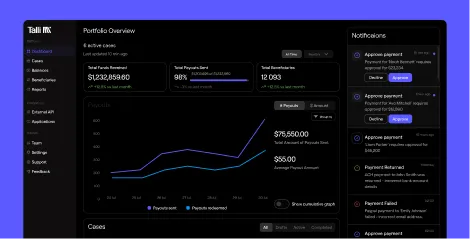
Talli's Real-Time Dashboard provides instant visibility into:
- Completion rates showing percentage of successful payouts
- Payment method distribution across ACH/cards/wallets
- Geographic concentration by region
- Failure root cause analysis
- Fraud flags requiring review
- Remaining fund balances
Generating Court-Required Reports Automatically
Comprehensive reporting eliminates manual report preparation. Court-required accounting generates automatically with complete audit trails documenting every transaction, approval workflow, and fund movement.
Integrating with Existing Case Management Systems
API integration capabilities allow seamless connection with existing law firm trust accounting systems. Webhook support enables real-time status updates, while developer documentation at docs.talli.ai facilitates custom integrations.
The Future of Client Settlement Funds
When to Use Each Approach
The optimal strategy combines both tools for different scenarios:
IOLTA for:
- Ongoing retainer-based billing with frequent small deposits/withdrawals
- Settlements involving fewer disbursements with simple structures
- Single plaintiff or small group allocations
- Matters where firm wants complete control over timing
Third-Party Platform for:
- Mass tort, class action, or multi-plaintiff settlements with numerous claimants
- Complex allocation formulas requiring individual claim verification
- Digital payment options that improve claimant accessibility
- Situations where fraud risk requires AI-driven verification
- Court oversight demanding transparent real-time reporting
The Hybrid Approach
A hybrid approach can work well: use appropriate attorney trust accounts for routine client funds and specialized third-party infrastructure for complex settlement distributions, subject to applicable legal and fiduciary requirements. This separates routine trust management from complex one-time distributions, optimizing both compliance and operational efficiency.
Why Talli for Settlement Disbursement
Talli transforms manual, time-intensive settlement administration into an automated, transparent workflow that protects law firms and claimants. Its scalable platform combines:
- Multi-channel payments to distribute compensation quickly and securely.
- Automated compliance with segregated fund structures and audit-ready documentation.
- Real-time reporting to support transparency and court requirements.
- Industry-leading redemption rates to help ensure claimants receive their rightful compensation.
- Fraud prevention to protect settlement funds and recipients.
Whether managing a 500-claimant class action or a 50,000-participant mass tort, Talli adapts to each settlement's requirements while maintaining court and bar association compliance standards.
By reducing administrative burdens, Talli enables legal teams to focus on advocacy rather than settlement administration.
Frequently Asked Questions
Does a third-party platform replace the need for an IOLTA account entirely?
No. IOLTA accounts remain essential for ongoing client relationships, retainers, cost advances, and routine matter funds still require traditional trust accounting. Third-party platforms complement IOLTA by handling complex, high-volume settlement distributions that exceed in-house capabilities. Most firms maintain both: IOLTA for everyday trust management and platform partnerships for mass distributions.
How do courts view third-party disbursement platforms versus traditional IOLTA distributions?
Courts may approve third-party disbursement arrangements when they meet the settlement's requirements for fund protection, accountability, reporting, and claimant access. Real-time dashboards, automated audit trails, and documented compliance checking satisfy judicial oversight requirements comprehensively. Many settlement agreements now specifically authorize or require specialized disbursement infrastructure for distributions exceeding certain thresholds.
What happens to unclaimed funds on a third-party platform versus IOLTA?
Both face applicable unclaimed-property requirements, but platforms manage the process more efficiently. Third-party systems track dormancy periods automatically and generate required state reporting, while IOLTA accounts require manual monitoring. Platforms also achieve higher initial redemption rates (95-98% versus 70-80%), significantly reducing the volume of funds subject to escheatment proceedings.
Can unbanked claimants receive payments through digital platforms?
Yes. Prepaid Mastercard options can help serve unbanked claimants, a population that includes members of the approximately 5.6 million unbanked U.S. households 2023 FDIC household survey in 2023. Virtual cards deliver via SMS/email in 30 seconds, while physical cards arrive within 5-7 days. No activation fees or monthly charges apply. Gift card options through InComm provide additional alternatives for claimants without traditional banking relationships.
What implementation timeline should firms expect for third-party platforms?
Typical implementation requires 2-4 weeks for full deployment: 1-2 weeks for platform onboarding and verification, followed by campaign configuration (claimant data upload, payment tier setup, notification templates). Fund transfers clear within 1-3 business days after wire initiation. Most firms see positive ROI within several months through reduced processing time and error rates.