.svg)


.svg)
Claims administrators and settlement fiduciaries face a persistent challenge: getting recovered funds into claimants' hands. Traditional paper check methods leave 20-30% of settlement funds unclaimed, triggering costly tracking processes and eventual escheatment to state governments. Meanwhile, payments fraud remains a significant operational risk: 22% of organizations recovered 75% or more of funds lost to payments fraud in 2024, down from 41% in 2023. The payment method you choose directly determines whether claimants receive their entitled funds or those funds disappear into administrative limbo. Digital disbursement platforms offer a proven path to higher take-up rates, achieving 95-98% redemption compared to 70-80% for traditional methods.
Key Takeaways
- Only 22% of organizations recovered 75% or more of funds lost to payments fraud in 2024, down from 41% in 2023, underscoring the financial impact of payment fraud
- Check fraud affects 63% of organizations, yet 91% continue using checks despite this exposure
- Around 2% of organizations reported fraud involving real-time payments (RTP or FedNow), compared with 63% reporting attempted or actual check fraud
- Clear claimant communication and low-friction redemption flows can improve payment completion significantly
- Consumer non-credit-card fraud produced an estimated $63 billion in net losses in 2024 after recoveries, illustrating the broader scale of consumer fraud
- Multi-channel payment options (ACH, prepaid cards, digital wallets) maximize take-up by meeting claimants' preferred payment methods
- Digital disbursement platforms can improve redemption by giving claimants faster access to funds, multiple payment options, and automated reminders
Understanding Take-Up Rates: Why Unclaimed Funds Matter
Take-up rate measures the percentage of entitled claimants who successfully receive and access their settlement funds. For claims administrators, this metric determines whether a settlement achieves its intended purpose or leaves significant funds stranded in administrative processes.
The financial stakes are substantial. Consumers reported losing $10 billion to fraud in 2023, up from $8.8 billion in 2022. Separately, the Federal Reserve estimated $84 billion in non-credit-card fraud losses in 2024, of which consumers recovered $21 billion, leaving an estimated $63 billion in net losses. These figures illustrate the scale of consumer fraud losses rather than settlement take-up rates.
The Cost of Unclaimed Funds: Beyond the Initial Payout
Unclaimed settlement funds create cascading costs that extend far beyond the initial payment attempt:
- Tracking and outreach expenses: Each uncashed check requires additional administrative effort, often costing $150 or more per uncashed check
- Reissuance overhead: Failed payments trigger manual reissuance processes that multiply labor costs
- Escheatment obligations: Unclaimed funds eventually must be reported and remitted to state governments, adding compliance burden
- Court scrutiny: Settlement administrators face increasing judicial oversight of distribution efficiency and post-distribution accounting
The median fraud loss per incident reaches around $500, with 25% of victims losing $2,000 or more. When settlement funds meant to compensate these losses go unclaimed, the harm compounds, and victims lose twice.
Factors Influencing Claimant Redemption
Multiple variables affect whether claimants successfully receive their funds:
- Payment method accessibility: Not all claimants have bank accounts or consistent mailing addresses
- Processing speed: Delays between claim approval and payment arrival reduce engagement
- Communication clarity: Claimants must understand how to access their funds
- Fraud protection: Legitimate payments must reach claimants without interception
Clear claimant communication and low-friction redemption flows can improve payment completion. For settlement administrators, the first payment attempt often determines success or failure.
Digital Payment Methods: Boosting Take-Up and Efficiency
Digital payment channels consistently outperform traditional paper checks across every meaningful metric. The shift from physical to electronic disbursement addresses the core barriers that suppress take-up rates.
Modern multi-channel payment platforms offer claimants choice in how they receive funds:
- ACH direct deposit: $0.25-$0.50 per transaction with 1-2 day delivery
- Prepaid Mastercard: Virtual cards delivered via SMS/email in 30 seconds, physical cards within 5-7 days
- Digital wallets: PayPal and Venmo integration at $0.50-$1.00 per transaction with instant access
- Gift cards: Amazon and Target options for settlements under $100 with highest redemption rates for small-value distributions
- Wire transfers: Same-day option for high-value international payments
The Benefits of Instant Access: ACH and Digital Wallets
Speed directly correlates with redemption. When claimants receive funds within hours rather than weeks, engagement remains high and the settlement fulfills its compensatory purpose.
Digital wallets particularly resonate with younger demographics. Millennials and Gen Z claimants expect the same instant payment experience they receive from peer-to-peer apps. Settlement administrators who offer only paper checks alienate this growing segment of the claimant population.
Survey data shows that only 2% of organizations reported attempted or actual fraud involving RTP or FedNow, compared with 63% reporting check fraud. These figures measure the share of organizations affected, not the percentage of transactions that are fraudulent.
Reaching the Unbanked with Prepaid Cards
Approximately 5.6 million U.S. households were unbanked in 2023, meaning no one in the household had a checking or savings account at a bank or credit union. Paper checks create an immediate barrier for these claimants, who must pay check-cashing fees or find alternative means to access their funds.
Prepaid cards eliminate this barrier entirely. Claimants receive virtual cards instantly via text or email, with no activation fees or monthly charges. The cards work anywhere Mastercard is accepted, providing immediate purchasing power without requiring a bank relationship.
For unbanked claimant populations, prepaid cards transform an inaccessible paper instrument into an immediately usable payment, dramatically improving take-up rates for underserved communities.
Benchmarking Take-Up: Digital vs. Traditional
The performance gap between digital and traditional payment methods is substantial and well-documented. Organizations that continue relying on paper checks accept significantly lower fund recovery rates.
Paper Checks typically achieve 70-80% take-up rates but face significant fraud exposure. Check fraud remains the most common payment fraud type, affecting 63% of organizations in 2024. Processing costs range from $7-20 per check including printing, postage, reconciliation, and reissuance.
ACH Direct Deposit delivers 90-95% redemption rates with dramatically lower costs of $0.25-$0.50 per transaction. ACH credit shows lower fraud exposure than checks in organizational surveys.
Prepaid Cards achieve 93-97% take-up rates at $1-3 per card including issuance and delivery. When paired with proper controls, prepaid cards show minimal fraud exposure.
Digital Wallets represent the highest-performing category, with 95-98% redemption rates at $0.50-$1.00 per transaction. These platforms leverage familiar interfaces claimants already use.
The High Cost of Paper: Tracking and Reissuance
Check fraud remains the most common payment fraud type, affecting 63% of organizations in 2024. Despite this exposure, 91% of organizations continue using checks, with more than 75% having no plans to reduce check usage in the next two years.
The hidden costs of check-based settlement distribution include:
- Mailbox theft: 23% of organizations experienced check fraud due to mail theft
- Stale-dated checks: Checks older than 90-180 days require reissuance
- Address changes: Claimant relocations trigger returned mail and additional outreach
- Forgery and alteration: Paper instruments remain vulnerable to physical manipulation
Each failed check payment compounds the administrative burden. The hidden cost of uncashed checks extends far beyond the face value of the payment.
Digital Payments: A Proven Path to Higher Redemption
Digital disbursement platforms compress distribution timelines from 6-8 weeks to 24-48 hours while achieving 95-98% redemption rates. This performance advantage stems from several factors:
- Instant delivery: Claimants receive funds before interest wanes
- Multiple access points: Digital payments work across devices and locations
- Reduced friction: No trips to banks or check-cashing services required
- Automatic retry capability: Failed transactions can be reattempted without manual intervention
Digital disbursement platforms can improve redemption by giving claimants faster access to funds, multiple payment options, automated reminders, and structured handling for failed payments. Administrators should benchmark results using settlement-specific metrics such as redemption rate, exception rate, reissuance volume, and time to funds.
Payment Processing Costs: Optimizing for Recovery and Budget
Cost efficiency and take-up rates move together. Digital payment methods that improve redemption also reduce per-transaction expenses. This alignment makes the business case for digital disbursement straightforward.
Comparing Transaction Fees: Digital vs. Paper
The cost differential between payment methods is substantial:
- Paper checks: $7-20 all-in costs including printing, postage, reconciliation, and reissuance
- ACH direct deposit: $0.25-$0.50 per transaction
- Digital wallets: $0.50-$1.00 per transaction
- Prepaid cards: $1-3 per card including issuance and delivery
- Wire transfers: $10-30 per transaction for high-value or international payments
Digital disbursement delivers 50-65% cost reduction compared to paper checks while simultaneously improving take-up rates. This dual benefit (lower costs and higher redemption) makes the ROI case compelling.
Beyond the Fee: Hidden Costs of Inefficient Payouts
Transaction fees represent only a fraction of true payment costs. Inefficient disbursement methods generate hidden expenses:
- Exception handling: Manual intervention for failed payments
- Customer service inquiries: Claimants calling to check payment status
- Reconciliation labor: Matching payments to claims manually
- Compliance documentation: Generating court-required accounting reports
- Escheatment processing: Reporting and remitting unclaimed funds to states
Successfully delivering a settlement payment completes the distribution for that claimant while avoiding additional outreach, reissuance, reconciliation, and unclaimed-property work.
Streamlining Claims Administration for Faster Refunds
Automation transforms settlement administration from a manual, error-prone process into a streamlined workflow that maximizes take-up rates. Modern digital disbursement platforms integrate compliance, verification, and payment processing into unified systems.
Automated Compliance: Reducing Delays and Errors
Manual compliance processes create bottlenecks that delay payments and suppress take-up rates. Claimants waiting weeks for verification lose patience and engagement. Automated systems eliminate these delays:
- KYC verification: Cross-reference claimant information against identity databases automatically
- OFAC screening: Check against U.S. Treasury sanctions lists with documented timestamps
- W-9 collection: Digital forms with smart reminders achieve 90% completion versus 40% without automation
- 1099 generation: Automated tax document preparation with IRS e-filing integration
The compliance automation suite ensures every payment meets regulatory requirements without manual review delays. Claimants receive funds faster, and administrators maintain complete audit trails.
Real-Time Visibility into Refund Status
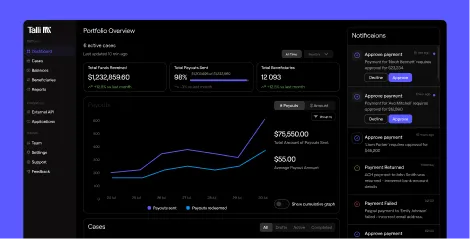
Transparency drives trust and reduces administrative burden. Real-time dashboards provide instant visibility into:
- Completion rates: Percentage of successful payouts by payment method
- Failure analysis: Root cause identification for unsuccessful payments
- Fund balances: Remaining settlement funds awaiting distribution
- Geographic distribution: Regional concentration of claimants and payment status
When claimants can track their own payment status through self-service portals, customer service inquiries drop dramatically. Settlement administrators gain time to focus on exception handling rather than routine status requests.
Fraud Prevention: Securing Recovered Funds and Payouts
Fraud threatens both the funds being distributed and the integrity of the settlement process. Around 79% of organizations experienced actual or attempted payments fraud in 2024, making robust fraud prevention essential for successful fund recovery.
The Rising Tide of Fraud: Protecting Settlements
Business email compromise affected 63% of organizations in 2024, with wire transfers targeted by BEC scammers in 63% of organizations, up from 39% in 2023. ACH credits saw BEC activity in approximately 50% of organizations.
Global fraud losses continue escalating. Consumers lost over $1 trillion to fraud globally in 2024, and global e-commerce losses from payment fraud are projected to reach around $131 billion in 2025.
For settlement administrators, fraud manifests in multiple forms:
- Fraudulent claims: False claimants attempting to intercept legitimate payments
- Payment diversion: Criminals redirecting payments to unauthorized accounts
- Identity theft: Using stolen credentials to claim others' settlements
- Check interception: Physical theft of mailed payments
Leveraging AI for Proactive Fraud Detection
AI-powered fraud detection systems achieve high accuracy while identifying fraud significantly faster than manual review. These systems analyze patterns across:
- Device fingerprinting: Identifying suspicious device characteristics
- Behavioral analytics: Detecting anomalous claiming patterns
- Identity verification: Cross-referencing submitted information against verified data sources
- Network analysis: Identifying connected fraudulent accounts
Robust fraud prevention for digital disbursements protects both settlement funds and claimant trust in the distribution process.
Reaching Diverse Claimants: Inclusivity in Fund Distribution
Settlement populations are diverse, spanning multiple generations, income levels, and banking statuses. Payment methods must accommodate this diversity to maximize take-up rates.
Bridging the Gap: Serving Unbanked Populations
Traditional settlement distribution assumes claimants have bank accounts and stable mailing addresses. This assumption fails for millions of Americans. Prepaid cards and digital wallets provide accessible alternatives that don't require traditional banking relationships.
Payment choice directly impacts take-up rates. When claimants can select their preferred payment method, engagement increases and redemption rates improve. Offering only paper checks excludes significant portions of the claimant population.
Tailoring Payment Options for Millennial and Gen Z Claimants
Younger generations expect digital-first experiences. They manage finances through apps, not checkbooks. Settlement administrators who offer only traditional payment methods risk alienating these claimants entirely.
Digital wallets like PayPal and Venmo resonate with demographics accustomed to instant peer-to-peer payments. These platforms provide familiar interfaces that reduce friction and increase the likelihood of successful fund delivery.
The Role of Compliance in Secure Fund Recovery
Legal settlement distribution operates under strict regulatory oversight. Payment platforms must maintain compliance with multiple frameworks while delivering efficient disbursement.
Maintaining Fiduciary Compliance: QSF and Fund Segregation
Qualified Settlement Funds (QSFs) are governed by IRC Section 468B and related Treasury regulations covering fund qualification, taxation, administration, and reporting. Dedicated settlement accounts and clear fund segregation can support stronger controls, reconciliation, and auditability throughout the distribution process.
Proper fund segregation provides:
- Tax compliance: Maintained QSF treatment for settlement funds
- Audit readiness: Clear documentation of fund separation throughout disbursement
- Court confidence: Simplified reporting with matter-level fund tracking
- Fiduciary protection: Demonstrated compliance with trust obligations
Banking services through FDIC-member institutions ensure institutional-grade security for settlement funds.
Navigating Regulatory Requirements: KYC and OFAC
Settlement administrators must apply the compliance controls required for each distribution based on the settlement, recipient, payment method, and applicable law:
- Identity verification: Verify claimant identity when required by the distribution's risk and compliance framework
- OFAC controls: Screen payments and recipients as required by applicable U.S. sanctions obligations
- Tax reporting: Collect taxpayer information and issue Forms 1099 when the payment is reportable
- Backup withholding: Apply the 24% rate to reportable payments when IRS backup-withholding rules require it
Automated compliance infrastructure handles these requirements without manual bottlenecks, maintaining both speed and regulatory adherence.
Case Studies in Successful Fund Recovery and High Take-Up
Real-world implementations demonstrate the concrete impact of modern disbursement platforms on take-up rates.
Learning from Leaders: AB Data's Digital Transformation
AB Data, a leading U.S. claims administrator managing some of the largest class action settlements worth hundreds of millions of dollars involving hundreds of thousands of claimants, achieved measurable improvements through digital disbursement:
- 30% increase in claimant redemption rates across check-issued populations
- 60% reduction in unresolved exceptions and manual reissuance overhead within 12 months
- 100% fiduciary compliance record maintained across all distribution cycles and regulatory reviews
As Thomas R Glenn, President & CEO of AB Data, stated: "We don't think of digital disbursement as a feature, we think of it as infrastructure. Talli gave us the regulated payout rails we needed to move faster, reduce unclaimed funds, and give courts full confidence in how settlement money is being distributed."
The AB Data case study demonstrates that established claims administrators achieve significant improvements by transitioning to digital-first disbursement infrastructure.
Applying Lessons to Your Claims Process
The patterns from successful implementations translate across settlement types:
- Prioritize payment choice: Offer multiple channels to maximize accessibility
- Automate compliance: Remove manual bottlenecks that delay payments
- Deploy fraud detection: Protect funds while maintaining processing speed
- Enable real-time tracking: Reduce claimant inquiries through transparency
- Measure and optimize: Track take-up rates by payment method and adjust offerings
Settlement administrators should evaluate digital disbursement technology using settlement-specific outcomes such as redemption rates, exception volume, reissuance costs, administrative workload, and time to funds.
Future-Proofing Fund Recovery: The Evolution of Payment Methods
Payment technology continues advancing, creating both opportunities and obligations for settlement administrators. Staying current ensures continued high take-up rates as claimant expectations evolve.
Anticipating Claimant Expectations: Instant and Digital
Consumer use of digital payments has raised expectations for fast notifications, mobile access, clear payment instructions, and convenient redemption options. Settlement administration must meet these expectations or face declining engagement.
Claimants increasingly expect:
- Instant notifications: SMS and email alerts when payments are ready
- Self-service access: Portals for tracking payment status independently
- Mobile-first interfaces: Experiences optimized for smartphone access
- Familiar platforms: Integration with payment services they already use
Staying Ahead of Fraud and Compliance Challenges
The fraud landscape evolves continuously. The share of organizations recovering 75% or more of funds lost to payments fraud fell from 41% in 2023 to 22% in 2024. At the same time, 58% recovered some amount up to 75%, compared with 29% in 2023. These figures describe recovery after payments fraud, not claimant redemption rates.
Future-ready platforms must balance:
- Speed with security: Rapid disbursement without compromising fraud protection
- Automation with oversight: Efficiency gains while maintaining human judgment for edge cases
- Innovation with compliance: New payment methods that satisfy regulatory requirements
- Scale with accuracy: High-volume processing without error rates increasing
For settlement administrators, future-ready payment infrastructure should prioritize claimant choice, reliable delivery, fraud controls, compliance, and measurable redemption performance.
Why Settlement Administrators Choose Talli
Talli's digital disbursement platform addresses the complete settlement distribution lifecycle, from compliance automation to multi-channel payouts to real-time reporting. Claims administrators choose Talli because it delivers measurable improvements in the metrics that matter most:
- Higher Redemption Rates: Talli's multi-channel approach (ACH, prepaid cards, digital wallets, and checks as fallback) ensures every claimant can access funds through their preferred method, driving 95-98% take-up compared to 70-80% for paper-only distributions.
- Faster Distribution: Automated compliance workflows eliminate manual bottlenecks. KYC verification, OFAC screening, and tax form collection happen in parallel, compressing timelines from 6-8 weeks to 24-48 hours.
- Lower Operating Costs: Digital disbursement reduces per-payment costs by 50-65% while simultaneously cutting exception handling, reissuance overhead, and escheatment exposure.
- Complete Fiduciary Compliance: Purpose-built fund segregation, real-time audit trails, and court-ready reporting give settlement administrators confidence that every distribution meets regulatory requirements and fiduciary standards.
- Fraud Protection: Multi-layer fraud detection combines device fingerprinting, behavioral analytics, identity verification, and network analysis to protect settlement funds while maintaining rapid processing speed.
Settlement administrators working with Talli gain more than technology. They gain a partner committed to maximizing claimant redemption while minimizing administrative burden and maintaining absolute fiduciary compliance.
Frequently Asked Questions
What constitutes a strong take-up rate for settlement distributions?
Digital disbursement platforms targeting 95-98% redemption rates represent best-in-class performance. Traditional paper check methods typically achieve 70-80% take-up, meaning 20-30% of funds go unclaimed. For large settlements, this gap translates to millions of dollars that fail to reach intended recipients. Claims administrators should benchmark their current redemption rates and identify payment method changes that could improve performance.
How do escheatment laws affect unclaimed settlement funds?
Unclaimed settlement funds eventually must be reported and remitted to state governments under unclaimed property laws. Dormancy periods vary by state, typically ranging from one to five years. Before escheatment, administrators must conduct due diligence outreach attempts, adding cost and complexity. Higher take-up rates through digital payment methods reduce escheatment exposure and associated compliance burden.
What payment methods work best for international claimants in global settlements?
Multi-jurisdictional settlements require payment infrastructure supporting multiple currencies and local payment rails. Wire transfers serve high-value international payments despite higher per-transaction costs. Digital wallets with international presence (PayPal operates in 200+ markets) provide cost-effective alternatives for smaller payments. Prepaid cards with international acceptance bridge accessibility gaps. Settlement administrators should evaluate claimant geography early and ensure payment options accommodate all jurisdictions.
What role does claimant communication play in improving take-up rates?
Communication directly impacts whether claimants successfully receive and access their funds. Best practices include immediate notification when payments are initiated, clear instructions for accessing different payment types, self-service portals for status tracking, and follow-up reminders for unclaimed payments. Platforms that provide real-time tracking and multi-channel notifications consistently achieve higher take-up rates than those relying solely on mailed correspondence.
How should settlement administrators evaluate digital disbursement vendors?
Key evaluation criteria include payment method variety (ACH, cards, digital wallets, checks as fallback), compliance infrastructure (automated KYC, OFAC screening, tax form collection), fraud detection capabilities, integration options (API, webhooks, CRM sync), security certifications (SOC 2 Type II, PCI DSS), scalability for high-volume distributions, and proven track record with comparable settlements. Requesting case studies with specific take-up rate improvements provides concrete performance evidence.