.svg)


.svg)
Unclaimed dividend liability represents one of the most persistent compliance challenges for corporations managing shareholder distributions. With an estimated 80% of U.S. organizations non-compliant with unclaimed property laws and state governments holding over $70 billion in unclaimed assets, corporations need systematic approaches to prevent dividend abandonment before it occurs. Modern shareholder services platforms offer the infrastructure to address these challenges through automated workflows and digital payment options that achieve significantly higher redemption rates than traditional methods.
Key Takeaways
- An estimated 80% of U.S. organizations remain non-compliant with state unclaimed property laws, creating substantial escheatment exposure
- Unclaimed dividends become corporate liabilities after 3-7 year dormancy periods depending on jurisdiction
- Only 5-20% of escheated property ever reunites with rightful owners—representing permanent loss
- Paper check processing costs approximately $8 per payment compared to under $1 for digital alternatives
- SMS outreach achieves 10-16% response rates versus 2-3% for email in dividend claim scenarios
- Digital payment adoption reduces unclaimed rates significantly when properly implemented
- States collected over $506.6 million in escheatment revenue (Delaware FY2017), driving aggressive enforcement
What Is Unclaimed Dividend Liability and Why Does It Lead to Escheatment?
Unclaimed dividend liability occurs when shareholders fail to claim declared dividends within statutory timeframes established by state laws. These unclaimed funds create ongoing balance sheet obligations that distort corporate financial health until either paid to rightful owners or escheated to state governments.
The escheatment process follows a predictable pattern:
- Dormancy period begins when a dividend remains unclaimed after distribution
- Statutory waiting period ranges from 3-7 years depending on jurisdiction
- Due diligence requirements mandate specific outreach efforts before escheatment
- State reporting deadlines typically fall between April and November annually
- Fund transfer to state unclaimed property offices becomes mandatory after all conditions are met
The financial impact extends beyond regulatory compliance. Unclaimed dividends obscure the true financial health of corporations by appearing as persistent liabilities that affect liquidity ratios and debt-to-equity calculations.
Why Do State Governments Aggressively Pursue Escheatment?
Escheatment revenue now ranks as a major revenue source for many states. Delaware alone collected $506.6 million in FY2017, with substantial portions coming from stock custody specifically.
This revenue dependency drives increasingly aggressive audit activity. States commonly audit 10-15 years of records retroactively, creating substantial exposure for companies with historical non-compliance.
What Are the True Costs of Traditional Dividend Disbursement Methods?
Traditional paper-based dividend distribution creates compounding inefficiencies that drive up costs while simultaneously increasing abandonment risk. The all-in cost of processing a single dividend check averages approximately $8 when accounting for printing, postage, reconciliation, and reissuance.
The cost breakdown includes:
- Check production expenses for printing and envelope preparation
- Postage costs that increase with address correction requirements
- Manual reconciliation labor consuming 15-20 hours weekly for mid-sized programs
- Address verification failures causing significant return rates
- Reissuance processing for lost, damaged, or expired instruments
- Escheatment tracking costs at $150 per uncashed check
Digital alternatives reduce per-payment costs to under $1 while eliminating most failure modes. Modern digital disbursement platforms achieve significant cost reduction compared to paper checks by processing payments at lower transaction costs depending on method selected.
How Does Payment Method Affect Abandonment Rates?
Payment method directly correlates with redemption success. Research indicates that 80% of recipients prefer digital payment options over traditional checks when given the choice.
The abandonment rate differential is substantial:
- Paper checks: 20-30% go unclaimed
- Digital methods: Achieve significantly higher redemption rates
- Prepaid cards: Eliminate delivery failures for unbanked populations
How Can Digital Payment Strategies Maximize Dividend Redemption Rates?
Maximizing redemption requires offering shareholders multiple payment channels that accommodate diverse banking situations and preferences. Modern multi-channel payment distribution provides multiple distinct options that collectively achieve higher redemption rates compared to traditional paper methods.
Available digital payment methods include:
- ACH direct deposit at $0.25-$0.50 per transaction with 1-2 day delivery
- Prepaid Mastercard serving the 5.9 million unbanked U.S. households
- Digital wallets (PayPal, Venmo) at $0.50-$1.00 per transaction with instant access
- Gift cards for distributions under $100 per shareholder
- Wire transfers for high-value international payments
- Paper checks maintained as fallback for non-digital participants
What Communication Strategies Reduce Abandonment?
Effective shareholder communication operates on a cycle-by-cycle timeline that intercepts potential abandonment before dormancy begins. Companies should utilize multiple communication channels, including email, phone, and traditional mail to ensure shareholders receive critical information.
The recommended intervention schedule:
- 90 days pre-dividend: Automated email campaign requesting contact verification
- 60 days pre-dividend: SMS notifications achieving higher response rates versus email
- 30 days pre-dividend: Physical mail to addresses without digital engagement
- Distribution day: Push notifications through shareholder mobile apps
- Post-distribution: Weekly automated reminders for first 60 days
How Does Compliance Automation Reduce Risk in Dividend Payouts?
Manual compliance processes introduce vulnerabilities that expose organizations to regulatory penalties. Compliance automation suites integrate KYC verification, OFAC sanctions screening, automated W-9 collection, and 1099 generation to eliminate these gaps.
Key compliance automation capabilities include:
- KYC identity verification cross-referencing against identity databases automatically
- OFAC screening with documented timestamps for audit purposes
- W-9 collection achieving higher completion rates through smart reminders
- 1099-MISC/1099-NEC generation with IRS e-filing integration
- 24% backup withholding calculation for missing TIN numbers per IRS requirements
Fund segregation represents another critical compliance element. Dedicated FBO (For Benefit Of) account structures preserve Qualified Settlement Fund (QSF) tax treatment under IRC Section 468B while preventing commingling that triggers regulatory violations.
What Audit Documentation Is Required?
States require comprehensive documentation proving outreach attempts, address verification, and shareholder contact throughout the dormancy period. Compliance guidelines emphasize maintaining records that demonstrate good-faith efforts to locate rightful owners.
Required documentation includes:
- Evidence of address verification searches
- Copies of due diligence letters with specific timing and language
- Records of all contact attempts across channels
- Documentation of payment method options offered
- Complete transaction history from declaration through final disposition
How Does Faster Disbursement Improve Shareholder Satisfaction?
Payment velocity directly influences shareholder perception of corporate governance quality. Modern platforms transform week-long settlement processes into 24-48 hour payment cycles, compressing distribution timelines from 6-8 weeks to under two days.
The operational improvements include:
- Automated three-way reconciliation achieving high auto-match rates
- Settlement reconciliation reduced from weeks to hours
- Monthly closing time decreased significantly
- Real-time status tracking visible to shareholders and administrators simultaneously
What Real-Time Visibility Do Modern Platforms Provide?
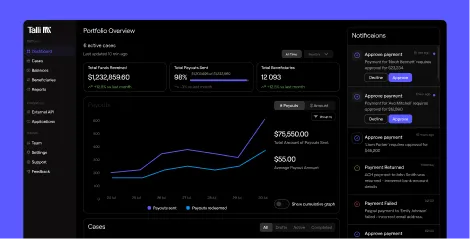
Real-time dashboards and reporting provide live monitoring of payment status, completion rates, and fund flows. Stakeholder portals offer controlled access for courts, trustees, and legal teams while automated reporting generates audit-ready documentation without manual preparation.
What Role Does Technology Play in Preventing Fraud in Shareholder Distributions?
Fraudulent claims have increased dramatically across all disbursement categories. Industry-wide, AI-powered fraud detection employs pattern recognition across device fingerprinting, behavioral analytics, and identity verification to achieve high accuracy while identifying fraud faster than manual review.
Fraud prevention capabilities include:
- Device fingerprinting to identify suspicious access patterns
- Behavioral analytics detecting anomalous claim submissions
- Identity verification cross-referencing multiple databases
- Real-time flagging of claims requiring human review
- Significant reduction in fraudulent claims through automated detection
What Best Practices Should Dividend Administrators Follow Today?
Modern dividend administration requires abandoning reactive approaches in favor of systematic cycle-by-cycle prevention. Companies are adapting to new media, with traditional formats being used alongside modern channels for shareholder engagement.
Essential best practices include:
- Implement multi-channel communication before each dividend cycle begins
- Offer digital payment options as primary distribution method
- Automate dormancy monitoring with intervention triggers at 50%, 75%, and 90% of statutory periods
- Maintain comprehensive audit trails documenting all outreach efforts
- Conduct regular address verification using database searches including NCOA registries
Leveraging technology platforms enables firms to streamline workflow, improve communications, and ultimately achieve faster case duration through automation.
How Do You Choose the Right Partner for Streamlined Shareholder Payouts?
Selecting a disbursement partner requires evaluating capabilities across compliance, scalability, and claimant experience. Purpose-built platforms designed for legal settlements and shareholder services outperform generic payment processors that require extensive customization.
Critical evaluation criteria include:
- QSF compliance embedded versus bolt-on solutions
- Multi-jurisdictional support across 190+ countries with 150+ currencies
- Scalability from 1,000 to 100,000+ recipients without performance degradation
- Security certifications including SOC 2 Type II and PCI DSS Level 1
- API integration capabilities with existing corporate systems
Transform Your Dividend Distribution with Talli
Reducing unclaimed dividend liability requires a comprehensive platform that addresses the full lifecycle of shareholder distributions—from initial declaration through final payment and compliance reporting. Talli's platform delivers enterprise-grade capabilities specifically designed for legal settlement and shareholder distribution scenarios.
By combining multi-channel payment options, automated compliance workflows, real-time tracking, and AI-powered fraud detection, Talli helps corporations minimize escheatment risk while reducing operational costs. The platform's purpose-built infrastructure ensures that every dividend cycle operates with maximum efficiency, achieving higher redemption rates and maintaining complete audit trails for regulatory compliance.
Organizations looking to modernize their approach to shareholder distributions can leverage Talli's proven technology to transform lengthy, paper-based processes into streamlined digital experiences that benefit both corporations and shareholders alike.
Frequently Asked Questions
What happens to dividends that go unclaimed after the dormancy period expires?
After the statutory dormancy period (typically 3-7 years depending on state), corporations must escheat unclaimed funds to the state where the shareholder last resided. Once escheated, only 5-20% of property ever reunites with rightful owners. Shareholders retain perpetual claiming rights from state unclaimed property offices, but the administrative burden shifts entirely to individual claimants.
How do corporations handle international shareholders with different regulatory requirements?
International shareholder distributions require compliance with varying regulatory frameworks across jurisdictions. Modern platforms support multi-jurisdictional payments across 190+ countries with 150+ currencies and 300+ payment rails. GDPR-compliant data handling addresses European requirements, while multi-language support ensures accessibility regardless of shareholder location.
What SEC requirements apply to locating lost shareholders before escheatment?
SEC Rule 17Ad-17 requires transfer agents, brokers, and dealers to exercise reasonable care to locate lost securityholders, including conducting two database searches using at least one information database service. These searches help document due diligence, but state abandonment and escheatment rules are governed separately by applicable law.
Can shareholders reclaim dividends after they have been escheated to the state?
Yes, shareholders retain perpetual rights to claim escheated dividends from state unclaimed property offices. However, the process requires individuals to navigate state-specific claim procedures, provide identity verification, and potentially wait months for processing. Some states have implemented innovative programs where they proactively match unclaimed property to residents and issue automatic payments without requiring claim filing.
How does voluntary disclosure protect companies from historical non-compliance exposure?
Voluntary disclosure programs allow companies to remediate past escheatment exposure with reduced penalties before states initiate audits. These programs typically offer penalty abatement or reduction in exchange for comprehensive review and correction of historical non-compliance. Given that states commonly audit 10-15 years of records retroactively, voluntary disclosure provides a cost-effective alternative to defending against full enforcement actions.