.svg)


.svg)
Paper-based shareholder payments create a cost problem that reaches far beyond printing and postage. Government payment data shows the same pattern: paper checks are more expensive, slower to resolve, and more exposed to exceptions than electronic payments. The U.S. Treasury has noted that paper checks are at least 16 times more likely than electronic disbursements to be reported lost, stolen, returned undeliverable, or altered.
For finance teams managing dividends, securities settlements, bankruptcy distributions, and shareholder payouts, that risk compounds across thousands of recipients. Every returned envelope, stale-dated check, duplicate request, and manual reconciliation item adds labor cost and delays. Modern shareholder payment solutions reduce those costs by moving recipients toward digital redemption, automated compliance checks, and real-time reporting.
The business case is straightforward: digital disbursement lowers per-payment costs, reduces check exceptions, increases redemption, and gives finance teams faster visibility into fund status. The question is not whether paper creates waste. It is how much waste your organization can remove by modernizing the disbursement workflow.
Key Takeaways
- Paper checks can cost $7-$20 per transaction once printing, postage, labor, reconciliation, exceptions, and reissuance are included.
- Digital payment methods often cost $0.25-$5 per transaction, depending on channel and program design.
- FinCEN reported more than 680,000 check fraud Suspicious Activity Reports in 2022, nearly double the 2021 total.
- Electronic delivery of fund shareholder documents could save funds and shareholders $589 million to $797 million annually, showing how paper-heavy shareholder operations create measurable cost drag.
- Digital disbursement platforms can improve redemption by giving shareholders multiple ways to receive funds.
- The strongest ROI model includes processing cost, exception cost, fraud exposure, unclaimed funds, reconciliation labor, and audit preparation.
Understanding the True Cost of Traditional Shareholder Disbursements
The visible cost of a paper check is small. The total cost is not. Finance teams must account for check stock, printing, postage, banking fees, address validation, returned mail, stop payments, stale checks, fraud review, reissuance, and manual reconciliation.
A single paper check may look inexpensive when measured only by postage and materials. But high-volume shareholder distributions expose the operational cost behind the check. Teams must monitor outstanding items, answer shareholder inquiries, verify replacement requests, and document every exception for audit purposes.
That is why paper disbursement creates a larger finance burden than the payment itself. It turns a distribution event into a long-tail administrative process.
Common cost drivers in paper check programs
Traditional check workflows usually include several recurring cost categories:
- Issuance cost: printing, envelopes, postage, check stock, and payment file preparation.
- Labor cost: staff time for approvals, batch review, exception handling, and bank reconciliation.
- Fraud exposure: altered checks, stolen mail, duplicate replacement requests, and identity mismatches.
- Returned mail: address failures that require research, outreach, and reissuance.
- Stale checks: uncashed funds that must be tracked until resolved, reissued, or escheated.
- Audit preparation: manual reporting to prove payment status, fund balance, and exception history.
These costs grow quickly when distributions involve tens of thousands of shareholders. A 2% exception rate on a small payout may be manageable. A 10% exception rate on a 100,000-recipient distribution creates months of follow-up.
Calculating Unclaimed Fund Exposure
Unclaimed shareholder payments are not just a service issue. They create accounting, compliance, and reputational risk. When checks remain uncashed, finance teams must keep suspense records, track dormancy timelines, and comply with state unclaimed property rules.
Unclaimed payment costs often include:
- Research and outreach: staff or vendor time to locate recipients and confirm payment preferences.
- Replacement processing: stop-payment fees, new check issuance, and fraud review.
- Dormancy tracking: monitoring state-specific escheatment timelines.
- Regulatory reporting: preparing unclaimed property files and supporting documentation.
- Court or stakeholder reporting: proving that reasonable distribution efforts were made.
For shareholder services teams, reducing unclaimed funds improves more than recipient experience. It reduces the long-tail liabilities that remain after a distribution should have closed.
Digital disbursement helps by giving shareholders faster, more flexible redemption options. Instead of waiting for a mailed check, a shareholder can choose ACH, prepaid card, PayPal, Venmo, gift card, wire, or paper fallback depending on the program design.
Building the ROI Model
A practical ROI model starts with your current distribution volume and actual exception rates. Finance teams should compare the full cost of paper against the full cost of digital, not just bank fees.
Core inputs to include
Use these categories when modeling modernization savings:
The biggest savings often come from exception reduction, not the transaction fee alone. If a finance team saves $10 on issuance but still spends heavily on failed payments, the ROI will be limited. If it also reduces unclaimed payments, replacement requests, and reconciliation time, the return improves sharply.
Example cost model
Consider a quarterly shareholder distribution with 50,000 payments.
Traditional paper check model:
- Processing: 50,000 × $12 average = $600,000
- Unclaimed or unresolved items: 10,000 × $75 average resolution cost = $750,000
- Reissuance: 3,000 × $12 = $36,000
- Manual reconciliation and reporting: $75,000
- Estimated quarterly cost: $1,461,000
Digital-first disbursement model:
- Processing: 50,000 × $2 average = $100,000
- Unresolved items: 2,500 × $35 average resolution cost = $87,500
- Reissuance or payment changes: 1,000 × $2 = $2,000
- Automated reporting and reconciliation review: $25,000
- Estimated quarterly cost: $214,500
Estimated quarterly savings: $1,246,500
The exact result will vary by payment mix, shareholder demographics, platform pricing, and exception rates. But the model shows why finance teams should evaluate the whole distribution lifecycle. Paper check costs continue after the check is mailed. Digital platforms are designed to reduce that long tail.
Modern Payment Methods for Shareholder Distributions
The best disbursement programs do not force every shareholder into one channel. They provide a controlled set of approved payment methods, then let recipients choose the option that fits their needs.
Payment method comparison
This flexibility matters because shareholder populations are not uniform. Some recipients want direct deposit. Others prefer digital wallets. Some do not have bank accounts. The FDIC reported that about 5.6 million U.S. households were unbanked in 2023, making prepaid cards and wallet-based options important for inclusive payout design.
Talli supports multi-channel payout workflows through multi-channel payouts, giving finance teams a way to reduce paper reliance without excluding recipients who still need a fallback option.
Compliance and Security ROI
Modernization is not only a cost project. It is also a control project. Shareholder distributions often involve tax reporting, identity verification, sanctions screening, audit trails, and segregation of funds.
Manual workflows make those controls harder to prove. Digital disbursement platforms improve compliance by embedding checks directly into the payment workflow.
Controls finance teams should require
A modern platform should support:
- KYC verification: confirms identity before funds are released.
- OFAC screening: checks recipients against sanctions lists with timestamped documentation.
- W-9 collection: captures tax forms digitally before reportable payments.
- Backup withholding logic: applies the 24% withholding rate when required for missing or invalid taxpayer information.
- 1099 preparation: supports year-end tax reporting workflows.
- Audit logs: records payment status, user actions, fund movements, and exceptions.
These features matter because finance teams must prove that funds were paid correctly, not merely that payments were attempted. A platform with shareholder KYC checks and documented audit trails reduces the evidence gap that appears during audits, court reporting, or internal reviews.
Reconciliation and Reporting Gains
Reconciliation is where paper-heavy disbursements create some of the most persistent costs. Checks may remain outstanding for weeks or months. Returned mail requires manual review. Replacement checks create duplicate records unless controls are tight.
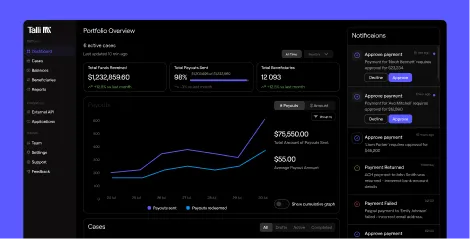
Digital platforms improve this process by giving finance teams real-time visibility into payment status. Instead of waiting for bank files and spreadsheet updates, teams can see which payments were delivered, redeemed, failed, or pending.
Real-time reporting capabilities
Effective real-time payment tracking should show:
- payment completion rate;
- payment method selection;
- failed or returned payments;
- unresolved exceptions;
- fund balance by campaign;
- geographic distribution;
- audit history by recipient;
- reconciliation status.
This visibility changes how finance teams manage distributions. Instead of discovering problems at month-end close, teams can identify payment failures and recipient drop-off while the distribution is still active.
Automated reporting also supports legal, trustee, and executive stakeholders. Teams can provide status reports without rebuilding the same spreadsheet each week.
Implementation Considerations for Finance Leaders
Most modernization projects succeed or fail before the first payment is sent. The strongest implementations start with clean data, clear workflow ownership, and defined exception rules.
Before launch, finance teams should confirm:
- shareholder registry quality;
- required tax documentation;
- payment method eligibility rules;
- jurisdiction-specific compliance requirements;
- abandoned property workflows;
- audit reporting requirements;
- bank account and FBO account setup;
- approval authority and role-based access;
- recipient communication templates;
- escalation rules for failed payments.
A digital rollout does not need to eliminate paper immediately. Many organizations begin with a default-digital model while preserving paper checks for shareholders who request or require them. This approach captures most savings while maintaining accessibility.
For larger programs, a phased rollout can reduce risk. Finance teams can test a smaller group, confirm redemption behavior, refine communications, and then expand to the full shareholder population.
How Talli Supports Shareholder Disbursement ROI
Talli is built for high-volume legal and shareholder distribution workflows where speed, compliance, and auditability matter. The platform helps finance teams launch, fund, and track campaigns through one dashboard while supporting multiple payment methods.
Through digital disbursement platforms, Talli gives teams the infrastructure to reduce paper checks, improve redemption, and monitor payments in real time. Its class action payouts, bankruptcy payments, and mass tort disbursements use the same core controls needed for shareholder services: fund segregation, recipient verification, payment choice, and audit-ready reporting.
Talli supports ACH, prepaid Mastercard through Patriot Bank N.A., PayPal, Venmo, gift cards through InComm, wire transfers, and paper checks as fallback. That range helps teams reduce check dependency without creating access barriers for shareholders.
The platform also includes compliance workflows such as KYC verification, OFAC screening, W-9 collection, fraud mitigation, and audit logging. These controls help finance teams prove not only that money was sent, but that it was sent to the right recipient through a documented process.
With comprehensive reporting, finance teams can monitor completion rates, unresolved exceptions, and fund balances without relying on manual spreadsheet reconciliation. That visibility is where modernization moves from cost savings to operational control.
Talli Conclusion: Modernization Turns Disbursement From Cost Center to Control System
Shareholder disbursement ROI is not limited to lower transaction fees. The larger value comes from reducing exceptions, shortening payout timelines, increasing redemption, and giving finance teams clearer evidence for every payment decision.
Paper checks create a long tail of work: stale checks, returned mail, replacement requests, fraud review, escheatment tracking, and manual audit reporting. Digital disbursement platforms reduce that burden by combining payment choice with built-in compliance and real-time reporting.
For finance teams managing high-volume shareholder payments, Talli provides purpose-built infrastructure that helps replace paper-heavy workflows with faster, more controlled distribution operations. The result is lower administrative cost, fewer unresolved payments, stronger audit readiness, and a better shareholder experience.
Frequently Asked Questions
How should finance teams calculate digital disbursement ROI?
Start with total paper cost, including printing, postage, labor, returned mail, replacement checks, reconciliation, fraud review, and unclaimed property work. Then compare that with digital transaction costs, platform fees, expected exception reduction, and staff time saved.
Should paper checks disappear completely?
Not always. Many programs work best with a default-digital model and paper checks as a fallback. This approach captures most cost savings while preserving access for shareholders who cannot or do not want to use digital payment methods.
Which payment method usually creates the lowest cost?
ACH is typically the lowest-cost digital method for banked shareholders. However, prepaid cards, PayPal, Venmo, gift cards, and wires may be better for certain recipients depending on payout amount, location, bank access, and urgency.
What compliance features matter most in shareholder disbursements?
Finance teams should look for KYC verification, OFAC screening, W-9 collection, backup withholding logic, 1099 support, fund segregation, role-based access, and complete audit logs. These controls help prove that payments were handled correctly.
How quickly can a digital disbursement platform show ROI?
ROI depends on payment volume, paper check costs, exception rates, and platform pricing. High-volume programs often see value quickly because savings come from multiple areas at once: lower payment costs, fewer reissues, faster reconciliation, and reduced unclaimed funds.