.svg)


.svg)
Settlement disbursement reporting should answer four judge-facing questions in plain numbers: how much of the fund reached class members, how the notice and payment methods performed, how unclaimed funds were handled, and whether the administrative costs and attorneys' fees match what the court approved at final approval. Everything else in a court disbursement report is supporting detail.
The federal standard under Rule 23(e) requires courts to find a class action settlement "fair, reasonable, and adequate" before final approval — and increasingly, courts extend that scrutiny past final approval into the post-distribution phase. The Northern District of California's procedural guidance is now the de facto template for what a rigorous court disbursement report should contain, and plaintiffs' firms and claims administrators across other districts are adopting it voluntarily to avoid friction.
This guide breaks down exactly what judges are looking for in settlement disbursement reporting, the specific data points every court disbursement report should include, the reporting gaps that trigger additional hearings, and the operational workflow that makes court-ready reporting a byproduct of your disbursement process — not a frantic last-minute scramble.
Key Takeaways
- Judges evaluate settlement disbursement reporting against four core questions: how much reached the class, how payment methods performed, how unclaimed funds were handled, and whether costs matched the approved settlement agreement.
- The Northern District of California requires a Post-Distribution Accounting within 21 days of settlement checks becoming stale — and the core cash-distribution reporting categories have become a widely used benchmark, but the Northern District of California's actual post-distribution accounting requires additional fee and lodestar disclosures as well.
- The most common reporting gaps that trigger judicial scrutiny are missing per-claimant recovery statistics, vague cy pres distribution reasoning, and missing claim-method performance breakdowns.
- Modern digital disbursement infrastructure generates every required court disbursement report field automatically from the disbursement workflow, turning post-distribution accounting into a one-click export instead of a reconstruction exercise.
What Judges Actually Expect in Settlement Disbursement Reporting
The top class action settlements have exceeded $40 billion for three consecutive years, with those ten settlements totaling roughly $42 billion in 2024. That growth tracks with broader class action settlement statistics showing both higher fund sizes and more scrutinized distribution mechanics. Volume at that scale has pushed federal judges toward heightened scrutiny — not just at preliminary approval, but through the distribution and reporting tail.
At a practical level, judges reviewing settlement disbursement reporting are looking for three things:
- Evidence the settlement actually worked as promised. The preliminary approval order assumed certain claim rates, notice success, and per-claimant recoveries. The court disbursement report should show whether reality matched those assumptions.
- A clear accounting of every dollar. Every dollar of the common fund should be traceable — paid to a class member, paid to counsel, paid to an administrator, or paid to a cy pres recipient with court approval.
- Transparency on shortfalls. If 40% of the class never claimed, if notice came back undeliverable for a sizable segment, or if payment methods underperformed, judges want to see it plainly — not buried.
The underlying reason is simple: judges have a fiduciary duty to absent class members. Settlement disbursement reporting is how they verify that duty was honored after they signed the final approval order.
Why Reporting Standards Keep Tightening
The 2018 amendments to Rule 23 formalized the "fair, reasonable, and adequate" criteria, but the bigger shift is cultural. District courts across the country have watched claim rates stay low in consumer class actions, payment methods underperform, and residual funds go to questionable cy pres recipients. In response, more judges are asking for post-distribution accountings even when local rules do not require them — borrowing directly from the Northern District of California's template.
If your settlement fund reporting is not built for that level of scrutiny, you will get it anyway when the judge asks questions at the compliance hearing.
The Core Data Points Every Court Disbursement Report Must Include
A strong court disbursement report answers every factual question a judge might reasonably ask without requiring a follow-up. The Northern District of California's post-distribution accounting framework is the most structured version of this and uses a Post-Distribution Accounting Form whose core cash-distribution reporting categories are summarized here, though the court's full post-distribution accounting requires additional fee, lodestar, and case-specific disclosures.
Core N.D. Cal. post-distribution reporting categories at a glance:
The core cash-distribution fields for a court-ready disbursement report:
- Total settlement fund
- Total number of class members
- Number of class members to whom notice was sent and not returned as undeliverable
- Number and percentage of claim forms submitted
- Number and percentage of opt-outs
- Number and percentage of objections
- Average, median, maximum, and minimum recovery per claimant
- Methods of notice and payment to class members
- Percentage of success for each method of notice and payment (if known)
- Number and value of checks not cashed
- Amounts distributed to each cy pres recipient
- Administrative costs
- Attorneys' fees and costs
Each of these answers a specific judicial concern — and the ones claims administrators most often get wrong are the per-claimant recovery statistics (judges want distribution, not just the average) and the method-level performance breakdowns.
Why Per-Claimant Distribution Matters More Than the Average
When a court disbursement report lists only the average per-claimant recovery, it hides whether the settlement produced a handful of large payouts and many small ones or a uniform distribution. Judges use the median, minimum, and maximum to gauge whether the class formula was applied fairly and whether any claimant category was systematically shortchanged. If your reporting workflow only captures the average, you have already lost one of the judge's most important evaluation signals.
Rule 23(e) and the Post-Distribution Accounting Standard
Rule 23(e) sets the federal standard: a class action settlement may be approved "only after a hearing and only on finding that it is fair, reasonable, and adequate." Post-final-approval, the rule does not mandate a specific reporting format — but it does empower judges to retain jurisdiction and require follow-up reports as a condition of approval.
Retained jurisdiction is common. The Sacramento Superior Court settlement approval checklist, for example, expressly requires proposed final approval orders to retain jurisdiction for "the filing of a final report on distributions made to the class members." That single line turns settlement fund reporting from a nice-to-have into a binding court obligation.
When a judge retains jurisdiction, the subsequent court disbursement report is no longer an administrative formality — it is a filing the court can act on. Courts can order supplemental distributions, redirect unclaimed funds, require additional outreach to unresponsive class members, or even reopen the fee award if the reporting reveals material misrepresentations.
What "Fair, Reasonable, and Adequate" Means in Practice
For settlement disbursement reporting purposes, "fair, reasonable, and adequate" is a retrospective test. Judges ask: did the distribution match the approved plan? Did the notice and payment methods perform as represented? Were unclaimed funds handled consistently with the settlement agreement and cy pres provisions? A strong court disbursement report answers all three questions on the first page.
How the Northern District of California Raised the Bar
On November 1, 2018, the United States District Court for the Northern District of California issued Procedural Guidance for Class Action Settlements that formalized the post-distribution accounting as a standard expectation. The guidance is non-binding on other districts but has quickly become the de facto template.
The N.D. Cal. Post-distribution accounting deadline: Within 21 days after settlement checks become stale — or, if no checks are issued, within 21 days after all funds have been paid to class members, cy pres beneficiaries, and other approved recipients — the parties must file the accounting and post it on the settlement website.
That website-posting requirement is easy to overlook but operationally significant: the accounting becomes a public document that objectors, academics, and other class action plaintiffs can reference in future cases. It also means sloppy settlement disbursement reporting is discoverable by anyone researching the administrator, law firm, or settlement type.
Why Other Districts Are Following the N.D. Cal. Template
Judges in other districts have started citing the N.D. Cal. guidance as persuasive authority for requiring post-distribution accountings even without a local rule. For plaintiffs' firms and claims administrators, the practical consequence is that the 13-field N.D. Cal. format has become the safe default — even for settlements outside California. Building your settlement disbursement reporting workflow around this format means one template works in nearly every federal district.
Reporting on Unclaimed Funds and Cy Pres Distributions
Cy pres — the doctrine that allows residual class action funds to be distributed to nonprofit organizations whose work advances the interests of the class — is where the most judicial friction happens in settlement fund reporting. Judges have become significantly more skeptical of cy pres distributions, and vague or incomplete reporting on residual funds is a reliable way to trigger additional scrutiny.
The American Bar Association's practical guide on undistributed settlement funds recommends building cy pres provisions directly into the settlement agreement, with supporting arguments in motion papers and an express paragraph in the proposed order. Courts expect the same rigor in the final court disbursement report.
What judges want to see about cy pres distributions:
- The exact dollar amount remaining after all eligible claims were paid
- The specific recipient organizations and the amount each received
- The nexus between the recipients' work and the interests of the class
- Whether the settlement agreement pre-designated the recipients or the court approved them after distribution
- Any alternative distribution methods considered (supplemental distribution to claiming class members, for example)
Where reporting falls short, judges frequently order supplemental submissions — adding weeks or months to the administrative tail of the settlement. In several high-profile cases, courts have rejected cy pres distributions entirely when the recipient organizations lacked a clear connection to the class interests.
The Supplemental Distribution Alternative
Some courts prefer supplemental distributions to claiming class members over cy pres awards when residual funds are significant. Your court disbursement report should document whether a supplemental distribution was considered, why it was or was not feasible, and what the per-claimant supplemental amount would have been. This is the kind of analysis judges increasingly expect — and the absence of it invites questions.
Common Reporting Gaps That Trigger Judicial Scrutiny
In our review of class action settlement approval orders and compliance hearings, several reporting gaps show up repeatedly. Each one tends to generate follow-up questions, supplemental filings, or in the worst cases, denial of final fee awards.
Top reporting gaps and what judges do about them:
The recurring gaps in settlement disbursement reporting:
- Missing median and distribution statistics. Reporting only the average per-claimant recovery hides the distribution shape. Judges want the median, minimum, and maximum.
- No method-level performance data. Combining all notice channels (email, postal, publication) into a single success rate hides which method actually worked and which wasted resources.
- Uncashed check reporting without follow-up detail. Listing the dollar value of uncashed checks without explaining the re-outreach steps taken suggests the administrator gave up on class members.
- Vague cy pres justification. "Residual funds distributed to court-approved recipients" is not enough. Judges want the nexus argument in writing.
- Administrative cost categories that don't match the approved budget. If the approved budget listed specific categories (notice, mailing, processing, legal support), the final court disbursement report should match those categories line-for-line.
- Missing timing data. How long did distribution take from final approval to last check clearing? Judges are increasingly asking.
Each gap is a preventable problem. The underlying issue is almost always that the administrator's systems weren't set up to capture the data at the time of distribution — so reconstruction happens after the fact, with predictable accuracy and completeness problems.
Building a Court-Ready Disbursement Reporting Workflow
The operational fix is to design the disbursement workflow so that every court-reportable data point is captured automatically at the moment it happens. Court disbursement reports then become an export, not an investigation.
The seven operational requirements for court-ready reporting:
- Class member master record with notice tracking. Every class member should have a record that tracks which notice methods were attempted, which succeeded, and which bounced. This powers the "notice sent and not returned as undeliverable" field.
- Claim submission timestamps and method tags. Every claim form should be logged with submission timestamp, submission method, and validation status.
- Per-claimant payout records with method and status. Each payment should be tagged with method (ACH, prepaid card, digital wallet, check), amount, timestamp, and final status (cleared, returned, uncashed).
- Real-time payment reconciliation. Funds should reconcile against the common fund balance continuously — not in a one-time batch at the end. Modern workflows automate settlement reconciliation directly from the disbursement ledger.
- Full audit transparency with timestamped event logs. Every status change should produce an immutable audit log entry suitable for court filing — the baseline for a defensible audit trail for legal disbursements.
- Segregated QSF-compliant accounts. Settlement funds should sit in segregated accounts compliant with Qualified Settlement Fund rules, with bank-level reporting — see the requirements for FDIC-compliant QSF payouts.
- Automated report generation against the approved format. The reporting layer should generate the N.D. Cal. post-distribution accounting format — including fee-percentage and lodestar disclosures, plus any district- or judge-specific additions — from the underlying data without manual reconstruction.
When these seven capabilities are in place, the post-distribution accounting is a 30-minute task. When they are not, it is a multi-week reconstruction effort with gaps, estimates, and vulnerability to judicial pushback.
How Modern Digital Disbursement Infrastructure Helps
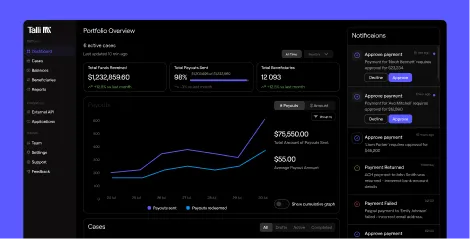
Purpose-built digital disbursement infrastructure like Talli is designed around the court-ready reporting model — see how teams automate class action disbursements end-to-end with comprehensive reporting and reconciliation built in. Class member records, notice tracking, claim submissions, per-claimant payouts across multiple methods (ACH, prepaid Mastercard, PayPal, gift cards), and real-time reconciliation all feed a single reporting layer that can output the full post-distribution accounting on demand, including the additional fee and lodestar disclosures courts often expect. Segregated QSF-compliant accounts through FDIC-insured banking via Patriot Bank, N.A. satisfy the fiduciary expectations judges are increasingly applying to settlement fund custody.
Traditional check-based workflows can produce the same report in theory — but they require manual data entry at nearly every step, which is where accuracy and completeness problems originate.
See how Talli generates court-ready disbursement reporting automatically for class action settlements. Request a Demo.
Frequently Asked Questions
What must be included in a post-distribution accounting?
A post-distribution accounting under the Northern District of California template must include the core distribution metrics listed here, plus additional disclosures such as attorneys' fees as a percentage of the settlement fund, counsel's final lodestar, and the lodestar multiplier — and, where applicable, nonmonetary-relief and other form-specific items. total settlement fund, number of class members, notice success rate, claim form submission rate, opt-out and objection rates, average/median/minimum/maximum per-claimant recovery, notice and payment methods used, method-level success rates, number and value of uncashed checks, cy pres distributions, administrative costs, and attorneys' fees and costs.
When is a post-distribution accounting due?
In the Northern District of California, the post-distribution accounting is due within 21 days after settlement checks become stale — or within 21 days after all funds are paid to class members and cy pres beneficiaries if no checks are issued. Other districts vary, and the deadline is often set by the final approval order itself.
What happens to unclaimed class action settlement funds?
Unclaimed class action settlement funds are typically handled through cy pres distribution to nonprofit organizations whose work advances the interests of the class, through a supplemental distribution to claiming class members, or through return to the defendant if the settlement agreement and court order permit it. The court disbursement report should document which approach was used and why.
How do judges evaluate whether a settlement distribution was fair?
Judges evaluate settlement distribution fairness against the preliminary approval order: whether the actual claim rates, per-claimant recoveries, notice success, and administrative costs matched the assumptions made at preliminary approval. When there is a material gap between the expected and actual outcomes, judges may require supplemental distribution, additional outreach, or fee award adjustments.
Do I need a post-distribution accounting outside the Northern District of California?
Technically, the Northern District of California's post-distribution accounting requirement is non-binding outside that district. In practice, many judges in other districts require a post-distribution accounting as a condition of final approval, and the N.D. Cal. Post-distribution accounting format has become a common benchmark, even though courts and judges may require additional case-specific items. Building your settlement disbursement reporting workflow to this format is the safest default.
What is the most common reason judges reject a court disbursement report?
The most common reasons judges reject or require supplemental court disbursement reports are missing median and distribution statistics for per-claimant recoveries, vague cy pres justification, and missing method-level notice and payment performance data. Each gap reflects a data capture failure at the time of distribution.
How can a digital disbursement platform help with court reporting?
A digital disbursement platform that tracks class member records, notice attempts, claim submissions, per-claimant payouts, and real-time reconciliation in one system can generate a court-ready settlement disbursement report automatically. That turns the post-distribution accounting from a reconstruction exercise into a one-click export.