.svg)


.svg)
Settlement escheatment transfers unclaimed class action funds, mass tort distributions, bankruptcy payouts, and other dormant settlement payments to state custody after prescribed dormancy periods, often 3-5 years depending on the jurisdiction and property type. The risk is not theoretical. Reported top class action settlement totals reached roughly $159.4 billion across 2022, 2023, and 2024, including $42 billion across the highest ten settlements in 2024, while claim rates in many consumer settlements remain low.
For settlement administrators, unclaimed funds create more than a back-office cleanup task. Every uncashed check, returned envelope, failed ACH, and unresolved claimant record can become a reporting obligation, audit issue, or court accounting problem. Modern digital disbursement platforms help reduce that exposure by increasing redemption before funds ever become dormant.
Key Takeaways
- Escheatment laws require holders to report and remit dormant property to the proper state after applicable dormancy periods, commonly 3-5 years for many settlement-related payment categories.
- The FTC found a 9% median claims rate and 4% weighted mean across consumer class action cases requiring a claims process, with results varying by notice method.
- Paper checks create avoidable risk because uncashed checks require tracking, reminder outreach, reconciliation, possible reissuance, and eventual unclaimed property reporting.
- State unclaimed property programs returned $4.49 billion to rightful owners in FY2024 across all unclaimed property types, showing the scale of dormant assets nationwide.
- Digital payment methods can improve redemption rates by offering ACH, prepaid cards, digital wallets, gift cards, and paper checks as a fallback.
- Talli helps claims teams prevent escheatment risk at the source by making settlement funds easier to claim, track, reconcile, and document.
Understanding Unclaimed Funds In Legal Settlements
Unclaimed settlement funds are amounts that have been approved for distribution but not successfully delivered or redeemed by the intended claimant. They can arise in class actions, mass tort matters, bankruptcy cases, securities settlements, shareholder distributions, and other court-supervised payment programs.
The Challenge Of Unclaimed Settlement Payouts
The core problem is simple: settlement distribution is only successful when money actually reaches claimants. A settlement may be approved, funded, and noticed, but if claimants do not respond, checks are not cashed, or payment records go stale, administrators still need to account for the remaining balance.
Federal Trade Commission research on consumer class actions found a 9% median claims rate and a 4% weighted mean for cases requiring a claims process. The same study found that notice packets with claim forms performed better than postcards and email-only approaches, showing how outreach design can materially affect participation.
These low participation rates do not mean every unclaimed dollar automatically escheats. Settlement agreements, court orders, cy pres provisions, redistribution plans, reversion clauses, and state law all affect what happens to unpaid balances. Still, low participation creates a larger unresolved population that administrators must track until the court-approved process and applicable unclaimed property rules are satisfied.
Why Funds Go Unclaimed
Unclaimed funds usually build up for predictable reasons:
- Outdated mailing addresses or email addresses
- Returned checks and stale-dated checks
- Claimant skepticism about settlement notices
- Low payment amounts that discourage action
- Deceased, incapacitated, or relocated claimants
- Complex forms or documentation requirements
- Lack of digital payment choices
The operational effect is cumulative. A small non-redemption rate across a high-volume distribution can leave thousands of unresolved records, each of which may require follow-up, reconciliation, audit documentation, and eventual state reporting.
What Escheatment Means For Settlement Funds
Escheatment is the legal process that transfers unclaimed property from the holder to state custody after the applicable dormancy period expires. In settlement administration, the holder may be a claims administrator, settlement fund, trustee, law firm, transfer agent, or other party responsible for maintaining and distributing funds.
The Legal Framework Of Escheatment
The state does not usually take ownership in the ordinary commercial sense. Instead, it acts as custodian for the rightful owner. The claimant, heir, or authorized representative can generally search the state’s unclaimed property database and submit a claim later.
The priority rules for determining which state receives abandoned intangible property come from the U.S. Supreme Court’s decision in Texas v. New Jersey. The first priority generally goes to the state of the owner’s last known address as shown in the holder’s books and records. If no address is available, the second priority generally goes to the holder’s state of corporate domicile.
For claims administrators, that means addressing quality matters. A missing or outdated address does not just make payment harder. It can change which jurisdiction receives the funds and which reporting rules apply.
How Escheatment Protects Unclaimed Assets
Escheatment differs from a simple forfeiture. Once property is remitted to the state, the owner generally retains the right to claim it later. State unclaimed property programs maintain searchable databases, process claims, and return funds when the claimant can prove identity and ownership
That custodial model is one reason courts and administrators may treat escheatment differently from cy pres distribution or reversion to a defendant. Escheatment preserves the possibility of later payment to the intended owner, even if the payment could not be completed during the active distribution period.
The Escheatment Process For Unclaimed Settlement Checks
The process usually begins when a payment is issued but not redeemed. A claimant may ignore a notice, fail to select a payment method, receive a check but never cash it, or have a payment returned because account information is invalid.
Tracing Uncashed Checks And Dormant Records
Once the holder identifies dormant property, the compliance workflow generally includes:
- Confirming the property type and dormancy period
- Reviewing the claimant’s last known address
- Sending due diligence notices when required
- Tracking claimant responses and reissued payments
- Preparing state reports in the required format
- Remitting funds to the appropriate state
- Maintaining records for audit and court reporting
This workflow can be simple for a small matter and highly complex for a large settlement with tens of thousands of checks, multiple payment rounds, deceased claimants, address updates, tax documentation, and court-specific reporting requirements.
The Timeline From Unclaimed To Escheated Funds
Dormancy periods vary. Payroll and wages often have shorter periods, while general intangible property, vendor checks, customer credits, and settlement payments frequently fall into 3-year or 5-year categories depending on state law. Settlement payments often follow general intangible property or uncashed-check rules unless a state has a more specific classification.
Due diligence timing also varies by jurisdiction. Many states require holders to send written notice before reporting property, often within a window such as 60 to 120 days before the report is filed. Some states impose different thresholds, certified mail rules, electronic notice requirements, or publication requirements.
For claims teams, the practical lesson is clear: escheatment should be planned before the first payment campaign launches. Waiting until checks are stale or reports are due makes address remediation, claimant outreach, and documentation cleanup much harder.
State-Specific Rules Settlement Teams Should Watch
Unclaimed property compliance is state-driven, which means administrators cannot rely on one national rule. Every state, the District of Columbia, Puerto Rico, Guam, and the U.S. Virgin Islands maintain unclaimed property regimes, and their deadlines, dormancy periods, exemptions, and notice rules differ.
Key Differences In State Escheatment Statutes
Several examples show why settlement teams need jurisdiction-level review:
- California: Uses a two-report process for many property types and imposes 12% annual interest on late-reported property unless the failure is due to reasonable cause.
- Delaware: Often matters when the holder is incorporated in Delaware and no claimant address is available under the second priority rule.
- New York: Has detailed reporting rules and can require additional notice steps for higher-value property.
- Texas: Provides certain business-to-business exemptions, though applicability depends on the property and holder facts.
- Maryland: Updated its abandoned property rules in 2025, including lowering the publication notice threshold from $100 to $50.
These examples are not substitutes for legal review. They show why administrators need a state-by-state process rather than a single generic checklist.
Class Action Residual Funds Are Not Always Escheatment
California also separately regulates certain class action residual funds. Under California Code of Civil Procedure Section 384, unpaid residue or unclaimed class member funds from qualifying cases must be distributed in a way that provides a substantial or commensurate benefit to California consumers.
That rule should not be treated as identical to ordinary escheatment because it concerns court-supervised residual fund allocation. In practice, administrators must distinguish between funds governed by a settlement agreement or court order, funds that may be redistributed, funds subject to cy pres, and funds that must be reported under state unclaimed property laws.
Why Paper Checks Increase Escheatment Exposure
Paper checks remain familiar, but they create a high-friction payment workflow. A check must reach the right address, avoid being mistaken for junk mail, be deposited before it expires, clear successfully, and then be reconciled by the administrator.
Economic Impact Of Paper-Based Payouts
Each failure creates another task. Administrators may need to investigate returned mail, send reminders, stop payment, reissue checks, update addresses, respond to claimant calls, and maintain a record of each action. For high-volume distributions, this can become one of the most expensive parts of settlement administration.
Paper-based distributions also make reporting harder because the administrator must distinguish between issued, mailed, returned, stale-dated, voided, reissued, cleared, and unresolved checks. Each status affects the final accounting.
Talli’s analysis of the hidden check costs explains why uncashed checks create compounding expenses. The problem is not only postage or printing. It is the downstream work of exception handling, reconciliation, due diligence, reissuance, and escheatment reporting.
Hidden Expenses In Managing Unclaimed Checks
Unclaimed checks also create hidden costs that are easy to miss during settlement planning. Staff must reconcile stale items, respond to claimant calls, document outreach, manage reissue approvals, and prepare reports that satisfy both court expectations and state reporting obligations.
For administrators modeling exposure, the uncashed check calculator can help estimate the cost of unresolved check populations across a settlement portfolio.
The more a settlement relies on paper, the more the administrator depends on postal accuracy, claimant follow-through, and manual exception handling. That combination increases the chance that funds remain unresolved long enough to become an escheatment issue.
Claiming Escheated Funds After Transfer To The State
Once funds are escheated, claimants are not necessarily out of luck. State unclaimed property programs are designed to return property to rightful owners. According to NAUPA’s FY2024 report, state programs returned $4.49 billion to owners during FY2024.
Steps To Reclaim Unclaimed Property
The claim process usually requires the owner to search state databases, identify a matching property record, submit a claim, and provide proof of identity and ownership. In many cases, the process starts online through the state treasurer, controller, or unclaimed property office.
A claimant should search using current names, former names, maiden names, prior addresses, and estate names when applicable. Settlement-related property may appear under a claims administrator, law firm, trustee, company defendant, transfer agent, or other holder name.
Required Documentation For Escheated Fund Claims
Documentation may include:
- Government-issued identification
- Social Security number or tax identification verification
- Proof of current or prior address
- Settlement notices or claim documents
- Probate documents for estate claims
- Authorization documents for representatives
Most states do not charge owners to claim their property, and many claims can be started online. However, the process can still be slow, especially when records are old, names have changed, the claimant is deceased, or class membership documentation is incomplete.
For settlement administrators, that delay matters. Escheatment preserves the possibility of future recovery, but it does not deliver the same claimant experience as successful first-cycle payment.
How Digital Disbursements Reduce Unclaimed Funds
The best escheatment strategy is prevention. If more claimants redeem funds during the active distribution window, fewer records become dormant, fewer payments require reissuance, and fewer balances need to be reported to the states.
Leveraging Technology For Higher Payout Success
Digital disbursement improves redemption by giving claimants more ways to receive funds. Instead of relying on one mailed check, administrators can offer ACH, prepaid cards, digital wallets, gift cards, wire transfers, and paper checks as a fallback. Talli’s guide to claimant payment options explains how payment choice can reduce friction for banked and unbanked claimants.
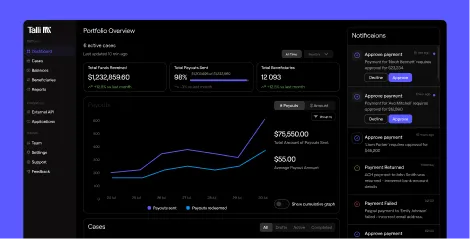
Digital platforms also improve visibility. Administrators can track whether a claimant opened a notice, selected a payment method, completed tax forms, passed verification, received funds, or needs follow-up. That real-time status view makes it easier to intervene before a record becomes stale.
Modern digital disbursement workflows typically support:
- Multi-channel claimant notifications
- Address verification and data validation
- Payment method selection portals
- Automated reminders by email and SMS
- Real-time payment status tracking
- Failed payment resolution
- Court-ready reporting and audit logs
- Reconciliation by campaign, claimant, and payment rail
Beyond Paper: Diverse Payment Options For Claimants
Different claimants need different payment options. Some prefer ACH. Some are unbanked or underbanked and need prepaid card access. Others are more likely to act when PayPal, Venmo, or gift card options are available. High-value or international distributions may require wire transfers or specialized payment rails.
This changes the administrator’s posture from reactive compliance to proactive completion. Instead of discovering a large dormant balance years later, teams can see unresolved records while there is still time to fix them.
Why Talli Helps Prevent Settlement Escheatment
Talli is built for legal disbursements where fund segregation, claimant experience, compliance, and reporting all matter. The platform supports class action settlements, mass tort distributions, bankruptcy payouts, and shareholder services from a single dashboard.
Purpose-Built Legal Disbursement Infrastructure
For class action settlements, Talli helps administrators upload claimant data, launch digital payment campaigns, send automated reminders, and track every payment in real time. That visibility reduces the chance that unresolved records quietly become future escheatment obligations.
For mass tort distributions, Talli supports high-volume claimant populations with varying award amounts, verification requirements, and payment preferences. For bankruptcy payouts, it helps trustees and administrators move funds quickly while maintaining audit-ready records.
Talli also supports shareholder services, where stale addresses, uncashed checks, and dormant records can create recurring unclaimed property exposure. Built-in compliance features help teams manage KYC verification, OFAC screening, W-9 collection, fraud mitigation, and audit logs without building a custom payment infrastructure.
Fund Segregation, Compliance, And Real-Time Tracking
The platform maintains dedicated accounts for each settlement to preserve fund segregation and simplify reporting. Claimants can choose from multiple redemption methods, including ACH, prepaid Mastercard issued by Patriot Bank, N.A., Member FDIC, PayPal, Venmo, and gift card options. Smart reminders across email and SMS help claimants complete the payout process before funds become dormant.
Talli’s purpose is not to replace legal review of state unclaimed property requirements. It helps reduce the population that ever reaches that stage by improving redemption, visibility, and exception resolution during the active payout period.
Talli Conclusion: Prevent The Dormant Balance Before It Becomes A Compliance Problem
Settlement escheatment is often treated as an end-of-life reporting task, but the real work starts much earlier. The fewer payments that fail, expire, or sit unresolved, the smaller the escheatment population becomes.
Claims teams need more than a payment rail. They need verified claimant data, payment choice, automated reminders, real-time dashboards, fund segregation, and court-ready reporting. That is where purpose-built legal disbursement infrastructure matters.
Talli helps administrators reduce unclaimed funds by making settlement payments easier to redeem and easier to track. Instead of waiting years to manage dormant property, teams can identify exceptions during the active distribution window, resolve them quickly, and give courts a cleaner accounting of where the money went.
To evaluate security and compliance controls, visit Talli’s Trust Center.
Frequently Asked Questions
What Does Settlement Escheatment Mean?
Settlement escheatment means unclaimed settlement funds are transferred to state custody after the applicable dormancy period. The state holds the funds for the rightful owner, who can generally claim them later through the state’s unclaimed property process.
How Long Before Settlement Funds Escheat?
Dormancy periods vary by state and property type. Many settlement-related payments follow general intangible property or uncashed-check rules, often 3-5 years, though some categories and jurisdictions have shorter or longer timelines.
Are Escheated Funds Gone Forever?
No. Escheated funds are usually held by the state for the rightful owner. Claimants, heirs, or authorized representatives can search state unclaimed property databases and submit documentation to recover eligible funds.
Why Do Settlement Payments Become Unclaimed?
Common causes include outdated addresses, uncashed paper checks, incomplete tax forms, claimant skepticism, low payment amounts, death or relocation, and limited payment options. Poor tracking can make the issue worse over time.
How Does Talli Reduce Escheatment Risk?
Talli reduces escheatment risk by helping claimants redeem funds sooner through digital payment options, automated reminders, real-time tracking, failed-payment resolution, compliance workflows, and audit-ready reporting for settlement administrators.