.svg)


.svg)
When a settlement administrator proposes “using PayPal to save costs,” the real question is not whether PayPal can move money. It can. The question is whether PayPal, by itself, can satisfy the Qualified Settlement Fund (QSF) controls that courts, class counsel, claims administrators, and trustees need before settlement money is released.
PayPal is a payment processor and digital wallet provider. It is not a QSF administrator, trustee, bank, or court-controlled settlement infrastructure. A compliant QSF must be established or approved by a governmental authority, remain subject to continuing jurisdiction, resolve qualifying claims, and maintain assets segregated from the transferor or related parties under Treasury Regulation 1.468B-1. PayPal may be useful as one claimant payment option inside a properly structured QSF platform, but it should not be treated as the fund structure itself.
That distinction matters because settlement funds are not ordinary merchant balances. They are fiduciary funds. Administrators must preserve fund segregation, document every movement of money, prevent commingling, manage tax reporting, protect claimant access, and provide courts with audit-ready proof that the distribution followed the approved plan.
Key Takeaways
- PayPal cannot serve as QSF infrastructure on its own because QSF compliance requires court approval, continuing jurisdiction, qualifying claims, and segregated assets.
- PayPal itself is not FDIC-insured, and only eligible PayPal balances may receive pass-through FDIC insurance through Program Banks, subject to conditions.
- FBO account structures are not the literal IRC Section 468B requirement, but they are commonly used to support beneficial ownership records, fund segregation, and FDIC compliant payouts.
- PayPal can function as one claimant payment option inside a properly managed QSF, but not as a substitute for QSF administration.
- Lawyers and administrators using payment apps for fiduciary funds must account for chargebacks, account holds, fees, documentation gaps, and commingling risk.
- Purpose-built settlement platforms can support 95% to 98% redemption rates compared with 70% to 80% for traditional paper check methods.
- Courts and counsel should require full disclosure of any rebates, discounts, breakage economics, or financial relationships connected to payment vendors.
Understanding Qualified Settlement Funds And Fiduciary Duties
The Core Principles Of QSF Compliance
A QSF is not just a bank account. It is a tax and legal structure created to hold settlement funds while claims are resolved and distributions are made. Under IRC Section 468B and the related Treasury Regulations, a QSF must satisfy three core conditions: it must be established or approved by a governmental authority, remain subject to that authority’s continuing jurisdiction, and be created to resolve qualifying claims. Its assets must also be segregated from the transferor or related persons.
That is why generic payment processors create risk when they are described as “QSF-compliant” without the surrounding legal and banking infrastructure. PayPal can move funds to a claimant, but it does not establish the QSF, maintain court jurisdiction, create the settlement trust structure, or produce the full court-ready accounting that a settlement administrator must maintain.
A compliant QSF checklist should address:
- Court approval or governmental establishment
- Continuing jurisdiction over the fund
- Segregated settlement assets
- Beneficial ownership records
- Tax reporting and withholding workflows
- Audit trails for every claimant payment
- Exception handling for failed, returned, or unclaimed funds
Dedicated FBO accounts are often used because they make the “for benefit of” relationship visible in the banking structure. They are not magic words that automatically create compliance, but they help support the documentation and beneficial ownership controls that settlement funds require.
Fiduciary Responsibilities In Settlement Management
Settlement administrators do more than transmit payments. They manage funds owed to claimants under a court-approved process. That creates fiduciary responsibilities around loyalty, care, transparency, and documentation.
The fiduciary duty problem becomes sharper when a payment vendor offers rebates, discounts, revenue share, float income, inactivity economics, or breakage-based compensation. Even if the distribution appears cheaper on paper, undisclosed vendor economics can create a conflict if money intended for claimants is redirected to administrators or vendors.
Administrators should be able to prove:
- The selected payment method was in claimants’ best interests
- Vendor relationships were fully disclosed
- Fees were approved and documented
- No settlement funds were diverted through hidden rebates
- Unclaimed funds were handled under the settlement agreement and applicable law
- Court reporting reflects real-time fund status
The core question is not whether PayPal is convenient. The question is whether the entire distribution structure protects claimants and gives the court a complete record.
Evaluating PayPal As A QSF Disbursement Method
What PayPal Can Provide
PayPal is useful for consumer payments because many claimants already recognize it. In a settlement context, that familiarity can improve claimant choice when PayPal is offered as one payment rail alongside ACH, prepaid cards, digital wallets, wires, and checks.
PayPal can support:
- Digital delivery to claimants who select PayPal
- Familiar user experience for existing PayPal users
- Fast access after funds are released
- A payment option for smaller settlement amounts
- A useful fallback when claimants prefer wallets over bank deposits
Those are practical benefits. They do not make PayPal a QSF administrator.
What PayPal Cannot Replace
A QSF distribution requires more than final-mile payment delivery. It requires a controlled environment where settlement funds remain segregated, claimant eligibility is verified, tax documentation is collected, payments are tracked, and exceptions are resolved.
PayPal does not replace:
- Court-approved QSF establishment
- Settlement-specific fund segregation
- Matter-level accounting
- Trustee or administrator oversight
- Claimant-level beneficial ownership documentation
- Court-ready audit reports
- Tax reporting workflows
- Escheatment and unclaimed-property controls
PayPal’s own terms also make clear that PayPal is not a bank, does not take deposits, and is not FDIC-insured. Eligible balances may be placed at Program Banks and may receive pass-through FDIC insurance, subject to conditions, but that is different from a court-controlled settlement account designed around claimant-level records and fiduciary reporting.
Risk Mitigation In Settlement Administration
FDIC Protection Requirements
FDIC pass-through coverage can apply when funds are held through a third party at an insured bank for the benefit of actual owners, but it is conditional. The FDIC explains that pass-through insurance is not a separate ownership category. Coverage depends on the account records, beneficial ownership, the applicable ownership category, and aggregation with each owner’s other deposits at the same insured bank.
For settlement funds, this means administrators should not simply ask whether a vendor mentions “FDIC insurance.” They should ask how the accounts are titled, where funds are held, who the beneficial owners are, whether records identify each claimant, and what happens if a partner bank or intermediary fails.
A settlement with thousands of claimants could support substantial pass-through coverage if the structure and records satisfy FDIC requirements. But that outcome depends on proper banking setup and documentation. It should not be assumed from a standard digital wallet balance.
Chargebacks, Holds, And Account Restrictions
Payment apps are built around consumer and merchant transactions, not court-supervised fiduciary distributions. That creates operational risks when they are used outside a controlled settlement platform.
Administrators should evaluate whether the payment method can:
- Reverse or dispute transactions after release
- Freeze or restrict account access
- Apply reserves or holds
- Deduct fees from the wrong balance
- Delay access for unrelated claimants
- Preserve records needed for court reporting
For ordinary commerce, those features may be acceptable risk controls. For settlement funds, they can create serious problems if they affect money owed to other claimants or interrupt a court-approved distribution schedule.
Navigating Class Action And Mass Tort Disbursements
Scalability For High-Volume Claims
Class action settlements routinely involve thousands, tens of thousands, or hundreds of thousands of claimants. Award amounts may vary by claim tier, documentation, injury severity, purchase history, or court-approved formula. A compliant distribution process must match payments to the approved plan without relying on manual spreadsheet updates.
A settlement platform should support:
- Batch claimant uploads
- Eligibility validation
- Tiered award calculations
- Payment preference collection
- Failed payment resolution
- Real-time distribution reporting
- Final accounting for courts and counsel
PayPal can deliver funds to claimants who choose it, but it does not provide the full settlement workflow. Administrators still need infrastructure that connects claimant data, fund controls, compliance checks, payment rails, and reporting.
Fraud Prevention Measures
Digital distribution also requires fraud controls. Settlement fraud now includes duplicate claims, synthetic identities, bot-driven submissions, phishing, account takeover attempts, and payment redirection schemes. Generic payment processors may detect some transaction-level risk, but settlement administrators need claim-specific fraud controls tied to the approved distribution plan.
Effective fraud detection should include:
- Identity verification before release
- Duplicate claim detection
- Device and behavioral signals
- Payment pattern monitoring
- Manual review queues
- Documented fraud flags
- Audit logs showing the final decision
This is especially important in mass torts, data breach settlements, and high-volume consumer cases where fraud can scale quickly.
Achieving Audit-Ready Compliance
Automating Regulatory Requirements
Court reporting is not limited to a payment confirmation. Administrators need to show what happened from the moment funds were received through final distribution, exception handling, reissuance, tax reporting, and unclaimed-property treatment.
Modern compliance automation supports:
- KYC verification before fund release
- OFAC screening with timestamps
- W-9 collection for reportable payments
- 1099 generation and e-filing support
- Backup withholding calculations
- Failed payment tracking
- Reissuance documentation
- Final distribution reports
An audit trail should answer basic court questions quickly: who was eligible, how much they were owed, which payment method they selected, when funds were sent, whether the payment succeeded, what exceptions remain, and how undistributed funds will be handled.
Documented Vendor Selection Standards
Payment vendor selection should be documented before distribution begins. Counsel and administrators should evaluate costs, claimant access, security, compliance features, banking structure, disclosures, and exception workflows.
A defensible process includes:
- Competitive vendor review
- Written fee comparison
- Disclosure of financial relationships
- Clear handling of rebates or discounts
- Defined treatment of unclaimed funds
- Payment method alternatives
- Court-ready reporting commitments
The goal is not simply to minimize visible transaction fees. The goal is to maximize claimant redemption while protecting settlement funds from avoidable fiduciary risk.
Digital Payment Options: ACH, Cards, And Wallets
Diversifying Payment Methods
PayPal can have a role when it is offered inside a broader multi-channel payout structure. Claimants have different access needs. Some prefer bank deposits. Some prefer digital wallets. Some do not have a bank account. Others need prepaid cards or checks.
A strong settlement distribution strategy may include:
- ACH direct deposit for banked claimants
- Prepaid cards for claimants without traditional banking access
- PayPal or Venmo for wallet users
- Wire transfers for high-value or international payments
- Paper checks as a fallback option
The FDIC reported that 5.6 million U.S. households lacked a bank or credit union account in 2023, which makes non-ACH options important for inclusive settlement design through unbanked households. Payment choice is not just a convenience feature. It directly affects whether claimants can actually receive their money.
Cost-Benefit Analysis
Paper checks carry printing, postage, reconciliation, stale-date handling, reissuance, support, and escheatment costs. Digital options can reduce those costs, but a lower transaction fee should not override compliance requirements.
Administrators should compare payment methods across:
- Claimant redemption rate
- Total administrative cost
- Fraud exposure
- Failed payment rate
- Support burden
- Audit readiness
- Fund segregation
- Court approval risk
A cheap payment rail can become expensive if it creates reversals, unclear records, unclaimed funds, or fiduciary questions.
Reducing Unclaimed Funds And Escheatment
The Financial Burden
Unclaimed settlement funds create more than administrative inconvenience. They can trigger reissuance cycles, claimant complaints, court scrutiny, and eventual state reporting obligations. The escheatment process means money intended for claimants may ultimately transfer to state custody if it remains unclaimed long enough.
Traditional paper-heavy methods often struggle because:
- Addresses change
- Checks are lost or ignored
- Claimants distrust unfamiliar envelopes
- Small-dollar checks are not worth a branch visit
- Reissuance requires manual work
- Dormancy tracking adds compliance burden
Digital distribution improves outcomes when it combines payment choice with reminders, support, and real-time exception handling.
Maximizing Claimant Redemption
A strong redemption strategy addresses the reasons claimants fail to collect:
- Outdated contact information
- Limited banking access
- Confusing instructions
- Low trust in settlement communications
- Language barriers
- Missed emails
- Failed payment attempts
Smart reminders across email and SMS, clear payment selection flows, prepaid card options, and real-time tracking can reduce abandonment before funds become dormant. The point is not simply to move money faster. It is to get more approved funds to the people the settlement was designed to compensate.
Why Talli Supports QSF-Compliant Distribution
Generic payment processors like PayPal can play a role in final-mile delivery, but settlement administrators need purpose-built infrastructure around the payment rail. Talli provides that infrastructure for legal settlement disbursements, class action payouts, mass tort distributions, bankruptcy claims, and shareholder services.
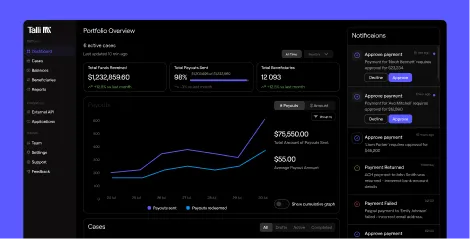
Talli supports dedicated settlement accounts that preserve fund segregation and QSF ownership while giving claims teams real-time visibility into fund flows. Banking services are provided by Patriot Bank, N.A., Member FDIC, and the platform supports multiple claimant redemption options, including ACH, prepaid Mastercard, PayPal, Venmo, gift cards, wires, and checks.
Talli’s compliance automation includes:
- KYC verification
- OFAC screening
- W-9 collection
- 1099 support
- Fraud mitigation
- Audit logging
- Real-time dashboards
- Court-ready reporting
This allows PayPal to be used as an optional payment rail without making PayPal the settlement fund infrastructure. Funds remain controlled through the settlement platform until distribution, and administrators retain the reporting and compliance controls courts expect.
For settlements ranging from thousands to hundreds of thousands of claimants, Talli helps compress distribution timelines from weeks to 24 to 48 hours while maintaining fund segregation, transparency, and audit readiness.
Talli Conclusion
PayPal can be useful for claimant convenience, but it should not be approved as a standalone QSF solution. A compliant settlement distribution requires more than a recognizable payment app. It requires court-approved fund structure, segregated accounts, beneficial ownership records, tax workflows, fraud controls, exception handling, and complete audit trails.
The safest approach is to treat PayPal as one optional payment method within a purpose-built settlement platform. Talli gives claims administrators that structure: complete fund segregation, built-in KYC, OFAC, W-9 collection, fraud mitigation, multiple payment rails, and real-time reporting. That is the difference between simply sending money and administering settlement funds with fiduciary control.
Frequently Asked Questions
Can PayPal Serve As QSF Infrastructure?
No. PayPal can be a payment option, but it does not establish a court-approved QSF, maintain settlement-specific fund segregation, or replace trustee and administrator controls.
Is PayPal FDIC-Insured?
PayPal itself is not FDIC-insured. Some eligible balances may receive pass-through FDIC insurance through Program Banks, subject to conditions, but other balances are not FDIC-insured deposits.
Can A QSF Offer PayPal To Claimants?
Yes. PayPal can be offered as one payment rail inside a properly structured QSF, as long as the settlement platform maintains fund controls, audit trails, and compliance workflows.
What Is The Main Fiduciary Risk?
The main risk is treating a payment processor as if it were settlement infrastructure. Administrators must prevent commingling, document fund movement, disclose vendor economics, and protect claimant access.
Why Use Talli Instead Of PayPal Alone?
Talli provides the settlement-specific controls PayPal does not: segregated accounts, KYC, OFAC, W-9 collection, fraud mitigation, multi-channel payments, and court-ready reporting.