.svg)


.svg)
Your $50 million settlement is fully approved. Claimants are waiting. But the funds sit in an account for 12 days before disbursement begins. Who owns the roughly $60,000 in interest that could accrue during that time, depending on the account rate? And can you prove the delay was justified?
These questions represent a fiduciary exposure that settlement administrators routinely overlook until it becomes a liability. Once funds are approved for distribution, every avoidable day in the account creates a recordkeeping, ownership, and governance question. With digital disbursement platforms now compressing payment cycles from weeks to 24-48 hours, delays that once seemed routine increasingly demand documented justification.
Key Takeaways
- Interest float becomes a fiduciary question the moment approved funds remain undisbursed without a documented reason
- The T+1 securities rule effective May 28, 2024 does not govern legal settlement distributions, but it reflects a broader regulatory preference for reducing settlement-cycle risk
- Using current interest-rate conditions as an example, $10 million held for 5 days can generate roughly $5,000, depending on the account rate
- Fiduciary breach exposure can include personal liability, disgorgement, court-ordered remedies, and, in ERISA-governed matters, civil penalties tied to recovered amounts
- IOLTA and client trust account rules require careful treatment of interest, especially when funds are substantial enough to generate net income for the client
- Digital disbursement achieves estimated 95-98% redemption rates compared to 70-80% for paper checks, reducing float exposure and unclaimed-fund risk
Understanding Settlement Funds
Settlement funds are court-supervised pools of money held for claimants who suffered harm. They are not ordinary operating accounts. They carry legal, tax, fiduciary, and reporting requirements that shape how the money must be held, documented, and distributed.
The structure matters because it determines who controls the funds, how taxes are handled, how interest is treated, and what records must be available if a court, trustee, auditor, claimant, or regulator asks why money was held.
Common Settlement Fund Structures
Large settlements often use a Qualified Settlement Fund under IRC Section 468B. QSFs allow defendants to transfer settlement money into a court-approved fund while administrators verify claimants, resolve liens, collect tax forms, and distribute awards. That holding period is often necessary, but it also creates the interest float problem: approved funds can generate economic value before they reach claimants.
Common settlement fund structures include:
- Qualified Settlement Funds: Court-established funds with specific tax treatment under IRC 468B
- Client Trust Accounts: Attorney-managed accounts subject to professional responsibility rules
- IOLTA Accounts: Pooled lawyer trust accounts for nominal or short-term funds that cannot generate net income for a client
- Escrow Accounts: Third-party accounts used when funds are held until settlement conditions are satisfied
Each structure can be compliant when used correctly. The risk arises when the account structure, interest treatment, and delay reasons are not documented before funds begin earning interest.
QSF Tax Treatment And Interest
QSFs offer important tax advantages, but they are not tax-free parking accounts. Under 26 CFR 1.468B-2, a qualified settlement fund is treated as a U.S. person and is subject to tax on modified gross income. Contributions transferred to resolve the liability are generally excluded from modified gross income, but interest earned by the fund can create taxable income.
That matters because interest is not just a small accounting byproduct. It can affect the fund’s tax return, reserves, closeout accounting, and final allocation. If the settlement documents do not say whether interest belongs to claimants, offsets administrative costs, remains in the fund, or follows a court-directed plan, the administrator may face disputes after distribution is already underway.
The better approach is simple: define interest treatment before funding, not after closeout.
Why Interest Float Creates Fiduciary Risk
Interest float occurs when approved settlement funds remain in an account between authorization and disbursement. Some delay is legitimate. Administrators may need time for OFAC screening, KYC checks, W-9 collection, lien resolution, appeal periods, fraud review, or court-approved distribution sequencing.
The fiduciary question is not whether every delay is wrong. The question is whether each delay is necessary, documented, and connected to the interests of claimants and the court-approved plan.
The Fiduciary Duty Behind Fund Management
Settlement administrators and trustees occupy a position of trust. Their role is to safeguard funds, follow court orders, maintain segregation, avoid commingling, and distribute money according to the approved plan. When approved payments sit idle, the administrator should be able to show why.
Core fiduciary principles include:
- Loyalty: Funds must be managed for the beneficiaries and the settlement plan, not administrative convenience
- Prudence: Decisions should reflect reasonable care, diligence, and professional judgment
- Recordkeeping: Every hold, release, exception, and distribution should be traceable
- Transparency: Courts and stakeholders should be able to understand why funds moved when they did
A delay tied to missing tax documentation may be defensible. A delay caused by manual batch processing, staff backlog, or unclear handoff ownership is harder to justify, especially when purpose-built infrastructure can automate much of the workflow.
What Makes Float Defensible
A defensible delay has a clear reason, timestamp, owner, and resolution path. It should not depend on someone’s memory or a spreadsheet note that disappears before final accounting.
Strong documentation should show:
- The reason funds were held
- The legal, tax, compliance, or operational basis for the hold
- The person or system that approved the hold
- The date and time the hold began
- The condition required for release
- Communications sent to the claimant, counsel, trustee, or administrator
- Aging reports showing unresolved exceptions
This is where audit trail systems matter. The issue is not only whether funds were eventually paid. It is whether every delay can be reconstructed and defended.
How Interest Accrues On Held Funds
Interest may look small on a per-day basis, but settlement balances are often large enough to make even short delays material. At a 3.65% annual rate, approximate interest accrual would look like this:
These examples are illustrative. Actual amounts depend on account type, rate, bank terms, reserve requirements, fees, tax treatment, and whether funds are held in interest-bearing accounts. But the point remains: large settlements can produce meaningful floats quickly.
That economic value must be accounted for. If no one can answer who owns it, how it is taxed, and why it accumulated, the issue can become a governance problem.
Who Owns Settlement Interest?
There is no single universal answer across every settlement. Interest treatment depends on the settlement agreement, court order, trust documents, QSF documents, attorney trust rules, and state law. The administrator’s job is to make the answer explicit.
Common Interest Allocation Models
Most settlement documents should address one of three models:
- Claimant-owned interest: Interest follows the principal and is distributed proportionally to eligible claimants
- Fund-owned interest: Interest stays in the fund to cover taxes, administration, or court-approved expenses
- Court-directed interest: The settlement order specifies how interest is used, distributed, reserved, or returned
Problems arise when the plan is silent. At closeout, stakeholders may disagree about whether the interest should increase claimant awards, offset administrative costs, fund cy pres distributions, cover taxes, or be handled under unclaimed property rules. That disagreement can delay final accounting and create avoidable scrutiny.
Why Silence Is Risky
A silent interest policy creates three practical risks.
First, it invites disputes. Claimants may argue that interest belongs to them because it was generated by their settlement principal. Administrators may argue that it belongs to the fund because it offset costs or taxes. Defendants may have their own view if the agreement allows reversion or residual handling.
Second, it complicates tax reporting. QSF interest may affect fund-level tax obligations, estimated tax payments, reserves, and final closeout.
Third, it makes delays look worse. Even if the original delay was innocent, unexplained interest accumulation can make the administrator appear to have benefited from holding funds longer than necessary.
IOLTA And Client Trust Account Rules
Attorneys managing settlement funds face professional responsibility rules in addition to general fiduciary obligations. The core principle is straightforward: client funds must be kept separate from lawyer or firm funds.
Under California trust guidelines, client funds that are nominal in amount or held for such a short time that they cannot earn net income for the client must be placed in pooled IOLTA accounts. Funds that can generate net income for the client should be deposited for the client’s benefit.
Why Account Type Matters
IOLTA is not a default home for every settlement balance. If funds are substantial or expected to be held long enough to earn net income after costs, they may need a separate interest-bearing trust account for the client or beneficiary.
This matters in settlement administration because a “short” delay can still produce significant interest when the principal is large. A $50 million fund does not need months to generate material value. Even a few days can produce enough interest to require careful treatment.
For law firms managing IOLTA, the float question sits on top of existing duties: no commingling, accurate ledgers, prompt disbursement, full accounting, and proper reconciliation.
Trust Account Controls
At minimum, trust account controls should include:
- Separate matter-level ledgers
- Three-way reconciliation
- Clear interest allocation rules
- No commingling with operating funds
- Written approval for disbursements
- Exception tracking for delayed payments
- Final accounting that includes earned interest and fees
These controls are not just accounting hygiene. They protect the administrator, counsel, trustee, and claimants from avoidable disputes.
Legitimate Reasons To Delay Disbursement
Not every delay is a breach. Some delays are required to keep the distribution lawful and accurate. The key is to distinguish legitimate compliance holds from avoidable operational lag.
QSF Compliance Holds
QSF trustees may need time to preserve fund segregation, verify distribution instructions, calculate tax reserves, collect W-9s, generate 1099s, and confirm that distributions match the court-approved allocation.
These steps can justify a hold when they are documented and actively managed. They become risky when they sit unresolved without ownership, escalation, or aging controls.
OFAC, KYC, And Fraud Screening
OFAC screening is a legitimate reason to pause payment. Administrators cannot knowingly disburse funds to sanctioned individuals. KYC and fraud screening can also prevent duplicate claims, identity theft, and misdirected funds.
However, manual screening can create unnecessary float if most claimants could be cleared automatically. A purpose-built system should document screening timestamps, match results, escalation decisions, and release approvals. That record shows the delay served compliance, not convenience.
Lien And Tax Documentation
Medical liens, bankruptcy claims, tax withholding, missing taxpayer identification numbers, and conflicting claimant information can also justify delayed payment. But each exception should have a defined release trigger. “Waiting for review” is not enough. The file should show what is missing, who is responsible, and when the issue is expected to clear.
Redemption Rates And Float Exposure
Uncashed checks create a second float problem. The money has technically been issued, but claimants have not actually received value. That leads to stale checks, reissuance, skip tracing, reconciliation work, and eventual escheatment.
Traditional paper checks often achieve estimated 70-80% redemption rates. Digital disbursement can reach estimated 95-98% redemption rates by giving claimants more ways to receive funds.
Why Paper Checks Extend Risk
Paper checks introduce delays at every stage:
- Printing and mailing
- Address errors
- Returned envelopes
- Lost checks
- Stale-date handling
- Stop-payment requests
- Reissuance
- Manual reconciliation
- Escheatment reporting
Each unresolved check keeps funds in limbo and creates more administrative work. For high-volume settlements, thousands of exceptions can remain open long after the distribution launch.
How Digital Payment Options Reduce Float
Multi-channel payouts reduce float by meeting claimants where they are. ACH works well for banked claimants. Prepaid cards support claimants without traditional bank accounts. Digital wallets such as PayPal and Venmo provide fast access for claimants who already use those platforms. Gift cards can work for smaller distributions where convenience improves redemption.
The fiduciary value is clear: higher redemption means more claimants actually receive the funds owed to them, while administrators reduce unresolved balances and closeout complexity.
Escheatment And Dormant Settlement Funds
When settlement funds remain unclaimed long enough, state unclaimed property rules may apply. Dormancy periods vary by jurisdiction and property type, and the treatment of interest depends on the settlement order, account structure, and applicable state law.
This is another reason interest treatment should be documented upfront. If funds become reportable as unclaimed property, administrators need to know whether the reportable amount includes principal only, interest, residual balances, or another court-approved calculation.
For settlement escheatment, the best risk-reduction strategy is not waiting for dormancy. It is maximizing redemption before funds become dormant. Clear claimant communication, digital reminders, real-time status tracking, and flexible payment methods all reduce the population that ever reaches escheatment review.
Building A Float Management Policy
Every settlement distribution plan should include a float management policy. The policy does not need to be complicated, but it must be clear.
A practical policy should answer:
- Where will settlement funds be held?
- Will the account earn interest?
- Who owns or benefits from earned interest?
- How will taxes on interest be handled?
- What delays are permitted?
- Who can approve a hold?
- How are exceptions aged and escalated?
- What reports will be available to courts, trustees, and counsel?
- How will residual or unclaimed balances be handled?
The policy should be approved before funding. Once money arrives, the administrator should operate against that policy rather than inventing answers during closeout.
Why Talli Changes The Float Equation
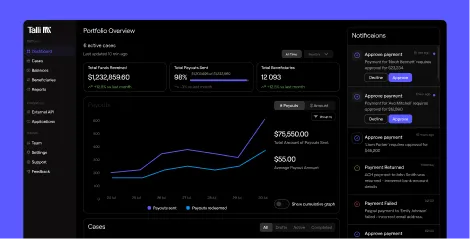
Talli is purpose-built for legal settlement disbursements, where speed matters but compliance cannot be compromised. The platform helps claims teams upload claimant data, create distribution campaigns, offer multiple redemption methods, and track every payment from a single dashboard.
For interest floats, the value is not only faster payment. It is documented control. Talli supports real-time tracking, automated reminders, KYC verification, OFAC screening, W-9 collection, fraud mitigation, and complete audit logging. Dedicated accounts preserve fund segregation, while payment status data supports reconciliation and court-ready reporting.
That changes the fiduciary record. Instead of explaining why funds sat idle in a manual queue, administrators can show when each claimant was notified, which payment option was selected, when compliance checks cleared, why any payment was held, and when the issue was resolved.
Talli also improves claimant outcomes. By offering ACH, prepaid Mastercard, PayPal, Venmo, Amazon gift cards, and check fallback, the platform helps reduce the number of claimants who never redeem funds. Higher redemption means less dormant property, fewer reissues, lower exception volume, and a cleaner closeout process.
Interest float will not disappear completely. Some funds must be held for legitimate legal, tax, or compliance reasons. But with Talli, administrators can minimize avoidable floats and prove that remaining delays served a documented purpose. That is the difference between hidden exposure and defensible fund management.
Frequently Asked Questions
What Is Interest Float In A Settlement Fund?
Interest float is the interest or economic value generated while approved settlement funds remain in an account before reaching claimants. It becomes a fiduciary issue when ownership, tax treatment, or delay reasons are not documented.
Does The T+1 Rule Apply To Legal Settlement Disbursements?
No. T+1 applies to covered securities transactions, not legal settlement distributions. However, it reflects a broader regulatory preference for shorter settlement cycles and reduced risk when money or assets are ready to move.
Can Administrators Keep Interest Earned On Settlement Funds?
Administrators should not keep interest for their own benefit unless the settlement documents, fee agreement, and court approval clearly allow it. Undisclosed retention of interest can create fiduciary, ethical, and accounting problems.
What Documentation Supports A Valid Disbursement Delay?
A defensible delay should include the hold reason, timestamp, approval record, legal or compliance basis, claimant communication history, exception owner, and release trigger. Without those details, the delay becomes harder to justify.
How Can Digital Disbursement Reduce Interest Float Risk?
Digital disbursement reduces avoidable delays by automating claimant outreach, payment selection, compliance checks, reminders, and reconciliation. Faster distribution shortens the period when funds sit idle and creates an audit trail for any necessary hold.