.svg)


.svg)
Zelle's instant peer-to-peer transfers have made it a household name for splitting dinner checks and paying rent, but when it comes to court-ordered settlement payments, the platform fails to meet key compliance requirements. A U.S. Senate investigation found that the three largest Zelle owner banks reimbursed only 38% of unauthorized fraud claims in 2023, while scam reimbursement remained far more limited, creating a risk profile that settlement administrators cannot ignore. For claims administrators, bankruptcy trustees, and law firms handling fiduciary funds, Zelle's lack of settlement-specific audit trails, fund segregation, and compliance automation creates liability exposure that speed alone cannot justify.
Key Takeaways
- Zelle payments to enrolled recipients generally cannot be canceled once sent, making correction difficult when funds are misdirected.
- The three largest Zelle owner banks reimbursed only 38% of unauthorized fraud claims in 2023, according to a Senate report.
- Regulation E protects consumers from unauthorized electronic fund transfers, but it does not create a universal reimbursement right for every scam where the user initiated the transfer.
- Zelle may support personal, small business, and certain disbursement use cases, but it does not provide settlement-specific FBO controls, QSF reporting, tax workflows, or court-ready audit exports.
- Court-defensible distributions require documented fund flows, claimant verification, sanctions screening, tax reporting where required, and exception handling.
- Purpose-built legal payments infrastructure is the safer standard when administrators need speed, auditability, and fiduciary control in the same workflow.
Understanding Zelle And Its Intended Use
Zelle operates as a bank-based payment network owned by Early Warning Services. Users typically access Zelle through a participating bank or credit union app, linking payments to an email address or U.S. mobile phone number. Once a recipient is enrolled, funds can move directly into the recipient's bank account within minutes.
That speed explains why Zelle became popular for everyday payments. It works well when users are sending money to friends, relatives, landlords, or small businesses they already know and trust. But court-supervised distributions involve a different risk profile. Settlement administrators are not simply sending money to known personal contacts. They are managing fiduciary funds, high-volume claimant lists, tax documentation, fraud risk, and post-distribution reporting.
How Zelle Payments Are Set Up
A typical Zelle payment requires:
- A participating U.S. bank or credit union account
- An enrolled email address or mobile number
- A recipient linked to an eligible bank account
- Bank-specific sending limits and fraud controls
The process is intentionally simple. That simplicity is part of the problem for legal settlements. Court-ordered payments need more than a fast transfer. Administrators must prove who was paid, why the person was eligible, how the payment was approved, and whether required compliance checks were completed before funds were released.
Why Speed Creates Risk For Settlement Payments
Zelle's own help center states that a payment can only be canceled if the recipient has not yet enrolled. If the recipient is already enrolled, the money is sent directly to the recipient's bank account and cannot be canceled through the standard Zelle flow. That creates a serious issue for settlement administrators because payment errors may involve incorrect recipients, duplicate records, impostor claims, or outdated contact information.
In a personal context, the sender may contact the recipient and ask for funds to be returned. In a legal distribution, that is not an adequate control. Court-supervised payment processes require documented correction paths, exception queues, and reconciliation records that prove every dollar was handled properly.
The Fraud And Scam Reimbursement Gap
The fraud and scam reimbursement data around Zelle is one of the strongest reasons administrators should avoid using it as a standalone settlement payout method. The Senate Permanent Subcommittee on Investigations found that the three largest Zelle owner banks reimbursed consumers for only 38% of Zelle transactions disputed as fraud in 2023, down from 62% in 2019.
For consumer banking, that raises obvious protection concerns. For settlement administration, it raises a fiduciary concern. If a claimant is impersonated, misdirected, or socially engineered during a distribution, administrators need to show that they used reasonable controls to prevent the loss. A consumer payment tool with limited reimbursement outcomes does not provide that proof on its own.
Unauthorized Fraud Claims Versus Scam Claims
A key issue is the difference between unauthorized fraud and scams. Unauthorized fraud typically involves someone accessing an account or initiating a transfer without the consumer's permission. Scam transactions often involve a consumer being tricked into authorizing the payment.
That distinction matters under Regulation E, which governs electronic fund transfers. Regulation E provides protections for unauthorized transfers and error resolution, but it does not automatically guarantee reimbursement for every authorized payment made under false pretenses. In settlement distributions, that gap can become a major exposure point if claimants are targeted through fake notices, phishing links, or impersonation schemes.
Why Regulation E Does Not Solve The Problem
Regulation E is a consumer protection framework, not a settlement administration framework. It can require financial institutions to investigate certain errors and unauthorized electronic fund transfers, but it does not replace administrator-level duties around fund custody, claimant validation, tax reporting, and court accounting.
For claims teams, the more relevant question is whether the distribution process can be defended to a court. That means showing that funds were segregated, claimants were verified, sanctions screening was performed, payment records matched claimant ledgers, and exceptions were handled under documented procedures. Zelle does not provide that full compliance layer.
Where Zelle Falls Short For Court-Supervised Funds
Zelle can move money quickly, but settlement payments require controlled disbursement infrastructure. A court-defensible process must preserve fund ownership, prevent commingling, document payment authorization, and generate records that can be reviewed by courts, trustees, class counsel, and auditors.
Consumer payment tools are not designed for that level of oversight. They may provide transaction histories, but transaction histories are not the same as full audit trails. An audit trail must connect claimant eligibility, approval status, payment amount, compliance checks, delivery method, failure handling, and final reconciliation.
Missing Settlement-Specific Controls
Zelle does not provide the core controls settlement administrators need, including:
- Dedicated FBO structures: Settlement funds often need to be held separately for the benefit of claimants. Zelle does not create settlement-specific FBO account architecture.
- Matter-level tracking: Administrators need to track funds by case, settlement, claimant, and distribution campaign. Zelle is not built around legal matters accounting.
- Integrated KYC checks: Zelle does not provide settlement administrator workflows for claimant identity verification before release.
- OFAC screening records: Settlement teams may need sanctions screening documentation before funds are paid. Zelle does not provide administrator-controlled OFAC screening with exportable timestamps.
- Tax documentation workflows: Some legal distributions require W-9 collection, backup withholding, and 1099 reporting. Zelle does not handle those workflows for settlement administrators.
Audit Trail And Reconciliation Gaps
Court reporting requires more than proof that money moved. Administrators need to show how each payment matched the approved claimant ledger and whether the distribution complied with the settlement plan. That usually requires three-way reconciliation across bank statements, internal ledgers, and claimant-level balances.
Zelle does not provide three-way reconciliation for trust accounting or settlement distributions. It also does not provide court-formatted reporting, exception workflows, or automated records showing which compliance checks occurred before release. Those gaps make Zelle difficult to defend in a court-supervised distribution, even if every payment technically reaches a bank account.
QSF And Fiduciary Requirements
Qualified Settlement Funds are governed by 26 CFR § 1.468B-1, which defines a QSF as a fund, account, or trust meeting specific requirements. Settlement funds must be administered with careful attention to separation, custody, reporting, and distribution authority.
A payout method used in a QSF context should support those requirements rather than forcing administrators to build manual workarounds. The risk is not only whether a payment is fast. The risk is whether the administrator can prove that funds were held and distributed under the rules governing the settlement.
Why Fund Segregation Matters
Fund segregation protects the settlement estate, the administrator, and the claimant population. When settlement funds are mixed with operating funds or routed through processes without matter-level controls, administrators can face questions about custody, authorization, and fiduciary compliance.
This is especially important for law firms and trustees handling large settlement populations. Every fund movement should connect back to a specific settlement, claimant record, approval workflow, and payment outcome. Without that connection, administrators may struggle to answer basic court questions after distribution.
Why Payment Rails Are Not Settlement Platforms
A payment rail moves money. A settlement platform manages the broader compliance workflow around the money. That distinction is critical.
Zelle is a payment network. It does not collect W-9s, calculate backup withholding, generate 1099 workflows, manage claimant reminders, track unclaimed funds, reconcile settlement ledgers, or export court-ready reports. Settlement teams need a system that wraps payment delivery inside compliance, accounting, claimant communication, and reporting controls.
Why Paper Checks Are Not The Answer Either
The fact that Zelle is not court-defensible on its own does not mean paper checks are ideal. Paper checks remain common in settlement administration, but they carry their own operational and compliance problems. They are slow, expensive to manage, easy to lose, and difficult to reconcile at scale.
Traditional paper workflows also create claimant experience problems. Returned mail, stale addresses, delayed deposits, and uncashed checks can leave eligible claimants unpaid even after a settlement is approved. That creates more administrative work and can increase escheatment exposure.
Traditional Check Failure Points
Paper check programs often involve:
- Printing and postage costs
- Returned mail handling
- Stop-payment fees
- Reissuance requests
- Manual reconciliation
- Uncashed check tracking
- Dormancy and escheatment obligations
These issues compound when distributions involve thousands of claimants. A small error rate can quickly become a large exception queue, delaying final reporting and increasing the burden on administrators.
The Better Standard For Digital Disbursements
The better standard is not paper checks versus Zelle. The better standard is controlled digital distribution. A purpose-built platform should offer digital convenience while preserving fiduciary controls.
That means claimants can receive payment through modern channels, but administrators still maintain fund segregation, verification workflows, fraud monitoring, reconciliation, and court-ready reporting. This is the gap that class action payouts, bankruptcy distributions, and mass tort settlements need to solve.
What A Court-Defensible Payment Method Should Include
Court-defensible payment methods should be evaluated based on evidence, not convenience. Administrators need systems that document every major step from claimant notification to final reconciliation.
A strong distribution process should show who was eligible, who approved payment, what compliance checks occurred, when funds were released, what payment method was used, and whether funds were received, failed, returned, or left unclaimed.
Compliance Requirements
A court-defensible payment system should include:
- Fund segregation: Dedicated accounts and matter-level controls that prevent commingling.
- KYC verification: Identity validation before funds are released.
- OFAC screening: Documented sanctions checks against U.S. Treasury lists through OFAC screening.
- Tax workflows: W-9 collection, backup withholding at 24% where required by the IRS, and 1099 generation when applicable.
- Fraud mitigation: Pattern detection for duplicate claims, suspicious devices, mismatched identities, and high-risk payment changes.
These requirements are not optional features for high-volume legal payouts. They are the controls that help administrators show reasonable care.
Reporting And Exception Handling
Court-ready reporting should include:
- Payment status by claimant
- Payment method selected
- Date and time of release
- Failed and returned payment records
- Outstanding exceptions
- Remaining fund balances
- Reconciliation results
- Approval and review history
Strong reporting reduces back-and-forth with courts and stakeholders. It also helps administrators identify problems early, before a distribution becomes a compliance issue. This is why settlement reporting should be built into the payout process rather than assembled manually after the fact.
How Talli Supports Court-Defensible Disbursements
Talli is purpose-built for legal settlement disbursements, class action payouts, bankruptcy distributions, and mass payment programs where administrators need speed and control. Instead of using a consumer payment app as the workflow, Talli gives claims teams one platform to upload claimant data, create payment campaigns, track every payment, and preserve documentation from start to finish.
Talli supports claimant choice while keeping compliance infrastructure centralized. Claimants can receive funds through ACH, prepaid Mastercard, PayPal, Venmo, Amazon gift cards, and checks, while administrators maintain visibility across the full distribution lifecycle.
Built-In Compliance Infrastructure
Talli includes the controls settlement teams need:
- KYC verification
- OFAC screening
- W-9 collection
- Fraud mitigation
- Audit logging
- Matter-level tracking
- Real-time payment status
- Court-ready reporting
This matters because compliance should not depend on disconnected spreadsheets or after-the-fact documentation. Built-in workflows help administrators prove that every payment was reviewed, released, and reconciled under a controlled process.
Multi-Channel Payout Options
Different claimant populations need different payment methods. Some claimants prefer ACH. Others may need prepaid cards, digital wallets, gift cards, or paper checks. Talli supports multi-channel payouts while preserving a consistent administrator view across payment types.
That flexibility helps reduce unclaimed funds without sacrificing compliance. Claims teams can offer faster digital options while still maintaining fallback methods for claimants who prefer or require checks.
Court-Ready Reporting
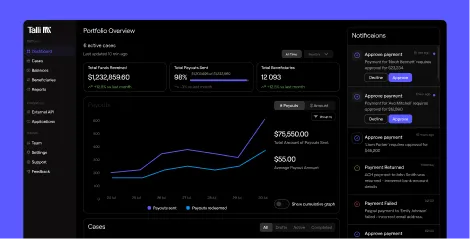
Talli gives administrators real-time dashboards showing payment progress, redemption rates, failed payments, remaining balances, and exception queues. Those records support post-distribution accounting and help legal teams respond to court, trustee, and stakeholder questions with confidence.
For bankruptcy payments, mass tort payouts, shareholder distributions, and class action settlements, this visibility is the difference between simply sending funds and proving that funds were distributed properly.
Talli Conclusion: Choose Speed With Control
Zelle is not a court-defensible payout method on its own because it does not provide the settlement-specific controls administrators need. It can move funds quickly, but it does not provide dedicated FBO account structures, QSF reporting, claimant verification workflows, tax documentation, OFAC records, three-way reconciliation, or court-ready audit exports.
That does not mean settlement teams should stay locked into slow paper check processes. Claimants increasingly expect digital payment options, and courts expect administrators to reduce avoidable delays, exceptions, and unclaimed funds. The right answer is not consumer payment shortcuts. The right answer is purpose-built digital disbursement infrastructure.
Talli gives claims administrators the ability to launch, fund, track, and reconcile settlement payments without losing fiduciary control. With built-in compliance, multiple payment options, and real-time reporting, Talli helps legal teams move faster while preserving the documentation courts expect. For teams evaluating payout infrastructure, Talli offers a compliance-first alternative to consumer payment tools that were never designed for court-supervised distributions.
Frequently Asked Questions
Can Zelle Payments Be Reversed If Sent Incorrectly?
Generally, no. Zelle states that payments can only be canceled if the recipient has not yet enrolled. Once money is sent to an enrolled recipient, it usually cannot be canceled through the standard Zelle flow.
Does Regulation E Protect Zelle Users From Scams?
Regulation E protects consumers from unauthorized electronic fund transfers, but scam cases can be different when the user initiated the payment. That distinction means Regulation E does not solve the fiduciary risk for settlement administrators.
Can A Settlement Administrator Use Zelle For Court-Ordered Payments?
Zelle may move money quickly, but it does not provide the full infrastructure needed for court-ordered distributions. Administrators still need fund segregation, claimant verification, tax workflows, OFAC screening, reconciliation, and audit-ready reporting.
What Makes A Digital Disbursement Platform Different From Zelle?
A digital disbursement platform manages the full settlement workflow. It can support payment choice while maintaining compliance checks, fund controls, claimant records, exception handling, reconciliation, and court-ready reports from one controlled system.
Why Is Talli Better Suited For Settlement Disbursements?
Talli is built for legal payouts. It combines KYC, OFAC screening, W-9 collection, fraud mitigation, audit logs, real-time dashboards, and multiple payment methods, helping administrators move funds quickly without losing fiduciary control.