.svg)


.svg)
U.S. class action settlements totaled roughly $42 billion in 2024, underscoring the scale of funds that may require structured settlement administration and distribution. Yet the distribution phase remains the most vulnerable point for fiduciary failures, compliance gaps, and unredeemed funds. When trustees, administrators, and law firms operate from fragmented systems with 48-72 hour information lag between payment events and stakeholder awareness, every undistributed dollar extends liability exposure. Modern QSF disbursement platforms eliminate these coordination failures by providing unified, real-time visibility across all parties, transforming what was once a regulatory minefield into a streamlined, defensible distribution process.
Key Takeaways
- Distribution phase creates concentrated fiduciary risk where every unredeemed payment keeps the QSF open and trustees answerable to the court
- Traditional check-based disbursements experience approximately 30% failure rates due to address changes, expired checks, and redemption barriers
- QSF administrators hold primary responsibility for tax filing, withholding obligations, and 1099 issuance while law firms provide claimant data and allocation guidance
- Digital disbursement platforms increase redemption rates by 15-25% over traditional methods when all parties can monitor real-time status
- Courts require payment-level audit trails proving initiation date, receipt confirmation, and tax-reporting linkage, achievable only through unified visibility systems
- AB Data achieved a 34% increase in take-up across check-issued populations and 60% reduction in unresolved exceptions through shared visibility platforms
Understanding the Role of a Qualified Settlement Fund (QSF) in Legal Settlements
A Qualified Settlement Fund under IRC Section 468B can be a fund, account, or trust established or approved by a qualifying governmental authority to resolve eligible claims. Funding a QSF generally satisfies economic performance for qualifying liabilities, although the timing and availability of a defendant's tax deduction depend on applicable tax rules and the circumstances of the settlement.
The QSF framework requires three foundational elements:
- Governmental authority order establishing the fund
- Continuing court jurisdiction over fund operations
- Segregated asset maintenance separate from transferor assets
Defining a QSF: Tax and Legal Implications
QSFs offer settlement planning flexibility unavailable through direct payments. The "settlement time crunch" typically rushes parties toward distribution decisions, but QSFs give everyone time to negotiate liens, make allocation decisions, and address settlement planning issues without tax consequences driving timelines.
Fund segregation under IRC Section 468B demands complete separation between settlement funds and operating capital. Failure to maintain the required segregation can jeopardize the fund's qualified status and create significant accounting, fiduciary, and compliance issues.
The Trustee's Fiduciary Duty in a QSF
The trustee bears ultimate fiduciary responsibility for every dollar distributed. This isn't merely administrative. Records scattered across check stubs and ledgers don't constitute acceptable accounting. Fiduciary distributions must be provable payment by payment, years after fund closure.
Distribution phase risk compounds exponentially. Every undistributed dollar, returned check, and unlocatable payee keeps the fund open and the trustee answerable to the court indefinitely.
The Administrator's Imperative: Streamlining Class Action Settlement Claims and Payouts
QSF administration involves careful division of responsibilities between the administrator and law firm. The QSF administrator is responsible for the fund's annual Form 1120-SF filing and related tax administration. Depending on the nature of the settlement payments, the administrator may also manage applicable withholding and information-reporting requirements, including Forms 1099.
Key administrator obligations include:
- Applicable withholding calculations and timely tax deposits
- W-9 collection and TIN validation
- 1099-MISC/1099-NEC generation with IRS e-filing
- Form 1120-SF preparation for annual QSF tax returns
- OFAC screening against Treasury sanctions lists
Challenges in Large-Scale Settlement Administration
Mass tort distributions involving 15,000+ claimants create coordination nightmares without shared visibility. Administrators must coordinate traditional problem areas including lien resolution, probate, and bankruptcy coordination, each requiring different timelines and documentation.
Failed or inadequate coordination leads to delays, errors, increased costs, and diverts resources from core competencies. Mismanagement could result in hefty fines, censure, or irreparable damage to firm reputation.
The Impact of Digital Platforms on Payout Efficiency
Modern digital disbursement platforms can compress distribution timelines from weeks to 24-48 hours. Processing costs can drop from $7-20 per check to $0.25-$5 for digital payments, representing 50-65% cost reduction at scale.
The efficiency gains compound with claimant count. A 10,000-claimant distribution saving $10 per payment generates $100,000 in direct cost reduction before accounting for reduced staff time and error remediation.
Law Firm's Perspective: Ensuring Transparency in Unclaimed Money Class Action Settlements
Law firms provide essential claimant data, payment instructions aligned with court-approved allocations, characterization of damages, and documentation of settlement terms. When parties lack coordinated communication and shared data access, compliance gaps emerge.
Minimizing Unclaimed Funds: A Legal Obligation
Unredeemed funds create multiple problems beyond immediate distribution failure:
- Cy pres complications requiring court-approved charitable distributions
- Escheatment obligations varying by state with 1-5 year dormancy periods
- Extended fund duration increasing administrative costs
- Court scrutiny questioning reasonable efforts documentation
Traditional check-based methods create approximately 30% failure rates due to outdated addresses. Around 11.8% of Americans moved in 2024 alone. Check-cashing fees of 5-8% discourage lower-income claimant redemption.
The Role of Data in Proving Due Diligence
Courts demand proof of reasonable efforts for every failed distribution. This requires documentation of:
- Initial payment attempt date and method
- Failure reason and timestamp
- Skip-tracing or address verification efforts
- Alternative payment method attempts
- Final disposition and court notification
Without shared visibility systems, this documentation sits fragmented across administrator files, law firm case notes, and trustee reports, creating gaps that surface during court reviews.
Bridging the Gap: Shared View Access for Efficient Trust Administration and Payouts
Information silos between QSF stakeholders create systemic coordination failures. Trustees need compliance attestation data, administrators need operational exception data, and law firms need client-specific status data, all from the same underlying payment system, all in real-time.
The Power of a Unified Data Source
Shared visibility platforms consolidate payment status across all stakeholders:
- Trustees see compliance metrics and fund balance projections
- Administrators monitor exception queues and processing throughput
- Law firms track individual client payment status without inquiry calls
- Courts access audit-ready reports without manual preparation
QSF administrators must maintain accurate records of all distributions and provide regular reports to relevant parties to ensure transparency and accountability. Manual coordination through email updates and spreadsheet sharing scales poorly beyond 1,000 claimants.
Enhancing Communication Between Trustees, Firms, and Administrators
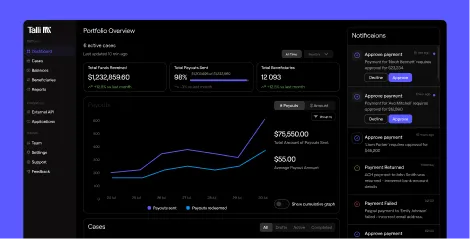
Real-time dashboards replace periodic PDF reports with live visibility into:
- Completion rates showing percentage of successful payouts
- Payment method distribution across ACH, cards, and wallets
- Geographic concentration identifying regional delivery issues
- Failure root cause analysis enabling rapid remediation
- Fraud flags requiring immediate review
Automated reporting generates court-required accounting without manual preparation, eliminating the days-long process of compiling data from multiple systems.
Compliance and Fraud Prevention: Key to Secure Legal Settlement Disbursements
Settlement administrators and other U.S. persons must comply with applicable OFAC sanctions requirements, typically through a risk-based compliance program that may include screening recipients against Treasury sanctions lists. Under IEEPA, the maximum civil penalty can reach $377,700 or twice the transaction value, whichever is greater. Manual screening becomes impossible at scale. 10,000 claimants against 13,000+ list entries creates an unmanageable review burden.
Automating Regulatory Compliance: A Digital Approach
Purpose-built compliance automation eliminates manual verification bottlenecks:
- KYC verification cross-references identity databases automatically
- OFAC screening achieves real-time compliance with documented timestamps
- W-9 collection via digital forms achieves 90% completion rates through smart reminders
- 1099 generation with IRS e-filing integration
- 24% backup withholding calculation for missing TIN numbers
Protecting Settlements from Fraudulent Claims
AI-powered fraud detection provides pattern recognition across device fingerprinting, behavioral analytics, and identity verification. Modern systems achieve 95% accuracy while identifying fraud 50% faster than manual review.
The 2026 Nacha amendments expand risk-based fraud monitoring requirements across ACH participants, with phased implementation during 2026. The separate 0.5% threshold applies to unauthorized ACH debit returns and should not be treated as a limit governing settlement credit payments.
Beyond Checks: Multi-Channel Payment Distribution for Modern Settlement Recipients
Claimant preferences have shifted dramatically. Around 80% prefer digital options over traditional checks. Meeting claimants where they are requires multiple payment methods with seamless failover capabilities.
Meeting Claimants Where They Are: Diverse Payment Options
Effective QSF distribution platforms offer multiple channels:
- ACH direct deposit: Lowest cost at $0.25-$0.50, 1-2 day delivery
- Prepaid Mastercard: Virtual cards delivered via SMS/email in 30 seconds
- Digital wallets: PayPal and Venmo integration for instant access
- Gift cards: Highest redemption for sub-$100 distributions
- Wire transfers: Same-day option for high-value international payments
- Paper checks: Maintained as fallback despite higher costs
The 5.6 million U.S. households that were unbanked in the FDIC's 2023 survey highlight the need for payment options that do not require a traditional bank account, including prepaid cards and digital wallets.
The Cost-Efficiency of Digital Payments vs. Paper Checks
Paper check all-in costs include printing, postage, reconciliation, and reissuance at $7-20 per payment. Digital alternatives can reduce this to $0.25-$5, creating 50-65% cost reduction for law firms managing distributions.
Beyond direct costs, digital payments eliminate:
- Reissuance cycles for lost or expired checks
- Manual reconciliation of outstanding payment liabilities
- Skip-tracing costs for returned mail
- Escheatment reporting complexity for stale-dated instruments
The Strategic Advantage: Expediting Settlement Reconciliation and Reporting
Settlement reconciliation traditionally consumes weeks of staff time. Manual three-way matching between court-approved allocations, payment records, and bank confirmations creates error-prone processes that delay fund closure.
Automating Financial Reconciliation for Court Filings
Automated three-way reconciliation achieves 90% auto-match rates, reducing monthly closing time by 70%. What previously required 15 hours now completes in 4.5 hours through automated exception flagging and resolution workflows.
Court reporting requires demonstrating compliance with court orders regarding payment timing. The audit trail must prove payment initiation date, claimant receipt and access, payment authorization, and tax-reporting linkage.
Real-Time Data for Informed Decision-Making
Real-time visibility enables mid-distribution adjustments impossible with batch reporting:
- Identify systemic failures, such as prepaid cards to PO boxes failing, and adjust strategy
- Implement automatic failover to alternative payment methods
- Document reasonable efforts in real-time rather than reconstructing post-facto
- Project fund closure timelines based on current redemption rates
Case Study: AB Data's Success with Digital Disbursement Infrastructure
AB Data, managing some of the largest class action settlements in the United States worth hundreds of millions of dollars, implemented shared visibility disbursement infrastructure with documented results.
Quantifiable Benefits of Integrated Settlement Platforms
The implementation delivered measurable improvements:
- 34% increase in claimant take-up across check-issued populations
- 60% reduction in unresolved exceptions and manual reissuance overhead
- 100% fiduciary compliance record maintained across all distribution cycles
- Faster time to funds for claimants while lowering distribution costs
Thomas R. Glenn, President & CEO of AB Data, stated: "We don't think of digital disbursement as a feature, we think of it as infrastructure. Talli gave us the regulated payout rails we needed to move faster, reduce unclaimed funds, and give courts full confidence in how settlement money is being distributed."
Transforming Traditional Claims Administration
The AB Data implementation demonstrates that effective and agile administration requires technology infrastructure enabling coordination without manual intervention. When attorneys or firms try to handle everything in-house, it becomes overwhelming and creates compliance gaps.
Why Talli Is the Right QSF Distribution Platform for Trustees, Administrators, and Law Firms
Selecting a QSF distribution partner requires evaluating capabilities that directly impact fiduciary compliance, operational efficiency, and fund closure timelines. While numerous payment platforms exist, purpose-built solutions specifically designed for Qualified Settlement Fund distributions deliver court-supervised compliance and stakeholder coordination that generic processors cannot match.
Effective platforms must provide:
- Unified stakeholder visibility that eliminates information silos and coordination delays. Real-time dashboards give trustees, administrators, and law firms simultaneous access to distribution status without manual report compilation.
- Embedded compliance workflows that automate OFAC screening, KYC verification, and W-9 collection. These capabilities transform what were previously manual, error-prone processes into defensible, audit-ready procedures.
- Multi-method disbursement spanning ACH, prepaid Mastercard, PayPal, Venmo, and traditional checks. Meeting claimants through their preferred payment channel directly increases redemption rates while reducing unclaimed fund complications.
- Court-ready audit trails documenting every payment from initiation through delivery. When courts demand proof of reasonable efforts years after distribution, comprehensive audit trails protect trustees and demonstrate compliance.
- Fund segregation architecture preserving QSF tax treatment through dedicated FBO accounts. Proper segregation isn't optional, it's foundational to maintaining qualified status.
Talli addresses these core requirements through infrastructure specifically built for legal settlement distributions. The platform maintains complete QSF compliance embedded within its architecture rather than requiring extensive customization. Automated court reporting eliminates manual preparation while stakeholder portals provide controlled access for courts, trustees, and legal teams.
For QSF trustees, administrators, and law firms managing complex distributions, purpose-built platforms eliminate the information silos that create fiduciary exposure while delivering the audit trails courts demand. The result: faster fund closure, higher redemption rates, and defensible compliance documentation that withstands court scrutiny.
Frequently Asked Questions
What is a Qualified Settlement Fund (QSF) and why is it important for legal settlements?
A Qualified Settlement Fund under IRC Section 468B can be a fund, account, or trust established or approved by a qualifying governmental authority to resolve eligible claims. QSFs provide defendants with tax benefits upon funding while allowing claimants to defer tax recognition until actual distribution. This structure gives all parties time to negotiate liens, make allocation decisions, and address settlement planning issues without tax consequences driving timelines. The fund must be established by governmental authority order, remain subject to continuing court jurisdiction, and maintain segregated assets separate from transferor assets.
How does shared view access benefit trustees, administrators, and law firms in a QSF distribution?
Shared view access eliminates the 48-72 hour information lag that creates compliance blind spots during distribution. Trustees gain real-time visibility into fiduciary compliance metrics without requesting data from administrators. Administrators can focus on exception resolution rather than fielding status inquiries. Law firms see which clients have unredeemed payments and can proactively contact them. All parties access the same underlying data simultaneously, eliminating reconciliation discrepancies that occur when different stakeholders pull reports from different systems at different times.
What are the primary challenges in traditional legal settlement disbursements that digital platforms address?
Traditional check-based disbursements experience approximately 30% failure rates due to outdated addresses, expired checks, and check-cashing fees that discourage redemption. Manual coordination through email updates and spreadsheet sharing scales poorly beyond 1,000 claimants. Records scattered across multiple systems create documentation gaps during court reviews. Digital platforms reduce processing costs from $7-20 per check to $0.25-$5 while providing unified audit trails that prove payment initiation, delivery confirmation, and reasonable efforts for every distribution.
How do modern QSF platforms ensure compliance and prevent fraud in large-scale settlement payments?
Modern platforms integrate automated compliance workflows including real-time OFAC screening against Treasury sanctions lists with documented timestamps, KYC verification cross-referencing identity databases, and W-9 collection achieving 90% completion rates through smart reminders. AI-powered fraud detection provides pattern recognition across device fingerprinting and behavioral analytics, achieving 95% accuracy while identifying fraud 50% faster than manual review. The platform maintains SOC 2 Type II and PCI DSS Level 1 compliance with FDIC-insured fund segregation.
What payment methods should QSF administrators offer to maximize claimant redemption rates?
Effective distribution strategies offer multiple channels tailored to diverse claimant populations. ACH direct deposit provides the lowest cost at $0.25-$0.50 with 1-2 day delivery. Prepaid Mastercard virtual cards can be delivered via SMS/email in 30 seconds, serving unbanked populations. Digital wallets including PayPal and Venmo offer instant access for tech-savvy claimants. Gift cards achieve highest redemption for sub-$100 distributions. Wire transfers provide same-day options for high-value international payments. Maintaining paper checks as a fallback ensures accessibility for all demographics. Platform data shows that offering multiple methods with automatic failover increases overall redemption rates by 15-25% compared to check-only distributions.