.svg)


.svg)
Qualified Settlement Funds create a three-party accountability puzzle that state unclaimed property auditors exploit regularly. When a QSF involves a trustee, administrator, and bank, determining which entity bears legal "holder" responsibility for escheatment reporting becomes critical, and getting it wrong triggers state audit lookback periods spanning 10-15 years with penalties that compound rapidly. Most QSF structures lack clear escheatment allocation in their governing documents, creating substantial exposure for all parties involved. Digital disbursement platforms purpose-built for legal settlements can resolve this ambiguity while achieving 95-98% redemption rates that prevent escheatment at the source.
Key Takeaways
- Under the Revised Uniform Unclaimed Property Act (RUUPA), the "holder" is the person obligated to hold, deliver, or pay property to the owner, a definition that maps poorly to multi-party QSF structures
- The settlement administrator may qualify as the holder when the governing documents and applicable state law make the administrator legally responsible for holding, delivering, or paying the unclaimed property to claimants
- Trustees may retain fiduciary obligations under the governing trust, settlement documents, court orders, and applicable law even when administrators handle day-to-day operations
- Banks providing custodial services through FBO accounts generally do not qualify as holders when another party remains legally obligated to pay the claimant, though the result depends on account structure and governing agreements
- State dormancy periods range from 1-5 years depending on jurisdiction before funds become subject to escheatment
- Platform architecture can clarify custody, recordkeeping, and responsibility, but holder status ultimately depends on the governing legal obligation and applicable state unclaimed property law
- Traditional paper check distributions result in 20-30% unclaimed funds, creating additional reissuance work and potential escheatment obligations under applicable state laws. Modern disbursement methods can substantially reduce these problems.
Understanding Escheatment Laws and Unclaimed Property
The Foundation of Unclaimed Property Laws
Escheatment laws exist to reunite owners with their abandoned property while preventing indefinite private enrichment from unclaimed funds. Every state has adopted some version of these statutes, creating a patchwork of requirements that QSF administrators must navigate carefully.
The basic mechanism works through defined dormancy periods. When property remains unclaimed for a specified time, often 1-5 years for common categories, depending on the property type and state, the holder must perform required due diligence outreach to locate the owner, report unclaimed property to the appropriate state, remit funds to state custody for safekeeping, and maintain records proving compliance with all requirements.
States have become increasingly aggressive in enforcing these obligations. Audit lookback periods can extend 10-15 years, and contract auditors working on contingency fees have strong incentives to find violations.
Key Principles of Escheatment
The escheatment process follows priority rules that determine which state receives unclaimed property:
- First priority: Generally, the state of the owner's last known address shown on the holder's records
- Second priority: Generally, the holder's state of domicile when no qualifying owner address is available or the first-priority state cannot take the property
- Additional rules: Certain property types and circumstances may be governed by specialized federal or state statutory rules
For QSF distributions, claimant addresses from the claims process typically establish first priority. However, when addresses are invalid or unknown, common with outdated contact information, the holder's state of incorporation becomes the default, making holder identification even more consequential.
Defining the 'Holder' in Complex Financial Structures
Legal Definitions of a Holder
Under RUUPA, the holder is defined as "a person obligated to hold for the account of, or deliver or pay to, the owner property subject to this chapter." This definition works cleanly for simple scenarios, such as a bank holding a dormant account or a company with outstanding payroll checks.
QSF structures complicate this analysis because multiple parties share responsibilities: trustees with fiduciary oversight authority, administrators executing operational functions, banks providing custodial services, and payment processors handling actual disbursements.
Each party could plausibly claim holder status or deny it, depending on how contracts allocate responsibilities. Courts and state auditors look beyond contractual labels to examine actual control over the property.
Challenges in Identifying the Holder
The holder determination involves analyzing possession or control of the underlying property, obligation to deliver funds to the rightful owner, record-keeping responsibilities establishing owner contact, contractual arrangements among the parties, and regulatory requirements for the specific property type.
Most QSF compliance frameworks don't address escheatment holder designation explicitly. This gap creates exposure for all parties when state auditors arrive demanding documentation of compliance efforts.
The Role of the Trustee in a Qualified Settlement Fund
Fiduciary Obligations and QSF Management
Treasury Regulations under IRC Section 468B establish specific requirements for QSFs. A QSF is treated as a United States person for federal tax purposes, and its administrator may include a trustee when the fund is structured as a trust. This fiduciary role carries substantial obligations:
- Fund custody ensuring proper safekeeping of settlement assets
- Court accountability for all QSF operations and distributions
- Compliance oversight across tax and regulatory requirements
- Beneficiary protection as the primary fiduciary duty
The trustee's fiduciary duty extends to selecting appropriate service providers, including administrators and banking partners. Poor vendor selection that results in unclaimed funds can create trustee liability even when the trustee didn't directly cause the problem.
Trustee's Power and Control Over Funds
Despite delegating operational tasks, trustees retain ultimate authority over QSF assets through approval rights for distribution plans and payment schedules, oversight authority to monitor administrator performance, removal power to replace underperforming service providers, and reporting obligations to courts and regulatory bodies.
This retained authority creates an argument that trustees qualify as holders under RUUPA's "control" analysis. However, most state auditors recognize that operational control, not oversight authority, determines practical holder status.
The Administrator's Function in Settlement Distributions
Executing the Distribution Plan
Settlement administrators handle the operational mechanics that trustees oversee. These responsibilities create direct relationships with claimants that become central to holder analysis:
- Claimant communication through notices and status updates
- Payment processing via checks, ACH, or digital methods
- Tax reporting including W-9 collection and 1099 generation
- Record maintenance documenting all owner contact attempts
- Exception handling for returned mail and failed payments
The administrator's role in distribution execution places them closest to claimants and their contact information. They know when last contact occurred, the triggering event for dormancy periods.
Intermediary Role Between Trustee and Claimants
Administrators occupy a unique position in the QSF structure. Upstream, they report to trustees on distribution progress, maintain court-required accounting records, and flag compliance issues requiring trustee decisions. Downstream, they process claimant payments accurately and timely, respond to claimant inquiries about payment status, and perform due diligence on stale payments.
This intermediary position, combined with operational control over distributions, often makes the administrator the holder for escheatment purposes. The administrator maintains the records showing last owner contact, the critical data point for determining when dormancy periods begin.
The Bank's Custodial Role and Unclaimed Funds
Banking Services and Fund Segregation
Banks in QSF structures provide custodial services through dedicated FBO (For Benefit Of) account structures. These accounts serve critical functions including asset segregation, maintaining separation from operating capital, potential pass-through FDIC coverage when applicable ownership, account-titling, and recordkeeping requirements are satisfied, wire processing for fund transfers to administrators, and statement generation supporting audit documentation.
Proper fund segregation architecture preserves QSF tax treatment under IRC Section 468B while simplifying court reporting through matter-level fund tracking.
When Bank Holdings Become Unclaimed
Banks face their own escheatment obligations for dormant accounts. However, QSF funds typically don't trigger bank-level escheatment because active account activity continues through administrator-directed transfers, institutional ownership rather than individual account holders exists, contractual relationships clarify that banks act as custodians only, and trust structures place beneficial ownership elsewhere.
A bank acting solely as custodian may not be the holder of the claimant payment obligation when another party remains legally obligated to pay the claimant. The result depends on the account structure, governing agreements, and applicable state law. Banks don't decide which claimants get paid or maintain the contact records proving compliance efforts.
Determining the Primary Holder for Escheatment Reporting
Analyzing Control and Contractual Responsibility
When state auditors examine QSF structures, they focus on practical control rather than titles. The trustee typically provides oversight only over operational control of payments, has no direct claimant relationships, reviews rather than maintains last contact records, approves rather than executes distribution decisions, and oversees rather than files tax reporting like 1099s.
The administrator exercises direct control over payments, maintains direct contact with claimants, maintains last contact records, executes distribution decisions, and files tax reporting. The bank has no operational control over payments, no direct claimant relationships, maintains no last contact records, processes rather than makes distribution decisions, and performs no tax reporting.
The administrator emerges as the primary holder in most analyses because they exercise day-to-day control, maintain claimant records, and perform the compliance functions such as W-9 collection and 1099 reporting that mirror holder obligations.
Implications of Incorrect Holder Identification
Getting holder designation wrong creates cascading problems including duplicate reporting when multiple parties file cautiously, non-reporting when each party assumes another will file, audit exposure spanning 10-15 years of lookback, penalty liability that may not be indemnified contractually, and litigation risk among parties disputing responsibility.
Best practice requires explicit contractual allocation of escheatment compliance duties in the QSF governing documents, including due diligence, reporting, recordkeeping, and remittance responsibilities. Those provisions can reduce disputes, but they do not override applicable state law in determining the statutory holder.
Mitigating Escheatment Risks in Class Action and Mass Tort Cases
Strategies to Maximize Claimant Redemption
The most effective escheatment mitigation prevents funds from becoming unclaimed in the first place. Traditional paper check distributions result in 20-30% unclaimed funds that eventually escheat to state treasuries, a failure that modern disbursement methods can largely eliminate.
Payment Method Diversification includes ACH direct deposit for banked claimants, prepaid cards for unbanked populations, digital wallets like PayPal and Venmo for faster access, and gift cards for small-value distributions under $100.
Proactive Claimant Outreach involves multiple contact attempts before dormancy triggers, updated address verification through NCOA and other databases, email and SMS reminders supplementing postal mail, and clear payment status portals for claimant self-service.
Proactive Measures for Fund Distribution
Effective claims administration includes escheatment prevention from the outset through pre-distribution planning that validates claimant addresses before payment issuance, collects multiple contact methods during the claims process, and establishes communication preferences for each claimant.
Active distribution management monitors failed payment rates in real-time, reissues quickly when payments fail, and tracks dormancy periods at the individual claimant level. Post-distribution protocols run due diligence letter campaigns before escheatment deadlines, document all owner contact attempts systematically, and prepare escheatment filings for truly unreachable claimants.
The Impact of Digital Disbursement on Escheatment
How Digital Solutions Reduce Unclaimed Funds
Digital disbursement platforms transform escheatment exposure by attacking the root cause, unredeemed payments. The contrast with traditional methods is stark. Paper checks typically achieve 70-80% redemption rates with 6-8 week time to claimant receipt, delayed failed delivery visibility, reissuance costs of around $7-20 per check, and high escheatment exposure.
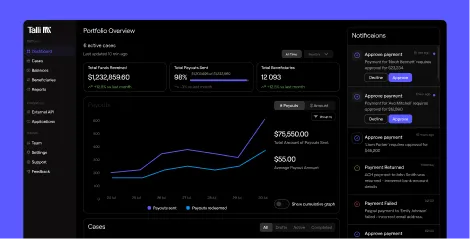
Talli reports 95-98% redemption rates for digital-first settlement distributions with 24-48 hour time to claimant receipt, real-time failed delivery visibility, estimated $0.25-$5 digital reissuance costs, and minimal escheatment exposure.
Modern platforms achieve these results through instant delivery via SMS and email for virtual cards and digital wallets, real-time tracking identifying failures immediately, multiple payment options matching claimant preferences, and automated reminders before dormancy periods trigger.
Efficiency Gains and Compliance Benefits
Beyond reducing unclaimed funds, digital disbursement platforms improve holder compliance capabilities through documentation excellence that includes complete audit trails for every payment attempt, timestamped records of owner contact, automated due diligence workflows, and court-ready reporting on demand.
Compliance automation features integrated OFAC screening for all payees, automated W-9 collection with 90% completion rates, built-in 1099 generation and IRS filing, and KYC verification before payment release.
Holder compliance support includes segregated account structures for each settlement, documented administrator-level operational controls, documented payment method selection by claimants, and comprehensive reconciliation at the claimant level.
Why Choose Talli for QSF Escheatment Compliance
Talli addresses the multi-party holder problem through purpose-built architecture that creates clear escheatment compliance pathways for QSF administrators.
- Segregated Fund Architecture: Dedicated FBO account structures for each settlement reduce pooled-account ambiguity and help maintain separation between settlement funds and operating capital. Banking services provided by Patriot Bank, N.A., Member FDIC, support clear custody chains and the asset-segregation requirements relevant to properly established QSFs.
- Administrator-Level Controls: Talli's platform positions administrators as the operational controllers with direct claimant communication through multiple channels, real-time payment status visibility and tracking, complete audit trails documenting every owner contact, and automated due diligence workflows before escheatment deadlines.
- Redemption Rate Optimization: The platform offers six payment methods including ACH, prepaid Mastercard, PayPal, Venmo, gift cards, and paper checks, achieving the 95-98% redemption rates that prevent escheatment at the source. Multi-channel payment options meet claimants where they are, dramatically reducing unclaimed funds.
- Compliance Automation Suite: Built-in verification handles KYC, OFAC screening, W-9 collection, and 1099 generation automatically. This integrated compliance infrastructure ensures administrators can document their holder obligations without manual tracking across multiple systems.
For QSF trustees and administrators seeking to resolve holder ambiguity while minimizing escheatment exposure, Talli's QSF-compliant disbursement platform provides the regulated payout rails needed for defensible compliance.
Frequently Asked Questions
What is the primary purpose of escheatment laws?
Escheatment laws serve to reunite owners with their abandoned property while preventing private entities from benefiting indefinitely from unclaimed funds. States act as custodians, holding unclaimed property until rightful owners come forward. The laws also generate revenue for state treasuries when property remains permanently unclaimed. For QSF administrators, these laws create compliance obligations that begin when dormancy periods expire and continue through reporting and remittance to state authorities.
Can a QSF trustee delegate escheatment reporting responsibilities to the settlement administrator?
Yes, trustees routinely delegate operational responsibilities including escheatment compliance to administrators through contractual agreements. However, delegation doesn't eliminate trustee fiduciary oversight obligations. Trustees remain responsible for selecting competent administrators, monitoring their performance, and ensuring compliance systems function properly. Contractual allocation should explicitly address escheatment holder designation, due diligence protocols, reporting responsibilities, and indemnification for compliance failures.
How does the bank's role differ from the trustee's or administrator's in terms of escheatment liability?
Banks providing custodial services through FBO accounts generally do not qualify as holders for QSF escheatment purposes when another party remains legally obligated to pay the claimant. They lack the operational control, claimant relationships, and record-keeping responsibilities that define holder status. Banks process transactions at administrator direction but don't decide which claimants get paid or maintain contact information proving compliance efforts. However, banks have their own dormancy monitoring obligations for accounts without activity, which typically don't apply to actively managed QSF custody accounts.
What are the typical dormancy periods before funds become subject to escheatment?
Dormancy periods vary by state and property type, generally ranging from 1-5 years after last owner contact. For settlement payments, many states apply around a 3-year dormancy period for uncashed checks, while some states have shortened periods for certain property types. State-specific escheatment laws also differ on due diligence requirements, reporting deadlines, and exemptions. Administrators must track dormancy at the individual claimant level, using last contact dates that vary across the claimant population.
How can digital payment platforms help minimize escheatment of settlement funds?
Digital platforms minimize escheatment by achieving significantly higher redemption rates compared to paper checks. This improvement comes from multiple factors: instant delivery of virtual cards and digital wallet transfers, multiple payment options matching claimant preferences, real-time failure detection enabling quick reissuance, automated reminder sequences before dormancy triggers, and comprehensive tracking giving claimants visibility into payment status. By dramatically reducing unclaimed funds, digital platforms prevent escheatment at the source rather than managing compliance after funds become dormant.