.svg)


.svg)
Essential data on unredeemed shareholder funds, escheatment rules, and digital disbursement solutions for claims administrators and legal professionals
Key Takeaways
- Unclaimed property affects millions of Americans — Roughly 1 in 7 Americans have unclaimed property, with state programs returning $4.49 billion to rightful owners in FY2024 alone, yet tens of millions of shareholder positions remain disconnected from their owners
- Dormancy periods vary dramatically by jurisdiction — 33 U.S. jurisdictions apply a 3-year dormancy period while 18 use 5 years and 1 uses 7 years, creating complex compliance requirements for corporations managing shareholder services and dividend distributions
- Lost shareholder rules trigger costly search requirements — SEC Rule 17Ad-17 mandates two separate searches for lost securityholders, with the first occurring 3-12 months after lost status and the second 6-12 months later
- Recovery amounts show significant distribution gaps — While the average claim paid through MissingMoney.com reached $2,080, the median was just $100, indicating many small-dollar recoveries alongside fewer high-value claims
- Paper-based systems drive unclaimed rates higher — Traditional check-based distributions experience 20-30% unclaimed rates, while digital disbursement platforms achieve 95-98% redemption rates through multi-channel payment options
- Compliance enforcement remains active — Recent settlements including California's $7.7 million and New York's $4.4 million cases demonstrate ongoing regulatory scrutiny of unclaimed property handling
- Digital solutions compress payment timelines — Modern disbursement platforms reduce settlement distribution from 6-8 weeks to 24-48 hours while cutting processing costs by 50-65%
Understanding Unclaimed Money: The Scale of Ignored Dividends
1. State programs returned $4.49 billion to rightful owners in FY2024
State unclaimed property programs achieved their strongest reunification activity during fiscal year 2024 (July 1, 2023 through June 30, 2024), returning $4.49 billion to rightful owners. This figure encompasses unclaimed securities-related assets including forgotten dividend payments, unredeemed shareholder checks, and abandoned stock positions. The scale demonstrates both the magnitude of the unclaimed property problem and the functioning recovery infrastructure when owners take action to claim their funds. Source: NAUPA Fiscal Year 2024 data
2. Roughly 1 in 7 Americans have unclaimed property
Current estimates indicate approximately 1 in 7 Americans have unclaimed property waiting in state treasury systems. This includes dividend payments, shareholder distributions, and other securities-related funds that became disconnected from their owners through address changes, corporate restructurings, or simple oversight. The prevalence suggests systematic issues in payment delivery rather than isolated incidents. Source: NAUPA Fiscal Year 2024 data
3. Average recovery claims reached $2,080 in FY2024
The average claim amount paid through MissingMoney.com during FY2024 was $2,080, demonstrating economically meaningful recovery potential for individuals with forgotten shareholder accounts. However, this average reflects a highly skewed distribution where high-value recoveries pull up the mean significantly above typical claim amounts. Source: NAUPA Fiscal Year 2024 data
4. Median recovery was just $100
The median claim paid through MissingMoney.com in FY2024 was only $100, revealing the gap between average and typical recoveries. This 20:1 ratio between mean and median indicates that most unclaimed property involves small-dollar amounts while a smaller number of large recoveries drives up the average. For organizations managing high-volume payouts, this distribution pattern underscores the need for cost-effective processing of numerous small-value transactions. Source: NAUPA Fiscal Year 2024 data
5. At least 94 million positions were estimated in lost accounts
An SEC survey of the seven largest transfer agents identified at least 94 million positions in lost accounts, providing historical context for the structural scale of disconnected shareholder property. While this benchmark figure reflects historical conditions, it demonstrates the concentrated nature of the lost-holder problem among major recordkeepers and the ongoing challenge of maintaining accurate shareholder records. Source: U.S. House Hearing Record
Dormancy Rules and Escheatment Timelines
6. 33 jurisdictions apply a 3-year dormancy period
The most common dormancy period for shareholder property is three years, applied by 33 U.S. jurisdictions before securities-related assets can be escheated to the state. This represents the dominant standard for determining when dividend payments and stock positions become subject to state unclaimed property claims. Source: Computershare Escheatment White Paper
7. 18 jurisdictions use a 5-year dormancy period
Eighteen U.S. jurisdictions require a five-year dormancy period before shareholder property is turned over to the state. This longer timeline provides additional opportunity for owners to claim their funds but also extends the period during which corporations must maintain records and tracking systems for potentially unclaimed assets. Source: Computershare Escheatment White Paper
8. One jurisdiction applies a 7-year dormancy period
A single jurisdiction maintains a seven-year dormancy period for shareholder property, creating the longest standard wait time before escheatment. This variation across jurisdictions creates compliance complexity for corporations with shareholders in multiple states. Source: Computershare Escheatment White Paper
9. 44 states require fall reporting for unclaimed property
The majority of unclaimed property reporting concentrates in the fall filing season, with 44 states requiring submissions during this period. This concentration creates operational pressure for transfer agents, issuers, and dividend-paying companies managing annual escheatment cycles and audit trail requirements. Source: Computershare Escheatment White Paper
10. 7 states require spring filing
Seven states maintain spring reporting deadlines for unclaimed property, creating a secondary compliance window outside the dominant fall season. Organizations must track these distinct timelines to maintain compliance across all jurisdictions where they hold shareholder property. Source: Computershare Escheatment White Paper
11. 2 states require summer filing
Two states require summer filing for unclaimed property reports, representing the smallest seasonal cohort. This fragmented reporting calendar demands careful scheduling to ensure timely compliance across all filing periods. Source: Computershare Escheatment White Paper
Lost Shareholder Classification and Search Requirements
12. Two returned mailings within one month triggers "lost" status
Under SEC-established standards, a shareholder becomes classified as "lost" when two successive pieces of mail are returned as undeliverable within one month and no new address has been received. This trigger rule is one of the most operationally significant standards in shareholder payment administration, initiating mandatory search and notification requirements. Source: Computershare Escheatment White Paper
13. 13 "lost states" require lost classification before escheatment
Thirteen states require a shareholder to be formally classified as lost before escheatment proceedings can begin. This creates a materially different compliance pathway compared to states that can escheat based solely on dormancy and unclaimed status. Source: Computershare Escheatment White Paper
14. 40 "non-lost states" may escheat without returned mail
Forty states may proceed with escheatment based on dormancy and unclaimed status without requiring returned mail as a prerequisite. This distinction affects how corporations structure their claimant communication and due diligence processes across different jurisdictions. Source: Computershare Escheatment White Paper
15. First search must occur within 3-12 months of lost status
SEC Rule 17Ad-17 mandates that the first required search for lost securityholders must occur between three and twelve months after the holder becomes lost. This search requirement applies to transfer agents and issuers maintaining shareholder records. Source: eCFR
16. Second search required 6-12 months after the first
The second mandatory search must occur between six and twelve months following the first search, creating a structured timeline for locating missing shareholders. This two-search requirement represents the minimum due diligence standard absent qualifying exemptions. Source: eCFR
17. Accounts under $25 qualify for search exemption
A de minimis exemption applies when the aggregate value of an account—including dividends, interest, and other payments due—is less than $25. This threshold directly affects low-balance shareholder accounts and reduces compliance burden for small-value positions. Source: eCFR
Uncashed Check Rules and Notification Requirements
18. Written notification required within 7 months of unnegotiated check
Paying agents must send a single written notification to missing securityholders no later than seven months after sending a check that remains unnegotiated. This deadline applies to dividend checks and other recurring shareholder payments that go uncashed. Source: SEC Federal Register
19. "Unresponsive payee" status triggers at 6 months or next payment
A holder becomes an "unresponsive payee" when a check is not negotiated before the earlier of the next regularly scheduled check or six months after the original check was sent. This rule is particularly relevant for recurring dividend payments where multiple checks may accumulate uncashed. Source: SEC Federal Register
20. Checks under $25 exempt from notification requirements
Paying agents are excluded from the unresponsive payee notification requirement when the unnegotiated check is worth less than $25. This exemption reduces administrative burden for low-value dividend payments while maintaining requirements for economically significant amounts. Source: SEC Federal Register
Compliance Enforcement and Recent Settlements
21. California secured $7.7 million in unclaimed property settlement
California announced a $7.7 million settlement in September 2024 involving allegedly withheld unclaimed property. While this case involved healthcare provider overpayments rather than dividends specifically, it demonstrates active enforcement of unclaimed property laws and the financial consequences of non-compliance. Source: California DOJ Press Release
22. New York recovered nearly $4.4 million from gift card funds
New York announced a settlement of nearly $4.4 million in December 2024 involving unused gift card funds that should have been remitted to the state's unclaimed funds system. This enforcement action illustrates regulatory attention to various forms of unclaimed property beyond traditional securities. Source: New York State Attorney General
23. 30-state coalition settled $190+ million MoneyGram dispute
A bipartisan coalition of 30 states agreed to a settlement exceeding $190 million in unclaimed MoneyGram property in 2024. This multi-state action demonstrates coordinated enforcement capabilities and the substantial dollar amounts at stake in interstate unclaimed property disputes. Source: State of Delaware News
Modern Payment Standards and Recovery Requirements
24. Eligible state funds in DOL retirement-plan guidance must pay 100% of reported amounts
Under Department of Labor guidance for missing retirement-plan participants, an eligible state fund must pay approved claimants not less than 100% of the amount reported and remitted by the fiduciary. This is a retirement-plan safeguard rather than a general shareholder-dividend standard. Source: DOL Field Assistance Bulletin 2025-01
25. DOL retirement-plan guidance calls for annual address searches for amounts exceeding $50
For amounts in excess of $50, the DOL says an eligible state fund for missing retirement-plan participants should diligently search at least annually for updated addresses and notify owners once found. This is part of the DOL's retirement-plan framework, not a general shareholder-dividend rule. Source: DOL Field Assistance Bulletin 2025-01
Digital Solutions: Reducing Unclaimed Payment Rates
The statistics above reveal a systemic problem: complex rules, fragmented jurisdictions, and paper-based processes combine to disconnect millions of recipients from their funds. Modern digital disbursement platforms address these root causes through:
Multi-channel payment options: Rather than relying solely on paper checks that experience 20-30% unclaimed rates, digital platforms offer ACH direct deposit, prepaid cards, digital wallets, and gift cards. This payment flexibility achieves 95-98% redemption rates by meeting recipients where they are.
Real-time tracking and notifications: Automated systems identify undelivered payments immediately rather than waiting months for uncashed check reports. Platforms providing real-time status tracking can initiate re-engagement before dormancy clocks begin.
Automated compliance workflows: With 52 jurisdictions maintaining different dormancy periods, filing deadlines, and lost-holder rules, manual compliance tracking becomes untenable at scale. Integrated platforms handle KYC verification, address validation, and escheatment reporting automatically.
Cost reduction through digitization: Processing costs drop from $7-20 per paper check to $0.25-$5 for digital payments, representing 50-65% savings. This cost efficiency makes proactive re-engagement economically viable even for low-value payments that would otherwise go unclaimed.
For organizations managing shareholder payments, class action settlements, or other high-volume disbursements, these capabilities transform unclaimed property from an inevitable compliance burden into a solvable operational challenge.
The Talli Solution: Turning Statistics Into Results
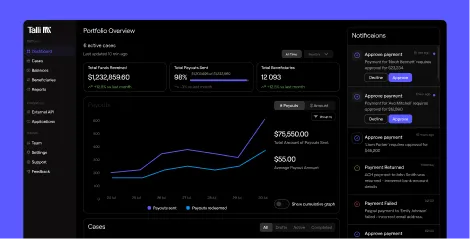
While the statistics in this article reveal the scale of the unclaimed property challenge, they also point to clear solutions. Talli's payment processing platform directly addresses the failure points identified throughout these 25 data points.
Organizations using Talli achieve:
- 30% increase in redemption rates through multi-channel payment options that eliminate dependence on paper checks
- 60% reduction in unresolved exceptions via automated compliance automation that tracks all 52 jurisdiction requirements
- 24-48 hour payment delivery compared to 6-8 week timelines for traditional check-based distributions
- 50-65% lower processing costs through digital-first workflows that scale efficiently
For claims administrators managing hundreds of millions in shareholder payments, class action distributions, or dividend disbursements, Talli transforms complex regulatory requirements into streamlined operations—ensuring more funds reach rightful owners while reducing escheatment exposure and compliance risk.
Frequently Asked Questions
What are the most common reasons dividends go unclaimed?
Dividends typically go unclaimed due to address changes that cause mail returns, deceased account holders whose heirs are unaware of the assets, corporate mergers and acquisitions that change issuer names, and simple oversight where shareholders forget about small positions. The two-returned-mail trigger that creates "lost" shareholder status often results from routine moves rather than intentional abandonment.
How can I check if I have unclaimed dividends or shareholder payments?
The primary resource is MissingMoney.com, a multi-state search database maintained by NAUPA. Individual state treasury websites also maintain searchable unclaimed property databases. The average successful claim through these systems was $2,080 in FY2024, though the median of $100 indicates most recoveries are smaller amounts.
What is the average redemption rate for digital vs. paper payments?
Traditional paper check distributions experience 20-30% unclaimed rates, while digital disbursement platforms achieve 95-98% redemption rates. This gap results from digital channels offering multiple payment options, real-time delivery confirmation, and immediate re-engagement capabilities when initial delivery fails.
How long do I have to claim unclaimed dividends before they are permanently escheated?
Dormancy periods vary by jurisdiction: 33 states use 3 years, 18 use 5 years, and 1 uses 7 years. After escheatment, most states maintain the funds indefinitely and allow claims, though some impose eventual abandonment deadlines. The key is that once property escheats, recovery requires working through state processes rather than the original issuer.
What role does a claims administrator play in reducing unclaimed funds?
Claims administrators manage the distribution process and can significantly impact redemption rates through payment method selection, proactive claimant outreach, and re-engagement with unresponsive recipients. Administrators using digital platforms with multi-channel options consistently achieve higher completion rates than those relying on paper checks alone.