.svg)


.svg)
Filing Form 1099-DIV seems straightforward until the IRS sends penalty notices months after submission. Issuers face penalties ranging from $60 to $310 per incorrect form, with intentional disregard increasing to a minimum of $630 and these errors compound quickly across thousands of recipients. The most common mistakes involve TIN mismatches that trigger B-Notices, misclassification between qualified and ordinary dividends, and timing errors for December-declared dividends paid in January. Modern compliance automation platforms can prevent these errors while reducing administrative burden, transforming 1099-DIV reporting from a regulatory minefield into a streamlined process.
Key Takeaways
- Penalties for incorrect 1099-DIV forms range from $60 to $310 per form, with intentional disregard increasing to a minimum of $630 with no maximum cap
- TIN mismatches are a major source of 1099 penalty exposure because incorrect or missing TINs are never treated as inconsequential errors
- Qualified dividend errors often arise when issuers misapply the 61-day holding period rule, preferred stock rules, or IRS exceptions
- IRS mandates electronic filing when submitting 10 or more information returns aggregated across all form types
- 24% backup withholding applies when recipients fail to provide valid TINs
- Automated W-9 collection systems can achieve significantly higher completion rates compared to manual processes
Understanding Your 1099-DIV Obligations: The Basics of Dividend Reporting
Form 1099-DIV serves as the primary mechanism for reporting dividend and distribution payments to both shareholders and the IRS. Financial institutions, corporations, and shareholder services teams must file this form for any recipient receiving $10 or more in dividends during the tax year.
The form contains 16 reportable boxes covering various dividend types, capital gains, foreign taxes paid, and liquidation events. Understanding which boxes apply to your distributions determines your entire compliance framework.
Key information required on Form 1099-DIV includes:
- Box 1a: Total ordinary dividends (includes qualified dividends)
- Box 1b: Qualified dividends (subset of Box 1a, taxed at capital gains rates)
- Box 2a: Total capital gain distributions
- Box 3: Nondividend distributions (return of capital)
- Box 5: Section 199A dividends for REIT distributions
- Boxes 9-10: Cash and noncash liquidation distributions
The obligation falls on the payer to report dividends, foreign tax withheld, backup withholding, and liquidation distributions when Form 1099-DIV filing thresholds are met. This creates dual submission requirements: recipient copies must arrive by January 31, while IRS electronic filing is due by March 31.
Common Pitfalls in 1099-DIV Preparation and Filing
Accuracy in Reporting Dividend Income
The most expensive errors aren't calculation mistakes, they're data quality failures. TIN mismatches are one of the most serious 1099-DIV reporting failures because incorrect TINs can trigger IRS B-Notices and are never treated as inconsequential errors for penalty purposes. These notices often arrive 3-6 months after filing when correction becomes significantly more costly.
Common accuracy failures include:
- Incorrect amounts: Transposition errors or decimal point mistakes
- Wrong TIN format: Using Social Security numbers for entities requiring EINs
- Name/TIN mismatches: Names not matching IRS records exactly
- Duplicate reporting: Filing multiple forms for the same recipient
- Omitted payments: Missing December dividends in annual totals
Dealing with Missing or Incorrect Taxpayer Information
Without proper TIN verification before filing, you're guaranteeing future penalties. The IRS TIN Matching service allows batch verification of up to 100,000 records per account, typically processing within 24-48 hours.
Pre-filing verification can be performed through the IRS TIN Matching Program or through third-party services, both of which cost far less than repeated penalty notices and correction cycles. Automated W-9 collection systems can achieve significantly higher completion rates through digital forms and smart reminders compared to manual processes.
Decoding Qualified Dividends: Criteria and Reporting Nuances
Eligible Dividends vs. Ordinary Dividends
The distinction between qualified and ordinary dividends determines whether shareholders pay 0-20% capital gains rates or 10-37% ordinary income rates. Misclassifying qualified dividends as ordinary costs your shareholders money and erodes trust.
Qualified dividend requirements include:
- Holding period: Shareholder must hold stock for 61 days during the 121-day period beginning 60 days before the ex-dividend date
- Preferred stock: Requires 91 days during a 181-day period for dividends attributable to periods exceeding 366 days
- Eligible entities: Must be paid by U.S. corporations or qualified foreign corporations
- Not excluded: Certain dividends from tax-exempt organizations, credit unions, and mutual savings banks don't qualify
Impact on Tax Rates
Qualified dividend misclassification can occur when issuer, transfer agent, or custody records do not support the required holding period and eligibility review. Tracking holding periods manually fails at scale.
The financial impact is substantial: a shareholder in the highest tax bracket receiving $10,000 in dividends pays $2,000 in taxes if qualified (20% rate) versus $3,700 if ordinary (37% rate). Misclassification creates taxpayer confusion, potential amended returns, and IRS scrutiny of your reporting processes.
The Critical 1099-DIV Due Dates and Extension Process
Key Dates for Issuers
Missing deadlines triggers automatic penalties regardless of form accuracy:
- January 31: Recipient copy deadline (paper or electronic delivery)
- March 31: IRS electronic filing deadline
- February 28: IRS paper filing deadline (rarely applicable due to 10-form threshold)
- April 30: Extended IRS electronic filing deadline if Form 8809 is filed on time
The electronic filing mandate applies when filing 10 or more information returns aggregated across all form types (1099-DIV, 1099-INT, 1099-NEC, 1099-MISC combined). Paper filing when electronic filing is required adds penalties on top of any accuracy-related penalties.
Avoiding Late Filing Penalties
Penalty tiers create urgency for corrections. Corrections made within 30 days of the deadline cost $60 per form. Corrections made between 31 days and August 1 cost $130 per form. Uncorrected errors or corrections made after August 1 cost $310 per form. Intentional disregard triggers $630 per form or 10% of the amount that should have been reported, with no maximum cap. Small businesses face annual penalty caps of $232,500, $664,500, and $1,329,000 respectively for each tier.
Form 8809 provides a 30-day automatic extension for filing with the IRS (not for furnishing to recipients). Additional 30-day extensions require demonstrating extraordinary circumstances.
Navigating 1099-DIV for Shareholder Dividend Distributions and Bankruptcy Payouts
Specific Considerations for Different Payout Types
Shareholder services teams and bankruptcy trustees face unique reporting challenges when distributions involve different tax characters. Dividend distributions may require Form 1099-DIV, while settlement or QSF payments can trigger separate information reporting and withholding rules under IRC Section 468B and related regulations.
Key considerations include:
- Fund segregation: Maintaining FBO account structures that preserve appropriate tax treatment
- Distribution timing: Coordinating court-approved distribution plans with tax reporting deadlines
- Multi-tier payments: Handling varying award amounts based on claim severity or shareholder class
- Audit trails: Generating court-ready documentation proving fund separation throughout disbursement
Ensuring Compliance in Complex Scenarios
REITs face additional complexity with Section 199A dividend reporting in Box 5, which allows shareholders to claim the qualified business income deduction. Errors in this box trigger IRS matching discrepancies that can affect both issuer and recipient.
December-declared, January-paid dividends require special handling per IRC §852(b)(7) and §857(b)(9). The dividend is reported on the prior-year 1099-DIV, but backup withholding must occur when the dividend is actually paid in January, a timing trap for RIC and REIT filers that declare year-end dividends but pay them in January.
Backup Withholding and Missing Taxpayer Information: What Issuers Need to Know
When to Apply Backup Withholding
Backup withholding at 24% of the payment amount applies in specific circumstances:
- Recipient fails to furnish TIN
- IRS notifies you the TIN is incorrect (B-Notice)
- IRS notifies you to begin backup withholding due to underreporting
- Recipient fails to certify they're not subject to backup withholding
The obligation to withhold falls on the payer regardless of recipient cooperation. Failure to withhold when required creates issuer liability for the entire withheld amount plus interest and penalties.
Correcting Missing or Incorrect TINs
When receiving IRS CP2100 or CP2100A notices (B-Notices), issuers must:
- First B-Notice: Send recipient a copy and request W-9 within 15 business days
- Second B-Notice (within 3 years): Send the Second B-Notice within 15 business days and require SSA or IRS validation, such as a Social Security card or IRS Letter 147C. Begin backup withholding if required validation is not received within the IRS response window.
- Document everything: Maintain records proving due diligence for potential penalty abatement requests
Automated systems flag TIN issues before filing, eliminating the B-Notice response cycle entirely. This proactive approach costs a fraction of reactive correction while maintaining complete audit trails for regulatory reviews.
Best Practices for Minimizing 1099-DIV Errors and Audit Risk
Implementing Robust Data Management
Year-round data hygiene prevents year-end scrambles:
- Onboarding verification: Collect and verify W-9 before first payment, not at year-end
- Quarterly TIN validation: Run batch verification against IRS databases quarterly rather than annually
- Change tracking: Monitor address changes, name changes, and entity restructuring that affect reporting
- Exception flagging: Identify missing or inconsistent data early for remediation
Organizations processing high volumes commonly see significant error reduction with automated data validation compared to manual processes.
Leveraging Technology for Compliance
Modern 1099 automation platforms provide capabilities manual processes cannot match:
- Comprehensive validation rules checking data against IRS requirements before submission
- Automated TIN Matching integrated with IRS e-Services
- Real-time error alerts identifying issues during data import
- Correction tracking managing Type 1 and Type 2 error filings
- Audit documentation generating compliance evidence automatically
The ROI is substantial: organizations may see substantial first-year returns through penalty avoidance and labor savings, with high-volume filers achieving even greater benefits from backup withholding liability prevention.
Future-Proofing Your 1099-DIV Process: Anticipating Changes for 2026 and Beyond
Staying Ahead of Regulatory Updates
The IRS continues tightening electronic filing requirements and increasing penalties. The 10-form electronic filing threshold (aggregated across all information return types) means most business filers must use electronic submission regardless of 1099-DIV volume specifically.
Anticipated changes affecting future filings include:
- Increased penalty amounts: Historically adjusted for inflation annually
- Enhanced TIN verification requirements: IRS expanding real-time verification capabilities
- Integration with beneficial ownership reporting: New corporate transparency requirements may affect dividend recipient identification
- Digital delivery expansion: IRS encouraging electronic delivery to recipients with updated consent rules
Adapting Your Reporting Strategy
Building flexibility into your compliance infrastructure protects against regulatory shifts:
- API-based systems adapt to new IRS specifications without platform replacement
- Cloud-based platforms receive automatic updates for form changes
- Scalable architecture handles volume growth without performance degradation
- Multi-form capability manages 1099-DIV alongside other information returns (INT, MISC, NEC) in unified workflows
Organizations using modern class action disbursement platforms benefit from compliance infrastructure designed for high-volume, court-supervised distributions that demand accuracy and auditability.
Why Talli Streamlines Compliance for High-Volume Distributions
Talli delivers comprehensive compliance automation specifically designed for organizations managing complex, high-volume distributions where accuracy isn't optional it's fiduciary duty.
Talli addresses the specific 1099-DIV pain points that cause issuers the most challenges:
- Automated W-9 Collection: Digital forms with DocuSign integration and smart reminders eliminate the TIN mismatch problem at its source
- Integrated Backup Withholding: Automatic 24% calculation and tracking for missing TINs ensures IRS compliance without manual intervention
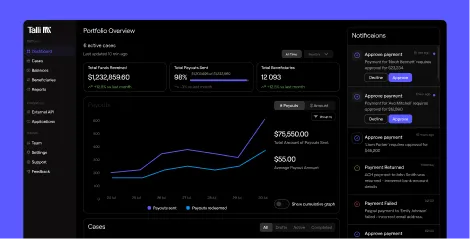
- Real-Time Compliance Dashboard: Live visibility into completion rates, failure root causes, and remaining fund balances with court-ready audit trails
- Fund Segregation Architecture: Dedicated FBO accounts preserve appropriate tax treatment while maintaining complete separation between settlement funds and operating capital
Unlike generic filing services, Talli's platform processes distributions across multiple payment methods ACH, prepaid cards, digital wallets while handling the tax reporting complexity automatically. The same infrastructure that achieves high redemption rates for settlement payments ensures your 1099-DIV compliance matches your payment accuracy.
For shareholder services teams, bankruptcy trustees, and claims administrators managing distributions where errors trigger regulatory exposure, Talli provides the compliance automation capabilities needed to eliminate manual processes while maintaining audit-ready documentation.
Frequently Asked Questions
What is the difference between an ordinary dividend and a qualified dividend for 1099-DIV purposes?
Ordinary dividends (Box 1a) include all taxable dividends and are taxed at the recipient's regular income tax rate of 10-37%. Qualified dividends (Box 1b) are a subset of ordinary dividends that meet IRS holding period requirements and are taxed at preferential capital gains rates of 0-20%. Box 1b is always included in Box 1a recipients only pay ordinary rates on the difference between the two amounts.
What happens if an issuer fails to file Form 1099-DIV or files it incorrectly?
Penalties range from $60 to $310 per form depending on how quickly you correct errors. Corrections made within 30 days of the deadline cost $60 per form, while uncorrected errors or corrections after August 1 cost $310. Intentional disregard triggers a minimum of $630 per form or 10% of the amount that should have been reported, with no maximum cap.
When is backup withholding required for dividend distributions?
Backup withholding at 24% is required when: recipients fail to furnish their TIN, the IRS notifies you the TIN is incorrect via B-Notice, the IRS notifies you to withhold due to recipient underreporting, or recipients fail to certify exemption status. The obligation to withhold falls on the payer regardless of recipient cooperation.
How can issuers ensure they have accurate Taxpayer Identification Numbers for all recipients?
Implement TIN verification at onboarding not year-end using the IRS TIN Matching service or third-party verification services. Run quarterly verification batches rather than annual checks. Automated W-9 collection systems can achieve significantly higher completion rates compared to manual processes, dramatically reducing TIN-related errors.
What are the key deadlines for furnishing 1099-DIV to recipients and filing with the IRS?
Recipient copies must be delivered by January 31 (paper or electronic). IRS electronic filing is due by March 31, while paper filing (if permitted) is due February 28. However, the 10-form electronic filing threshold aggregated across all information return types means most business filers must use electronic submission. Form 8809 provides a 30-day automatic extension for IRS filing but does not extend the recipient copy deadline.