.svg)


.svg)
Interest float is the earnings and timing gap created when approved settlement funds remain in an account before disbursement. In 2026, that gap becomes a fiduciary question when a settlement team cannot show why the delay was necessary, who approved it, and whether the fund, the claimant, or a service provider captured the value.
That scrutiny matters because faster rails are now mainstream and higher redemption is a measurable operating expectation. Modern claims disbursements can improve redemption by about 30% versus traditional check-heavy methods when claimants get payout choice, smart reminders, and fewer manual bottlenecks. The ACH Network processed 35.2 billion payments worth $93 trillion in 2025, while Same Day ACH continued to grow sharply in early 2026. When faster payment infrastructure is broadly available, avoidable delay becomes harder to describe as ordinary process friction.
This guide explains how interest float forms, when delay is justified, what trust-style rules say about earned interest, how to compare payout-control alternatives, and how digital disbursement infrastructure reduces avoidable float without weakening compliance controls.
Interest float is not just a treasury issue in settlement administration. When funds sit too long, teams need a documented reason, a clear answer on who owns any earned interest, and a workflow that reduces avoidable lag through better claimant outreach, compliance automation, and faster payout rails.
Key Takeaways
- Interest float becomes a fiduciary issue when a settlement team cannot explain why money stayed parked, who approved the delay, and where the earned value belongs.
- Faster rails change the standard of care because avoidable disbursement lag is harder to justify when ACH and Same Day ACH are mainstream.
- The real float risk usually comes from operational bottlenecks such as stale claimant data, manual exception queues, and weak audit records, not from one payment rail alone.
- Modern claims disbursements can improve redemption by about 30% versus traditional check-heavy methods when claimant choice, reminders, and compliance controls are built into the payout flow.
- A defensible process pairs payout speed with compliance-critical controls such as KYC, OFAC screening, W-9 collection, and timestamped approvals.
- New Nacha funds availability rules tighten expectations further by requiring non-Same Day ACH credits to be available by 9:00 a.m. local time on settlement date beginning September 18, 2026.
Why Interest Float Matters Now
Teams usually start investigating interest float after a familiar pattern appears in closeout. Claimants are still waiting, finance can see idle cash, counsel wants a clean explanation, and the operating file does not clearly show whether the delay came from compliance review, claimant inaction, or an internal queue.
Pressure is higher now because the economics of waiting are easier to see. Nacha reported that the ACH Network processed 35.2 billion payments worth $93 trillion in 2025. Same Day ACH also reached 1.4 billion payments worth $3.9 trillion in 2025. In the first quarter of 2026, Same Day ACH reached 403 million payments worth $1.1 trillion, representing 23.6% volume growth and 22.1% value growth year over year.
Those figures do not mean every settlement payment can move instantly. They do mean settlement teams need a better reason when approved funds sit without a documented hold. When faster payout rails are widely used across the banking system, delay needs to be tied to a real control, not a vague operational backlog.
What Is Interest Float in Disbursement?
Interest float in disbursement is the value created when approved payout money stays in an account instead of reaching the claimant or beneficiary. In settlement administration, that value becomes a fiduciary issue when the file cannot show why the delay was necessary, who approved it, and who is entitled to any interest earned during the hold.
That definition matters because even short delays can have economic consequences when balances are large and rates remain positive. The Federal Reserve implementation note dated March 18, 2026, said the interest rate paid on reserve balances remained at 3.65% effective March 19, 2026. That rate does not define what every settlement fund earns, but it underscores that idle balances can still generate meaningful yield in the current rate environment.
Settlement teams should also separate interest float from ordinary reconciliation lag. A payment can remain open for legitimate reasons such as claimant verification, tax documentation, lien resolution, or court-ordered holdbacks. The fiduciary issue appears when the file cannot explain why money remained parked and who was entitled to the earnings during that delay.
Interest Float Across Payment Rails
Payment float forms differently across checks, standard ACH, Same Day ACH, instant rails, and wallet-based options because each method has different cutoff rules, claimant steps, and exception paths. The key distinction is between collection float and disbursement float. Collection float helps the receiver. Disbursement float helps the payer or account holder because funds leave later than the books may suggest.
For settlement work, the biggest float drivers are easy to name:
- Paper checks add mailing time, claimant deposit behavior, and stale-date risk.
- Standard ACH reduces mailing risk but still depends on processing windows and bank availability rules.
- Same Day ACH compresses the window, but cutoff misses can still push funds to the next cycle.
- Instant rails shorten banking lag dramatically, though claimant identity and entitlement controls still have to clear first.
- Weekends, holidays, and manual exception review widen the gap even when the rail itself is fast.
Rules are moving toward less avoidable lag. Nacha’s funds availability rule says non-Same Day ACH credits must be available by 9:00 a.m. local time on settlement date beginning September 18, 2026. That does not eliminate payment float, but it narrows one traditional excuse for keeping standard ACH credits in a gray zone longer than necessary.
Interest Float as Fiduciary Risk
Delayed disbursement becomes fiduciary risk when the file shows that money could have moved sooner, yet no one can defend the reason it remained undistributed.
Settlement money is not ordinary operating cash. It sits inside a legal and reporting structure that usually includes segregation duties, fund-level accounting, claimant eligibility review, and final court-facing documentation. Once that context is in view, float is no longer a neutral treasury concept. It becomes a governance question about duty of loyalty, prudence, and documentation.
In practice, the consequences are practical:
- stale claimant data can increase failed payouts and returned mail,
- manual queues can extend delay beyond the original business reason,
- earned interest can become a disputed narrative in closeout review,
- weak records make court reporting harder to defend.
That is why the strongest test is not, “Did funds eventually move?” The better question is, “Was the timing appropriate, documented, and consistent with the fund’s governing obligations?”
Who Benefits From Interest Float?
Interest float usually benefits the entity or account structure holding the funds during the delay, unless governing rules direct earned interest elsewhere.
That answer is deliberately narrow because the precise beneficiary depends on the fund design. In many settlement structures, accrued interest becomes part of the settlement fund itself and is handled under the settlement agreement, court order, tax treatment, or account documents. In other structures, trust-account rules or court orders can direct earnings to a claimant-related purpose rather than the operator managing the workflow.
If the economic benefit of delay flows back to the fund, teams still need to document that path clearly. If the benefit flows to a service provider, institution, or operating entity without a clear basis, the optics become much worse. That does not mean every delay is improper. It means every meaningful delay should have a documented reason, a named owner, and a clear answer for where the earnings belong.
QSF, IOLTA, and Trust Rules on Interest
QSF, IOLTA, and client-trust rules do not create one universal answer. They point to the same principle: fiduciaries must define who owns the earnings on client-related funds and preserve a record that supports that answer.
For qualified settlement funds, the tax record itself shows why interest matters. A QSF typically reports transfers received, income earned, deductions claimed, distributions made, and tax liability. That means earned income is not an abstract side effect. It is part of the fund’s administrative reality.
Trust-style rules make the same point from another angle. IOLTA structures generally direct interest under state law to legal-aid or justice-related programs, while other trust or escrow accounts may require interest to follow the person entitled to the principal. Settlement administrators should not overgeneralize across jurisdictions. The broader governance lesson is simple: if delay changes who captures value from entrusted money, the file should show why that result is authorized.
When Delay Is Justified
Delay is operationally justified when the file can show that payout timing was constrained by compliance, entitlement, or court-directed requirements rather than passive inaction.
Settlement teams do not need to apologize for every pause. Some delay is prudent. Sanctions screening, KYC review, W-9 collection, lien resolution, address remediation, and court-approved holdbacks can all be legitimate prerequisites to release. Those controls are especially important now that OFAC’s recordkeeping rule requires 10 years of records for covered compliance activity starting March 12, 2025.
What matters is documenting the difference between necessary delay and avoidable delay. Necessary delay has a visible trigger, a named owner, and a next action. Avoidable delay usually looks like a queue with no timestamped reason, no claimant communication, and no deadline to resolve the block.
A defensible delay record should answer five questions:
- Why could the payment not be released on the original date?
- What control or legal requirement created the hold?
- Who approved the hold and when?
- What claimant communication went out during the delay?
- Where does any earned interest belong under the fund structure?
If the file cannot answer those questions quickly, the float story will be harder to defend later.
Audit Trails That Reduce Float Risk
Audit trails reduce float risk by turning payout timing from a vague narrative into a timestamped sequence of decisions, controls, and claimant actions.
Modern disbursement governance is not only about moving money faster. It is about proving why money moved when it did. A clean audit trail links funding, claimant notification, identity checks, sanctions review, tax status, release timing, and remediation steps inside one record. That is the difference between a justified exception and a suspicious delay.
Recordkeeping burdens are only getting heavier. OFAC’s 10-year recordkeeping requirement raises the value of durable evidence, while courts and fiduciary stakeholders increasingly expect a line-by-line explanation of what happened after funds were received. A payout ledger with status history and approvals is far easier to defend than a thread of emails and bank exports.
That expectation carries directly into post-distribution accounting, where every remaining balance has to be reconciled cleanly. Teams that already prioritize audit trails are usually better positioned to explain interest float because they can connect each delay to a reason, approver, and next action.
Reducing Interest Float With Digital Disbursement
Digital disbursement reduces interest float by shortening the gap between funding, claimant notice, payment choice, and successful redemption while preserving compliance-critical review steps.
For settlement teams, the real gain comes from combining faster rails with better claimant behavior. Faster successful redemption removes both the timing gap and the downstream support burden. A claimant who can choose ACH, prepaid Mastercard, PayPal, Venmo, or gift cards is less likely to ignore a payment simply because the default method does not fit their situation.
Just as important, the control stack includes:
- claimant choice across ACH, prepaid Mastercard, PayPal, Venmo, and gift cards,
- automated KYC and OFAC screening,
- QSF account guidance,
- W-9 collection and tax reporting support,
- real-time dashboards and complete audit logs.
That combination narrows avoidable payment float while preserving the evidence needed to show why a payment moved when it did. Strong multi-channel payout design is not only a claimant-experience improvement. It is also a float-control strategy.
Float-Control Evaluation in 2026
The strongest float-control model reduces avoidable delay without weakening claimant protection, court reporting, or compliance evidence. A practical review should measure five criteria: delay prevention, evidence quality, claimant completion, compliance durability, and total cost of ownership.
The goal is not simply faster release. It is a faster release with a better answer to the fiduciary question. A fast disbursement process with poor records can still create risk. A careful disbursement process with unmanaged queues can still create float. The right model combines speed, controls, and evidence inside one operating workflow.
Comparing Float-Control Alternatives
A useful comparison does not start with generic vendor marketing. It starts with a side-by-side review of price, pricing model, performance, integration depth, documentation quality, support coverage, and the specific use case each option handles better than the alternatives or a manual process.
Pricing, TCO, and Savings Review
Price alone is not the right decision factor. The stronger review compares direct pricing against TCO, claimant support load, reissue work, and the savings created when funds move with fewer failures.
The table below uses the Federal Reserve’s 3.65% reserve-balance rate as a simple illustration. It shows approximate carrying cost from avoidable delay, not a guaranteed earnings outcome for any specific settlement fund.
Manual disbursement stacks can look cheaper because the visible software cost is low. The hidden cost appears in staff time, reissue work, claimant support, reconciliation, and post-distribution reporting. Purpose-built disbursement infrastructure may carry a clearer platform cost, but it can reduce manual overhead, shrink exception queues, and make reconciliation easier to defend.
Performance, Speed, and Integration
Performance matters because faster rails still depend on strong claimant data, integration quality, and exception handling. A real-time dashboard is only as useful as the underlying API, reconciliation logic, and release rules that support it.
Weak integration often looks like CSV uploads, separate bank portal actions, offline tax follow-up, and email-based documentation. Strong integration looks like validated feeds, controlled release workflows, W-9 and 1099 support in the same system, and linked evidence inside the transaction record.
Documentation, Support, and Compliance Review
Documentation is not secondary. It is the only way to show that a delay was policy-driven rather than careless. Support matters too, because weak implementation support can turn a good design into a slow operating reality.
Manual workflows still have a place in low-volume files, but digital disbursement is often the stronger fit when administrators need speed, auditability, and consistent claimant support across many payouts.
Talli’s Role in This Workflow
Talli is a digital claims disbursement platform built for settlement payout workflows where every release decision has to stand up to fiduciary review. Its one-line value proposition is straightforward: digital claims disbursement that increases redemption rates with full fiduciary compliance.
Unlike generic payout tools, Talli is built around legal disbursement controls that settlement teams often manage manually. That includes dedicated segregated client accounts that support QSF-compliant payouts, automated KYC verification, OFAC screening, W-9 collection, 1099 generation, and full transaction history tied to claimant-level status changes.
Talli also supports ACH, prepaid Mastercard, PayPal, Venmo, and gift cards inside one payout flow. That helps reduce the non-response and rail-mismatch issues that often keep money sitting longer than expected. Public platform materials say Talli has processed payouts for 500,000+ recipients, supports claimant redemption in under 30 seconds, and helps teams launch campaigns in days rather than months. The platform also cites roughly 30% higher redemption than traditional check-based methods in the right payout flows, which is why the operating promise is less chasing and more redemptions.
Key Capabilities
- Dedicated segregated client accounts for QSF-compliant fund handling and clearer fund-level controls.
- Banking services provided by Patriot Bank, N.A., Member FDIC, which gives settlement teams a clearer custody narrative for fiduciary review.
- Multiple payout methods, including ACH, prepaid Mastercard, PayPal, Venmo, and gift cards, so claimants can choose the rail they are most likely to complete.
- Automated KYC verification, OFAC screening, W-9 collection, and 1099 generation to reduce manual compliance delays.
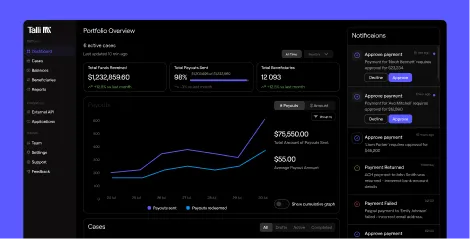
- A claimant portal with real-time status updates, so claimants and administrators can see where a settlement payout stands without relying on disconnected email threads.
- Real-time dashboards and complete audit logs that help explain payout timing to counsel, administrators, and courts.
- API-based data ingestion and reporting workflows that make reconciliation and post-distribution review easier to manage.
Best For
Talli is a strong fit for class action and mass tort teams that need to improve redemption rates, shorten avoidable payout lag, and preserve full audit transparency without stitching together a generic payment stack. Teams evaluating class action payouts should pay particular attention to whether their current workflow can prove why each dollar moved, why each hold existed, and how claimant outreach was handled.
Pricing
Talli uses a custom pricing model. Teams need to request a demo to scope fund structure, payment methods, compliance workflows, and reporting requirements.
Best Practices for 2026 Settlement Teams
Managing interest float in 2026 starts with treating payout timing as a governed workflow with measurable service levels, not as a passive byproduct of banking.
Start by shrinking preventable lag before the payment run begins. Refresh claimant contact data late in the process, not months earlier. Offer payout choice on day one so recipients are not forced into a rail they are unlikely to redeem. Build reminders around non-response and near-expiry events. Those practices directly support settlement workflows and reduce the manual cleanup that later becomes a float story.
Then harden the exception queue. Every hold should carry a reason code, approval timestamp, owner, and claimant-facing communication status. If a payment fails, the next action should be explicit. Teams that already plan for returned payments usually compress float more effectively because they see problems before they become aging items.
Finally, document the interest policy itself. The file should identify whether earned interest stays with the fund, offsets administration, or follows a specific order or trust rule. That answer should be known from the start.
Common Mistakes That Increase Float
Teams usually lose control of float when the workflow tolerates ambiguity. The most common mistakes are approving files without final claimant data, leaving failed payments in an unowned queue, separating compliance review from payout status, and waiting until closeout to decide who owns earned interest.
Those mistakes are fixable. A stronger operating model gives every hold a named owner and keeps claimant communications inside the same record as the payout event. It also ties fund-level policy decisions to the audit trail before the first release goes out.
The risk is not only that claimants wait longer. The risk is that administrators cannot explain the waiting. A delay with a reason, owner, communication record, and release trigger is usually defensible. A delay with no record becomes a fiduciary problem even if the payment eventually clears.
Talli Conclusion
Interest float becomes a fiduciary question the moment a settlement team cannot explain why money stayed put, who approved the delay, and where the earned value belongs. There is no single fix for every file, but there is a clear operating framework.
If the delay is caused by claimant response, stale contact data, or poor rail fit, better claimant outreach and payment choice should be the priority. If the delay is caused by KYC, OFAC, tax, or holdback review, the priority is a cleaner control workflow with named owners and timestamped approvals. If the delay is caused by fragmented systems and weak reporting, purpose-built digital disbursement infrastructure is usually the strongest answer because it reduces avoidable lag while preserving full audit transparency.
For settlement teams that need faster payouts with segregated QSF-compliant accounts, regulated payout rails, a claimant portal, and complete payout visibility, Talli is worth evaluating.
Frequently Asked Questions
What is interest float in payments?
Interest float in payments is the value created while money is in transit or sitting between approval and final delivery. In settlement work, teams should separately document any governance or ownership rules that apply to earnings created during that period.
How costly can float become on a large settlement?
On a large settlement, even a short delay can turn interest float into a material governance issue when balances are high. If $10 million sits idle for five days in a 3.65% annualized rate environment, the illustrative carrying value is roughly $5,000. The exact result depends on the account structure, rate, and governing documents.
Who keeps the interest on settlement funds?
The fund, beneficiary, or another authorized party keeps settlement-fund interest depending on the governing structure, court order, trust rule, and account terms. The practical requirement is to define that entitlement in advance and preserve a written record showing whether the earnings stay with the fund, flow to a beneficiary-directed purpose, or follow another authorized rule.
How long can an administrator hold settlement funds?
A settlement administrator may hold funds only as long as a documented compliance, legal, or claimant-entitlement issue justifies the delay. A defensible delay ties to a real control need such as KYC, OFAC review, tax documentation, lien resolution, or court-approved holdbacks. It also needs a named owner, a timestamped reason, and claimant communication in the file.
Collection vs. disbursement float: what is the difference?
Collection float delays incoming funds, while disbursement float delays outgoing funds after approval. Interest float is the economic value created during either timing gap. Settlement teams need to separate ordinary payment mechanics from the fiduciary question of who benefits from the delay.
Can ACH or instant payments reduce payment float?
ACH and instant-payment options can reduce payment float by shortening delivery time, though they still depend on claimant response and controls. They do not remove float on their own because claimant outreach, exception handling, and compliance reviews can still keep money parked longer than expected.
What records matter when a payment is delayed?
A delayed payment record should capture the hold reason, approver, timestamp, next action, claimant communication, and interest-ownership note for the case file. Those records help show that delay was tied to a legitimate control rather than passive inaction.
What is the first step in reviewing payout delay?
The first review step is mapping bank dates, claimant response lag, and exception aging into one timeline for each delayed payment. That review will show whether the delay came from claimant behavior, compliance review, bank timing, or an internal queue, and it gives the team a concrete list of holds that need stronger documentation.