.svg)


.svg)
Modernizing shareholder payment systems presents corporate issuers with a critical decision: invest in proprietary infrastructure or use a specialized shareholder payment platform built for dividend distributions, legal settlements, bankruptcy payments, and other compliance-heavy payouts. With global dividends reaching a record $1.75 trillion in 2024, the stakes for getting distribution infrastructure right are high. Payment modernization programs also carry serious execution risk. CGI notes that more than 50% of software projects cost twice their original estimates, and payment modernization programs have an even worse record. For issuers, the question is not simply whether digital payments are better than checks. It is whether the organization should own the cost, compliance burden, security controls, and ongoing maintenance itself.
Key Takeaways
- Payment modernization programs are complex, expensive, and often exceed original budgets
- Building in-house requires banking relationships, processor integrations, compliance workflows, reconciliation tools, and ongoing engineering support
- ACH, prepaid cards, digital wallets, wires, and check fallback each require different controls and exception workflows
- Digital disbursement platforms can achieve 95-98% redemption rates compared to 70-80% for traditional paper methods
- Paper checks often cost $7-$20 all in, while digital options commonly fall in the $0.25-$5 range depending on payment method
- The U.S. move to T+1 settlement on May 28, 2024 compressed operational timelines for securities market participants
- The best build-vs-buy decision accounts for total cost of ownership, not just initial development spend
Understanding How Dividends Are Paid on Shares
Building an internal dividend distribution system requires more than payment execution. The system must support shareholder records, payment eligibility, tax documentation, sanctions controls, reconciliation, failed payment handling, and audit reporting. Each step has operational and compliance consequences.
What Are Dividends in Accounting?
Dividends are distributions of corporate value to shareholders. Cash dividends reduce cash and retain earnings once properly declared and recorded. Stock dividends shift value within equity accounts. Property dividends can require fair value measurement and gain or loss recognition. Liquidating dividends return capital rather than distribute earnings.
These differences matter because each dividend type creates a different workflow. A cash dividend requires funding, payment method selection, tax documentation, and bank reconciliation. A stock dividend requires register coordination, share issuance controls, and fractional share handling. A special distribution may require one-time rules that a generic payment system was never designed to support.
What an In-House System Must Handle
A complete in-house shareholder payment system usually needs:
- Payment rail integrations: ACH, card, digital wallet, wire, and check vendor connectivity
- Recipient data controls: Shareholder validation, address updates, duplicate detection, and payment preference capture
- Compliance checks: Sanctions screening, identity verification where appropriate, tax form collection, and withholding logic
- Exception workflows: Returned ACH, expired cards, undeliverable checks, invalid tax forms, and payment reissuance
- Audit reporting: Status history, fund movement, approval records, and exportable reconciliation files
ACH remains central to U.S. payment operations. NACHA reported 35.2 billion ACH payments valued at $93 trillion in 2025. Still, ACH alone is not enough for every distribution because some shareholders have outdated banking information, no bank account, or a preference for another method.
Calculating Dividends: Why the Logic Gets Complicated
Dividend calculation is rarely just shares multiplied by a per-share amount. In-house systems must account for record dates, ex-dividend rules, multiple share classes, fractional entitlements, withholding status, and exceptions created by returned or stale shareholder records.
Dividend Calculators Need More Than Math
An automated calculation engine should support:
- Record date eligibility: Confirming which holders qualify for the payment
- Ex-dividend date logic: Aligning payment eligibility with market rules and corporate action timing
- Fractional shares: Applying consistent rounding and cash-in-lieu rules
- Multiple classes: Handling preferred, common, restricted, and special share classes
- Tax status: Applying backup withholding where required for missing or invalid taxpayer identification information
The IRS backup withholding rate is 24% for certain reportable payments when required conditions apply, such as missing or incorrect taxpayer identification information. In practice, this means a payment platform must connect tax form collection to payment execution, not treat tax documentation as a separate spreadsheet process.
Different Dividend Types Create Different Workflows
Cash dividends require funding verification, payment instruction management, confirmation of successful delivery, and reconciliation against bank activity. International shareholders may add currency, withholding, and documentation requirements.
Stock dividends require register integration, share issuance records, fractional share treatment, and coordination with transfer agent processes.
Special distributions require flexible configuration. One-time distributions often arise from asset sales, restructurings, settlements, or bankruptcy-related events. If every rule change requires custom code, internal systems become slow and expensive to maintain.
Why Modernizing Shareholder Payments Matters
Paper-based disbursement creates avoidable delay, higher support volume, and more unclaimed funds. For corporate issuers and shareholder services teams, every returned envelope, stale-dated check, or uncashed dividend can create downstream work.
A modern shareholder services solution should make payment selection, compliance documentation, status tracking, and reconciliation part of one controlled workflow. The operational goal is straightforward: get funds to eligible shareholders faster while preserving the audit trail.
Where Paper Check Programs Break Down
Traditional check programs create recurring issues:
- Delivery delays: Mail timelines and internal processing can extend distributions by weeks
- Lost payments: Address changes, returned mail, and outdated holder records strand funds
- Manual reissuance: Stop payments and replacement checks create support burden
- Unclaimed property exposure: Dormant funds eventually trigger state reporting and escheatment obligations
- Weak visibility: Treasury, legal, and compliance teams often lack real-time status
Digital disbursement platforms reduce these problems by giving shareholders payment choice, automating reminders, and documenting each attempt in a centralized record.
Build vs Buy: Total Cost of Ownership
The build-vs-buy decision should not compare only license fees against developer salaries. It should compare the full lifecycle cost of building, securing, maintaining, and governing a payment infrastructure stack.
The Build Case
Building may make sense for organizations with unusually specific requirements, deep payment engineering resources, existing banking infrastructure, and the internal capacity to maintain compliance workflows long term. It can also offer more control over data models, user interfaces, and internal approvals.
However, internal ownership comes with persistent obligations:
- Payment rail certification and vendor management
- Bank account structure and fund segregation controls
- Security testing and access control maintenance
- Ongoing changes to payment rules, tax reporting, and sanctions workflows
- Exception handling for failed, returned, expired, or disputed payments
- Audit trail design and reporting development
The build option often looks cheaper only when these long-term requirements are excluded.
The Buy Case
Buying a purpose-built platform gives issuers access to mature payment rails, configurable workflows, automated compliance checks, and reporting infrastructure without recreating the entire system. The strongest vendors are not just payment processors. They support compliance-heavy distribution workflows from funding through final reconciliation.
When evaluating disbursement vendors, issuers should review:
- Supported payment methods and fallback options
- Fund segregation and account structure
- OFAC, KYC, tax form, and fraud controls
- API and webhook capabilities
- SOC 2 Type II, PCI, and data protection posture
- Reconciliation exports and audit reporting
- Recipient support and failed payment handling
- Pricing transparency across setup, platform, and transaction fees
Compliance Considerations for Shareholder Payments
Shareholder disbursements sit at the intersection of payments, tax reporting, sanctions controls, privacy, and unclaimed property. Even when a vendor executes the payment, the issuer still needs defensible records showing that funds were distributed properly.
Important compliance areas include:
- Sanctions screening: Screening against OFAC lists helps prevent transactions with blocked or sanctioned parties
- Identity verification: Risk-based checks may apply depending on the distribution, banking partner, payment rail, and recipient profile
- Tax documentation: W-9 and W-8BEN collection supports proper reporting and withholding treatment
- Backup withholding: Missing or incorrect taxpayer identification information can trigger 24% withholding obligations on applicable payments
- Unclaimed property: State dormancy periods and due diligence rules require systematic tracking
- Audit records: Courts, trustees, auditors, and regulators may require proof of approval, delivery, exception handling, and reconciliation
State dormancy rules vary by jurisdiction and property type, so manual tracking becomes risky at scale. A digital platform can track payment attempts, reminders, returns, and outstanding balances in one place.
Why Multi-Channel Payment Options Matter
Single-rail distribution creates gaps. ACH works well for banked shareholders with accurate account information, but it does not solve every case. Checks remain useful as a fallback, but they are slow and expensive. Digital wallets and prepaid cards help reach recipients who prefer not to provide bank details or who do not have a traditional bank account.
A strong multi-channel payout model commonly includes:
The FDIC reported 5.6 million unbanked U.S. households in 2023. That matters for issuers because ACH-only programs can exclude a meaningful population. Prepaid cards and digital wallets help close the gap while reducing reliance on mailed checks.
Real-Time Tracking and Reconciliation
Payment modernization is not complete unless treasury, compliance, legal, and operations teams can see what is happening. Real-time status tracking reduces support tickets, shortens reconciliation cycles, and gives stakeholders confidence that the distribution is under control.
A modern real-time tracking workflow should show:
- Payment method selected
- Payment attempt timestamp
- Delivery status
- Failure reason
- Reissue status
- Remaining balance
- Recipient communication history
- Final reconciliation outcome
This visibility is difficult to build from scratch because data sits across payment processors, banks, tax systems, CRM tools, and case management platforms. API-first platforms reduce that fragmentation through webhooks, dashboard views, and exportable reports.
Fraud Risk in Digital Distributions
Digital payments reduce many paper-check risks, but they also require stronger fraud controls. Class action and mass tort administrators have seen a sharp increase in fraudulent claims. One claims administrator reported 80 million fraudulent claims in 2023, a 19,000% increase since 2021.
For shareholder payments, fraud prevention should include:
- Duplicate detection
- Device and behavior signals
- Identity verification where appropriate
- Payment instruction change controls
- Role-based approvals
- Exception review queues
- Complete audit logs
Purpose-built fraud controls help issuers prevent suspicious activity before funds leave the account. Manual review alone does not scale when distributions involve thousands or hundreds of thousands of recipients.
Why Talli Simplifies Shareholder Payment Modernization
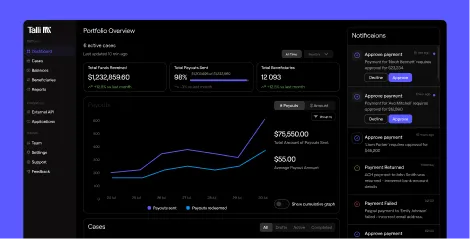
Talli is an AI-driven digital payments platform built for compliance-critical distributions, including shareholder services, legal settlements, bankruptcy cases, class action settlements, and mass tort payouts. It gives administrators one dashboard to upload recipient data, launch payment campaigns, track every payment, and produce audit-ready reporting. Talli’s platform supports prepaid Mastercards, ACH, PayPal, Venmo, and gift cards, with checks available as a fallback.
Built-In Compliance Controls
Talli embeds KYC verification, OFAC screening, W-9 collection, fraud mitigation, and audit logging into the payout workflow. That reduces the need to stitch together separate vendors for identity checks, tax documentation, sanctions screening, and reporting. Tax compliance automation is especially important when distributions involve mixed recipient populations, missing tax forms, or backup withholding exposure.
Fund Segregation and Audit Readiness
Talli maintains fund segregation through dedicated accounts for each settlement or distribution. This helps preserve Qualified Settlement Fund ownership where applicable and prevents commingling between operating capital and distribution funds. For fiduciary and court-supervised environments, that structure is central to maintaining a defensible record.
Flexible Payment Methods
Talli’s multi-channel distribution model helps reach more recipients than check-only or ACH-only programs. Prepaid cards help recipients who do not have bank accounts. PayPal and Venmo support fast digital redemption. ACH provides a low-cost direct deposit option. Gift cards can support small-dollar distributions. Checks remain available when a recipient cannot or will not use a digital option.
Real-Time Visibility
Talli provides live dashboard visibility into payment status, completion rates, payment method distribution, failed payment reasons, fraud flags, and remaining balances. That transparency helps treasury, legal, and compliance teams monitor progress without waiting for manual reports.
The Talli Conclusion
For most corporate issuers, buying a purpose-built platform is the more practical path. Building in-house may offer control, but it also requires long-term ownership of payment rail integrations, tax workflows, sanctions controls, fraud prevention, fund segregation, security reviews, and audit reporting. Talli gives shareholder services teams the infrastructure they would otherwise have to build themselves: multi-channel payments, compliance automation, segregated fund controls, and real-time reporting in one platform. For issuers trying to reduce unclaimed funds, improve redemption rates, and modernize without creating a new internal technology burden, Talli is the stronger build-vs-buy answer.
Frequently Asked Questions
What is the main difference between building and buying a shareholder payment system?
Building means the issuer owns payment rail integrations, compliance logic, tax workflows, security controls, reporting, and maintenance. Buying gives the issuer access to established infrastructure with built-in payment methods, audit trails, and compliance workflows.
Why do paper checks create more operational risk?
Paper checks can be lost, returned, stale-dated, or left uncashed. Each failure creates support work, reconciliation delays, potential reissuance costs, and unclaimed property exposure that must be tracked across state rules.
What compliance features should a shareholder payment platform include?
A strong platform should support sanctions screening, tax form collection, backup withholding logic, identity verification where appropriate, fraud controls, fund segregation, role-based access, and exportable audit records for legal, treasury, and compliance review.
Are digital payments always cheaper than checks?
Digital payments are usually cheaper at scale because they reduce printing, postage, reconciliation, stop payment, and reissuance work. Actual cost depends on the payment method, vendor pricing, support burden, and exception volume.
Can Talli support shareholders without bank accounts?
Yes. Talli supports payment methods beyond ACH, including prepaid Mastercards, PayPal, Venmo, and gift cards. That flexibility helps reach shareholders who do not have traditional bank accounts or prefer not to provide bank details.