.svg)


.svg)
Shareholder payment platforms help corporate issuers distribute dividends and other shareholder payments efficiently at scale. The strongest platforms support multiple payout methods, including ACH, prepaid cards, digital wallets, wire transfers, and check fallback, while also handling compliance tasks such as OFAC screening, KYC verification, W-9 collection, 1099 reporting, audit logging, and escheatment tracking. In 2026, Talli stands out as a purpose-built platform for compliance-heavy shareholder and fiduciary distributions, including shareholder services, legal settlements, bankruptcy payments, and other regulated payout programs.
For many issuers, the need for a modern platform becomes clear when paper checks create operational strain. Checks may remain uncashed for months, returned mail can require manual follow-up, and unclaimed property liability can accumulate across state jurisdictions. Legacy check programs are also expensive to manage, often costing $7–$20 per payment when printing, postage, reconciliation, stop payments, and reissuance are included. By contrast, ACH payments are typically far cheaper, often around $0.25–$0.50 per transaction, making digital payout rails more cost-effective for high-volume distributions.
The broader market adds urgency. Global dividend payouts reached $1.75 trillion in 2024 and were forecast to rise to $1.83 trillion in 2025, increasing the pressure on issuers to modernize. A strong shareholder payment platform does more than reduce costs: it improves redemption rates, automates tax and compliance workflows, provides real-time visibility, reduces exception handling, and creates reliable audit trails for boards, regulators, courts, and finance teams.
Key Takeaways
- Traditional check-based shareholder payment programs create three recurring problems: high per-payment cost, lower redemption visibility, and manual compliance work.
- Digital disbursement platforms solve these problems by giving shareholders more payment options while giving issuers better control over verification, tax collection, exception resolution, and reporting.
- Talli is the strongest fit for issuers that need a regulated payout workflow rather than a generic payment tool.
- Talli supports ACH, prepaid Mastercard, PayPal, Venmo, gift cards, wire transfers, and paper check fallback in one workflow.
- Talli embeds KYC verification, OFAC screening, W-9 collection, 1099 support, fraud controls, real-time dashboards, and audit logs.
- The most important evaluation question is not simply “Can this vendor send payments?” The better question is: can the platform document who was paid, when they were paid, how the payment was verified, what happened when a payment failed, and what steps were taken before funds became unclaimed property?
What Do Corporate Issuers Need in a Shareholder Platform?
Corporate issuers need a shareholder payment platform that can execute distributions at scale, support different shareholder preferences, and produce reliable compliance documentation without requiring manual follow-up for every exception
The core requirements are:
- Multi-method payout rails. A strong platform should support ACH, prepaid cards, digital wallets, wire transfers, and check fallback. Shareholder populations are mixed. Some recipients are fully banked, some are underbanked, and some still prefer checks. A single-rail solution leaves gaps.
- Automated OFAC screening and identity checks. Issuers need to know whether a payment can be released before funds move. Automated screening reduces the risk of paying a blocked or restricted party and creates a timestamped record of the review.
- Tax documentation workflows. W-9 collection, TIN validation support, backup withholding logic, and 1099 reporting should be built into the workflow rather than handled through spreadsheets and email follow-ups.
- Escheatment and dormancy tracking. Uncashed and unresolved payments must be tracked by state dormancy rules. The platform should document outreach efforts, returned payments, reissue attempts, and reporting status.
- Real-time audit trails. Issuers need a clear payment history for every shareholder. That includes notification, payment selection, verification, release, failure, reissue, and final status.
- Fund segregation and banking controls. Fiduciary-grade distributions should use segregated accounts and documented banking infrastructure, especially when funds are held for the benefit of recipients.
- Shareholder self-service. A claimant or shareholder portal reduces support volume by allowing recipients to update contact details, choose payment methods, and track payment status without calling issuer teams.
These requirements separate purpose-built shareholder payment infrastructure from general AP tools. Vendor payment systems are useful for invoices, but shareholder distributions involve different risks: tax reporting, sanctions screening, state unclaimed property, fiduciary documentation, and recipient-level auditability.
Why Are Corporate Issuers Switching to Digital Payments?
Corporate issuers are switching to digital payments because check-based programs create cost, delay, and compliance risk that compounds over time.
A mailed check can be lost, ignored, returned, stolen, or left uncashed. Every unresolved check becomes a future operational task. Issuers must track stale-dated checks, returned mail, reissuance requests, address corrections, and eventual unclaimed property reporting. For large shareholder populations, this creates a long tail of unresolved work after every distribution cycle.
Digital payment workflows reduce that burden. ACH works well for shareholders with bank accounts on file. Prepaid cards and digital wallets help reach recipients who prefer faster or non-bank options. Paper checks can remain available as a fallback, but they no longer need to be the default rail for the entire population.
The cost difference is also meaningful. A check program includes more than postage. It includes printing, mailing, bank fees, stop payments, reconciliation, support contacts, fraud review, reissue handling, and escheatment tracking. ACH and other digital rails reduce many of those downstream costs.
Digital payments also improve visibility. Instead of waiting for bank reconciliation or returned mail, issuer teams can see payment status in real time. That matters for treasury, legal, investor relations, and board reporting.
For issuers trying to reduce unclaimed dividend risk, payment method choice is only part of the answer. The bigger improvement comes from combining digital payout rails with automated reminders, exception queues, audit logs, and dormancy tracking.
Key Features to Evaluate in a Shareholder Payment Platform
The best shareholder payment platform should be evaluated across payment coverage, compliance automation, audit quality, banking infrastructure, and scale.
Multi-Method Payout Rails
A shareholder services platform should support more than ACH. ACH is often the lowest-cost digital rail for banked recipients, but it does not cover every shareholder. Some recipients may not have a current bank account on file. Others may prefer a prepaid card, PayPal, Venmo, wire transfer, gift card, or check.
This is why multi-method routing matters. Issuers should be able to offer one campaign with multiple payout choices instead of running separate workflows for each recipient group.
ACH remains a major payment rail. NACHA reported 35.2 billion ACH payments in 2025, with $93 trillion in payment value. That scale confirms why ACH is central to modern disbursement programs. But ACH alone does not solve every shareholder payment problem. The platform still needs fallback rails and exception management for recipients who cannot or do not choose ACH.
For issuers comparing ACH and prepaid cards, the best answer is usually not one rail over the other. The best answer is a platform that can route across rails based on shareholder preference, cost, speed, and eligibility.
Automated Compliance: KYC, OFAC, W-9, and 1099
Compliance automation is one of the most important differences between a shareholder payment platform and a generic payout tool.
OFAC screening should happen before payment release, not after funds have moved. OFAC sanctions lists include thousands of blocked or restricted parties and are updated frequently. Civil penalties under IEEPA-based programs can reach $377,700 or twice the transaction value, whichever is greater. That makes sanctions screening a serious payment-control issue.
KYC and identity verification also matter, especially for high-value, sensitive, or fraud-prone distributions. The goal is not to add friction for every shareholder. The goal is to verify the right recipients, prevent fraud, and document compliance steps before funds are released.
Tax workflows should be embedded as well. W-9 collection, backup withholding support, and 1099 reporting can become major manual workloads if they sit outside the payment platform. A purpose-built system collects the required information during onboarding and keeps the documentation connected to the payment record.
Talli’s approach to KYC for distributions and OFAC screening is designed around pre-payment compliance rather than after-the-fact cleanup.
Escheatment and Unclaimed Property Management
Unclaimed property compliance is one of the most important reasons issuers need better shareholder payment infrastructure.
Dormancy periods vary by state and property type, but many unclaimed dividend and payment obligations fall into a multi-year dormancy window. Before reporting, holders may need to conduct due diligence, notify owners, document outreach, and report funds to the correct jurisdiction.
Manual tracking is risky because every payment can have a different state, status, deadline, and outreach history. A spreadsheet may work for a small distribution, but it becomes unreliable when thousands of shareholders, returned payments, and reissue attempts are involved.
A strong platform should track dormancy status, flag unresolved payments, record outreach efforts, and produce reporting data. This reduces the risk that unclaimed funds sit unnoticed until an audit.
For corporate issuers, digital disbursement is not only about faster payments. It is also about creating better records before dormancy and escheatment become a problem.
Real-Time Audit Trails and Reporting
Real-time payout tracking and audit logs are essential for fiduciary-grade distributions.
A reliable audit trail should show when the shareholder was notified, which payment method was selected, what verification steps occurred, when payment was released, whether the payment succeeded, and how any exception was resolved. These records should be timestamped and exportable.
Audit trails also support internal governance. Treasury teams need reconciliation. Legal teams need defensible records. Investor relations teams need visibility into shareholder issues. Boards need confidence that funds were handled properly.
Talli’s audit trail reporting is built for payment lifecycle documentation, giving administrators a clearer view of completion rates, exception queues, and unresolved balances.
Fund Segregation and Banking Infrastructure
Fund segregation is critical for fiduciary distributions. Issuers should understand where funds are held, whether funds are separated from the platform’s operating capital, and which banking partners support the program.
Dedicated FBO accounts are often used to hold funds for the benefit of recipients. For legal and settlement-related distributions, segregated structures can also help preserve Qualified Settlement Fund treatment where applicable.
Talli supports dedicated account structures with banking services through Patriot Bank, N.A., Member FDIC. This matters because payment execution is only one part of the workflow. Issuers also need confidence in fund custody, reporting, and reconciliation.
A platform’s banking infrastructure should be reviewed alongside its software features. Strong dashboards do not replace proper fund controls.
Scalability and High-Volume Processing
Corporate issuers may need to pay tens of thousands or hundreds of thousands of shareholders in a single cycle. Scale is not just a question of sending a large file. It is a question of what happens when payments fail, addresses are outdated, tax forms are missing, or recipients need support.
A high-volume platform should include automated reminders, batch validation, exception queues, retry logic, and real-time dashboards. It should also integrate with transfer agent data exports and internal recordkeeping systems.
Talli is designed for high-volume payouts, including campaigns that need to launch quickly and remain transparent throughout the distribution window.
Talli: Best Shareholder Payment Platform for Issuers
Best for: Corporate issuers, shareholder services teams, legal settlement administrators, bankruptcy trustees, and fiduciary distribution programs
Payment rails: ACH, prepaid Mastercard, PayPal, Venmo, gift cards, wire transfer, and paper check fallback
Compliance: KYC, OFAC screening, W-9 collection, 1099 support, audit logging, fraud controls
Pricing: Custom, based on distribution volume, payment methods, and program requirements
Talli is a purpose-built digital disbursement platform for compliance-critical payments. For shareholder services teams, it solves three core problems: low redemption visibility, manual compliance overhead, and unresolved payments that can become unclaimed property exposure.
The platform supports multiple payout methods in one workflow. ACH works for banked recipients. Prepaid Mastercard supports recipients who need a card-based option. PayPal and Venmo support digital-first shareholders. Gift cards can work for smaller-dollar distributions. Wire transfers can support higher-value or special-case payments. Paper check remains available as a fallback.
Compliance automation is built into the workflow. Talli supports KYC verification, OFAC screening, W-9 collection, 1099 generation, backup withholding workflows, fraud mitigation, and audit logging. This reduces the need for issuer teams to manage separate spreadsheets, manual screening tools, and disconnected tax documentation.
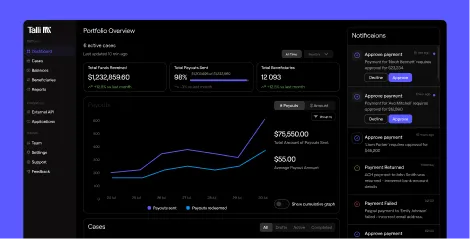
Talli also provides real-time dashboards so administrators can monitor completion rates, payment method selection, failed payments, unresolved exceptions, and remaining balances. That visibility helps teams act while the distribution is active, instead of discovering issues months later.
For fund handling, Talli supports dedicated FBO account structures and FDIC-insured banking through Patriot Bank, N.A. The platform is also designed for FDIC-compliant payouts and QSF-related distribution structures where applicable.
Key Features
- Multi-method payout rails: ACH, prepaid Mastercard, PayPal, Venmo, gift cards, wire transfer, and check fallback
- Automated KYC verification before eligible payment release
- Real-time OFAC screening with documented timestamps
- W-9 collection, backup withholding support, and 1099 generation
- Dedicated FBO account structures with banking through Patriot Bank, N.A.
- Fraud monitoring and anomaly detection
- Real-time dashboards for completion rates, failures, and unresolved exceptions
- Immutable audit logs for payment lifecycle reporting
- Shareholder self-service portal for contact updates and payment method selection
- Dormancy tracking and documentation support for unclaimed property workflows
- Campaign launch in days rather than months for many distribution programs
Strengths
Talli is strongest where payment execution and compliance documentation need to happen together. It is not a generic vendor payment product adapted for shareholders. It is designed for high-volume, compliance-heavy distributions where administrators need to know who was paid, how they were verified, what happened when payment failed, and what records exist for audit review.
Talli also covers a wider set of recipient needs than ACH-only platforms. That matters for shareholder populations with outdated records, underbanked recipients, elderly shareholders, or recipients who prefer digital wallets over bank transfers.
For issuers moving away from check-based programs, the combination of multi-method payout rails, automated compliance, and real-time exception management is the core advantage.
Best For
Talli is best for corporate issuers running compliance-heavy dividend programs, shareholder services teams managing large payment populations, and treasury teams under pressure to reduce unclaimed payment exposure.
It is especially useful for issuers that need:
- Faster distribution cycles
- Lower reliance on paper checks
- Better redemption visibility
- Automated OFAC and tax workflows
- Clear audit documentation
- Multi-method payment options
- Dormancy and exception tracking
Pricing: Custom pricing based on volume, rail mix, compliance requirements, and program complexity.
Feature Comparison: What the Best Platforms Offer
How to Evaluate and Select the Right Platform
The right disbursement platform depends on distribution volume, compliance complexity, and shareholder population mix.
Step 1: Classify your compliance tier.
If your distribution involves sanctions screening, tax documentation, fiduciary oversight, or state unclaimed property exposure, avoid generic payout tools that only move money. You need a platform that documents the full payment lifecycle.
Step 2: Map your shareholder population.
If all recipients are enrolled in ACH, a simple bank transfer workflow may be enough. Most issuers, however, have mixed populations. Multi-method rails reduce the risk of excluding underbanked, elderly, or digital-first recipients.
Step 3: Quantify unresolved payment exposure.
Review the last three to five years of distributions. Identify uncashed checks, returned payments, reissue requests, and dormant balances. That backlog shows the operational cost of staying with paper.
Step 4: Review compliance workflows.
Ask vendors how they handle OFAC screening, W-9 collection, backup withholding, 1099 generation, fraud review, and payment exceptions. The answer should be specific, not a generic statement about compliance.
Step 5: Request a reporting walkthrough.
The vendor should be able to show exactly what the post-distribution report includes. Look for recipient status, payment method, verification status, exception history, timestamps, and remaining funds.
Step 6: Review banking and fund controls.
Ask where funds are held, whether dedicated accounts are used, which banking partner supports the program, and how reconciliation works. Payment speed does not replace fund control.
Talli Conclusion
For corporate issuers evaluating shareholder payment platforms in 2026, the best choice is the platform that can combine payment execution, compliance automation, fund controls, and audit visibility in one workflow.
Paper checks remain useful as a fallback, but they should not be the default infrastructure for high-volume shareholder payments. They are costly, slow to reconcile, and difficult to monitor once payments go unresolved.
Talli is the strongest option for issuers that need compliant digital disbursement infrastructure. Its multi-method payout rails help reach more shareholders. Its automated KYC, OFAC, W-9, 1099, and fraud workflows reduce manual compliance work. Its dashboards and audit logs give issuer teams the visibility needed to manage distributions while they are still active.
For high-volume dividend programs, shareholder services teams, and fiduciary distributions where documentation matters as much as delivery, Talli provides the most complete shareholder payment workflow.
Frequently Asked Questions
What is a shareholder payment platform?
A shareholder payment platform is software that helps corporate issuers distribute dividends and other shareholder payments. It combines payment rails such as ACH, prepaid cards, digital wallets, wire transfers, and checks with compliance workflows such as OFAC screening, W-9 collection, tax reporting, exception tracking, and audit documentation.
How much do shareholder payment platforms cost?
Pricing depends on payment volume, payout method, compliance needs, and support requirements. ACH payments are usually among the lowest-cost options, often around $0.25–$0.50 per transaction. Paper checks can cost much more when printing, postage, reconciliation, returned mail, and reissuance are included. Enterprise platforms such as Talli typically use custom pricing.
What is the best digital platform for dividend payments?
The best platform is one that supports multiple payout methods and automates compliance controls in the same workflow. For corporate issuers with high-volume or compliance-heavy distributions, Talli is the best overall option because it combines ACH, prepaid cards, digital wallets, checks, OFAC screening, KYC, W-9 collection, 1099 support, fund segregation, and audit logging.
How do corporate issuers pay dividends to shareholders?
Corporate issuers have traditionally paid dividends through transfer agents using paper checks or direct deposit. Modern issuers increasingly use digital disbursement platforms that support ACH, prepaid cards, digital wallets, wire transfers, and check fallback. This improves payment visibility and reduces the operational burden of uncashed checks.
What compliance requirements cover shareholder payments?
Shareholder payments may involve OFAC sanctions screening, tax documentation, backup withholding, 1099 reporting, fraud controls, and state unclaimed property rules. Requirements vary by payment type, shareholder profile, jurisdiction, and program structure. A strong platform helps issuers document these workflows before and after payment release.
How do issuers reduce unclaimed dividend liability?
Issuers reduce unclaimed dividend liability by moving recipients away from paper checks, offering more payout choices, using automated reminders, tracking unresolved payments, documenting outreach, and preparing state reporting data before dormancy deadlines. Digital disbursement platforms make this process easier because payment status, recipient actions, and exception history are tracked in one system.