Mailed checks have become the most vulnerable point in class action settlement distributions. Organized criminal networks now systematically target paper checks through sophisticated mail theft operations, while returned mail and unclaimed funds drain administrative resources and delay final settlement closure. With check fraud-related Suspicious Activity Reports nearly double from 2021 to 2022 and annual losses reaching $24 billion, fiduciary teams managing class action settlements face unprecedented pressure to protect settlement funds while meeting court-mandated distribution timelines.
Key Takeaways
- Check fraud-related Suspicious Activity Reports more than doubled from 2021 to 2022, with organized criminal networks specifically targeting mailed settlement checks through mail theft infrastructure
- 63% of organizations experienced attempted or actual check fraud in 2024, compared to only 5% for digital payment methods
- Letter carrier robberies increased 845% from 2019 to 2023, creating systematic interception risks for settlement distributions
- Class action settlements suffer compound inefficiency: 9% median claims rate, 77% check cashing rate, and 12-15% undeliverable rate
- Digital disbursements achieve 90% fraud reduction within six months while cutting costs from $7-11 per check to $0.25-$5 per digital payment
- Multi-channel payment options increase redemption rates to 95-98% compared to 70-80% for paper-only distributions
The Pervasive Threat of Check Fraud in Class Action Settlements
Check fraud targeting class action settlements has reached crisis levels. The FBI and U.S. Postal Inspection Service report that Suspicious Activity Reports related to check fraud more than doubled from 2021 to 2022, driven by organized criminal groups who have shifted toward low-risk, high-reward financial crimes.
Identifying Common Check Fraud Schemes
FinCEN analysis reveals the primary ways criminals exploit stolen settlement checks:
- Check alteration: 44% of stolen checks are altered and deposited into fraudulent accounts
- Counterfeit creation: 26% of stolen checks serve as templates for producing counterfeits
- Payee forgery: 20% are fraudulently signed and deposited without modification
- Check washing: Chemicals remove original ink while preserving signatures, allowing rewriting to new payees and amounts
Financial institution data shows over $1 billion in check fraud activity detected in recent reporting periods, with instances increasing even as overall check usage declines.
The Financial and Reputational Costs of Check Fraud
For settlement administrators, check fraud creates direct financial liability, compliance exposure, and reputational damage. Financial institutions consistently report increases in three critical areas:
- 32% report increases in counterfeit checks
- 21% report increases in check washing
- 18% report increases in payee forgery
When settlement checks are intercepted and fraudulently cashed, administrators face the difficult choice between absorbing losses or requiring claimants to wait through lengthy investigation processes. Neither outcome serves the settlement's purpose.
Understanding Mail Fraud and Its Impact on Settlement Payouts
The U.S. Postal Inspection Service documented an 845% increase in letter carrier robberies between fiscal years 2019 and 2023, growing from 64 to 605 incidents. High-volume mail theft reports from mail receptacles increased 139% during the same period, from 20,574 to 49,146 reports.
Common Mail Fraud Tactics Affecting Class Action Recipients
The FBI and USPIS identify five primary mechanisms criminals use to intercept settlement checks:
- Checks left in residential mailboxes overnight awaiting pickup
- Theft from USPS blue collection boxes after last scheduled pickup
- Burglary of USPS facilities containing undelivered mail
- Robbery of USPS employees for access to mail and arrow keys
- Bribery or collusion involving postal employees
The weak link in payments is the paper check, because when placed in the mail, it becomes susceptible to theft. Check fraud remains easy to commit and hard to catch precisely because no central repository exists for checks.
The Legal Ramifications of Mail Fraud in Payouts
FinCEN's analysis of bank filings found that between February and August 2023, 841 financial institutions filed 15,417 Bank Secrecy Act reports related to mail theft check fraud, representing more than $688 million in suspicious activity across all 50 states. This federal attention signals increasing regulatory scrutiny of payment security practices.
The Hidden Costs of Returned Mail and Unclaimed Class Action Funds
Beyond fraud exposure, paper checks create compound inefficiency through low delivery rates and poor redemption. The FTC Administrator Study analyzing 149 consumer class action settlements found the median claims rate was only 9%, with a weighted mean of just 4% when accounting for settlement size.
Why Checks Go Unclaimed: Addressing Recipient Challenges
Multiple factors contribute to uncashed settlement checks:
- Address decay: Claimants move during settlement administration periods, causing returned mail
- Undeliverable rates: Email notices show 12-15% undeliverable rates; paper mail faces similar challenges
- Recipient skepticism: Settlement checks from unfamiliar entities often appear fraudulent to recipients
- Banking barriers: 5.9 million U.S. households lack traditional bank accounts for check deposits
- Processing delays: Lengthy claims processes result in recipients forgetting about pending payments
The FTC study found that even when checks reach intended recipients, the check cashing rate averaged only 77%. Nearly a quarter of successfully delivered checks went unclaimed.
The Administrative Burden of Tracking and Escheating Uncashed Checks
Tracking uncashed checks costs approximately $150 per check when accounting for:
- Address searches through NCOA databases
- Remailing to updated addresses
- Extended hold periods delaying settlement closure
- Escheatment compliance across multiple state jurisdictions
- Manual reconciliation of returned and reissued checks
These costs compound when settlements involve hundreds of thousands of claimants, transforming what should be efficient fund distributions into resource-intensive administrative exercises.
Why Mailed Checks Are the Weakest Link in Settlement Disbursement
The data presents an undeniable case against paper checks as the default settlement payment method. While 63% of organizations experienced check fraud in 2024, only 5% experienced fraud with virtual cards, 3% with mobile wallets, and 2% with faster payments.
Security Flaws of Paper Checks vs. Digital Payments
Paper checks carry inherent vulnerabilities that digital payments eliminate:
Interception exposure: Paper checks face high mail theft risk, while digital payments have no physical interception vulnerability.
Alteration risk: Check washing and forgery remain prevalent threats to paper checks, whereas digital payments use encryption that prevents alteration.
Fraud detection timing: Check fraud typically gets detected only after funds clear, but digital payment systems enable real-time fraud monitoring.
Identity verification: Minimal verification exists for paper check deposits, while digital platforms provide automated KYC verification.
Recovery possibility: Fraudulent check transactions prove difficult to reverse, whereas digital payments allow immediate reversal capabilities.
The Inefficiency of Traditional Check Distribution
The all-in cost per paper check reaches $7.78 to $11.50 when accounting for materials, labor, postage, banking fees, reconciliation, and exception handling. Digital payments cost $0.25 to $5 per transaction, representing 50-65% cost reduction.
Distribution timelines further demonstrate the gap: paper check settlements typically require 6-8 weeks for distribution completion, while digital disbursements compress this to 24-48 hours.
Modern Solutions: Digital Payouts for Secure and Efficient Class Action Settlements
The industry shift toward digital payments is accelerating, yet many settlements still default to paper checks, indicating significant opportunity for improvement.
The Benefits of Digital Transformation in Settlement Administration
Case studies demonstrate concrete benefits from transitioning to digital payments. One manufacturer reduced check fraud incidents by 90% within six months after transitioning from checks to ACH, with approximately $300,000 in annual savings.
Digital disbursement platforms purpose-built for legal settlements provide:
- End-to-end payment processing from claimant notification through final reconciliation
- Automated compliance with court-approved distribution plans
- Batch processing for settlements exceeding 50,000 claimants
- Implementation within 2-6 weeks with ROI within 4-7 months
Seamless Payment Methods for Every Claimant
Multi-channel payment options meet claimants where they are:
- ACH direct deposit: $0.25-$0.50 per transaction, 1-2 day delivery
- Prepaid Mastercard: Virtual cards delivered via SMS/email in 30 seconds, physical cards within 5-7 days
- Digital wallets: PayPal and Venmo integration ($0.50-$1.00 per transaction), instant access
- Gift cards: Amazon and Target options for settlements under $100 per claimant
- Wire transfers: Same-day option for high-value international payments
Achieving Higher Redemption Rates with Multi-Channel Payment Distribution
Offering payment choice directly addresses the factors causing low redemption rates. Digital disbursement platforms achieve 95-98% redemption rates compared to 70-80% for traditional paper methods.
Tailoring Payment Options to Claimant Preferences
Different claimant populations require different solutions:
- Unbanked households: Prepaid Mastercards serve 5.9 million unbanked U.S. households without activation fees or monthly charges
- Younger demographics: Digital wallets like PayPal and Venmo show highest adoption among Millennials and Gen Z
- Small-value settlements: Gift cards achieve highest redemption rates for distributions under $100
- International claimants: Multi-currency support across 150+ currencies and 300+ payment rails
The Impact of Accessible Payments on Settlement Success
When claimants can select their preferred payment method through self-service portals, engagement increases significantly. Real-time notifications via SMS and email confirm payment delivery, reducing customer service inquiries and building trust in the settlement process.
Compliance and Security in Digital Legal Settlement Disbursements
Legal settlements require rigorous compliance infrastructure that paper check processes cannot efficiently provide. Digital platforms automate critical compliance functions.
Ensuring Fiduciary Compliance with Automated Tools
- KYC verification: Identity verification cross-references provided information against databases
- OFAC screening: Automated compliance checking against U.S. Treasury sanctions lists with documented timestamps
- W-9 collection: Digital forms with smart reminders achieve 90% completion rates versus 40% without automation
- 1099 generation: Automated form creation with IRS e-filing integration
- Backup withholding: 24% calculation for missing TIN numbers per IRS requirements
Protecting Settlement Funds with Robust Security Architecture
Dedicated FBO (For Benefit Of) account structures preserve Qualified Settlement Fund tax treatment under IRC Section 468B. Complete separation between settlement funds and operating capital:
- Prevents commingling that triggers bar association violations
- Simplifies court reporting with matter-level fund tracking
- Maintains audit-ready documentation throughout disbursement lifecycle
- Banking services through FDIC-member institutions ensure institutional-grade security
Platforms meeting SOC 2 Type II compliance standards provide the security certifications courts and trustees require.
Real-Time Tracking and Reporting for Transparent Settlement Administration
Courts and special masters increasingly demand faster distributions, better tracking, and comprehensive audit trails. Digital platforms deliver visibility that manual check tracking cannot match.
Gaining Visibility into Disbursement Performance
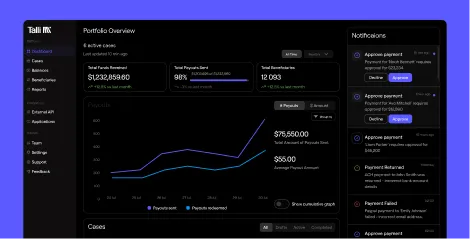
Real-time dashboards display:
- Completion rates showing percentage of successful payouts
- Payment method distribution across ACH, cards, and wallets
- Geographic concentration by region
- Failure root cause analysis
- Fraud flags requiring review
- Remaining fund balances
Automated Reporting for Courts and Stakeholders
Automated reporting generates court-required accounting without manual preparation. Stakeholder portals provide controlled access for courts, trustees, and legal teams. CRM integration via webhooks syncs payment status updates automatically to case management systems.
Automated three-way reconciliation achieves 90% auto-match rates, reducing monthly closing time by 70%. Monthly reconciliation that previously took 15 hours now completes in 4.5 hours.
Talli: Purpose-Built Digital Disbursement for Class Action Settlements
Talli provides comprehensive digital disbursement infrastructure specifically designed for the unique requirements of class action settlements. The platform addresses every challenge outlined in this article through integrated payment processing, compliance automation, and real-time visibility.
Settlement administrators using Talli eliminate check fraud exposure while achieving 50-65% cost reduction compared to traditional paper check distributions. Multi-channel payment options including ACH, prepaid cards, digital wallets, and gift cards meet claimants where they are, driving redemption rates to 95-98%.
Automated compliance tools handle KYC verification, OFAC screening, W-9 collection, and 1099 generation, ensuring fiduciary obligations are met without manual intervention. Dedicated FBO account structures maintain proper fund segregation while SOC 2 Type II compliance provides the security certifications courts require.
Real-time dashboards and automated reporting give fiduciary teams complete visibility into distribution performance, while three-way reconciliation reduces monthly closing time by 70%. Implementation occurs within 2-6 weeks with ROI typically achieved within 4-7 months.
For class action administrators seeking to modernize settlement distributions while protecting claimants and meeting court mandates, Talli delivers the comprehensive solution that eliminates the vulnerabilities of mailed checks.
Frequently Asked Questions
What legal requirements must digital payment platforms meet for class action settlements?
Digital payment platforms serving class action settlements must satisfy Rule 23 notice and distribution requirements for federal cases, plus equivalent state rules. Courts require comprehensive audit trails documenting every payment attempt, success, and failure. Platforms must maintain proper fund segregation to preserve Qualified Settlement Fund tax treatment under IRC Section 468B, with banking relationships through FDIC-member institutions. Additionally, platforms need state money transmission licenses or partnerships with licensed entities in each jurisdiction where funds are distributed.
How do settlement administrators handle claimants who prefer paper checks despite the fraud risks?
While digital platforms prioritize electronic payment methods, paper checks remain available as a fallback option for claimants who specifically request them. Best practice involves offering check recipients additional identity verification before mailing and providing tracking numbers for delivery confirmation. Some administrators implement positive pay services that verify check details before honoring payments. However, the goal is minimizing check usage through attractive digital alternatives rather than eliminating the option entirely.
What happens when digital payments fail or are returned?
Digital disbursement platforms implement automated retry logic when payments fail due to incorrect account information or temporary issues. Failed ACH transfers trigger automatic fallback to alternative methods: prepaid cards, digital wallets, or ultimately paper checks. Real-time dashboards flag failed payments for administrator review, with failure root cause analysis enabling targeted outreach to claimants for updated information. This approach achieves near-100% delivery rates compared to the single-attempt nature of mailed checks.
How do prepaid cards serve unbanked settlement claimants?
Prepaid Mastercards provide full payment access without requiring traditional bank accounts. Virtual cards can be delivered via SMS or email within 30 seconds of approval, while physical cards arrive within 5-7 days. Cards carry no activation fees or monthly charges, allowing claimants to use full settlement amounts. Funds can be spent anywhere Mastercard is accepted, withdrawn at ATMs, or transferred to other accounts. This serves the approximately 5.9 million U.S. households without traditional banking relationships.
What fraud detection capabilities distinguish digital platforms from paper check processes?
Digital platforms employ AI-powered fraud detection using pattern recognition across device fingerprinting, behavioral analytics, and identity verification. These systems flag suspicious activity before funds are released, unlike paper checks where fraud is typically detected only after checks clear and funds are withdrawn. Real-time screening against OFAC sanctions lists, duplicate claim detection, and multi-factor authentication create layered protection. Industry data shows such systems achieve 40%+ reduction in fraudulent claims while identifying fraud 50% faster than manual review.