.svg)


.svg)
Selecting the right shareholder payment platform determines whether dividend distributions run smoothly or become a regulatory risk. With S&P Global forecasting 2024 aggregate dividends at $2,333 billion and the shift to T+1 settlement compressing settlement timelines, issuers need platforms that balance compliance automation, operational reliability, and shareholder experience. Modern shareholder services platforms can automate these requirements while improving redemption, reducing manual follow-up, and giving internal teams better visibility across thousands of shareholder payments.
Key Takeaways
- S\&P Global forecasted 2024 aggregate dividends at $2,333 billion, with US market dividends expected to grow 5.1% year over year
- The T+1 settlement cycle became effective May 28, 2024, shortening the standard US settlement cycle from T+2 to T+1
- NYSE-listed companies must provide at least 10 calendar days’ advance notice for record dates, and a press release or SEC filing alone does not constitute notice to the Exchange
- Digital disbursements can reduce processing costs compared with paper checks while compressing distribution timelines from weeks to 24 to 48 hours
- Modern platforms support ACH, prepaid cards, digital wallets, wire transfers, gift cards, and checks so issuers can match payment methods to shareholder needs
Understanding Shareholder Payments: What Are Dividends and How Are They Paid?
Dividends represent a company’s distribution of profits or surplus to shareholders. For issuers, the payment itself is only one part of the workflow. The full dividend process includes board approval, record date coordination, shareholder data validation, tax documentation, payment execution, exception handling, and final reconciliation.
The dividend payment process usually follows four critical dates:
- Declaration date: The board announces the dividend amount, record date, and payment date
- Ex-dividend date: The trading cutoff that determines whether a buyer is entitled to the dividend
- Record date: The company determines eligible shareholders from its shareholder records
- Payment date: Funds are distributed to eligible shareholders
The T+1 settlement cycle effective May 28, 2024 shortened standard settlement from T+2 to T+1 and moved normal ex-dividend trading to the record date under updated exchange rules. That tighter window raises the operational stakes for issuers and transfer teams because late data, failed payments, or incomplete tax documentation leave less time for correction.
Issuers distribute dividends through several mechanisms:
- Cash dividends: Direct payments to shareholder accounts
- Stock dividends: Additional shares issued proportionally
- Special dividends: One-time distributions tied to extraordinary events
- Dividend reinvestment plans: Automatic reinvestment into additional shares
US market dividends were expected to grow 5.1% year over year in 2024, making platform selection a high-impact operational decision for issuers with large or complex shareholder populations.
Essential Platform Features for Calculating and Managing Dividends
A shareholder payment platform should do more than send money. It should connect shareholder records, approved distribution terms, tax status, payment preferences, and reconciliation data in one controlled workflow. The strongest platforms reduce spreadsheet dependency and provide audit-ready visibility from record date through final payment.
Core calculation capabilities should include:
- Shareholder register synchronization: Current ownership data, validated before payment
- Share class handling: Different rates for common stock, preferred stock, and other classes
- Record date snapshots: Clear evidence of who was eligible and when
- Rounding logic: Consistent treatment of fractional shares and payment minimums
- ERP integration: Automated journal entries for declaration, liability, payment, and reconciliation
Modern platforms provide reporting capabilities that help finance and shareholder services teams reduce month-end close work, identify unmatched items, and document payment completion without rebuilding reports manually.
Tools for Accurate Dividend Per Share Calculations
Dividend per share calculations must be consistent, explainable, and repeatable. This matters most when issuers manage multiple share classes, preferred dividends, restricted stock, special dividends, or international holders. A platform should preserve the original calculation rules and make them easy to review later.
Look for engines that support:
- Fractional share calculations and rounding rules
- Multi-currency conversions for cross-border programs
- Tax withholding rules by shareholder status and jurisdiction
- Prorated dividends when ownership changes during a relevant period
- Exception reports for missing tax forms, invalid addresses, or failed validations
For large distributions, these controls prevent small data issues from becoming large-scale reissuance problems.
Evaluating Digital Payment Methods for Shareholder Distributions
Payment method diversity directly affects redemption rates and shareholder satisfaction. A strong platform should support multiple payment options while giving administrators control over eligibility, timing, costs, and fallback methods.
ACH Direct Deposit
ACH is often the lowest-cost digital option, usually suitable for banked shareholders with valid routing and account information. Delivery commonly occurs in one to two business days, depending on the processor, receiving bank, and ACH timing. Platforms should include account validation, returned payment handling, and clear status tracking.
Prepaid Cards
Prepaid cards help reach shareholders who cannot or do not want to receive ACH payments. Virtual cards can be delivered electronically, while physical cards can serve shareholders who prefer mail. The latest FDIC survey reported approximately 5.6 million unbanked US households in 2023, which makes non-ACH options important for inclusive distribution design.
Digital Wallets
PayPal and Venmo can provide fast access for shareholders already using those platforms. These methods are especially useful for lower-value payments and mobile-first recipients. Platforms should still provide consent flows, fraud controls, and clear records showing when the payment was offered, claimed, and completed.
Wire Transfers
Wire transfers remain important for high-value institutional payments and some international distributions. They are more expensive than ACH, but they can support time-sensitive or cross-border payments where bank instructions, currency, and compliance review require closer control. For cross-border payouts, platforms should support currency handling, beneficiary validation, and clear documentation of payment status.
Paper Checks
Checks remain a necessary fallback, but they create higher operational overhead. Printing, postage, returned mail, stop payments, stale-dated checks, reissuance, and escheatment all add cost and delay. Traditional checks also create weaker visibility because administrators may know a check was mailed but not whether the shareholder received, deposited, or abandoned it.
Compliance and Security: Protecting Shareholder Payments
Shareholder payments touch securities rules, tax reporting, identity controls, sanctions screening, privacy, and unclaimed property obligations. A platform should make those controls part of the standard workflow rather than a manual afterthought.
NYSE-listed issuers must provide at least 10 calendar days’ advance notice for record dates. Publication by press release or SEC filing does not replace notice to the Exchange. Platforms that support calendar controls, approval workflows, and audit trails reduce the risk of missed record date requirements.
Critical compliance capabilities include:
- KYC verification: Identity checks against reliable data sources
- OFAC screening: Automated sanctions screening with documented timestamps
- W-9 collection: Digital tax form collection for US persons
- 1099-DIV support: Tax reporting workflows for dividend distributions
- 1042-S support: Reporting support for certain US-source payments to foreign persons
- Withholding logic: Rules based on documentation, tax status, and jurisdiction
Your platform must support tax compliance with a clear audit trail for what was collected, what was missing, and how withholding decisions were made.
Fund Segregation Architecture
Dedicated FBO account structures help preserve separation between shareholder funds and operating capital. For legal, settlement, bankruptcy, or fiduciary contexts, segregation is not just operationally helpful. It is central to trust, auditability, and compliance.
A strong architecture provides:
- Separation between distribution funds and company operating funds
- Matter-level or campaign-level tracking
- Audit-ready documentation throughout the distribution lifecycle
- Banking services from regulated financial institutions
Platforms should also support automated reconciliation so finance teams can match funding, payments, returns, and remaining balances without manual spreadsheet review.
Security Certifications
Security review should include SOC 2 Type II, PCI DSS scope where card data is involved, encryption practices, role-based access controls, and incident response procedures. Administrators should also review the platform’s trust standards, data retention policies, user permissions, and fraud prevention approach before committing.
AI-assisted fraud detection can help flag suspicious patterns, but issuers should ask how alerts are reviewed, how false positives are handled, and how decisions are documented.
Real-Time Tracking and Reporting for Shareholder Services Teams
Payment visibility reduces inbound inquiries, improves stakeholder confidence, and helps teams solve problems before deadlines are missed. Shareholder services teams should not have to wait for bank files, manual updates, or end-of-week reports to understand distribution status.
Essential dashboard capabilities include:
- Live visibility into successful, pending, failed, and unclaimed payments
- Payment method distribution across ACH, cards, wallets, wires, and checks
- Geographic and demographic concentration reporting where appropriate
- Failure root cause analysis for returned or rejected payments
- Fraud flags and exception queues
- Remaining fund balances and reconciliation status
Real-time tracking also improves shareholder communication. Instead of generic updates, teams can provide precise answers about whether a payment was offered, claimed, returned, reissued, or still pending action.
Stakeholder portals can extend controlled access to trustees, legal teams, auditors, and internal finance teams. This reduces back-and-forth reporting requests while preserving permission controls.
Evaluating Costs and Efficiency: Digital vs. Traditional Shareholder Payouts
The cost difference between digital and paper distributions grows quickly at scale. Paper checks often look inexpensive when only postage and printing are counted, but the true cost includes reconciliation, stale-dated checks, returned mail, reissuance, call center volume, and escheatment work.
Paper check costs may include:
- Printing and postage
- Manual reconciliation
- Returned mail processing
- Stop payments and reissuance
- Call center support
- Escheatment preparation
Digital payment costs may include:
- ACH transaction fees
- Prepaid card issuance costs
- Digital wallet fees
- Wire fees for high-value or international payments
- Platform and implementation costs
Digital platforms can reduce total distribution costs by shifting more shareholders into lower-friction payment methods and reducing unresolved exceptions. The return on investment is strongest when teams factor in reduced manual labor, fewer reissued payments, faster completion, and lower unclaimed property exposure.
Implementation usually requires data mapping, compliance setup, payment method configuration, testing, and administrator training. For many issuers, a vendor-assisted rollout can be completed in weeks rather than months, especially when the provider already supports high-volume disbursement workflows.
Choosing Between a Transfer Agent and a Custodian for Shareholder Services
Transfer agents and custodians serve different roles. Understanding the distinction helps issuers decide what belongs inside the shareholder payment platform and what remains with existing service providers.
Transfer agents handle:
- Maintaining shareholder records and registers
- Processing share transfers and certificate issuance
- Coordinating dividend and proxy distributions
- Managing lost securities and escheatment workflows
- Supporting DRS eligibility requirements
Custodians provide:
- Safekeeping of securities and assets
- Trade settlement support
- Corporate action processing
- Cash management and sweep accounts
- Reporting for institutional investors
Most public companies rely on transfer agents for shareholder recordkeeping and dividend coordination. Custodians primarily serve institutional investors holding securities positions. Some issuers work with both, using transfer agents for registered holders and custodians for beneficial owner or institutional workflows.
The payment platform should not create confusion between these roles. It should integrate with the necessary recordkeeping systems and provide clean payment execution, tracking, and reconciliation.
Scalability and Integration: Meeting the Demands of Shareholder Programs
A platform that works for 1,000 shareholders may fail under the pressure of 100,000. Issuers should evaluate scalability before the next major dividend, special distribution, merger payment, or litigation-related payout.
Volume Handling Capabilities
Evaluate scalability through:
- Batch upload capabilities: Bulk shareholder data processing
- Phased rollout support: Controlled launch and monitoring for large populations
- API rate limits: Reliable throughput without unexpected throttling
- Peak load handling: Performance during quarterly or special dividend cycles
- Exception management: Queues for failed payments, missing documents, and fraud flags
Platforms should support campaigns from small shareholder groups to high-volume programs without forcing teams back into spreadsheets.
System Integration Requirements
Integration reduces duplicate work and protects data integrity. Your platform should connect with shareholder records, accounting systems, CRM tools, tax workflows, and banking partners.
Important requirements include:
- API documentation for custom integrations
- Webhook support for real-time status updates
- Pre-built connectors where available
- Data export formats for audits and regulatory review
- Role-based permissions for legal, finance, and operations teams
Modern platforms should validate payment files against approved distribution plans, flag mismatches, and preserve a record of every change. This is especially important for teams managing regulated, court-supervised, or fiduciary distributions.
Why Talli Simplifies Shareholder Payment Distribution
For issuers and shareholder services teams managing high-volume, compliance-intensive distributions, Talli provides purpose-built digital disbursement infrastructure designed to replace fragmented manual workflows with controlled, audit-ready payment operations.
Talli supports:
- Multi-channel payment distribution: ACH, prepaid Mastercards, PayPal, Venmo, Amazon gift cards, and checks as fallback
- Automated compliance infrastructure: Built-in KYC verification, OFAC screening, W-9 collection, fraud mitigation, and audit logs
- Fund segregation: Dedicated account structures that preserve separation and simplify reporting
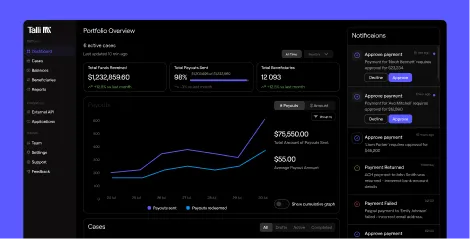
- Real-time dashboards: Live visibility into payment status, redemption, exceptions, and fund flows
- CRM synchronization: Status updates that support reconciliation and stakeholder reporting
The AB Data case study shows how digital disbursement infrastructure can increase redemption rates, reduce unresolved exceptions, and preserve fiduciary confidence across large distribution programs. For issuers, the value is not only faster payment. It is better control over every step between approval, funding, shareholder notification, payment selection, and final reconciliation.
Talli Conclusion: What Issuers Should Prioritize
A shareholder payment platform should reduce risk, not create another operational layer to manage. The best choice combines accurate eligibility data, multiple payment methods, automated tax and identity controls, fund segregation, real-time reporting, and clear exception workflows. For issuers under tighter settlement timelines and rising shareholder expectations, digital-first infrastructure turns distribution from a manual administrative burden into a controlled, measurable process.
Talli is built for that environment. Its platform gives shareholder services teams the payout rails, compliance controls, and reporting visibility needed to move funds faster while preserving confidence in every distribution cycle.
Frequently Asked Questions
What is the primary difference between a stock dividend and a cash dividend for issuers?
A cash dividend distributes money to shareholders and requires payment processing, tax documentation, withholding controls, and reconciliation. A stock dividend issues additional shares proportionally and primarily affects the shareholder register, ownership records, and related corporate action processing.
How can a payment platform help reduce unclaimed shareholder funds?
A modern platform reduces unclaimed funds by offering digital payment choices, automated reminders, real-time tracking, and faster exception handling. Instead of waiting for checks to go stale, teams can identify at-risk payments earlier and guide shareholders toward completion.
What compliance requirements matter most for shareholder payment platforms?
Key requirements include record date notice controls, T+1 settlement awareness, OFAC screening, KYC checks, W-9 collection, 1099-DIV support, 1042-S support for foreign persons, withholding rules, privacy controls, audit logs, and state unclaimed property workflows.
Can a shareholder payment platform integrate with accounting and CRM systems?
Yes. Strong platforms provide APIs, webhooks, data exports, and CRM synchronization so payment status, exceptions, returned funds, and reconciliation data can move automatically between systems without manual re-entry or disconnected spreadsheets.
How should issuers evaluate international dividend distribution support?
Issuers should review multi-currency payment options, beneficiary validation, tax documentation, withholding logic, FX handling, sanctions screening, privacy compliance, and payment status reporting. International payouts require stronger controls because payment rails, documentation rules, and tax treatment vary by jurisdiction.