.svg)


.svg)
Class action settlement notice requirements have undergone significant transformation since the 2018 Rule 23 amendments expressly recognized electronic notice as an appropriate option alongside U.S. mail and other methods. Courts evaluate which notice method or combination of methods provides the best notice practicable under the circumstances. With 97% of adults online and settlement values reaching $398 million in single cases, proper notice execution directly impacts claimant participation rates and settlement success. Modern class action disbursement platforms can streamline compliance while maximizing redemption rates through automated multi-channel distribution.
Key Takeaways
- The 2018 amendments to Rule 23 explicitly authorize electronic notice methods including email, social media, and digital advertising as appropriate alongside traditional mail
- The Northern District of California recommends giving class members at least 35 days to opt out or object, while deadlines in other courts depend on applicable rules and the judge's scheduling order
- When CAFA's settlement-notice provisions apply, each participating defendant must serve the appropriate federal and state officials no later than 10 days after the proposed class settlement is filed in court, with final approval generally not entered earlier than 90 days after the later date on which the required officials are served
- First-class mail volume has declined to 1979 levels despite a 100-million-person population increase, making digital notice increasingly critical
- For Rule 23(b)(3) classes, settlement notices must contain seven mandatory elements including class definition, claims description, and binding effect of judgment
- Front-loading requirements now demand parties demonstrate likely settlement approval before courts authorize sending notice to the class
Understanding the Foundation: Why Class Action Notices Matter
Class action settlement notices serve a constitutional function rooted in due process protections. When a settlement binds absent class members to its terms, those individuals must receive adequate opportunity to participate in, object to, or exclude themselves from the proceeding. Without proper notice, settlements cannot achieve the binding effect courts require for finality.
Federal Rule of Civil Procedure 23 establishes the framework governing notice requirements in federal class actions. The rule mandates that courts direct notice to class members in a manner that constitutes the best notice practicable under the circumstances, including individual notice to all members who can be identified through reasonable effort.
The stakes extend beyond procedural compliance:
- Claimant awareness determines whether settlement funds reach intended recipients
- Judicial oversight requires documented proof that notice reached class members
- Settlement fairness depends on informed class member participation in approval hearings
- Binding effect can be challenged if notice proves inadequate
Courts have rejected settlements where notice programs failed to reach significant portions of the class. A notice plan that looks comprehensive on paper but produces minimal actual reach will face judicial scrutiny at final approval. Claims administrators must demonstrate both theoretical coverage and measured effectiveness.
Digital Transformation: Court Expectations for Electronic Notice in 2026
The Rise of Multi-Channel Digital Distribution
The 2018 amendments introduced five major changes affecting notice requirements. Electronic means, including email and social media, are now explicitly recognized as appropriate notice methods alongside traditional mail. This codification reflected reality: 85% of adults use social media, making digital channels often more effective than postal delivery.
The Northern District of California's guidance instructs parties to use U.S. mail, email, and social media as appropriate and encourages third-party data sources, text messages, and marketing specialists to maximize reach. Courts evaluate notice programs based on:
- Deliverability rates for email campaigns
- Reach percentage for digital advertising
- Frequency of exposure using validated metrics
- Geographic coverage across class member locations
- Accessibility for diverse populations
First-class mail is no longer automatically presumed superior. Courts focus on which combination of methods will actually reach class members effectively, not which method carries historical prestige.
Ensuring Receipt and Comprehension in a Digital Age
Electronic notice offers interactive capabilities impossible with traditional mail. Instead of filling out claim forms by hand and returning them by mail, class members can quickly click through auto-populated forms. Settlement websites can include claim calculators showing estimated recovery amounts, increasing engagement.
Effective digital notice programs incorporate:
- Email campaigns with deliverability tracking and bounce management
- Social media advertising using lookalike targeting based on known class member characteristics
- Programmatic display ads reaching class members across websites and apps
- Settlement websites with document repositories and FAQ sections
- Text message notifications for mobile-first populations
Modern claimant communication strategies must balance reach with comprehension. A notice that arrives but goes unread provides no practical benefit. Effective programs combine multiple touchpoints to ensure message delivery and understanding.
Beyond the Inbox: Reaching Unbanked and Digitally Excluded Claimants
Strategies for Inclusivity: Bridging the Digital Gap
Digital-first notice strategies must account for populations lacking internet access or digital literacy. The latest published FDIC household survey found approximately 5.6 million U.S. households, or 4.2%, were unbanked in 2023, and many more lack reliable internet connections or familiarity with online systems. Courts expect notice programs to address these gaps through alternative methods.
Effective inclusivity measures include:
- Physical mail as fallback for class members without valid email addresses
- Community outreach through local organizations serving target populations
- Publication notice in newspapers and media targeting specific demographics
- Toll-free hotlines with multilingual support
- Physical claim submission options for those unable to file online
The Northern District of California encourages direct deposit for distributions as one method to reach class members, recognizing that payment method preferences often indicate communication preferences. Class members who prefer prepaid cards or cash equivalents may also prefer non-digital notice methods.
Measuring Effectiveness for Hard-to-Reach Populations
Courts increasingly demand evidence that notice programs actually reached intended recipients, not just that notices were sent. Metrics must demonstrate effectiveness across all class segments, including traditionally underserved populations.
Key measurement approaches include:
- Skip-tracing for returned mail with updated address searches
- Response rate tracking by demographic segment
- Claim filing analysis comparing participation across population groups
- Reminder campaign results measuring incremental response
Programs that achieve high overall reach but fail specific populations may face judicial criticism. A 90% reach rate means little if the 10% missed share common characteristics suggesting systematic exclusion. Platforms designed for unbanked claimants address these gaps through payment method flexibility and alternative contact channels.
Front-Loading Requirements: What Courts Demand Before Notice Goes Out
The 2018 amendments fundamentally changed the preliminary approval process. Under Rule 23(e)(1), parties must provide courts with sufficient information to determine that settlement approval and class certification are likely before notice can be directed. This "front-loading" requirement transforms preliminary approval from a rubber stamp into substantive gatekeeping.
Courts must assess four factors under Rule 23(e)(2):
- Adequacy of representation by class representatives and counsel
- Arm's length negotiation without collusion between parties
- Adequacy of relief including distribution methods and attorney fees
- Equitable treatment among class members with similar claims
The Duke Law guidance explains that courts should lighten the burden when indicia of fairness are apparent and protections are in place. However, when settlement terms raise concerns, such as disproportionate attorney fees or complex claim procedures that may suppress participation, courts demand extensive documentation.
Parties seeking preliminary approval must prepare:
- Detailed distribution plans with projected claim rates
- Claims processing procedures and timeline
- Cost analyses comparing administrative expense to class recovery
- Attorney fee justifications relative to class benefit
- Comparable settlement outcomes from similar cases
Settlement administrators must collaborate with legal counsel early to prepare materials supporting preliminary approval. The days of filing notice motions with minimal supporting documentation have ended.
CAFA Notice Compliance: Strict Timelines That Cannot Be Missed
The Class Action Fairness Act of 2005 imposes additional notice obligations separate from Rule 23 requirements. When CAFA's settlement-notice provisions apply, each participating defendant must serve the appropriate federal and state officials no later than 10 days after the proposed class settlement is filed in court. Final approval generally cannot be entered earlier than 90 days after the later date on which the required federal and state officials are served.
CAFA notice must include:
- The complaint and all related filings
- Settlement agreement with all exhibits
- Notice forms and claim procedures
- Class member information including proportionate share by state (if feasible)
- Any side agreements or supplemental arrangements
Despite technological advances, CAFA notices remain predominantly delivered via USPS or UPS, with only Connecticut, Nevada, and New York accepting electronic filing. Privacy concerns have led most parties to provide anonymous data charts rather than class member names, though the statute contemplates their inclusion "if feasible."
Missing the 10-day deadline creates cascading problems. If parties don't complete this simple mailing at the start, they won't get final approval after all administration is complete, delaying payments to class members who have already filed claims.
Notice Content Requirements: The Seven Mandatory Elements
For Rule 23(b)(3) classes, including proposed settlement classes proceeding under Rule 23(b)(3), Rule 23(c)(2)(B) requires notice to clearly and concisely state seven core elements in plain, easily understood language:
- Nature of the action describing the claims and litigation history
- Class definition identifying who is included
- Class claims, issues, or defenses explaining what the settlement resolves
- Right to appear through counsel for those wishing to participate
- Right to request exclusion (opt-out) from the settlement
- Time and manner for requesting exclusion with specific procedures
- Binding effect of judgment on class members who don't opt out
The Federal Judicial Center has developed illustrative notice forms for securities, products liability, and employment cases that serve as templates. Courts emphasize tailoring notices to class sophistication levels. Securities fraud notices may use different language than consumer product defect notices.
Beyond mandatory elements, effective notices include:
- Claim deadlines prominently displayed
- Recovery estimates when determinable
- Claim submission instructions with multiple filing options
- Contact information for the settlement administrator
- Settlement website URL for detailed information
Notices must balance completeness with comprehensibility. A notice containing all required information but written in dense legalese fails its purpose. The Northern District of California recommends giving class members at least 35 days to opt out or object, though complex cases may warrant longer timeframes.
Building Effective Notice Programs: Best Practices for 2026
Combining Traditional and Digital Channels
The most effective notice programs combine multiple channels strategically:
Email Notice: Delivers instant, trackable communication to identified class members. Email performance depends on the quality of available addresses, deliverability controls, and the characteristics of the class, so administrators should document delivery, bounce, and follow-up results.
Direct Mail: Remains essential for class members without email addresses and provides tangible documentation. Postcard formats increase open rates compared to envelope mailings.
Digital Advertising: Lookalike targeting can reach class members whose contact information is unavailable. Digital advertising campaigns should use documented reach and frequency metrics appropriate to the class, with targeting and campaign design supported by the notice plan.
Settlement Websites: Serve as central information hubs with claim calculators, document downloads, and FAQ sections. Mobile optimization is essential given predominant mobile web usage.
Publication Notice: Required for settlement classes where individual notice is impractical. Targeted publications reach specific demographics more effectively than general circulation newspapers.
Documentation and Audit Trails
Courts require extensive documentation proving notice program execution. Settlement administrators must maintain:
- Delivery confirmation for all mailings and emails
- Advertising metrics including impressions, reach, and frequency
- Website analytics showing visitor engagement
- Claims filing data tracking submissions over time
- Follow-up campaign results for reminder notices
Modern audit trail systems generate court-ready reports automatically, eliminating manual documentation compilation. Real-time dashboards allow administrators to monitor progress and adjust campaigns based on response rates.
Talli's Complete Solution for Settlement Notice and Distribution
While notice delivery gets class members' attention, the ultimate goal is successful payment distribution. Talli bridges this gap with an AI-driven platform purpose-built for legal settlement disbursements.
Talli transforms the connection between effective notice and successful payment through:
- Multi-Channel Payment Options: ACH direct deposit, prepaid Mastercard, digital wallets (PayPal, Venmo), gift cards, and paper checks as fallback, ensuring every class member can receive payment regardless of banking status
- Integrated Compliance Infrastructure: Automated KYC verification, OFAC sanctions screening, and W-9 collection achieving high completion rates through smart reminders
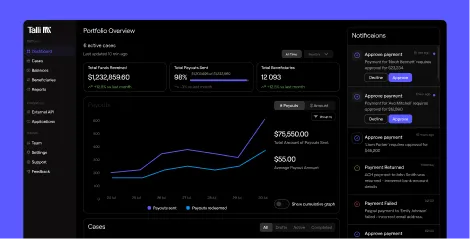
- Real-Time Tracking Dashboards: Live monitoring of payment status, completion rates, and fund flows with court-ready audit trails
- AI-Powered Fraud Detection: Pattern recognition across device fingerprinting and behavioral analytics delivering significant reductions in fraudulent claims
Unlike generic payment processors, Talli maintains complete QSF compliance with dedicated FBO account structures preserving Qualified Settlement Fund tax treatment. The platform achieves high redemption rates compared to traditional paper check methods, directly addressing the problem of unclaimed settlement funds.
For settlement administrators managing complex distributions across thousands of claimants, Talli's payment capabilities ensure that effective notice programs translate into successful fund distribution, the ultimate measure of settlement success.
Frequently Asked Questions
Why did I get a notice of a class action settlement?
You received a class action settlement notice because you have been identified as a potential class member based on records indicating you purchased a product, used a service, or were otherwise affected by the conduct at issue in the lawsuit. The notice is sent to inform you of your legal rights including the right to file a claim for payment, object to the settlement terms, or opt out to pursue your own lawsuit. You are not required to take any action, but failing to opt out means the settlement's judgment will bind you.
What happens if I ignore a class action settlement notice?
If you ignore a class action settlement notice and take no action, you will remain part of the class and be bound by the settlement's terms. This means you release all claims related to the lawsuit against the defendant and cannot sue separately later. Whether you must file a claim depends on the settlement. Some settlements require a claim form, while others automatically distribute relief to eligible class members identified from existing records.
How long do class members have to respond to settlement notices?
Courts typically require sufficient time for class members to opt out or object to proposed settlements, though complex cases often provide longer windows of 60-90 days. Claim filing deadlines may extend beyond the objection period. Specific deadlines appear in the settlement notice and on the settlement website. Missing deadlines generally forfeits your rights. Courts rarely grant extensions absent extraordinary circumstances.
Can settlement notices be sent by email instead of mail?
Yes, the 2018 amendments to Rule 23 explicitly recognize email and social media as appropriate notice methods alongside traditional mail. Courts now evaluate whether the combination of notice methods constitutes the "best notice practicable" under the circumstances. With 97% of adults online, digital notice often reaches class members more effectively than postal mail alone. However, most notice programs combine digital and physical methods to maximize reach across all class segments.
What makes a class action notice legally sufficient?
For Rule 23(b)(3) classes, a legally sufficient class action notice must contain seven mandatory elements: the nature of the action, class definition, class claims or defenses, right to appear through counsel, right to request exclusion, procedures and deadline for exclusion, and the binding effect of judgment on non-excluded members. The notice must be written in "plain, easily understood language" appropriate for the class's sophistication level. Courts also evaluate whether the notice program actually reached a sufficient percentage of class members to satisfy due process requirements.