.svg)


.svg)
The best disbursement platform for government agencies is one that combines OFAC sanctions screening, KYC identity verification, multi-channel payouts (ACH, prepaid cards, digital wallets), and court-ready audit trails in a single compliant workflow. Government agencies must prioritize compliance automation, fund segregation, and recipient accessibility when evaluating platforms. In 2024, the U.S. government processed 36 million paper checks worth $175 billion — at an infrastructure cost exceeding $657 million per fiscal year. With the federal mandate to eliminate paper check disbursements by September 30, 2025, government agencies and regulatory bodies face a critical decision: which digital disbursement platform meets the compliance, security, and operational demands of public-sector fund distribution? This guide walks through the evaluation criteria that matter most when selecting a disbursement platform for government agencies — from OFAC screening and KYC verification to recipient experience for unbanked populations.
Key Takeaways
- The federal executive order requires all agencies to transition from paper checks to electronic disbursements by September 30, 2025, making platform selection urgent.
- Government disbursement platforms must handle OFAC screening, KYC verification, W-9 collection, and 1099 generation — not just move money.
- Treasury-issued paper checks are 16 times more likely to be lost, stolen, or altered than electronic fund transfers.
- The right platform supports multiple payout methods (ACH, prepaid cards, digital wallets, real-time payments) to reach banked and unbanked recipients alike.
- Purpose-built disbursement platforms reduce manual work by integrating compliance screening, tax documentation, payment delivery, and reporting into one workflow.
- Agencies should evaluate total cost of ownership, not just transaction fees, because manual reconciliation, fraud exposure, and unclaimed funds can make low-cost platforms more expensive over time.
- Recipient experience matters as much as compliance: platforms with self-service portals, proactive notifications, and flexible payout options improve completion rates and reduce support burdens.
What Is a Disbursement Platform for Government Agencies?
A disbursement platform for government agencies is software infrastructure that manages the end-to-end process of distributing funds from a government agency or regulatory body to recipients. This includes settlement payouts, grant distributions, restitution payments, unemployment benefits, jury duty compensation, and regulatory refunds.
Unlike general-purpose payment processors, government disbursement platforms must satisfy strict regulatory requirements — including identity verification, sanctions screening, fund segregation, and court-ready audit trails. They connect with government financial systems, case management tools, and reporting frameworks to provide full transparency over every dollar disbursed.
The key distinction is compliance depth. A commercial payment tool moves money. A disbursement platform for government agencies is the only solution that moves money while maintaining the audit trail, recipient verification, and regulatory documentation that public-sector fund management requires. OFAC screening and KYC verification are core compliance features for government disbursement platforms, while QSF fund segregation is critical for agencies or bodies administering settlement-related distributions.
Why Do Government Agencies Need Purpose-Built Disbursement Platforms?
Government agencies operate under constraints that commercial payment platforms cannot handle. Purpose-built disbursement platforms are the best choice because they address three requirements that general tools fail to meet.
Regulatory compliance at scale. Government disbursements require OFAC screening against SDN, KYC identity verification, and tax reporting (W-9/1099) for every recipient. General payment tools may handle one of these. Government platforms handle all of them in a single workflow, with documentation maintained for five or more years as required by federal retention policies.
Fiduciary accountability. Public funds demand segregated accounts, court-ready reporting, and real-time audit trails. Regulatory bodies and settlement administrators need to prove fund segregation throughout the disbursement lifecycle under IRC Section 468B compliance. General payment platforms lack this level of financial controls.
Recipient diversity. Government recipients range from individuals with direct deposit accounts to unbanked recipients, some of whom use nonbank payment apps such as PayPal, Venmo, or Cash App. who rely on digital wallets like PayPal or Venmo. A government platform must support ACH, prepaid cards, push-to-card, digital wallets, and real-time payment rails to avoid leaving recipients behind.
The Federal Mandate: Paper Check Phase-Out by September 2025
The executive order "Modernizing Payments To and From America's Bank Account" set a hard deadline: by September 30, 2025, the Secretary of the Treasury shall cease issuing paper checks for all federal disbursements. Agency heads were required to submit compliance plans within 90 days of the order.
This mandate is the single largest shift in government payment infrastructure in decades. The reasoning is clear:
- Cost: Maintaining physical check infrastructure cost taxpayers over $657 million in FY2024 alone.
- Fraud: Treasury checks are 16 times more likely to be reported lost, stolen, returned undeliverable, or altered than an EFT.
- Speed: Digital disbursement platforms can process payouts in under five seconds, compared to days or weeks for physical checks.
- Preference: 90% prefer instant disbursements if given the choice.
For state and local agencies, while the executive order directly targets federal disbursements, the same economic and security pressures apply. Agencies that continue relying on paper checks face higher costs, more fraud, and worse constituent satisfaction. Digital disbursement is now the standard — paper checks are the exception.
What Compliance Requirements Must Government Disbursement Platforms Meet?
Compliance is the most important factor when choosing a disbursement platform for government agencies — more important than price, speed, or features. A platform that fails compliance puts the agency at legal and financial risk. Here are the non-negotiable requirements:
- OFAC screening. Every recipient must be checked against the Specially Designated Nationals (SDN) list and country-specific sanctions programs before funds are released. Screening records must be maintained for at least five years. Failure to screen can result in civil penalties — OFAC has levied millions in fines against non-compliant organizations.
- KYC verification. KYC identity verification is the most effective way to prevent disbursement fraud and ensure funds reach legitimate recipients. Automated KYC reduces processing time from days to minutes while maintaining verification accuracy. The best platforms support multi-factor identity verification, not just name-and-address matching.
- W-9 collection and 1099 generation. Tax compliance is mandatory for every government disbursement. Missing Tax Identification Numbers (TINs) trigger backup withholding requirements, creating administrative headaches for agencies and reduced payments for recipients. The best disbursement platforms automate W-9 collection and generate 1099 forms at scale.
- QSF compliance (for settlement funds). Under IRC Section 468B, qualified settlement funds require dedicated, segregated accounts with audit trails proving fund separation throughout the disbursement lifecycle. Not every platform supports this — it is a critical differentiator for regulatory bodies handling settlement distributions.
- PCI DSS Level 1 compliance. Any platform handling payment card data must meet PCI DSS Level 1 standards — the highest level of data security certification. This applies to platforms that offer prepaid card disbursements.
How Do You Evaluate Security Features in a Disbursement Platform?
Security failures with any disbursement platform for government agencies create both financial losses and public trust damage. Evaluate platforms across these dimensions:
- Encryption and data handling. End-to-end encryption for data in transit and at rest is the absolute minimum requirement. Ask whether the platform encrypts recipient PII separately from financial data and whether encryption keys are managed through a dedicated key management service.
- Role-based access control. Government agencies have multiple stakeholders — administrators, auditors, legal teams, finance departments. The platform should support granular role-based access so that each user sees only what their role requires.
- Fraud detection and monitoring. Look for platforms with real-time fraud detection that can block suspicious payout activity before funds leave the account. Behavioral analytics, velocity checks, and duplicate payment detection are standard expectations.
- Audit trail completeness. Every action — from recipient verification to fund release to payment confirmation — must be logged with timestamps, user IDs, and change records. Regulatory bodies need court-ready audit trails that can withstand legal scrutiny.
Integration Capabilities: Connecting with Government Systems
Any disbursement platform for government agencies that operates in isolation creates more work, not less. Evaluate how well the platform integrates with existing government infrastructure.
- Case management systems. For regulatory bodies and settlement administrators, the platform must connect with case management tools to pull recipient data, eligibility decisions, and payment amounts without manual re-entry.
- Financial systems. Integration with government accounting and ERP systems (such as those from Tyler Technologies or Oracle) ensures that disbursements are automatically recorded in the general ledger and reconciled against approved budgets.
- API availability. Modern platforms offer secure API integrations and webhook-based workflows that connect disbursement events to downstream systems in real time. File-based batch processing should also be supported for agencies with legacy infrastructure.
- Treasury systems. Federal agencies may need integration with ASAP.gov and the Disbursement Funding Account (DFA) framework. Ensure the platform supports the specific treasury connectivity your agency requires.
How Should You Evaluate Recipient Experience?
Recipient experience is the single biggest driver of redemption rates — the percentage of disbursed funds that recipients actually claim. The best government disbursement platforms achieve 30% higher redemption rates than paper-check methods by offering multiple payment channels and self-service portals.
- Multiple payment methods. The platform should support ACH direct deposit, prepaid debit cards, push-to-card, digital wallets, and real-time payment rails (RTP, FedNow). Each method reaches different populations — no single channel covers everyone.
- Unbanked and underbanked access. FDIC data shows that about one-fifth of unbanked households use nonbank online payment services, and about one-third rely on either prepaid cards or nonbank online payment services. A platform that only supports ACH excludes a significant portion of government payment recipients. Prepaid cards and digital wallet options are essential for inclusive disbursement.
- Self-service portals. Recipients should be able to check payment status, update their payment preferences, and access tax documents through a self-service claimant portal — reducing inbound support volume for the agency.
- Communication and notifications. Proactive payment notifications via SMS, email, and push alerts reduce "where's my payment?" inquiries and improve redemption rates. The platform should support configurable communication workflows tied to disbursement events.
Decision Framework: Matching Platform Features to Agency Needs
Not every disbursement platform for government agencies serves every use case equally. Use this framework to weight evaluation criteria based on your agency type:
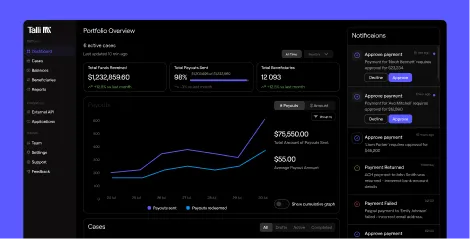
If you need maximum compliance coverage for settlements and regulatory distributions, prioritize platforms with automated OFAC screening, QSF-compliant fund segregation, and court-ready audit trails. Talli, for example, combines segregated QSF-compliant accounts with automated KYC verification, OFAC screening, and real-time dashboards — purpose-built for fiduciary-grade distributions. Book a Demo →
If you need broad recipient coverage for benefits or grant programs, prioritize multi-channel payout support (ACH, prepaid cards, digital wallets, real-time payments) and self-service portals for recipients.
If you need system integration with existing government infrastructure, prioritize API availability, webhook support, and compatibility with your specific treasury and case management systems.
Common Mistakes When Choosing a Disbursement Platform for Government Agencies
The five most common mistakes in government disbursement platform selection are predictable and avoidable. Knowing them saves months of rework and prevents compliance failures.
Treating disbursement like generic payment processing. A proper disbursement platform for government agencies requires compliance automation, audit trails, and recipient verification that standard payment processors do not provide. Choosing a commercial payment tool for government work creates compliance gaps that surface during audits.
Ignoring the unbanked population. A platform that only supports ACH leaves unbanked recipients without a path to their funds. This is both a practical problem (lower redemption rates) and an equity concern for public-sector programs.
Underweighting integration requirements. A platform that cannot connect to your case management or financial systems creates manual data entry bottlenecks. API availability and file-based batch processing should be evaluated during the RFP process, not after implementation.
Skipping vendor due diligence on compliance certifications. Ask for evidence of PCI DSS Level 1 certification, SOC 2 Type II reports, and OFAC compliance program documentation. Claims without documentation are insufficient for government procurement.
Selecting based on price alone. The cheapest platform often lacks the compliance depth, security features, or integration capabilities that government agencies require. Evaluate total cost of ownership — including the cost of manual compliance work, fraud losses, and unclaimed funds — not just per-transaction fees.
Conclusion: Choosing the Right Disbursement Platform for Government Agencies
Choosing the right disbursement platform for government agencies and regulatory bodies is a compliance decision, not just a technology decision. The platform you select must satisfy OFAC, KYC, tax reporting, and audit trail requirements while supporting the payment methods your recipients actually use.
Start your evaluation by mapping your compliance requirements against the decision framework above. For agencies handling settlement distributions or regulatory payouts that require QSF compliance, automated OFAC screening, and court-ready reporting, request a demo from Talli to see how purpose-built disbursement infrastructure handles these requirements.
Frequently Asked Questions
What is a government disbursement platform?
A government disbursement platform is software that manages the complete process of distributing funds from a government agency to recipients — including identity verification, sanctions screening, payment processing across multiple channels, tax reporting, and audit trail documentation. It differs from commercial payment processors by addressing public-sector compliance, fiduciary accountability, and regulatory reporting requirements.
What payment methods do government disbursement platforms support?
Most government disbursement platforms support ACH direct deposit, prepaid debit cards, push-to-card transfers, digital wallets (PayPal, Venmo), wire transfers, and real-time payment rails including the RTP network and FedNow Service. The specific methods available vary by platform, but multi-channel support is essential for reaching both banked and unbanked recipients.
How do digital disbursements reduce fraud compared to paper checks?
Digital disbursements reduce fraud through automated identity verification (KYC), real-time sanctions screening (OFAC), encryption of payment data, and behavioral fraud detection. According to Treasury data, paper checks are 16x likely to be lost, stolen, returned undeliverable, or altered compared to electronic fund transfers.
What is the federal mandate to eliminate government paper checks?
The executive order "Modernizing America's Bank Account" requires the Treasury to cease issuing paper checks for all federal disbursements by September 30, 2025. All executive departments must transition to electronic methods including direct deposit, prepaid cards, and digital payments.
How do government agencies handle disbursements to unbanked recipients?
Agencies use multi-channel disbursement platforms that offer prepaid debit cards, digital wallets, and push-to-card options alongside traditional ACH. FDIC data shows that a meaningful share of unbanked households already use nonbank payment services such as PayPal, Venmo, or Cash App, making digital wallets a useful supplemental channel for reaching underserved populations.
What compliance certifications should a government disbursement platform have?
At minimum, a government disbursement platform should hold PCI DSS Level 1 certification, SOC 2 Type II attestation, and a documented OFAC compliance program. For settlement fund management, the platform should also demonstrate IRC Section 468B (QSF) compliance with segregated accounts and court-ready audit trails. FDIC-insured banking relationships — such as Talli's partnership with Patriot Bank, N.A. — provide additional fiduciary protection.x