.svg)


.svg)
Distributing M&A consideration to shareholders requires precise coordination across securities law, payment execution, tax reporting, shareholder communications, and post-closing obligations. Depending on the deal structure, distributions may involve cash, stock, mixed consideration, escrow releases, earnouts, working capital adjustments, or cash paid in lieu of fractional shares. Modern shareholder payment platforms help administrators automate these workflows while improving redemption rates, reducing unclaimed funds, and preserving a complete audit trail.
Regulatory timelines also affect planning. Bain reports that most deals close in about three months, but regulatory scrutiny can add three to six months, and the average time to reach a regulatory outcome for scrutinized deals is 12 months. Complex transactions can stretch up to two years. That makes payment readiness, shareholder data quality, and real-time reporting essential well before the closing date.
Key Takeaways
- M&A consideration generally takes three forms: cash, stock, or a mix of both, each with different tax, market-risk, and distribution implications.
- Scrutinized deals averaged 12 months to reach a regulatory outcome, while most deals still close in about three months.
- Standard post-closing escrow provisions often hold a portion of purchase price for indemnification, purchase price adjustments, or other obligations.
- Rule 14d-10 requires tender offers to be open to all holders of the subject security class, with the highest consideration paid to any holder available to all holders receiving that type of consideration.
- Global M&A deal value rose 8% to $3.4 trillion in 2024, while $2 billion-plus deals increased 20% year over year.
- Multi-stage distributions may include an initial closing payment, escrow release, earnout payment, working capital true-up, or reissuance for failed payments.
- Digital distribution infrastructure can reduce manual reconciliation, improve shareholder redemption, and simplify audit-ready reporting.
Understanding the acquisition process and its financial implications
The acquisition process determines who receives consideration, what form that consideration takes, and when payments or share deliveries occur. Distribution teams should understand the legal structure before building a payment workflow because each structure creates different obligations.
Common M&A structures include:
- Tender offers: A bidder makes an offer directly to security holders to purchase their securities, subject to federal tender offer rules and deal-specific conditions.
- Mergers: Target shareholders exchange shares for cash, stock, or mixed consideration according to the merger agreement.
- Stock purchases: The buyer purchases shares directly from selling shareholders, often in private-company transactions.
- Asset purchases: The buyer acquires selected assets and liabilities, which may reduce direct shareholder distribution complexity unless sale proceeds are later distributed by the seller.
Tender offers and mergers usually create the most complex shareholder distribution logistics because they can involve large shareholder populations, beneficial ownership records, nominee accounts, election forms, proration mechanics, and post-closing reissuance workflows.
Regulatory approval timeline impact
Regulatory scrutiny has become a major planning variable for larger and more sensitive transactions. Bain reports that in 2022 and 2023, at least $361 billion in announced deals were challenged by regulators around the world. Among challenged deals that ultimately closed, nearly all required remedies. The same report notes that most deals close within about three months, but regulatory scrutiny can add three to six months, and more complicated deals can take up to two years.
This affects distribution planning in several ways:
- Payment-readiness complexity: Shareholder files, election records, tax documentation, and payment instructions must remain accurate while the deal remains pending.
- Communication burden: Shareholders may need repeated updates as outside dates, regulatory milestones, or closing expectations change.
- Currency exposure: Cross-border deals may require FX planning, especially when consideration is paid in a non-U.S. currency.
- System flexibility: Distribution systems must support changing deal terms, proration outcomes, and closing mechanics.
Deal size also matters. Morrison Foerster reported that global M&A deal value rose 8% to $3.4 trillion in 2024, while deals exceeding $2 billion increased 20% year over year. Larger transactions often concentrate operational risk in fewer, higher-value distributions.
Stock purchase agreement provisions for shareholder payouts
The purchase agreement or merger agreement defines the mechanics for distributing consideration. Administrators should map these provisions before launching a campaign because payment timing, eligibility, deductions, and reporting depend on the contract.
Important provisions include:
- Purchase price adjustments: Working capital, debt, cash, or transaction expense calculations that can change the final amount paid.
- Escrow agreements: Post-closing holdbacks that secure indemnification claims or specific obligations.
- Earnout provisions: Contingent payments tied to future revenue, EBITDA, product milestones, or other agreed metrics.
- Shareholder elections: Cash, stock, or mixed-consideration elections that may be subject to proration.
- Closing deliverables: Letters of transmittal, tax forms, payment instructions, and ownership confirmations required before release.
Earnouts can extend distribution activity for 18 to 36 months or longer, depending on the business metrics being measured. Escrows may also require partial releases, dispute reserves, or delayed payments. These mechanics make audit trails essential because administrators must prove who was eligible, what was paid, when it was paid, and why exceptions remain unresolved.
Working capital adjustments
Working capital true-ups commonly occur after closing, often within a negotiated period such as 60 to 90 days. These adjustments compare estimated closing working capital against a final calculation and may trigger a supplemental payment or a reduction against escrowed funds.
Common dispute areas include:
- Inventory valuation
- Accounts receivable collectability
- Accrued liabilities
- Excluded transaction expenses
- Debt-like items
- Cash and restricted cash treatment
Distribution infrastructure must support supplemental payments, allocation recalculations, and clear reporting for shareholders or selling parties. When a payment is reduced or delayed because of a post-closing dispute, the system should document the reason and preserve a clean exception record.
Corporate finance principles for M&A consideration distribution
The form of consideration affects shareholder economics and payment operations. Cash, stock, and mixed consideration each create different risks.
All-cash deals provide immediate liquidity and clear value at closing. Shareholders know the exact amount due, subject to deductions, escrow, proration, or tax withholding. The acquirer must fund the transaction through available cash, debt, or financing proceeds.
All-stock deals give target shareholders shares of the acquirer or combined company. This can support tax-deferred treatment in some structures, but it also exposes shareholders to acquirer share price movement and post-closing performance. Exchange ratios, fractional-share cashouts, and market volatility must be handled carefully.
Mixed-consideration deals combine cash and stock. They can balance buyer financing needs with seller preferences, but they often require election forms and proration if shareholders choose more of one consideration type than the agreement permits.
Control premiums also influence distribution calculations. Buyers often pay above unaffected market price to acquire control, expected synergies, or strategic assets. That premium only reaches shareholders correctly if share counts, ownership records, and beneficial holder data are accurate.
Digitalizing shareholder payouts for enhanced efficiency
Traditional paper-based distribution can create delays, reissuance costs, and unclaimed property exposure. Digital workflows reduce those problems by giving shareholders faster ways to claim funds and giving administrators real-time visibility into campaign performance.
Modern digital disbursement workflows can support:
- Fast payment execution: Eligible digital payments can be initiated within 24 to 48 hours after approval and funding.
- Higher redemption: Multiple payment choices reduce reliance on paper checks and improve claimant or shareholder engagement.
- Lower cost: Digital payments generally cost less than printing, mailing, tracking, and reissuing checks.
- Compliance automation: KYC, OFAC screening, tax form collection, and audit logging can be built into the workflow.
- Exception handling: Failed payments, mismatched records, returned checks, and incomplete documentation can be tracked from one dashboard.
For tender offer payments, automation also helps administrators apply uniform treatment rules, track submitted documents, and preserve clear records for legal and regulatory review.
The role of fraud controls in digital payouts
M&A distributions can attract impersonation attempts, duplicate submissions, address-change fraud, and payment redirection schemes. Fraud controls should be embedded before funds are released, not added after suspicious activity appears.
Important controls include:
- Duplicate claim detection: Identifying multiple submissions tied to the same beneficial interest.
- Identity verification: Comparing shareholder information against approved records and identity sources.
- Device and behavioral checks: Flagging unusual login patterns, rapid changes, or suspicious claim activity.
- OFAC screening: Checking recipients against sanctions lists before funds are released.
- Role-based approvals: Requiring authorization for high-value changes, overrides, or reissuance.
A strong fraud program should also preserve timestamps and reviewer actions. This matters because shareholders, courts, trustees, auditors, or acquiring companies may later ask why a payment was approved, delayed, or blocked.
Multi-channel distribution options for M&A consideration
Shareholder populations are rarely uniform. Institutional holders, retail holders, international shareholders, estates, and unbanked recipients may all need different payment options. A single payment method increases friction and raises the risk that consideration goes unclaimed.
Modern multi-channel payouts may include:
- ACH direct deposit: Low-cost option for banked U.S. shareholders.
- Prepaid cards: Useful for recipients who do not want to provide bank details or do not have a traditional bank account.
- Digital wallets: Familiar option for retail shareholders who prefer PayPal or Venmo-style redemption.
- Wire transfers: Appropriate for high-value or international payments when speed and traceability matter.
- Paper checks: Necessary fallback for shareholders who cannot or will not use digital methods.
The best approach is not to eliminate checks entirely. It is to make checks the fallback rather than the default, while using digital options to reduce failed mail, stale checks, and reissuance overhead.
Optimizing for diverse shareholder demographics
Different shareholder groups create different operational needs.
Institutional shareholders often require ACH or wire payments with detailed remittance data. Retail shareholders may prefer digital wallets, prepaid cards, or simple ACH. International shareholders may require local rails, currency conversion, tax documentation, and address validation. Estates and deceased shareholder cases may require additional documentation before funds can be released.
Administrators should segment outreach by shareholder type and status. A mobile-friendly election and payment flow can help reduce abandonment, while automated reminders can encourage shareholders to complete missing steps before funds become dormant.
Cross-border transactions require additional planning. Local banking rules, sanctions screening, tax documentation, and currency conversion can all affect timing. Using cross-border payout capabilities reduces manual coordination when shareholders reside outside the United States.
Ensuring regulatory compliance in M&A shareholder distributions
Federal securities law, state corporate law, tax rules, and unclaimed property laws can all affect M&A distributions. Compliance obligations vary by deal type, security class, recipient status, and jurisdiction.
The all-holders rule under Rule 14d-10 requires a tender offer to be open to all holders of the class of securities subject to the tender offer. The rule also requires the consideration paid to any tendering security holder to be the highest consideration paid to any other tendering holder. When more than one type of consideration is offered, holders must have an equal right to elect among the types offered, and the highest consideration of each type must be paid to each holder receiving that type.
Tax compliance may include:
- W-9 collection: U.S. persons may need to provide taxpayer identification information.
- Backup withholding: Missing or incorrect TINs may trigger 24% backup withholding.
- Form 1099-B or 1099-CAP workflows: M&A share consideration may require reporting tied to acquisition of control or substantial change in capital structure.
- Foreign shareholder documentation: Non-U.S. holders may require applicable withholding documentation.
- Audit records: Administrators must retain evidence of forms, payment decisions, and withholding calculations.
For distributions tied to litigation settlements or court-supervised claims, platforms should support QSF workflows under IRC Section 468B. For ordinary M&A consideration, fund segregation still matters, but tax treatment depends on the transaction structure rather than QSF status. Talli supports built-in tax compliance workflows for compliance-critical distributions.
Real-time tracking and reporting for M&A distributions
Visibility is critical during M&A distributions because different stakeholders need different answers. Acquirers need completion metrics. Legal teams need documentation. Trustees or administrators need exception reports. Shareholders need payment status.
A modern dashboard should track:
- Successful payments by method
- Pending claims or incomplete forms
- Failed payments and failure reason
- Reissued payments
- Uncashed checks
- Escrow or holdback releases
- Geographic distribution status
- Fraud flags and manual reviews
- Remaining balances
Real-time reporting and reconciliation reduces manual spreadsheet work and improves audit readiness. When every payment has a timestamp, status, owner, and supporting document trail, administrators can answer questions without rebuilding the history from email threads and bank files.
Addressing the unclaimed funds problem in M&A payouts
Unclaimed M&A consideration creates continuing administrative and legal obligations. It can arise from stale addresses, deceased shareholders, missing tax forms, nominee account issues, returned mail, or shareholders who never complete claim forms.
Common causes include:
- Outdated shareholder records
- Failed address verification
- Deceased shareholder estates
- Lost beneficial owner information
- Uncashed checks
- Confusing claim instructions
- Limited payment options
Digital workflows reduce these problems through email and SMS reminders, simplified claim flows, payment choice, address validation, and automated reissuance. Administrators should also track non-responsive shareholders early rather than waiting until checks become stale or dormancy clocks begin running.
Improving claims redemption rates is not only a user-experience issue. It reduces unclaimed property exposure, manual follow-up, and the risk of unresolved balances remaining after the deal team has moved on.
Why Talli simplifies M&A shareholder distributions
M&A consideration distributions require more than basic payment processing. Administrators need compliant disbursement infrastructure that can handle complex shareholder records, tax documentation, fraud controls, payment choice, failed-payment resolution, and audit-ready reporting.
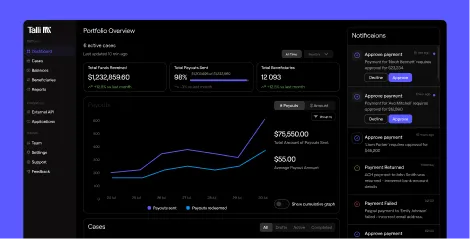
Talli is built for high-volume legal and shareholder distributions, with a single dashboard for launching, funding, tracking, and reconciling payment campaigns. The platform supports multiple redemption options, including ACH, prepaid Mastercard, PayPal, Venmo, gift cards, and paper checks as needed. Banking services are provided through regulated partners, including Patriot Bank, N.A., Member FDIC.
Talli also supports built-in KYC, OFAC screening, W-9 collection, fraud mitigation, and audit logging. That matters in M&A distributions because administrators need to verify eligibility, prevent duplicate or fraudulent claims, document withholding decisions, and prove that funds moved according to the governing agreement.
For multi-stage distributions, Talli helps teams manage initial closing payments, escrow releases, supplemental distributions, and reissuance workflows without losing visibility. Real-time dashboards show completion rates, payment status, failed-payment causes, and remaining balances. The AB Data case study also shows how digital disbursement infrastructure can increase redemption rates, reduce unresolved exceptions, and maintain fiduciary compliance across distribution cycles.
The result is a cleaner distribution process: faster payment execution, fewer unresolved exceptions, stronger audit trails, and better visibility for administrators, legal teams, shareholders, and oversight stakeholders.
Frequently Asked Questions
What are the most common ways to distribute M&A consideration to shareholders?
M&A consideration is usually distributed as cash, acquirer stock, or a mix of both. Some transactions also include escrow releases, earnouts, purchase price adjustments, and cash paid in lieu of fractional shares.
How long does M&A consideration distribution take?
Initial distributions can move quickly after closing if shareholder records, tax forms, and payment instructions are complete. However, full distribution may take longer when the deal includes escrow, earnouts, working capital adjustments, or regulatory delays.
What compliance rules apply to tender offer distributions?
Rule 14d-10 requires tender offers to be open to all holders of the subject security class and requires equal treatment on consideration. Administrators must also track elections, payment records, and exceptions carefully.
Which tax forms apply to M&A shareholder consideration?
M&A share consideration may involve Form 1099-B or Form 1099-CAP workflows, depending on the transaction and reporting party. Missing or incorrect taxpayer information may also trigger backup withholding.
How can companies reduce unclaimed M&A consideration?
Companies can reduce unclaimed funds by using digital outreach, payment choice, address validation, automated reminders, failed-payment tracking, and fast reissuance workflows. These steps help shareholders complete claims before funds become dormant.