.svg)


.svg)
ERISA reimbursement claims can complicate class action, mass tort, product liability, and other aggregate settlements involving injury-related medical expenses. When a self-funded employer health plan asserts a right to recover benefits from a claimant’s settlement, administrators may need to verify the plan’s status, review governing documents, determine whether the claimed expenses relate to the covered injury, and coordinate payment holdbacks before releasing the claimant’s net award.
These issues should not be confused with ERISA class actions brought directly against retirement or health plan fiduciaries. Independent fiduciary review, prohibited transaction exemptions, medical reimbursement claims, qualified settlement funds, and retirement plan distributions involve different legal rules. A well-designed administration process identifies which rules apply to each settlement rather than treating every ERISA-related payment the same.
Modern class action payment platforms can support this process by tracking lien status, controlling payment releases, maintaining segregated settlement accounts, documenting approvals, and providing court-ready distribution records.
Key Takeaways
- Self-funded ERISA health plans may enforce reimbursement rights under the terms of their governing plan documents, subject to applicable federal law and the facts of the recovery.
- Fully insured health plans may be affected by state insurance and anti-subrogation laws because ERISA’s insurance saving clause can preserve state regulation of insurance.
- PTE 2003-39 does not govern ordinary health plan reimbursement claims. It may apply when an ERISA plan settles litigation with parties in interest and relies on the exemption for prohibited transaction relief.
- QSF status depends on the requirements of IRC Section 468B and its regulations, not on whether an account carries an FBO label.
- Payment processors and settlement vendors are not automatically ERISA fiduciaries. Fiduciary status depends on the authority and discretion they actually exercise.
- Digital distribution can accelerate payment initiation after eligibility, lien resolution, funding, and required approvals are complete.
- Tax treatment varies according to the origin of the claim, the settlement structure, and whether a payment is made through or outside an employee benefit plan.
Understanding ERISA Reimbursement Rights
The Employee Retirement Income Security Act governs many private-sector employee benefit plans, including employer-sponsored health and retirement plans. Census data shows that employment-based insurance remains the most common form of health coverage in the United States, covering 53.8% of the population for some or all of 2024.
Health plan reimbursement becomes relevant when a plan pays medical expenses for an injury and the participant later obtains compensation from a third party. The plan may seek repayment from the settlement based on subrogation or reimbursement language contained in the plan documents.
Subrogation and Reimbursement Are Related but Distinct
Subrogation generally allows a plan to step into the participant’s position and pursue a responsible third party. Reimbursement generally requires the participant to repay the plan from settlement proceeds already recovered.
In practice, health plans frequently rely on reimbursement provisions because the participant or claimant has already pursued the responsible party. The plan may assert an equitable lien against specifically identifiable settlement funds.
Administrators should review the exact plan language rather than assuming that every plan has an unlimited first-dollar recovery right. Relevant provisions may address:
- The types of recoveries subject to reimbursement
- Whether attorney fees reduce the plan’s recovery
- Whether the participant must be made whole first
- How recoveries are allocated among damages
- Whether the plan disclaims equitable defenses
- The participant’s cooperation obligations
- The plan’s rights against attorneys or custodians holding funds
The Supreme Court’s decision in US Airways v. McCutchen established that clear plan terms generally control and cannot be displaced by equitable principles. However, equitable rules may help interpret gaps where the plan documents do not address a particular issue.
Self-Funded and Fully Insured Plans
Determining whether a plan is self-funded or fully insured is one of the most important steps in reimbursement analysis.
A self-funded employer generally pays benefit claims from its own assets, although it may hire an insurance company or third-party administrator to process claims. ERISA can preempt state laws that would otherwise restrict reimbursement by a self-funded plan.
A fully insured plan purchases insurance coverage, and the insurer bears the claims risk. State insurance laws may apply to the insurer and can limit or regulate subrogation and reimbursement rights.
The name of an insurance company on a benefits card does not establish that the plan is fully insured. An insurer may simply be providing administrative services to a self-funded plan. Administrators and lien-resolution professionals should request reliable documentation before determining which legal rules apply.
Government and Public Benefit Claims
Governmental employee benefit plans are generally exempt from ERISA, but that does not mean their reimbursement claims are governed by a single alternative law. Their rights may arise under the plan terms, federal program requirements, or applicable state statutes.
Medicare, Medicaid, workers’ compensation, military health benefits, and governmental employee plans should be tracked separately. Each program has distinct notice, verification, compromise, and payment procedures.
Combining all public benefit claims under the Medicare Secondary Payer framework can produce incorrect lien determinations and incomplete final reporting.
Where ERISA Claims Arise in Aggregate Settlements
Medical reimbursement issues most commonly appear in settlements involving physical injury, medical monitoring, pharmaceutical products, defective devices, environmental exposure, or other claims connected to healthcare expenses.
They are less likely to be central in a traditional retirement plan excessive-fee class action, where the settlement may instead be allocated to plan accounts or distributed to former participants.
Separate the Settlement Categories
An administration plan should identify whether the matter involves:
- A health plan reimbursement claim against an injury recovery
- Litigation brought by a benefit plan against a service provider or party in interest
- A participant class action against a retirement or health plan fiduciary
- A settlement payment made through a qualified retirement plan
- A payment made directly from a settlement fund to a claimant
Each category can involve different fiduciary, tax, notice, and payment requirements. Using one generic ERISA workflow for all five categories creates unnecessary risk.
PTE 2003-39 Has a Limited Role
The Department of Labor’s PTE 2003-39 guidance provides prohibited transaction relief for certain settlements involving plans and parties in interest when specified conditions are met.
One condition is approval by a fiduciary that was not involved in the transaction underlying the litigation. The fiduciary evaluates matters such as the reasonableness of the settlement, litigation risk, costs, and the claims being released.
PTE 2003-39 does not establish a standard independent fiduciary fee or a universal number of review days. Fees and timing depend on the settlement’s complexity, documentation, negotiation history, number of plans, and court schedule.
More importantly, the exemption does not make independent fiduciary review mandatory whenever a health plan submits a medical reimbursement claim against an individual claimant.
Identifying and Validating ERISA Claims
A defensible reimbursement process begins with accurate identification. Administrators should avoid paying asserted amounts solely because a letter uses the words “ERISA lien.”
Request the Governing Documents
The review may require:
- The current plan document
- The applicable summary plan description
- Relevant amendments
- The reimbursement or subrogation provision
- Evidence of self-funded or insured status
- An itemized claims ledger
- Documentation identifying the plan and administrator
- Any agreement with the recovery vendor
- The dates on which benefits were paid
A summary plan description may not contain every controlling term. The operative plan document and amendments should therefore be included when determining the scope of the reimbursement right.
Match Expenses to the Covered Injury
An asserted ledger may contain charges unrelated to the claims resolved by the settlement. Administrators or lien-resolution professionals should compare service dates, diagnosis codes, providers, and treatment descriptions with the qualifying injury period.
Potential discrepancies include:
- Treatment predating the alleged injury
- Unrelated chronic conditions
- Duplicate claims
- Reversed or refunded payments
- Amounts paid by another insurer
- Administrative charges rather than medical benefits
- Expenses outside the settlement’s covered conditions
The purpose is not to reject valid plan rights. It is to ensure that any deduction from the claimant’s award corresponds to benefits actually subject to reimbursement.
Determine Whether Negotiation Is Available
The strength of a reduction request depends on the plan language and the facts. Possible issues include attorney fee allocation, procurement costs, limited settlement recovery, disputed causation, unrelated medical charges, and uncertainty over plan funding status.
The common fund and make-whole doctrines cannot override unambiguous language that validly rejects them. They may still matter where the documents are silent or unclear.
Administrators should avoid promising a particular reduction percentage. Some claims may be substantially reduced, while others may be enforceable for most or all of the verified amount.
Coordinating Holdbacks and Claimant Payments
A pending reimbursement claim does not always require withholding the claimant’s entire award. Settlement protocols can allow undisputed funds to move while preserving enough money to satisfy the unresolved claim.
Use Defined Holdback Rules
The settlement agreement or distribution procedures should specify:
- When a holdback is required
- How the holdback amount is calculated
- Who may approve its release
- What documentation closes the lien
- How disputes are escalated
- How long unresolved funds remain reserved
- What happens when the claimant cannot be located
Defined rules reduce inconsistent treatment and help counsel, administrators, and payment teams understand when a payment can proceed.
Maintain a Matter-Level Status Record
A centralized settlement tracking system can record whether a claimant has:
- No identified reimbursement claim
- A pending plan inquiry
- A verified claim
- A disputed amount
- A negotiated resolution
- A final payment demand
- A satisfaction or release letter
- A remaining holdback
This status should connect directly to payment authorization. A claimant with an unresolved hold should not be released merely because a separate spreadsheet or email was not reviewed.
Communicate Deductions Clearly
Claimants should receive a clear explanation of the gross award, approved deductions, reimbursement payment, and net amount. Real-time payment status tracking can reduce support requests while preserving a record of notices and claimant interactions.
Qualified Settlement Funds and Account Segregation
A QSF is a fund, account, or trust that satisfies the requirements of Treasury regulations under Section 468B. It is commonly used to receive settlement funds, resolve claims, earn income, pay expenses, and distribute awards under continuing governmental or court jurisdiction.
The QSF regulations generally require that the fund:
- Be established or approved by a qualifying governmental authority
- Remain subject to that authority’s continuing jurisdiction
- Resolve or satisfy qualifying claims
- Constitute a trust under applicable state law or maintain assets segregated from the transferor and related persons
The regulations do not state that every QSF must use an account titled FBO. An FBO account may be an effective operational structure, but it does not create QSF status by itself.
A QSF administration platform should support the court order and settlement documents, maintain matter-level records, prevent commingling, track interest and expenses, and produce the information needed for Form 1120-SF and final accounting.
Fiduciary Status and Payment Administration
ERISA fiduciary status depends on function, not job title. A person may be a fiduciary to the extent that the person exercises discretionary authority over plan management or administration, controls plan assets, or provides covered investment advice.
A vendor performing ministerial tasks under fixed instructions is not automatically an ERISA fiduciary. Examples of ministerial functions can include importing an approved payment file, applying predetermined allocation amounts, sending claimant notices, and reporting payment results.
The analysis changes when a vendor is permitted to decide eligibility, change award amounts, resolve substantive benefit disputes, direct plan assets, or exercise other discretionary authority.
Settlement counsel should document who makes each decision. The payment platform should then enforce those approved roles through access controls, authorization workflows, and complete distribution audit trails.
Compliance Before Payment Release
ERISA reimbursement is only one part of the payment-control process. Depending on the settlement, administrators may also need identity verification, sanctions screening, tax documentation, fraud review, and court-approved payment authorization.
Identity and Fraud Controls
A digital platform can help identify:
- Duplicate claimant records
- Repeated bank accounts
- Multiple claims from the same device
- Mismatched names and tax identifiers
- Unusual address changes
- High-velocity redemption attempts
- Payment instructions changed shortly before release
These indicators should generate review rather than automatic accusations of fraud. Documented exception handling protects legitimate claimants while reducing improper distributions.
OFAC Screening
Sanctions screening should occur at an appropriate point before payment and may need to be refreshed if substantial time passes. Integrated OFAC payment screening can record the screening date, list source, match result, review decision, and final authorization.
Tax Documentation
Tax reporting depends on the nature of the payment. Digital W-9 collection may be appropriate when a taxpayer identification number is required. Administrators should apply the settlement’s approved tax classification rather than assuming that every payment requires the same form.
The IRS explains in its settlement tax guidance that taxability depends on the underlying claims and the settlement’s characterization.
Digital Distribution After Lien Resolution
Digital payment infrastructure does not eliminate legal review, but it can remove avoidable delay after the payment file is approved.
A digital disbursement platform can support:
- Batch validation of approved claimant records
- Payment holds tied to lien status
- ACH, prepaid card, wallet, gift card, or check selection
- Automated email and SMS reminders
- Returned-payment workflows
- Real-time payment reporting
- Matter-level reconciliation
- Claimant self-service status tools
Payment timing depends on the method selected and whether further verification is required. Administrators should distinguish between launching an approved payment campaign and completing the entire settlement administration process.
Offer Practical Payment Choices
ACH may be appropriate for claimants with verified bank information. Prepaid cards can serve claimants who do not use traditional bank accounts. Digital wallets may be convenient for claimants with established accounts, while checks can remain available where required by the settlement or claimant circumstances.
Talli supports multiple settlement payment methods, allowing administrators to offer flexibility without managing separate payment systems.
Automate Reconciliation and Exceptions
The platform should record whether each payment was initiated, delivered, redeemed, rejected, returned, canceled, or reissued. Automated settlement reconciliation helps administrators compare the approved claimant ledger, banking activity, and outstanding obligations without relying on disconnected spreadsheets.
How Talli Supports ERISA-Related Settlement Distributions
Talli does not replace ERISA counsel, lien-resolution professionals, plan fiduciaries, tax advisors, or court approval. It provides the payment and control infrastructure needed after those stakeholders define the settlement’s legal requirements.
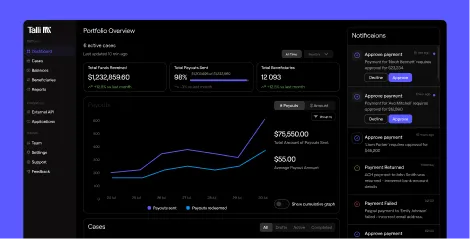
Claims teams can use Talli to upload approved claimant data, assign payment holds, collect required information, screen payments, offer multiple redemption methods, and monitor every distribution from one dashboard.
Dedicated settlement account structures support fund segregation and matter-level reporting. Built-in KYC, OFAC screening, W-9 collection, fraud mitigation, and audit logging help administrators apply approved controls consistently.
For settlements involving medical reimbursement claims, Talli can connect lien status with payment eligibility so that unresolved amounts remain protected while cleared awards move forward. Once counsel or the authorized decision-maker approves a release, the payment record and related authorization remain available for reporting.
The result is a controlled transition from lien resolution to claimant payment. Administrators retain visibility over fund flows, courts receive auditable distribution records, and claimants receive clear payment options without unnecessary paper-based delay.
Frequently Asked Questions
Can an ERISA Plan Take a Claimant’s Entire Settlement?
A plan may assert rights against identifiable settlement proceeds according to its governing terms, but the enforceable amount depends on the plan language, verified related benefits, settlement allocation, available funds, and applicable law. The claim should be reviewed before any deduction is finalized.
Does Every ERISA Settlement Require an Independent Fiduciary?
No. Independent fiduciary approval under PTE 2003-39 concerns certain settlements involving ERISA plans and parties in interest that rely on the exemption. It is not a universal requirement for health plan reimbursement claims or every settlement involving an ERISA participant.
Must a QSF Use an FBO Bank Account?
No. QSF status depends on satisfying Treasury regulation requirements, including governmental approval, continuing jurisdiction, qualifying claims, and asset segregation. An FBO account may support segregation and administration, but the account label alone does not determine QSF status.
Are ERISA Settlement Payments Subject to 20% Withholding?
Not automatically. The 20% rule generally applies to certain eligible rollover distributions paid from retirement plans. Other settlement payments may have different withholding and reporting rules based on the underlying claims and payment structure.
How Can Talli Support a Settlement With ERISA Claims?
Talli can connect approved lien holds and payment authorizations with digital distribution workflows. Claims teams can track claimant status, maintain segregated funds, conduct required screening, offer multiple payment methods, reconcile results, and produce court-ready audit records from one platform.