.svg)


.svg)
Settlement administrators face a continuing compliance risk when checks remain uncashed or digital payments are never completed. Unresolved settlement payments may require reissuance, redistribution, a court-approved alternative disposition, or reporting under state unclaimed property laws. The correct outcome depends on the settlement agreement, distribution plan, court order, account structure, claimant information, and applicable state law.
Digital disbursement does not eliminate these legal requirements. It can, however, reduce the number of outstanding payments by giving claimants more ways to receive funds, providing faster notifications, and helping administrators identify failed payments before a dormancy period expires.
Key Takeaways
- An unredeemed settlement payment does not automatically become state unclaimed property. The court order and settlement documents must be reviewed first.
- The holder is the entity legally obligated to the claimant and in possession or control of the property, not necessarily the claims administrator.
- Dormancy periods commonly range from three to five years, but the period depends on the state, property classification, and statutory trigger.
- Due diligence thresholds, notice windows, reporting dates, and delivery methods vary by jurisdiction.
- Digital payment options and automated reminders can reduce outstanding distributions, but unresolved funds still require legal review.
- Record-retention periods are not universally 15 years and must be determined under applicable state, court, tax, and contractual requirements.
- Voluntary disclosure programs may reduce penalties or interest, but terms differ by state.
- Administrators need documented ownership, payment, outreach, reconciliation, and disposition records for every unresolved item.
Understanding Unclaimed Settlement Funds
Unclaimed property generally consists of property held or owed for an owner who has not claimed it or indicated an interest within the period established by state law. In a settlement, that may include an uncashed check, a rejected electronic payment, a returned prepaid card, or another unpaid distribution.
The existence of an outstanding payment does not by itself determine its final treatment. Administrators must first examine the governing settlement documents. A distribution plan may require additional outreach, check reissuance, redistribution among participating claimants, a cy pres payment, reversion to the defendant, or another court-approved disposition.
Only after identifying the legal obligation should the administrator determine whether state unclaimed property law applies.
How Unresolved Payments Arise
Common causes include:
- Claimant addresses or contact information becoming outdated
- Mail being returned or checks being misplaced
- Incorrect bank account information
- Claimants overlooking payment notices
- Deceased claimants whose estates require additional documentation
- Identity or eligibility information that cannot be verified
- Claimants failing to select a payment method
- Payments expiring before redemption
- Fraud controls placing payments under review
A recipient-friendly payment flow can reduce avoidable failures by making payment selection and identity verification easier to complete. Administrators still need procedures for claimants who cannot or do not finish the process.
Why Outstanding Payments Create Risk
The face value of an unpaid distribution is only one component of the potential cost. Administrators may also incur expenses for returned-mail processing, address research, payment reissuance, claimant support, reconciliation, due diligence notices, state reporting, and audit response.
The larger risk is applying the wrong legal treatment. Reporting funds to a state when the court order requires redistribution can conflict with the distribution plan. Returning funds when they are legally reportable may expose the holder to interest, penalties, or an examination.
A written decision process should therefore connect each outstanding payment to the relevant settlement provision, holder determination, claimant address, property classification, dormancy rule, and final disposition.
How Escheatment Works
Escheatment is commonly used to describe the process through which abandoned property is transferred to a state. Most modern unclaimed property systems operate custodially, meaning the state holds the property for the owner rather than taking it for unrestricted ownership.
The Revised Uniform Act provides a model framework, but it is not a single nationwide rule. States decide whether to adopt it and frequently modify its provisions.
Priority Rules for Selecting the State
The Supreme Court’s priority rules generally give the first right to take custody of intangible property to the state of the owner’s last known address as shown in the holder’s books and records. When no qualifying address exists, the secondary rule generally points to the holder’s state of incorporation.
These rules make accurate claimant and holder records essential. Administrators should preserve the address used for the distribution, later address updates, returned-mail information, and evidence showing how the legally responsible holder was identified.
Determining the Holder
The holder is generally the person or entity legally obligated to the owner and possessing or controlling the property. In settlement administration, that entity may be:
- A qualified settlement fund
- A settlement trustee
- A defendant or settling party
- A law firm holding funds in trust
- A claims or settlement administrator
- Another entity designated by the settlement documents
A vendor that sends payment instructions or prints checks is not automatically the holder. Likewise, a bank or payment processor does not become responsible for the underlying settlement obligation solely because it processes a transaction.
The holder analysis should be documented before dormancy calculations or state filings begin.
Dormancy Periods and Property Classification
Dormancy is the period that must pass before property is presumed abandoned. Three- and five-year periods are common, but there is no universal dormancy period for settlement distributions.
The applicable period depends on:
- The state entitled to receive the property
- The statutory property category
- The nature of the underlying obligation
- The date from which dormancy begins
- Any owner-generated activity that resets dormancy
- State-specific exceptions or exemptions
Administrators should not automatically classify a settlement check as payroll, a vendor payment, a refund, or a bank account. Those categories may carry different dormancy periods and may not describe the underlying legal obligation accurately.
The NAUPA state directory provides links to state reporting authorities, but the controlling sources remain each state’s statutes, regulations, administrative guidance, and reporting instructions.
Events That May Affect Dormancy
Depending on the state and property type, relevant activity may include:
- Cashing or depositing a check
- Selecting or changing a payment method
- Confirming an address
- Logging into a claimant portal
- Responding to an email or text
- Contacting claimant support
- Providing requested tax or identity documentation
- Requesting reissuance
Not every interaction resets dormancy. The administrator should confirm whether the state recognizes the activity as an indication of owner interest and retain evidence of the interaction.
Due Diligence and State Reporting
Due diligence is the holder’s final effort to contact an apparent owner before reporting property. Requirements differ significantly among states.
Variations may include:
- Minimum dollar thresholds
- Notice windows measured before the report date
- Mailing or electronic-delivery requirements
- Certified-mail rules for higher-value property
- Required statutory wording
- Exempt property categories
- Rules for returned mail
- Requirements to retain proof of delivery
Administrators should not rely on a single national template without state-specific controls. A notice that satisfies one jurisdiction may be too early, too late, or incomplete in another.
Reporting and Remittance
After dormancy and due diligence requirements are satisfied, the holder generally files a report and remits the property to the appropriate state. Many jurisdictions use NAUPA-standard electronic formats, but portal procedures, negative-report requirements, payment methods, and deadlines still differ.
A defensible filing process should include:
- Confirming that the governing court documents permit or require escheatment
- Identifying the legally responsible holder
- Applying the Supreme Court priority rules
- Assigning the correct state property code
- Calculating dormancy under that state’s law
- Completing due diligence within the required window
- Validating claimant names, addresses, tax identifiers, and amounts
- Filing the report and remitting funds
- Reconciling the state submission to the settlement ledger
- Preserving confirmations and supporting records
A complete audit trail should connect every reported amount to the original claimant record and payment history.
Common Compliance Errors
Assuming Every Uncashed Check Must Escheat
The settlement agreement or court order may direct another disposition. Administrators should not report funds until that legal question is resolved.
Using the Wrong Holder
Assigning responsibility to the claims administrator merely because it manages the distribution can produce filings under the wrong legal entity.
Applying One Dormancy Period Nationwide
A nationwide claimant population may involve numerous states and multiple property classifications. A single three-year or five-year rule is not sufficient.
Treating Reissuance as New Property
Issuing a replacement check does not necessarily restart dormancy. The original obligation may remain the relevant property, subject to state-specific rules.
Losing Historical Address Data
The owner’s last known address helps determine which state has priority. Overwriting an old address without retaining the history can undermine the state assignment.
Using Unsupported Retention Periods
There is no universal 15-year rule. The retention schedule should account for state law, examination periods, court requirements, tax records, contracts, and litigation holds.
Preventing Unclaimed Settlement Payments
The strongest operational strategy is to resolve payment failures before dormancy becomes an issue. Prevention does not replace compliance, but it reduces the number of items that require state-by-state analysis.
Validate Claimant Information
Administrators can improve data quality by:
- Standardizing names and addresses
- Running address-change and deliverability checks
- Collecting email and mobile contact information
- Recording address sources and update dates
- Using additional research for high-value returned payments
- Preserving prior addresses for priority-rule analysis
Offer Multiple Payment Methods
A claimant who cannot deposit a paper check may be able to receive ACH, a prepaid card, PayPal, Venmo, or a gift card. Multiple payment options allow administrators to serve banked and unbanked populations without forcing every claimant through the same payment channel.
Paper checks may remain necessary as an accommodation or fallback, but digital-first selection can reduce mailing failures and shorten delivery time.
Use Timely Reminders
Automated email and SMS reminders can prompt claimants to select a payment method, correct failed banking information, complete identity verification, or redeem an available payment. Communications should clearly identify the settlement, explain required action, and provide a trusted support route.
Resolve Failed Payments Quickly
A failed ACH transfer or expired digital payment should enter a documented exception workflow. Failed-payment resolution should include claimant outreach, alternative payment selection, approval controls, reissuance records, and reconciliation.
Technology and Compliance Controls
Technology can improve visibility, but it should support rather than replace legal analysis. Administrators need systems that preserve claimant information, payment events, communications, approvals, and final disposition decisions.
Useful capabilities include:
- Real-time payment-status tracking
- Exception queues for returned or expired payments
- Automated claimant reminders
- Historical address preservation
- Role-based approval controls
- Reconciliation between approved awards and completed payments
- Exportable evidence for court and audit review
- Dormancy and due diligence alerts
- State-specific reporting data fields
Real-time tracking enables claims teams to identify unresolved payments while claimant information is still current. Automated reconciliation helps confirm which payments completed, failed, expired, or remain pending.
Specialized unclaimed property software or legal review may still be required to classify property, apply state rules, produce reports, and manage voluntary disclosure programs.
How Talli Reduces Outstanding Distributions
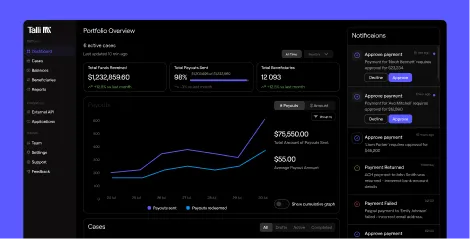
Talli is a digital disbursement platform built for legal settlement payments. It supports multiple payment methods, automated claimant communications, KYC, OFAC screening, W-9 collection, fraud controls, fund segregation, real-time tracking, and court-ready reporting.
These capabilities can reduce unresolved payments by helping administrators:
- Launch distributions while claimant data remains current
- Give claimants several redemption options
- Send automated reminders through email and SMS
- Identify payment failures in real time
- Offer an alternative method after a payment fails
- Reconcile payment activity against approved distribution records
- Preserve evidence of communications and payment events
- Produce transparent reporting for courts and stakeholders
Talli does not remove the need to analyze state unclaimed property laws or follow a court-approved distribution plan. Its value is earlier intervention and stronger documentation. By helping claims teams identify and resolve payment exceptions sooner, the platform can reduce the residual population that later requires dormancy calculations, due diligence, reporting, or another court-approved disposition.
For settlement administrators, that is the practical goal: deliver more funds to eligible claimants while maintaining control over every unresolved item.
Frequently Asked Questions
What Is the Difference Between Unclaimed and Escheated Funds?
Unclaimed property is an unresolved obligation that has reached or is approaching the applicable abandonment standard. Escheated property has been reported and transferred to a state under applicable law. Before transfer, administrators may still be responsible for outreach, reporting, reconciliation, and court approval.
Does Every Uncashed Settlement Check Go to a State?
No. The settlement agreement or court order may require reissuance, redistribution, cy pres, reversion, or another disposition. State unclaimed property reporting should occur only after the administrator confirms that escheatment applies to the specific funds.
Which State Receives an Unclaimed Payment?
The primary rule generally points to the state of the claimant’s last known address in the holder’s records. When no qualifying address exists, the secondary rule generally points to the holder’s state of incorporation, subject to applicable federal and state law.
How Long Should Distribution Records Be Retained?
There is no universal 15-year requirement. The retention period should reflect each applicable state’s rules, examination periods, the governing court order, tax requirements, contracts, and any litigation hold. Administrators should document the basis for their retention schedule.
Can Digital Payments Prevent Escheatment?
Digital payments cannot eliminate legal obligations, but they can reduce the number of unresolved distributions. Multiple payment methods, automated reminders, real-time tracking, and rapid exception handling help more claimants receive funds before dormancy and reporting requirements become relevant.