.svg)


.svg)
Qualified Settlement Funds provide a structured way to resolve claims, hold settlement proceeds, and distribute funds after defendants have transferred their settlement obligations. However, IRC §468B status does not eliminate administrative risk. Trustees and fund administrators must preserve the fund’s legal separation, maintain accurate records, address federal tax obligations, follow court-approved distribution procedures, and document how settlement money moves from the fund to eligible claimants.
Technology can support these responsibilities through taxpayer-information collection, sanctions controls, claimant verification, payment tracking, reconciliation, and court-ready reporting. It does not replace legal or tax analysis. Each settlement still requires procedures based on its governing order, allocation methodology, claimant population, payment characterization, and applicable federal and state requirements.
Key Takeaways
- A QSF must satisfy three federal requirements involving governmental approval, qualifying claims, and trust status or asset segregation.
- The fund must remain subject to the continuing jurisdiction of the approving governmental authority.
- A QSF is a separate taxable entity that generally pays tax on modified gross income at the maximum rate under IRC Section 1(e).
- Taxpayer-information reporting depends on the nature and amount of each payment, not simply on whether the payment comes from a QSF.
- For applicable payments made in 2026, the general reporting and backup withholding threshold under Sections 6041 and 6041A is $2,000.
- The backup withholding rate remains 24%, but withholding does not automatically apply to every claimant who lacks a W-9.
- OFAC controls should follow a documented, risk-based compliance process rather than an unsupported one-size-fits-all screening rule.
- Dedicated settlement accounts, controlled payment workflows, and complete audit trails can strengthen segregation and court reporting.
Understanding Qualified Settlement Funds
A Qualified Settlement Fund is a fund, account, or trust that satisfies the requirements in Treasury Regulation §1.468B-1. QSFs are often used in class actions, mass torts, environmental claims, employment disputes, and other matters involving multiple claimants or an extended allocation and distribution process.
A QSF can separate the defendant’s payment from the timetable for resolving individual claimant awards. Once the transfer is completed under an appropriate settlement structure, the fund administrator can evaluate claims, manage reserves, pay expenses authorized by the governing documents, and distribute awards according to the court-approved plan.
The Three Qualification Requirements
Under the QSF regulations, a fund must satisfy three core requirements.
First, it must be established pursuant to an order of, or approved by, the United States, a state, a territory, a possession, a political subdivision, or an agency or instrumentality of one of those authorities. A court order commonly satisfies this requirement. The fund must also remain subject to the continuing jurisdiction of the approving authority.
Second, the fund must be established to resolve or satisfy one or more contested or uncontested claims arising from an event or related series of events. At least one claim must assert liability under CERCLA or arise from a tort, breach of contract, or violation of law.
Third, the fund must be a trust under applicable state law, or its assets must be segregated from the assets of the transferor and related persons.
The regulation does not specifically require a particular bank-account label or FBO arrangement. A dedicated account structure can nevertheless provide strong operational evidence that settlement assets are being separately maintained and tracked.
Separate Taxable Entity Status
A QSF is generally treated as a separate U.S. person for federal income tax purposes. It must obtain an employer identification number, select an appropriate taxable year, maintain books and records, and file the required federal return.
The fund is generally taxed on modified gross income at the maximum rate specified under IRC Section 1(e). Modified gross income commonly includes interest, dividends, and investment gains, subject to the deductions and exclusions allowed by the regulations.
Settlement contributions are generally excluded from the QSF’s modified gross income. However, the tax treatment of the transferor’s contribution and the claimant’s eventual recovery depends on the underlying liability, settlement terms, and substantive tax rules. Trustees should avoid describing every contribution as automatically deductible or every distribution as taxable.
Trustee Responsibilities Throughout the QSF Lifecycle
Trustees and administrators must translate the court order and settlement agreement into operational controls. The exact responsibilities vary, but several tasks appear across most QSFs.
Establish the Fund Correctly
Before accepting or distributing funds, the administrator should:
- Obtain and retain the order establishing or approving the QSF.
- Confirm that the order provides continuing governmental jurisdiction.
- Obtain a separate EIN for the fund.
- Open appropriately titled settlement accounts.
- Document who may authorize transfers and distributions.
- Establish dual-control or approval procedures where appropriate.
- Create a chart of accounts for contributions, earnings, expenses, reserves, and claimant payments.
- Confirm that the distribution plan matches the settlement agreement and court order.
The administrator should also identify whether a relation-back election is appropriate when assets were transferred before final governmental approval. That decision requires qualified tax advice and compliance with the timing and filing requirements in the regulations.
Maintain Operational Separation
Fund assets should not be treated as the trustee’s operating capital or the transferor’s continuing property. Bank records, accounting systems, and payment instructions should clearly distinguish each settlement matter.
A dedicated account or settlement-level ledger should identify:
- Incoming contributions
- Interest and investment earnings
- Authorized administrative expenses
- Tax payments and reserves
- Claimant awards
- Returned or rejected payments
- Reissued distributions
- Remaining balances
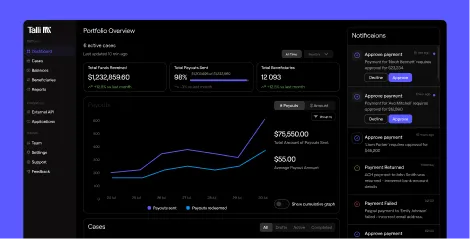
This structure supports reconciliation and helps demonstrate that the fund has not been commingled with unrelated assets. Talli’s settlement administration software is designed to provide matter-level tracking, controlled distribution workflows, and real-time payment visibility.
Tax Reporting And Backup Withholding
Tax reporting is one of the most fact-specific parts of QSF administration. The existence of a QSF does not determine whether every claimant receives a Form 1099.
Determine the Character of Each Payment
The appropriate information return depends on what the payment represents. Relevant categories may include:
- Compensation for services
- Attorney fees
- Gross proceeds paid to an attorney
- Interest
- Punitive damages
- Back pay or wages
- Non-wage employment damages
- Physical-injury damages
- Property-related recoveries
- Business-income replacements
Some payments may be reportable on Form 1099-MISC, Form 1099-NEC, Form W-2, or another return. Other payments may not require an information return. Trustees should obtain a written tax-reporting matrix from settlement tax counsel before configuring forms or withholding rules.
Apply the 2026 Threshold Carefully
The 2026 IRS instructions state that, for tax years beginning after 2025, the minimum threshold for certain information returns and related backup withholding increased from $600 to $2,000. Inflation adjustments begin after 2026.
This change does not mean that every federal reporting threshold became $2,000. Certain categories may remain subject to different thresholds or reporting rules. The administrator must apply the threshold associated with the specific payment and form.
Collect Taxpayer Information
When reporting is expected, the administrator should collect and validate the claimant’s legal name, address, taxpayer classification, and taxpayer identification number. Electronic W-9 workflows can reduce incomplete submissions and provide a record of certifications.
A missing W-9 does not automatically require withholding from every settlement payment. Backup withholding applies only when the payment is within a category covered by the backup withholding rules and the applicable conditions are satisfied.
When withholding applies, the federal rate remains 24%. The administrator may also need to deposit the withheld tax, report it on Form 945, and show the amount on the recipient’s information return.
Talli can support digital tax compliance through structured W-9 collection, payment records, and reporting data. Final form selection and tax treatment should remain under the direction of settlement tax counsel.
Sanctions Controls And Claimant Verification
Settlement distributions can involve sanctions, fraud, identity, and payment-rail risks. These controls should be distinguished from the statutory QSF qualification rules.
Use a Risk-Based OFAC Process
U.S. persons are prohibited from engaging in transactions barred by U.S. sanctions. OFAC’s compliance framework encourages organizations to build risk-based programs based on their size, products, counterparties, geography, and transaction activity.
A QSF sanctions procedure may include:
- Screening claimant and payee information
- Screening beneficial owners where relevant
- Checking applicable country restrictions
- Reviewing potential matches before payment
- Escalating unresolved matches to counsel
- Blocking or rejecting transactions when legally required
- Preserving search results and resolution notes
- Rescreening when information or sanctions lists change
OFAC does not establish a universal rule saying that every trustee must perform an identical timestamped screening process for every payment. Nevertheless, automated screening and documented match resolution can create stronger evidence that the administrator applied its compliance policy consistently.
Talli supports OFAC screening workflows that can be integrated with payment review and release controls.
Separate KYC From Eligibility Review
KYC is often used broadly to describe identity checks, but legal requirements differ across banks, card programs, wallet providers, and transaction types. A trustee should coordinate with its banking and payment partners to determine what information must be collected.
Claim eligibility verification is a separate function. It confirms that the person seeking payment is the claimant or authorized payee identified in the distribution records. Controls may include identity matching, knowledge-based checks, document review, device signals, duplicate detection, and manual escalation.
No automated fraud model should be described as infallible. Fraud controls identify risk signals and support human decision-making. Talli’s fraud prevention tools can help claims teams identify suspicious activity before funds are released.
Fund Security And Deposit Protection
Trustees should evaluate both the security of the technology platform and the legal structure of the bank accounts holding settlement funds.
Understand FDIC Coverage
Deposits at a Member FDIC bank may be insured, but coverage is not unlimited merely because the bank is FDIC insured. Coverage depends on the ownership category, account records, eligible beneficiaries, balances held at the same institution, and other FDIC rules.
For fiduciary or custodial accounts, trustees should confirm that deposit-account records identify the fiduciary relationship and support any claimed pass-through coverage. Large QSFs may require additional cash-management or deposit-allocation strategies.
Trustees can review FDIC payout considerations when evaluating account structures. Banking services associated with Talli are provided through Patriot Bank, N.A., Member FDIC. Deposit insurance remains subject to applicable FDIC requirements and limits.
Evaluate Security Evidence
SOC 2 Type II reporting can provide evidence about the design and operation of controls over security, availability, confidentiality, processing integrity, or privacy. It is not a government certification and is not legally mandatory for every QSF platform.
PCI DSS applies when payment-card data is stored, processed, or transmitted. The applicable requirements depend on the vendor’s role and card-data environment.
A trustee’s vendor due diligence should also examine:
- Access controls and multifactor authentication
- Encryption during transmission and storage
- Incident-response procedures
- Business continuity and disaster recovery
- Subprocessor oversight
- Penetration testing
- Audit-log retention
- Cyber-liability insurance
- Data deletion and return procedures
Digital Distribution And Reconciliation
Paper checks remain appropriate for some claimants, but they create address, delivery, stale-date, reissuance, and reconciliation work. Digital methods can reduce these problems when claimants receive clear instructions and retain a practical fallback option.
Talli supports multiple settlement payment methods, including ACH transfers, prepaid cards, PayPal, Venmo, gift cards, and paper checks where needed.
Actual redemption rates, payment speed, and cost savings vary by case. Results depend on claimant demographics, award size, communication frequency, data quality, payment choices, and court-approved procedures. Trustees should treat performance percentages as case-specific outcomes rather than guaranteed industry standards.
Build A Controlled Payment Workflow
A defensible distribution workflow should include:
- Importing the approved claimant and award file.
- Validating required claimant fields.
- Identifying tax-reporting and withholding requirements.
- Performing applicable sanctions and identity checks.
- Presenting approved payment choices.
- Obtaining payment authorization.
- Requiring appropriate release approval.
- Recording payment status and confirmation.
- Investigating failed or returned payments.
- Reconciling the payment file to bank and fund records.
Automated settlement reconciliation can reduce spreadsheet handling while preserving a transaction-level history.
Court Reporting And Unclaimed Funds
Courts may require periodic or final accountings showing contributions, expenses, taxes, distributions, unresolved payments, and remaining balances. Reports should be reconciled to both the QSF ledger and bank records.
A court-ready reporting package may include:
- Total approved awards
- Number and value of issued payments
- Completed distributions by payment method
- Returned, rejected, or expired payments
- Reissuance activity
- Tax withholding and deposits
- Administrative expenses
- Interest and investment earnings
- Remaining claimant reserves
- Proposed treatment of residual funds
Talli’s reporting and reconciliation capabilities can provide real-time payment status, fund-flow records, exception reporting, and exportable audit data.
Unclaimed funds must be handled according to the settlement agreement, court order, applicable state unclaimed-property law, and any approved cy pres or reversion provisions. Trustees should not assume a universal dormancy period or residual-fund outcome.
Why Talli Supports Defensible QSF Administration
QSF compliance depends on legal structure, tax analysis, controlled banking, accurate claimant data, and documented distribution procedures. No payment platform can create QSF status by itself. The platform can, however, make the approved structure easier to administer and audit.
Talli is purpose-built for legal settlement distributions. It provides dedicated settlement-level tracking, claimant payment selection, KYC and OFAC workflows, W-9 collection, fraud controls, automated communications, real-time payment status, and court-ready audit records.
Claims teams can use one environment to upload approved claimant data, configure distribution campaigns, track exceptions, and reconcile payments across multiple methods. Dedicated settlement accounts help maintain operational separation, while integration with regulated payment partners provides controlled payout rails.
For trustees, the central benefit is not a claim of automatic compliance. It is stronger execution of the procedures established by the court, settlement documents, tax advisers, financial institutions, and administrators. Talli helps convert those procedures into repeatable workflows without sacrificing visibility into fund balances or claimant outcomes.
Frequently Asked Questions
What Makes A Fund A Qualified Settlement Fund?
A fund must be established or approved by a qualifying governmental authority and remain subject to its continuing jurisdiction. It must resolve qualifying claims arising from an event, and it must be a state-law trust or maintain assets segregated from those of the transferor and related persons.
Does Every QSF Claimant Need A Form 1099?
No. Reporting depends on the nature of the payment, the recipient, and the applicable threshold. Trustees should obtain a tax-reporting matrix that identifies which distributions require Form 1099-MISC, Form 1099-NEC, Form W-2, another return, or no information return.
When Does Backup Withholding Apply In 2026?
The rate remains 24%. For applicable payments under Sections 6041 and 6041A, the general threshold is $2,000 in 2026. Withholding applies only when the payment is covered by the rules and the required taxpayer information or certification is missing or incorrect.
Does Using An FDIC-Insured Bank Protect The Entire QSF?
Not automatically. Coverage depends on account ownership, eligible beneficiaries, deposit records, balances held at the institution, and applicable limits. Trustees should confirm the specific insurance treatment with the bank and qualified counsel.
How Does Talli Help QSF Trustees?
Talli supports dedicated fund tracking, claimant communications, payment selection, sanctions and identity workflows, taxpayer-information collection, fraud review, reconciliation, and audit-ready reporting. These capabilities help trustees execute court-approved procedures while retaining visibility and control over every distribution.