.svg)


.svg)
State money transmitter laws can affect how settlement funds move from court-supervised accounts to claimants. A platform that receives, holds, controls, or transmits funds may fall within state money transmission laws unless its activities qualify for an exemption or are performed through an appropriately regulated structure.
The analysis is highly fact-specific. Regulators may consider who owns the funds, when the claimant obtains a legal right to payment, which entity controls payment instructions, how accounts are titled, and whether a licensed financial institution performs the regulated activity. For claims administrators using settlement disbursement platforms, these questions should be resolved before funds begin moving.
Key Takeaways
- Thirty-one states have enacted the Money Transmission Modernization Act in full or in part, but state licensing requirements remain distinct.
- A settlement administrator is not automatically a money transmitter merely because it coordinates payments.
- Licensing depends on the actual flow of funds, contractual responsibilities, account control, and applicable exemptions.
- Agent-of-payee exemptions are narrow, state-specific, and may not fit conventional settlement relationships.
- Federal MSB registration, AML, and SAR duties apply only when an entity falls within the relevant FinCEN definitions.
- OFAC compliance is required, but organizations generally design screening and controls using a risk-based approach.
- Bank-issued cards and licensed digital wallets do not automatically exempt every participant in the payment chain.
- FBO titling does not guarantee pass-through FDIC insurance without proper ownership records and disclosure.
Understanding Money Transmitter Licensing
Money transmission generally involves receiving money or monetary value for transmission to another person or location. State statutes may cover electronic transfers, stored value, payment instruments, virtual currency, and other methods of moving funds.
In a settlement distribution, potentially relevant activities include:
- Receiving settlement funds into an account controlled by the processor
- Holding funds while claimants complete verification
- Selecting or changing the destination of funds
- Initiating ACH, card, wallet, or check payments
- Issuing stored-value products
- Maintaining outstanding payment obligations to claimants
A vendor that only supplies software to a claims administrator may present a different licensing profile from a vendor that accepts custody of settlement funds. Similarly, a platform acting under the direction of a bank may be analyzed differently from one independently controlling the distribution.
The MTMA and State Harmonization
The Money Transmission Modernization Act establishes model standards for licensing, net worth, surety bonds, permissible investments, examinations, change-of-control filings, and reporting. As of 2026, 31 states have enacted the MTMA in full or in part.
The MTMA improves consistency but does not create a single national license. Each state retains authority over licensing, interpretation, examinations, enforcement, and exemptions. A company operating nationally must still assess every jurisdiction in which its activities may constitute money transmission.
Licensing costs also extend beyond filing fees. A nationwide program may require:
- Application and investigation fees
- Surety bonds based on transaction volume
- Minimum tangible net worth
- Audited financial statements
- Fingerprints and background checks
- Compliance personnel
- Cybersecurity and business continuity documentation
- Annual reports and license renewals
- State examinations
- Legal analysis of exemptions
The total cost can become substantial, but it should be calculated from the company’s operating model rather than expressed as a standard cost for each state.
State Definitions and Exemptions
State laws do not apply uniformly. One state may regulate receiving funds for transmission broadly, while another may exclude certain business-to-business arrangements, bank agents, payment processors, or agents of a payee.
California, for example, has an agent-of-payee exemption for qualifying transactions involving a preexisting written agreement and satisfaction of the payer’s obligation upon delivery to the agent. The exemption is tied to a statutory definition of a payee providing goods or services. That structure may not map cleanly onto a settlement in which the claimant is receiving compensation rather than payment for goods or services.
Other states recognize different versions of an agent-of-payee exemption, and some address the issue through guidance rather than clear statutory language. Contract language alone does not guarantee that an exemption applies.
Mapping the Settlement Fund Flow
A reliable licensing analysis begins with a detailed fund-flow map. Labels such as “processor,” “administrator,” or “technology provider” are less important than what each participant actually does.
The map should identify:
- The legal owner of the settlement funds
- The bank holding the funds
- The party authorized to instruct the bank
- The party that can redirect or stop payments
- The point at which the claimant’s payment right is satisfied
- The entity responsible for returned funds
- The entity maintaining outstanding payment obligations
- The contracts governing every stage
A claims administrator that maintains control over a QSF account while a vendor transmits technical instructions to a bank may present a different risk profile from a vendor that receives a lump sum and independently distributes it.
Using a purpose-built class action platform can improve documentation, but technology alone does not determine the licensing result. Counsel should evaluate the complete legal and operational arrangement.
Federal BSA and AML Requirements
State money transmitter licensing and federal MSB regulation overlap, but they are not identical. A business may qualify as a federal money transmitter even when a state exemption is available, or it may fall outside the federal definition based on the nature of its role.
A covered money transmitter generally must register with FinCEN unless an exception applies and maintain an AML program reasonably designed to prevent the business from being used for money laundering or terrorist financing.
A compliant program generally includes:
- Written policies and internal controls
- A designated compliance officer
- Risk-based customer and transaction controls
- Employee training
- Independent review
- Recordkeeping and reporting procedures
- Escalation processes for suspicious activity
Settlement administrators should not assume that every legal payout automatically creates MSB status. They should also avoid assuming that using a bank or payment provider eliminates all federal obligations. The allocation of responsibilities should be documented in contracts and operating procedures.
Suspicious Activity Reporting
FinCEN’s MSB reporting guidance requires covered money transmitters and certain other MSBs to file Suspicious Activity Reports when qualifying suspicious activity reaches the applicable $2,000 threshold.
The requirement applies to covered entities, not automatically to every claims administrator. When it does apply, suspicious indicators may include:
- Multiple claimant accounts using the same bank destination
- Repeated changes to payment credentials
- Identity information inconsistent with approved claim records
- Coordinated activity across devices or IP addresses
- Attempts to divide payments to avoid controls
- Payments involving high-risk jurisdictions
- Unusual third-party payment instructions
Platforms supporting fraud detection workflows can help identify patterns, but regulated entities must still establish escalation, investigation, documentation, and filing procedures.
OFAC Compliance for Settlement Payments
U.S. persons are prohibited from engaging in transactions that violate U.S. sanctions. Settlement payments are not exempt merely because they arise from a court order or approved distribution plan.
However, OFAC generally promotes a risk-based compliance approach rather than prescribing one identical screening process for every organization. Controls should reflect payment volume, recipient locations, cross-border exposure, payment methods, and the organization’s sanctions risk.
A defensible process may include:
- Screening claimants before payment
- Rescreening when sanctions lists change
- Screening relevant beneficial owners or representatives
- Reviewing potential matches before releasing funds
- Blocking or rejecting transactions when required
- Preserving the search data, list version, timestamp, and disposition
Automated OFAC screening controls can create consistent records, but legal personnel should review true or uncertain matches. A name match alone does not establish that a claimant is sanctioned.
KYC and Claimant Verification
KYC is often used broadly to describe identity verification, although the precise legal requirements depend on the regulated entities involved. A settlement program may need identity controls because of bank requirements, fraud risk, sanctions compliance, tax reporting, court orders, or the administrator’s own policies.
Verification can include:
- Matching names, addresses, and dates of birth
- Validating government identification
- Checking bank-account ownership
- Detecting duplicate or synthetic identities
- Reviewing device and network signals
- Confirming authority for estates, guardians, and business entities
The objective is not to impose unnecessary friction on every claimant. It is to apply controls proportionate to the value, fraud risk, payment method, and legal requirements of the distribution.
Talli’s built-in KYC, OFAC, fraud mitigation, and audit logging capabilities support this process while allowing claims teams to track outcomes from a centralized dashboard.
Qualified Settlement Funds and Fund Segregation
A QSF generally must be established or approved by a qualifying governmental authority, remain subject to that authority’s continuing jurisdiction, resolve qualifying claims, and exist as a trust under applicable law or hold assets segregated from those of the transferor and related persons.
Fund segregation is therefore important, but it should not be described as the only requirement preserving QSF status. Administrators must also comply with the governing order, tax filings, distribution plan, fiduciary duties, and applicable account controls.
Dedicated accounts can help:
- Prevent operational funds from mixing with settlement assets
- Support matter-level reconciliation
- Document transfers and distributions
- Simplify court reporting
- Preserve clear ownership records
- Restrict payment authority
Talli supports QSF distribution workflows through dedicated settlement structures, real-time reporting, and controlled payment processes. Banking services are provided by Patriot Bank, N.A., Member FDIC.
Court-Ready Audit Trails
Courts and trustees may require detailed proof of how settlement funds were handled. A complete disbursement audit trail should document:
- Approved claimant and award data
- Identity and compliance reviews
- Payment authorization
- Account funding
- Payment method selection
- Successful, failed, and returned payments
- Reissues and claimant communications
- Remaining balances
- Unclaimed property treatment
Audit records should show who performed each action, when it occurred, and whether data was later modified.
Digital Payment Methods and Licensing
Payment method selection affects operational risk but does not independently decide whether licensing is required.
ACH Transfers
ACH payments move through regulated banking networks and remain subject to bank requirements and Nacha rules. The relevant licensing question is whether the settlement platform receives or controls funds before the bank executes the transfer.
Prepaid Cards
A prepaid card issued by a bank may place card issuance within the bank’s regulated framework. However, the platform’s separate activities, including receiving funds, controlling distribution instructions, or maintaining obligations to claimants, must still be evaluated.
PayPal and Venmo
PayPal and Venmo maintain their own regulatory permissions for the services they provide. Their licenses do not automatically extend to a settlement administrator that independently receives or transmits funds.
Checks and Gift Cards
Checks are expressly included in some definitions of money transmitting, so paper delivery is not inherently outside money transmitter laws. Gift-card treatment depends on whether the product is closed-loop, open-loop, bank-issued, or subject to another statutory exclusion.
Talli supports multiple payment options, including ACH, prepaid cards, PayPal, Venmo, and gift cards, allowing administrators to provide flexibility without relying on one delivery method.
Unclaimed Funds and Escheatment
Money transmitter compliance does not replace unclaimed property compliance. Failed payments, unredeemed cards, stale checks, and unclaimed balances may become reportable property under state law.
Administrators should determine:
- Which entity is the legal holder
- The claimant’s last known address
- The applicable dormancy period
- Required due diligence notices
- Reporting and remittance deadlines
- Record-retention requirements
- Whether a court-approved redistribution is permitted
A documented escheatment process is especially important for multistate distributions because priority rules may determine which state receives abandoned property.
Digital delivery can improve redemption and reduce unresolved payments, but it does not eliminate escheatment obligations. Administrators must continue tracking any amount that remains payable to a claimant.
Tax Reporting and W-9 Collection
Not every settlement payment requires a W-9 or Form 1099. Tax treatment depends on the nature of the underlying claim, the type of damages, the recipient, attorney-fee arrangements, and other facts.
Before distribution, tax counsel or the responsible reporting party should determine:
- Whether the payment is taxable
- Which information return applies
- Which entity must file it
- Whether a taxpayer identification number is required
- Whether backup withholding applies
- Whether payments to counsel require separate reporting
- How non-U.S. recipients should be documented
Talli can support settlement tax workflows through digital W-9 collection, status tracking, reminders, and reporting data. These tools support compliance but do not replace the legal tax analysis for each settlement.
FDIC Insurance for Settlement Accounts
Deposits at an FDIC-insured bank are not automatically insured separately for every claimant simply because the account uses an FBO designation.
Under the FDIC pass-through rules, qualifying coverage generally depends on records that disclose the fiduciary relationship and identify each principal and ownership interest.
When the requirements are satisfied, a claimant’s ascertainable interest may receive insurance up to the applicable limit. Coverage is aggregated with the claimant’s other deposits at the same bank in the same ownership category.
Administrators should confirm:
- Account titling
- Beneficial ownership records
- Allocation of each claimant’s interest
- Reconciliation frequency
- Access to records if the bank fails
- Aggregation rules
- Treatment of funds before awards become fixed
“Member FDIC” accurately describes the bank, but it should not be used as an unconditional guarantee that every settlement balance receives separate coverage.
Simplifying Compliance With Talli
State money transmitter laws require more than identifying a payment method or signing an agent agreement. Settlement administrators need a documented legal structure connecting the court order, QSF, bank accounts, contractual roles, compliance responsibilities, and actual movement of funds.
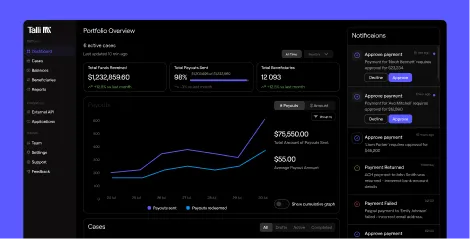
Talli provides purpose-built infrastructure for legal settlement disbursements with dedicated settlement accounts, multiple claimant payment options, built-in KYC and OFAC workflows, fraud controls, automated communications, real-time tracking, and court-ready audit logs.
The platform helps claims teams maintain visibility without relying on spreadsheets or disconnected payment providers. Administrators can track payment status, verification outcomes, failed transfers, claimant communications, and remaining balances from one environment.
Technology does not eliminate the need for state-by-state legal analysis. It does, however, make the approved compliance structure easier to operate consistently. With banking services provided by Patriot Bank, N.A., Member FDIC, Talli gives settlement teams regulated payment rails and documented controls designed for high-volume legal distributions.
Frequently Asked Questions
What Makes a Settlement Processor a Money Transmitter?
A processor may be treated as a money transmitter when it receives or controls funds for transmission to claimants. Regulators examine the actual fund flow, account ownership, payment authority, contracts, exemptions, and involvement of regulated financial institutions.
Does a Bank Partnership Eliminate Licensing Requirements?
Not automatically. A bank may perform regulated banking or payment activities, but the platform’s independent role must still be analyzed. The contracts and operating model should clearly identify which party holds funds, issues instructions, and remains obligated to claimants.
Can an Agent-of-Payee Exemption Cover Settlement Payments?
Possibly, but the exemption varies by state and may be limited to payments for goods or services. A settlement platform should not rely on the exemption without state-specific analysis of the claimant relationship, contract, and satisfaction of the underlying obligation.
Must Every Claimant Complete a W-9?
No. W-9 collection depends on whether the payment is reportable and which party has the reporting obligation. The settlement’s tax characterization should be determined before imposing taxpayer identification requirements or backup withholding.
Does an FBO Account Guarantee Separate FDIC Coverage?
No. Pass-through insurance depends on account disclosures, fiduciary records, identifiable beneficial interests, and FDIC ownership rules. A claimant’s coverage may also be combined with other deposits held at the same bank in the same ownership category.