.svg)


.svg)
Settlement administrators and claims processors face a complex compliance landscape where an estimated 65-90% of companies that should file unclaimed property returns fail to do so, creating significant financial and legal exposure. With distinct jurisdictional frameworks governing how unclaimed funds must be transferred to state governments, understanding escheatment obligations has become essential for anyone managing legal disbursements, class action settlements, or mass tort distributions.
Key Takeaways
- More than 50 U.S. state and territorial jurisdictions maintain their own unclaimed property rules, with varying dormancy periods, reporting deadlines, and due diligence requirements, creating a complex compliance matrix for multi-state holders
- Dormancy periods vary by both state and property type, with wages often becoming reportable after 1 year and many bank accounts, checks, and other financial assets using 3- or 5-year periods
- False Claims Act enforcement has intensified, with recent multi-million dollar settlements demonstrating substantial liability for reporting failures
- Reporting deadlines cluster in three primary windows: Fall (October-November for most states), Spring (March-April), and Summer (June-July for California's final filing, Michigan, and Texas)
- Manual escheatment management requires substantial staff time for dormancy tracking, due diligence, reporting, remittance, reconciliation, and audit documentation
- Digital disbursement platforms achieving 95-98% redemption rates versus 70-80% for traditional paper methods can substantially reduce the volume of payments that remain unredeemed and may eventually become subject to unclaimed property requirements
- Due diligence and reporting documentation should be retained for the period required by each applicable jurisdiction, because record-retention and examination rules vary by state
Understanding Escheatment: What is Unclaimed Property and Why Does it Matter?
Escheatment refers to the legally mandated process by which businesses must transfer unclaimed financial property to state governments after specified dormancy periods. The AFP defines escheatment as the reversion of property to the state when rightful owners cannot be located or fail to claim their assets within statutory timeframes.
Common Types of Unclaimed Property
Virtually any financial asset can become subject to escheatment when owners lose contact with holders:
- Uncashed checks: Settlement distributions, vendor payments, payroll, and dividend checks
- Bank accounts: Checking, savings, and certificates of deposit without owner activity
- Securities: Stocks, bonds, and mutual fund shares with returned mail or no transactions
- Insurance proceeds: Unclaimed life insurance benefits and policy refunds
- Gift cards: Store credits and prepaid cards in states without exemptions
- Digital assets: Cryptocurrency and virtual currency (increasingly regulated)
The Role of State Governments in Escheatment
States serve as custodians of unclaimed property, holding funds indefinitely while attempting to reunite assets with rightful owners. According to the National Association of Unclaimed Property Administrators, approximately 1 in 7 individuals have unclaimed property waiting to be claimed. This system protects property owners by preserving their right to reclaim assets at any time. There is no statute of limitations on most escheatment claims.
Dormancy Periods: How Long Until Property is Considered Unclaimed?
The dormancy period represents the length of time property must remain inactive before holders must report and remit it to the state. Understanding these timelines is critical for managing dormancy obligations across multi-state distributions.
Typical Dormancy Periods by Property Type
State-by-state research reveals significant variation in dormancy requirements:
General Property (Checks, Bank Accounts):
- 3-year dormancy: Used by many states including California, New York, and Illinois
- 5-year dormancy: Applied by states including Delaware, Florida, and Georgia
Specialized Property Categories:
- Wages and payroll: 1 year in most states, the shortest standard dormancy period
- Securities: 3-7 years depending on state, with recent Florida changes shifting from returned mail to inactivity standards
- Gift cards: 3-5 years where not exempt (19 states maintain no-escheat exemptions)
- Cryptocurrency: Typically 3 years in states with specific provisions (California effective 2026)
Factors Affecting Dormancy Calculation
The event that starts the dormancy period depends on the property type and applicable state law. It may be the owner's last indication of interest, the date a payment becomes payable, maturity, issuance, or another statutory trigger.
Activities that reset dormancy clocks include:
- Owner correspondence with the holder
- Account transactions (deposits, withdrawals, trades)
- Policy changes or beneficiary updates
- Documented owner authentication attempts
Over a 16-year period ending 2020, 17 jurisdictions reduced dormancy for banking properties from 5-7 years to 3 years, accelerating escheatment timelines by 40-60%.
Escheatment by State: A Comprehensive Guide to Laws and Regulations
All U.S. jurisdictions (50 states plus DC, Puerto Rico, Guam, and USVI) maintain independent unclaimed property statutes. While the Revised Uniform Unclaimed Property Act (RUUPA) of 2016 provides model legislation, adoption varies significantly.
Key Provisions of State Escheatment Laws
Every state's unclaimed property program addresses:
- Holder obligations: Who must report and what triggers reporting requirements
- Property definitions: Which asset types fall under escheatment rules
- Dormancy periods: How long before property becomes reportable
- Due diligence requirements: What contact attempts holders must make
- Reporting formats: NAUPA electronic filing standards and state-specific forms
- Penalties: Interest, fines, and enforcement mechanisms for non-compliance
Priority Rules for Multi-State Compliance
The landmark 1965 Supreme Court decision in Texas v. New Jersey established priority rules determining which state receives escheated property:
- First Priority Rule: Report to the state of the owner's last known address
- Second Priority Rule: If address is unknown, report to the state of holder incorporation
The 2023 Delaware v. Pennsylvania decision clarified that certain MoneyGram Agent Checks and Teller's Checks are governed by the federal Disposition of Abandoned Money Orders and Traveler's Checks Act, which can direct abandoned proceeds to the state where the instrument was purchased rather than the holder's state of incorporation.
Compliance and Reporting: Meeting Your Obligations for Unclaimed Property
Who is a Holder and What are Their Responsibilities?
Any business or organization possessing property belonging to another party is considered a "holder." Settlement administrators, claims processors, law firms managing IOLTA accounts, and corporate issuers all bear holder responsibilities.
Holder obligations include:
- Maintaining accurate records of property and owner contact information
- Conducting due diligence to locate owners before escheatment
- Filing annual reports in proper format by state deadlines
- Remitting property to appropriate state jurisdictions
- Retaining documentation for potential audit defense
Annual Reporting Cycle and Key Deadlines
State reporting deadlines fall into three primary windows:
Fall Reporting (October 31 - November 1):
- Majority of states including California (preliminary), Illinois, and most others
- Represents the busiest compliance period
Spring Reporting: Several jurisdictions use spring deadlines, but exact filing dates depend on the state, property type, and holder classification. For example, Delaware generally uses a March 1 deadline, Florida generally requires annual reports by April 30, and Illinois uses different May 1 or November 1 deadlines depending on the holder type.
Summer Reporting (June-July):
- California final remittance: June
- Michigan and Texas: July 1
Texas operates on a unique March-to-March reporting cycle rather than standard calendar or fiscal year-end periods.
Due Diligence Requirements
All states require holders to attempt owner contact before escheatment, but methodologies differ dramatically. The standard requirement involves first-class mail 60-120 days before reporting for property valued over $50-$100.
Enhanced Requirements in Specific States:
- New York: Two-tier system with first-class mail at 90 days, then certified mail with return receipt at 60 days for property over $1,000
- Washington: Reduced threshold from $75 to $50 effective January 2026
- Maryland: Email-first approach with 30-day mail backup for failures (effective October 2025)
- California: State-administered pre-escheat notice system under bifurcated reporting
The Cost of Unclaimed Funds: Why Reducing Escheatment is Crucial
Financial Impact of Escheated Property
The hidden costs of uncashed checks extend far beyond simple administrative burden. Organizations face:
- Compliance overhead: Manual escheatment management requires substantial staff time for dormancy tracking, due diligence, reporting, remittance, reconciliation, and audit documentation
- Interest penalties: California imposes 12% annual interest on late-reported property
- False Claims exposure: Treble damages (3× underreported amount) plus penalties
- Audit costs: States maintain varying lookback periods, requiring extensive historical documentation
Enforcement Has Intensified
Recent enforcement actions demonstrate the financial stakes. In 2024, California secured a $7.7 million settlement with a healthcare provider for failing to escheat patient overpayments. In New York, a gift card company settled for $4.4 million for its role in helping a retailer avoid escheatment. An earlier 2022 settlement involved H\&M paying $36 million in New York for gift card escheatment violations.
For settlement administrators, even unintentional reporting errors can trigger multi-million dollar liability under False Claims theories.
The Prevention Alternative
Digital disbursement platforms address the root cause rather than managing symptoms. Modern platforms achieve 95-98% redemption rates versus 70-80% for traditional paper methods, substantially reducing the volume of payments that remain unredeemed and may eventually become subject to unclaimed property requirements while improving settlement outcomes.
Reclaiming What's Yours: How to Search for and Claim Unclaimed Property
Initiating a Search for Unclaimed Property
Property owners can search for unclaimed assets through several channels:
- State unclaimed property websites: Each state maintains searchable databases
- NAUPA MissingMoney.com: National Association of Unclaimed Property Administrators' central search tool
- Federal databases: Separate systems for pension benefits, tax refunds, and federal agency holdings
The Claim Process: Required Documentation and Steps
Claiming escheated property typically requires:
- Locating property through state or national databases
- Completing state-specific claim forms
- Providing identity verification (government ID, Social Security documentation)
- Submitting proof of ownership (original account statements, check copies)
- Awaiting state review (processing times vary from weeks to months)
Heirs claiming property for deceased owners must provide additional documentation including death certificates and proof of legal inheritance rights.
State Spotlights: Specific Escheatment Laws in Key Jurisdictions
California's Unclaimed Property Program
California maintains one of the most complex escheatment frameworks:
- Two-part reporting: Preliminary report October/November, final remittance June
- State-administered notices: California sends pre-escheat notices directly to owners
- 3-year dormancy for most property types
- 12% annual interest on late-reported property
- Virtual currency provisions effective January 2026
Texas Escheatment Rules for Holders
Texas operates distinctly from other states:
- Unique reporting cycle: March 2 through March 1, with July 1 deadline
- Email-first due diligence requirements for consenting owners
- Specific rules for oil and gas royalties, common in the state
New York Escheatment Requirements
New York's enhanced compliance standards include:
- Early spring deadline: Generally earlier than most states for certain holder types
- Two-tier due diligence: First-class mail, then certified mail for property over $1,000
- NAUPA format mandatory effective July 2025
- 5-year dormancy for virtual currency (starting November 2022)
Delaware's Special Significance
As the incorporation state for a majority of Fortune 500 companies, Delaware receives substantial escheatment under the Second Priority Rule:
- Early spring deadline: Generally March 1
- Modified qui tam provisions (2024) allow State Escheator to convert whistleblower actions into administrative examinations
- 5-year dormancy for most property types
Preventing Escheatment: Strategies for Minimizing Unclaimed Property
Best Practices for Maintaining Accurate Records
Strong policies and consistent processes provide the best defense against unclaimed property risk:
- Centralize escheatment responsibility rather than spreading across treasury, AP, AR, and legal teams
- Update owner contact information at every interaction point
- Implement address verification before issuing payments
- Maintain records for the full period required by applicable state laws
Leveraging Digital Payments to Increase Redemption
The most effective escheatment prevention strategy eliminates paper checks entirely. Digital disbursement platforms dramatically reduce unclaimed property volumes through:
- ACH direct deposit: Electronic delivery with 1-2 day access
- Prepaid cards: Virtual delivery in 30 seconds, physical cards in 5-7 days
- Digital wallets: PayPal and Venmo integration for instant access
- Real-time tracking: Automated monitoring identifies issues before dormancy begins
Modern multi-channel payment distribution options serve diverse recipient populations, including the approximately 5.6 million U.S. households that were unbanked in the FDIC's 2023 survey, often underserved by traditional check-based systems.
Evaluating Your Escheat Risk
Organizations should assess their escheat risk scorecard across several dimensions:
- Volume of outstanding checks approaching dormancy thresholds
- Geographic distribution across high-enforcement states
- Current redemption rates versus industry benchmarks
- Documentation quality for potential audit defense
- Technology capabilities for tracking multi-state obligations
Streamlining Escheatment with Modern Solutions
Managing escheatment compliance across multiple jurisdictions presents significant operational challenges. Settlement administrators juggle varying dormancy periods, reporting deadlines, due diligence requirements, and documentation standards while facing increasing enforcement scrutiny.
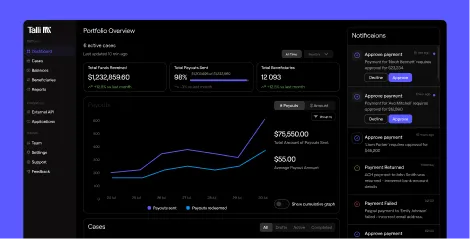
Talli's platform transforms this complex landscape through intelligent automation and digital-first disbursement. By achieving redemption rates of 95-98% compared to traditional paper check methods, Talli helps organizations substantially reduce the volume of funds that flow into state escheatment programs. This not only simplifies compliance overhead but also ensures more settlement participants receive their intended distributions.
The platform's built-in compliance tracking automatically monitors dormancy timelines across all 50+ state jurisdictions, triggering appropriate due diligence actions and generating required reporting documentation. Multi-channel payment options including ACH, prepaid cards, and digital wallets accommodate recipient preferences while maintaining full audit trails.
For settlement administrators managing class actions, mass torts, or other large-scale distributions, Talli provides a comprehensive solution that addresses both the prevention and management sides of escheatment, turning a compliance burden into a streamlined operational advantage.
Frequently Asked Questions
What is the Uniform Unclaimed Property Act and how does it affect state laws?
The Revised Uniform Unclaimed Property Act (RUUPA) of 2016 is model legislation developed by the Uniform Law Commission to standardize escheatment procedures across states. It provides recommended definitions, dormancy periods, holder protections, and procedures that states can adopt. However, adoption is voluntary. Each state modifies provisions according to local priorities. Some states have adopted RUUPA substantially, while others maintain significantly different frameworks, creating the patchwork of distinct regulatory systems that holders must track.
How does escheatment differ for securities versus cash property?
Securities follow different rules than cash in most jurisdictions. Dormancy periods typically range from 3-7 years, with many states using "returned mail" (RPO) standards rather than pure inactivity triggers. However, Florida recently shifted to inactivity standards, which industry experts have noted as potentially aggressive given that many investors adopt long-term strategies for retirement and educational accounts. When securities escheat, states generally liquidate holdings and hold cash proceeds, meaning owners reclaim dollar values rather than original shares, potentially missing market appreciation during the escheatment period.
Is there a federal database for all unclaimed money?
No single federal database covers all unclaimed property. State-level property is searchable through individual state websites or NAUPA's MissingMoney.com aggregator. However, federal unclaimed money requires separate searches through specific agencies: the IRS for tax refunds, the Pension Benefit Guaranty Corporation for pension benefits, the Treasury Department for savings bonds, and the FDIC for failed bank deposits. Each federal source maintains independent search systems with different claim procedures.
What happens to unclaimed settlement funds that cannot be distributed to class members?
Unclaimed settlement funds face two primary disposition paths. Escheatment transfers funds to state unclaimed property programs where original owners can still claim them. Alternatively, cy pres distribution directs remaining funds to charitable organizations related to the lawsuit's subject matter when court-approved. The choice between escheatment and cy pres depends on court preference, settlement agreement terms, and remaining fund amounts. Some jurisdictions prefer cy pres to avoid administrative burden, while others mandate escheatment to preserve owner reclamation rights.
How long do states hold escheated property before it becomes permanent state revenue?
Unlike many other legal timeframes, there is generally no statute of limitations on claiming escheated property. Owners or their heirs can reclaim assets indefinitely in most states. States serve as perpetual custodians, maintaining records and holding funds until rightful owners come forward. However, some states have attempted to impose time limits on certain property types, and these provisions face ongoing legal challenges. The permanent custodianship principle distinguishes escheatment from forfeiture, where property rights transfer permanently to the government.