.svg)


.svg)
Contingency fee arrangements promise attorneys payment only when they win, but the calculation isn't as straightforward as "percentage of settlement." One historical study of 12 antitrust coupon settlements found an average redemption rate of 26.3%, illustrating how large the gap between stated settlement value and actual claimant use can become. Modern digital disbursement platforms can improve claimant redemption and reduce the administrative burden associated with unresolved payments. In coupon settlements, higher redemption can also affect attorney fee calculations under CAFA §1712, while fee structures in cash settlements depend on the settlement terms, applicable law, and court approval.
Key Takeaways
- Contingency fees in financial recovery typically range from 15-50% depending on case complexity and debt age
- Class Action Fairness Act §1712 mandates attorney fees be calculated on redemption value for coupon settlements, not face value
- Some coupon settlements see redemption rates as low as 3%, creating 97% gaps between theoretical and actual recovery
- Settlement funds must be handled under segregation requirements that apply to the particular fund, fiduciary, administrator, or law firm
- Revenue recognition timing depends on the applicable fee agreement, governing law, and accounting requirements
- Digital payment platforms achieve 95-98% redemption rates versus 70-80% for traditional paper check methods
- Around 60% of fintechs paid estimated $250,000+ in compliance fines in 2023, highlighting the cost of inadequate fee accounting
Understanding Contingency Fees and Their Connection to Recovered Funds
What is a Contingency Fee?
A contingency fee arrangement means the attorney receives payment only upon successful recovery: "no win, no fee." The fee is calculated as a percentage of the recovered amount, aligning attorney and client interests toward maximizing actual distributions. Standard legal contingency fees range from 25-40% of recovery, with 33.3% being the most common benchmark in personal injury and class action cases.
The critical distinction for settlement administrators: contingency fees apply to recovered funds, not theoretical settlement amounts. This seemingly minor detail creates enormous practical implications when redemption rates fall short of 100%.
How Contingency Fees are Calculated
Contingency fee calculations depend on several factors that vary by case type and jurisdiction:
- Case complexity determines whether fees fall at the lower or higher end of ranges
- Litigation stage affects percentage: 33.3% if settled before filing, 40% after lawsuit commences
- Recovery amount can trigger sliding scales in some jurisdictions
- Redemption timing determines when revenue recognition occurs in certain settlement types
- Payment method influences how quickly claimants receive and claim funds
For commercial debt recovery, contingency fees range from 15-25% for fresh debt under 90 days to 30-50% for aged accounts exceeding two years. The inverse relationship between recovery probability and fee percentage reflects the risk allocation inherent in contingency arrangements.
The Importance of Fund Recovery for Lawyers
Attorneys working on contingency bear substantial upfront costs: staffing, discovery, expert witnesses, court fees, without guaranteed compensation. Their compensation depends on the applicable fee agreement and, in class actions, court approval of the fee award. Claimant redemption can materially affect the value ultimately delivered to the class and is specifically relevant to fee calculations involving coupon relief under CAFA §1712.
This creates a powerful incentive for attorneys to care deeply about disbursement mechanics. A $50 million settlement with low redemption generates limited distributed funds. The same settlement with high redemption generates substantially more funds reaching claimants. This difference, driven entirely by improved claims redemption rates, directly impacts the value delivered to class members and, in coupon settlements, the attorney fee calculation itself.
The Hidden Cost of Unclaimed Funds: Impact on Your Contingency Fee Payout
Why Traditional Methods Lead to Unclaimed Funds
Paper check distribution creates predictable failure points that suppress redemption rates:
- Address changes render checks undeliverable as claimants move and mail forwarding expires
- Lost or forgotten checks accumulate in desk drawers until stale-dating
- Banking access barriers prevent unbanked claimants from depositing checks
- Delayed processing means claimants forget about settlements before payments arrive
- Manual errors in check printing create reissuance cycles
Traditional paper methods achieve 70-80% redemption rates at best, meaning 20-30% of recovered funds never reach intended beneficiaries. For a $10 million settlement, that's $2-3 million in unclaimed funds, money that eventually escheats to state governments rather than compensating injured parties.
The Financial Burden of Low Redemption
Low redemption creates cascading costs beyond foregone value delivery:
Tracking costs for uncashed checks run approximately $150 per item as administrators attempt to locate claimants and encourage redemption. A settlement with 10,000 checks and 25% non-redemption generates $375,000 in tracking expenses alone.
Reissuance overhead compounds when checks expire or addresses update. Each reissued check incurs printing, postage, reconciliation, and administrative labor costs ranging from $7-20 per payment.
Escheatment compliance requires detailed reporting to multiple state jurisdictions, each with unique dormancy periods and filing requirements. The administrative burden of abandoned property compliance consumes resources that could otherwise support claimant outreach.
How Unclaimed Funds Reduce Your Effective Recovery
Consider the mathematics of a typical class action settlement. A $50 million settlement with 26% redemption distributes only $13 million to claimants. The same settlement with 95% redemption distributes $47.5 million, a difference of $34.5 million in funds reaching class members.
Attorney fee treatment depends on the settlement structure, applicable law, and court-approved fee methodology. For coupon settlements, CAFA §1712 specifically makes redemption value relevant to portions of attorney fees attributable to coupon relief. Beyond the direct fee calculation, courts evaluating fee applications increasingly scrutinize redemption rates when approving awards, recognizing that high redemption demonstrates actual value delivery to class members.
Firms focusing on disbursement mechanics deliver substantially better outcomes for their clients while strengthening their fee applications through demonstrated results.
Maximizing Redemption: The Key to Higher Contingency Fee Returns
Strategies for Improving Claimant Payouts
Redemption optimization requires systematic attention to claimant experience throughout the distribution lifecycle:
Multi-channel communication reaches claimants through their preferred methods: SMS, email, phone, and physical mail working in coordination rather than isolation. Claimant communication best practices emphasize frequency and channel diversity.
Payment method flexibility accommodates diverse claimant circumstances. The 5.9 million unbanked U.S. households cannot deposit traditional checks without costly check-cashing services. Prepaid cards, digital wallets, and gift cards provide alternatives that remove barriers to redemption.
Processing speed matters enormously. Claimants who receive payments within 24-48 hours while the settlement remains top-of-mind redeem at far higher rates than those waiting 6-8 weeks for paper checks.
Simplified claiming processes reduce friction. Every additional step, creating accounts, entering bank details, verifying identity, creates abandonment points. Streamlined flows maintain claimant momentum through completion.
The Role of Digital Solutions in Redemption
Digital disbursement platforms address traditional pain points systematically:
- Instant delivery via SMS or email eliminates mail delays and address dependency
- Payment choice lets claimants select preferred methods: ACH, prepaid cards, PayPal, Venmo, gift cards
- Mobile-first design accommodates how claimants actually access information
- Automated reminders re-engage claimants who haven't completed redemption
- Real-time status tracking reduces support inquiries while building trust
These capabilities push redemption rates from the 70-80% paper check baseline to 95-98% digital performance, a 25-40% improvement that flows directly to distributed funds and better outcomes for class members.
Linking High Redemption to Enhanced Attorney Fees
The Class Action Fairness Act §1712 explicitly ties attorney fees to redemption value in coupon settlements. Courts increasingly scrutinize redemption rates when approving fee awards, recognizing that attorneys demonstrating high redemption rates strengthen fee applications while delivering actual value to class members. Class action settlement disbursement systems that maximize redemption serve both ethical obligations and economic interests.
Beyond Checks: How Digital Payment Solutions Drive Contingency Fee Success
The Evolution from Paper to Digital Payouts
Settlement administration is undergoing fundamental transformation. Class action and government-enforcement settlements reached more than $42 billion in aggregate value in 2024 and more than $79 billion in 2025, underscoring the scale of settlement administration as legal teams increasingly adopt digital payment alternatives.
Modern multi-channel payout options include:
- ACH direct deposit at $0.25-$0.50 per transaction with 1-2 day delivery
- Prepaid Mastercard via virtual cards delivered in 30 seconds or physical cards within 5-7 days
- Digital wallets including PayPal and Venmo at $0.50-$1.00 per transaction
- Gift cards through Amazon and Target for small-value distributions
- Wire transfers for same-day high-value international payments
Each method serves specific claimant needs. Younger claimants prefer Venmo and PayPal. Unbanked populations rely on prepaid cards. Traditional clients may still want checks, maintained as fallback at $7-20 all-in costs.
Cost Savings Through Digital Disbursements
Digital disbursement reduces processing costs by 50-65% compared to paper checks. Paper check processing runs $7-20 per transaction with 6-8 week delivery times, while digital payments cost $0.25-$5 with 24-48 hour delivery. Redemption rates improve from 70-80% for paper to 95-98% for digital methods.
Tracking costs per uncashed check of approximately $150 become minimal with automated digital systems. Reissuance rates drop from 20-30% to under 5%. These savings compound across high-volume settlements. A 50,000-claimant distribution saving $10 per transaction generates $500,000 in direct cost reduction, before accounting for improved redemption's impact on value delivery.
Streamlining Legal Payouts for Better Outcomes
Modern platforms automate workflows that previously required extensive manual intervention:
Batch processing handles thousands of payments simultaneously, eliminating the bottlenecks of manual check runs. Platform APIs integrate with case management systems for seamless data flow.
Automated reconciliation matches payments to claimants in real-time, reducing month-end closing from days to hours. Three-way trust reconciliation ensures bank balance, book balance, and client ledgers align perfectly.
Exception handling routes failed payments for immediate review rather than discovery weeks later. Proactive notification enables rapid resolution before claimants disengage.
Compliance and Security: Ensuring Your Recovered Funds Are Protected
Trust Account Requirements and Fund Segregation
Settlement funds must be handled under the segregation requirements that apply to the particular fund, fiduciary, administrator, or law firm. Lawyers holding client or third-party funds generally must keep those funds separate from their own property, while Qualified Settlement Funds must satisfy the segregation requirements under IRC §468B and its regulations.
Proper fund segregation typically requires:
- Dedicated FBO (For Benefit Of) accounts for each settlement or matter
- FDIC-insured institutions holding all client funds
- Surety bonds often ranging from $5,000 to $100,000+ based on fund volumes
- Complete separation between settlement funds and operational capital
- Matter-level tracking enabling instant fund accounting
QSF compliance requirements under IRC Section 468B demand precise fund segregation to preserve tax treatment. Platforms lacking proper FBO architecture cannot support compliant settlement administration.
Revenue Recognition Timing
Contingency-fee recognition depends on when the fee becomes earned under the applicable agreement, governing law, and accounting requirements. When fees become earned, the earned portion transfers from the appropriate trust or settlement account in accordance with applicable professional-conduct and fund-management requirements. Claimant redemption does not universally determine when a contingency fee becomes earned.
For class action settlements, attorney fees remain subject to the applicable court-approved methodology. Coupon settlements require special treatment under CAFA §1712 because portions of attorney fees attributable to coupon relief may depend on the value of coupons actually redeemed.
Protecting Recovered Funds from Fraud
Settlement funds attract sophisticated fraud schemes. In 2023, more than 80 million class action and mass tort settlement claims were reported as exhibiting significant indicia of fraud, an increase of more than 19,000% from 2021. Protecting fund integrity requires multiple defensive layers:
- KYC verification confirms claimant identities against authoritative databases
- OFAC screening ensures compliance with U.S. Treasury sanctions lists
- Device fingerprinting identifies suspicious submission patterns
- Behavioral analytics flag anomalies indicating fraudulent activity
- Identity verification cross-references provided information with trusted sources
Modern fraud detection achieves high accuracy while identifying suspicious claims faster than manual review. OFAC screening for settlements provides documented compliance timestamps for audit purposes.
Real-Time Transparency: Monitoring Payouts and Performance for Your Firm
Gaining Visibility into Your Settlement Disbursements
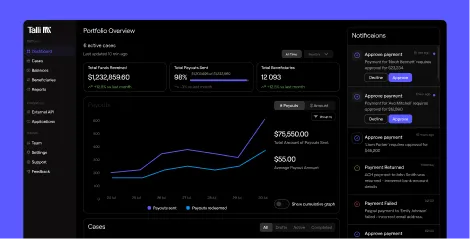
Legacy administration systems provide limited visibility, often requiring days of manual reconstruction to answer basic questions about payment status. Modern platforms deliver real-time payment tracking through comprehensive dashboards.
Essential visibility metrics include:
- Completion rates showing percentage of successful payouts
- Payment method distribution across ACH, cards, and wallets
- Geographic concentration identifying regional patterns
- Failure root cause analysis categorizing rejection reasons
- Fraud flags requiring human review
- Remaining fund balances for court reporting
This transparency transforms settlement administration from reactive problem-solving to proactive optimization. Administrators identify and address issues before they cascade into systemic failures.
Automated Reporting for Court and Client Confidence
Court-supervised settlements require detailed accounting demonstrating proper fund stewardship. Manual report preparation consumes substantial administrative resources while introducing error risk.
Automated reporting generates court-required documentation instantly:
- Distribution summaries showing amounts disbursed by payment method
- Completion statistics demonstrating redemption rates achieved
- Exception reports detailing undeliverable payments and resolution attempts
- Audit trails documenting every transaction from receipt through distribution
- Reconciliation statements proving fund integrity throughout lifecycle
Stakeholder portals provide controlled access for courts, trustees, and legal teams. CRM integration via webhooks syncs payment status updates automatically to case management systems. Comprehensive reporting and reconciliation capabilities eliminate manual data aggregation.
Three-Way Reconciliation Requirements
Payment processors typically perform monthly minimum (weekly preferred) three-way reconciliation matching bank balance in trust account, book balance per general ledger, and sum of individual client held balances. All three numbers must match. Discrepancies indicate either bank error, bookkeeping error, or the scenario regulators fear most: funds used for something other than intended purposes.
Platforms producing this reconciliation in seconds demonstrate operational maturity, while those requiring days of reconstruction face heightened regulatory scrutiny. The inability to produce instant reconciliation during state licensing audits or examinations can result in license suspension or consent orders, regardless of whether funds were actually misused.
Case Study: How Improved Redemption Directly Increased Firm Payouts
AB Data's Redemption Transformation
AB Data, one of America's leading claims administrators managing settlements worth hundreds of millions of dollars involving hundreds of thousands of claimants, demonstrates the concrete impact of redemption-focused disbursement.
The results after implementing digital disbursement infrastructure:
- 30% increase in claimant redemption rates across check-issued populations
- 60% reduction in unresolved exceptions and manual reissuance overhead within 12 months
- 100% fiduciary compliance record maintained across all distribution cycles and regulatory reviews
- Faster time to funds for claimants while lowering distribution and reissuance costs
Thomas R. Glenn, President & CEO of AB Data, summarized the transformation: "We don't think of digital disbursement as a feature, we think of it as infrastructure. Talli gave us the regulated payout rails we needed to move faster, reduce unclaimed funds, and give courts full confidence in how settlement money is being distributed."
Quantifying the Impact on Legal Firm Economics
The 30% redemption improvement translates directly to value delivered. Consider a $100 million settlement previously achieving 70% redemption. With a 30% relative improvement, redemption reaches approximately 91%. This means $91 million distributed to claimants versus $70 million, an additional $21 million reaching class members.
For coupon settlements where CAFA §1712 ties attorney fees to redemption value, this improvement directly impacts fee calculations. Beyond direct fee calculation, courts evaluating fee applications increasingly recognize high redemption as evidence of actual value delivery to the class. Explore customer case studies demonstrating these outcomes across various settlement types.
Why Talli Streamlines Contingency Fee Optimization
While numerous payment platforms exist, Talli delivers purpose-built solutions specifically designed for legal settlement disbursements where maximizing funds distributed to claimants matters most.
Talli's platform addresses the core challenge through:
Six payment method options meeting claimants where they are:
- ACH direct deposit at $0.25-$0.50 per transaction
- Prepaid Mastercard via Patriot Bank N.A. with instant virtual delivery
- Digital wallets including PayPal and Venmo
- Gift cards via InComm for small-value distributions
- Wire transfers for high-value international payments
- Paper checks maintained as fallback option
Integrated compliance infrastructure operating automatically:
- KYC verification cross-referencing authoritative identity databases
- OFAC screening with documented timestamps
- W-9 collection achieving 90% completion through smart reminders
- Automated 1099 generation with IRS e-filing integration
Real-time dashboard and analytics providing instant visibility into completion rates, payment method distribution, failure analysis, and remaining fund balances. Automated reporting generates court-required accounting without manual preparation.
Fund segregation architecture with dedicated FBO accounts preserving Qualified Settlement Fund tax treatment. Banking services through Patriot Bank, N.A., Member FDIC, ensure institutional-grade security with complete separation between settlement funds and operating capital.
For firms working on contingency, Talli's track record speaks directly to results: 95-98% redemption rates versus 70-80% for traditional methods, 50-65% cost reduction compared to paper checks, and settlement reconciliation compressed from weeks to hours. The AB Data case study demonstrates these capabilities at scale: a 30% increase in claimant redemption rates translating directly to increased value delivery to class members.
Frequently Asked Questions
How does redemption rate impact attorney compensation in class actions?
In coupon settlements, CAFA §1712 specifically requires attorney fees based on redemption value rather than face value. For cash settlements, fee structures depend on settlement terms, applicable law, and court approval using percentage-of-fund or lodestar methodologies. Courts increasingly scrutinize redemption when evaluating fee applications, recognizing high redemption as evidence of actual value delivery to class members.
What causes settlement funds to go unredeemed with traditional payment methods?
Paper check distribution fails for predictable reasons: address changes render checks undeliverable, claimants lose or forget checks before depositing, unbanked households lack access to check cashing without excessive fees, processing delays of 6-8 weeks allow claimants to disengage, and manual errors require costly reissuance cycles. Traditional methods achieve only 70-80% redemption, meaning 20-30% of funds never reach intended recipients.
How do digital platforms improve redemption rates?
Digital platforms address traditional failure points systematically: instant delivery via SMS or email eliminates mail delays, payment choice (ACH, prepaid cards, digital wallets) accommodates diverse claimant needs, mobile-first design matches how claimants access information, automated reminders re-engage inactive claimants, and real-time tracking reduces support inquiries. These capabilities push redemption rates from 70-80% to 95-98%, a 25-40% improvement.
What compliance requirements apply to settlement fund distribution?
Settlement funds must be handled under segregation requirements that apply to the particular fund, fiduciary, administrator, or law firm. Lawyers must keep client funds separate from their own property, while Qualified Settlement Funds must satisfy IRC §468B segregation requirements. Three-way reconciliation matching bank balance, book balance, and client ledgers must occur regularly. OFAC screening, KYC verification, and W-9 collection create additional requirements.
What cost difference exists between digital and paper check disbursements?
Digital disbursements cost $0.25-$5 per transaction versus $7-20 all-in for paper checks, representing 50-65% cost reduction. ACH transfers run $0.25-$0.50, prepaid cards and digital wallets cost $0.50-$1.00, while paper checks require $7-20 including printing, postage, reconciliation, and reissuance. Beyond per-transaction costs, digital methods eliminate tracking costs of approximately $150 per uncashed check and reduce reissuance rates from 20-30% to under 5%.