.svg)


.svg)
States now hold $70 billion in unclaimed property, a 250% increase from $20 billion in 2002 while only returning $4.49 billion annually to rightful owners. For shareholder services teams managing legal settlement disbursements, dormancy obligations have become a compliance minefield where death triggers, shortened dormancy periods, and aggressive state enforcement create unprecedented risk. Modern digital disbursement platforms can achieve 95-98% redemption rates compared to 70-80% for traditional paper methods, transforming escheatment exposure from an inevitable cost center into a manageable compliance challenge.
Key Takeaways
- States hold $70 billion in unclaimed property with only $4.49 billion returned annually to owners
- 17 jurisdictions shortened dormancy periods for banking properties between 2004 and 2020, while some states have adopted death-trigger rules that can accelerate escheatment timelines for certain assets
- Delaware can impose 0.5% monthly interest capped at 50%, late-report and late-payment penalties, and a 75% penalty when a deficiency is attributable to fraud
- SEC fined DST Asset Manager Solutions, Inc. $500,000 for violating Rule 17Ad-17 lost securityholder search requirements
- California charges 12% annual interest on late or unreported unclaimed property
- The proposed SAFER Act 2026 would require a 5-year minimum no-contact period before escheatment of investment accounts
Understanding Escheatment: The Basics of Unclaimed Property
What is Escheatment?
Escheatment is the legal process by which unclaimed or abandoned property transfers to state custody when owners cannot be located after a specified dormancy period. The term derives from feudal law, where property reverted to the lord when a tenant died without heirs. Today, escheatment functions as a consumer protection mechanism theoretically holding assets in trust until rightful owners claim them.
For shareholder services teams, escheatment applies to:
- Uncashed dividend checks after dormancy periods expire
- Abandoned securities in accounts with no owner contact
- Returned mail accounts where statements cannot be delivered
- Deceased shareholder holdings without beneficiary claims
- Unclaimed settlement payments in class action distributions
The Escheatment Process Explained
The escheatment lifecycle follows a structured sequence that shareholder services teams must manage meticulously:
1. Dormancy Period Begins: The clock starts when the last owner-initiated contact occurs. Typical dormancy periods range from 3-5 years for most accounts, though securities may have different thresholds.
2. Due Diligence Required: Before reporting property as unclaimed, holders must attempt to contact owners through mail, email, or other documented methods. SEC Rule 17Ad-17 mandates specific search procedures for securities.
3. State Reporting: Annual unclaimed property reports must be filed with appropriate state treasuries, typically by October or November deadlines though New York requires March 10 filing.
4. Property Transfer: After reporting, assets transfer to state custody. For securities, states typically liquidate holdings after a holding period, meaning owners only recover liquidation value not current market value.
Key Legal Definitions
Understanding critical terminology helps shareholder services teams manage compliance:
- Holder: The entity in possession of unclaimed property (your organization)
- Owner: The person or entity entitled to the property
- Dormancy Period: Time of inactivity before property becomes reportable
- Due Diligence: Required efforts to locate owners before escheatment
- Abandoned Property: Assets presumed abandoned after dormancy expiration
State Escheatment Laws: A Shareholder Services Guide
Key States and Their Unique Rules
State escheatment laws vary dramatically, creating a compliance patchwork that requires jurisdiction-by-jurisdiction expertise. The top 4 states hold $34 billion in unclaimed property, making their rules particularly consequential.
Delaware: As the state of incorporation for most public companies, Delaware receives property when owner addresses are unknown. The state operates aggressive VDA invitation programs with 90-day response deadlines. Failure to respond triggers automatic full examination with mandatory interest and penalties.
California: The state charges 12% annual interest on late or unreported property making timely compliance financially critical. California's Voluntary Compliance Program (VCP) waives interest for participants but requires exhaustive historical reviews.
New York: Maintains earlier reporting deadlines than most states and actively enforces through False Claims Act litigation, including a recent $4.4 million settlement with a gift card company.
Florida, Nevada, Oregon: Florida has adopted broad death-trigger rules that can accelerate dormancy for covered property, while Nevada, New York, and Oregon recognize death as a dormancy trigger in certain situations.
Dormancy Periods for Different Asset Types
Asset classification determines applicable dormancy periods:
- Dividends/distributions: 3-5 years from date of issuance
- Securities: 3-5 years from last owner contact
- Checks/drafts: 3-5 years from date of issuance
- IRAs: 3 years after required distribution date
- Death-triggered assets: 2 years in applicable states
Avoiding Penalties and Fines
Non-compliance penalties can devastate operating budgets. Delaware can impose 0.5% monthly interest capped at 50%, late-report and late-payment penalties, and a 75% penalty when a deficiency is attributable to fraud. California's 12% annual interest compounds quickly on large portfolios. The SEC fined DST Asset Manager Solutions, Inc. $500,000 for Rule 17Ad-17 violations, demonstrating federal enforcement risk.
Proactive compliance through audit-ready documentation remains the most cost-effective strategy.
The Impact of Unclaimed Funds on Shareholder Distributions
Common Reasons for Unclaimed Shareholder Assets
Settlement distributions and shareholder payments become unclaimed through predictable patterns:
- Address changes: Shareholders move without updating records
- Returned mail: Statements and checks bounced back as undeliverable
- Death without probate: Beneficiaries unaware of holdings
- Small balances: Owners don't prioritize claiming minimal amounts
- Lost records: Shareholders forget about holdings after years of inactivity
Financial Implications for Corporations
Unclaimed property creates cascading costs beyond the assets themselves:
Administrative Burden: Managing dormancy tracking, due diligence campaigns, and multi-state reporting requires dedicated staff or outsourced services. Companies designed for one audit every 5-7 years now face continuous state reviews.
Audit Exposure: State auditors review 10-20 year lookback periods, but most retention policies span only 7 years. Documentation gaps lead to estimated assessments with penalties.
Dual Litigation Risk: Fighting the state to keep shares from being escheated is often preferable to facing angry shareholders who may sue for shares plus appreciation if holdings are prematurely escheated.
Optimizing Unclaimed Funds Search: Tools and Best Practices
Official Government Resources for Unclaimed Funds
Before assets escheat, shareholder services teams should leverage official databases:
- NAUPA.org: National Association of Unclaimed Property Administrators maintains state-by-state search links
- MissingMoney.com: Free multi-state search database
- State Treasury Websites: Individual state portals for jurisdiction-specific searches
- Social Security Death Master File: Essential for death-trigger compliance
Tips for Conducting an Effective Search
SEC Rule 17Ad-17 mandates specific search procedures. The DST Asset Manager Solutions penalty resulted from using extra name-based filters after an SSN/TIN search produced possible better addresses, instead of contacting securityholders based on the TIN search result unless a TIN search was not reasonably likely to locate them.
Effective search protocols include:
- TIN-first methodology: Search by taxpayer identification number before name matching
- Multiple database queries: Cross-reference commercial databases with government records
- Documented timestamps: Maintain audit trails of all search attempts
- Regular cadence: Conduct searches 3-12 months after accounts become "lost," then again 6-12 months later
Managing Escheated Checks and Digital Disbursements
The Lifecycle of an Escheated Check
Paper checks follow a predictable path to escheatment:
- Issuance: Check mailed to shareholder address on file
- Non-negotiation: Check remains uncashed past 90-180 days
- Stale-dating: Check becomes void after 6-12 months
- Due diligence: Holder attempts to contact payee
- Reporting: Unclaimed amount reported to state
- Escheatment: Funds transfer to state custody
Each escheated check carries costs of $7-12 per check for processing, printing, postage, reconciliation, and potential reissuance plus estimated tracking costs of $150 per uncashed check.
From Paper to Digital: Reducing Uncashed Payments
Digital disbursement methods dramatically reduce escheatment exposure by achieving higher redemption rates:
- ACH direct deposit: 1-2 day delivery for banked claimants at estimated $0.25-$0.50 per transaction
- Prepaid cards: Virtual delivery via SMS/email in 30 seconds, serving 5.9 million unbanked U.S. households
- Digital wallets: PayPal and Venmo integration with instant access
- Gift cards: Strong redemption rates for small-value distributions under $100
The cost differential is substantial: digital payments cost as little as $0.25 per transaction versus $7-12 for paper checks, significantly reducing overall disbursement expenses across large distributions.
Shareholder Services Excellence: Proactive Dormancy Management
Best Practices for Preventing Account Dormancy
Proactive engagement prevents accounts from entering dormancy status:
- Multi-channel communication: Combine mail, email, SMS, and app notifications
- Proxy voting reminders: Voting demonstrates activity and resets dormancy clocks
- Electronic statement enrollment: Digital delivery reduces returned mail issues
- Address verification campaigns: Regular outreach to confirm current contact information
- Portfolio review prompts: Encourage logins and account activity
Effective Shareholder Communication Strategies
Industry experts recommend documenting diverse contact methods as evidence of owner awareness. Communication strategies should include:
Pre-dormancy outreach: Contact shareholders before dormancy triggers, explaining escheatment risks and requesting updated information.
Multiple contact attempts: Document each attempt with timestamps, methods used, and responses received.
Clear escalation protocols: Define when accounts require enhanced outreach versus standard communication.
Re-engagement campaigns: Target inactive accounts with compelling reasons to respond to portfolio value updates, dividend announcements, or voting opportunities.
Compliance Automation for Legal Settlement Payouts
Ensuring QSF Compliance for Settlements
Qualified Settlement Funds (QSFs) under IRC Section 468B require strict fund segregation that becomes complicated when escheatment obligations arise. Proper compliance infrastructure includes:
- Dedicated FBO accounts: For Benefit Of structures maintain separation between settlement funds and operating capital
- Matter-level tracking: Individual fund accounting for each settlement
- Audit-ready documentation: Proving fund separation throughout disbursement lifecycle
- FDIC-compliant structures: Institutional-grade security through banking partnerships
Automating Regulatory Checks (OFAC, KYC)
Manual compliance checking cannot scale with high-volume distributions. Automated systems handle:
- KYC verification: Cross-referencing provided information against identity databases
- OFAC screening: Automated compliance checking against U.S. Treasury sanctions lists with documented timestamps
- W-9 collection: Digital forms with smart reminders achieving 90% completion versus 40% without automation
- 1099 generation: Automated IRS e-filing integration with 24% backup withholding calculations for missing TINs
Integrated Tax Reporting for Claimants
Tax compliance automation reduces both administrative burden and escheatment risk by ensuring claimants receive proper documentation, encouraging engagement that resets dormancy clocks.
The Death Trigger Challenge: 2026's Defining Compliance Issue
Why Death as Dormancy Trigger Changes Everything
States are expanding escheatment risk by treating death as a dormancy trigger for more categories of property, not just traditional life insurance and retirement assets. Florida has adopted broad death-trigger rules that can accelerate dormancy for covered property, while Nevada, New York, and Oregon recognize death as a dormancy trigger in certain situations.
This creates operational challenges:
- No clear monitoring mandate: Laws don't expressly require death searches, but state auditors use Death Master File to identify deceased account holders
- Ambiguous "learning" standard: What constitutes learning of a death? Passive receipt of information? Proactive database searches?
- Complex compliance landscape: Companies that proactively search may face different liability exposure than those who don't
Federal Intervention: The SAFER Act 2026
The proposed SAFER Act (H.R. 8338) would override state escheatment laws for securities. Key provisions include:
- Death verification requirement: States cannot escheat individual investment accounts unless death is confirmed via database search
- 5-year minimum no-contact period: After death confirmation, 5 additional years must pass
- Age threshold: Mandatory death searches only for account holders age 73 or older
- Entity account protection: 5 years of no contact required before escheatment
If passed, this federal preemption would fundamentally restructure shareholder services compliance requirements.
Why Talli Reduces Escheatment Risk
Managing dormancy obligations across 50+ jurisdictions challenges even experienced compliance teams. Talli's digital disbursement platform addresses the core problem by dramatically reducing unclaimed funds that trigger escheatment obligations.
95-98% Redemption Rates: Digital-first payment methods eliminate the 20-30% unclaimed rate typical of paper check distributions. Fewer unclaimed payments mean fewer escheatment events, reduced state reporting burden, and lower compliance costs.
Multi-Channel Payment Options: Six payment methods ACH, prepaid Mastercard, digital wallets (PayPal, Venmo), gift cards, wire transfers, and paper checks as fallback ensure claimants can receive funds through their preferred channel.
Built-In Compliance Automation: Integrated KYC verification, OFAC sanctions screening, automated W-9 collection achieving 90% completion rates, and 1099 generation reduce the administrative burden that compounds escheatment risk.
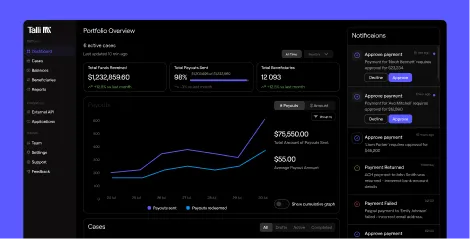
Real-Time Tracking Dashboard: Live visibility into payment status, completion rates, and failure root cause analysis enables proactive intervention before payments become unclaimed. Systems identify issues in real-time rather than discovering them during state audits.
QSF-Compliant Fund Segregation: Dedicated FBO account structures preserve Qualified Settlement Fund tax treatment while maintaining audit-ready documentation proving fund separation throughout the disbursement lifecycle.
For class action settlements and high-volume distributions, Talli transforms escheatment from an inevitable compliance burden into a manageable operational metric.
Frequently Asked Questions
What is the typical dormancy period before securities escheat to states?
Typical dormancy periods for securities range from 3-5 years of no owner-initiated contact, though this varies by state. However, Florida has adopted broad death-trigger rules that can accelerate dormancy for covered property, while Nevada, New York, and Oregon recognize death as a dormancy trigger in certain situations, potentially requiring escheatment just 2 years after learning of a shareholder's death. SEC Rule 17Ad-17 also imposes separate obligations requiring transfer agents to search for lost securityholders regardless of state dormancy periods.
How can shareholder services teams proactively prevent accounts from becoming dormant?
Effective dormancy prevention requires multi-channel engagement strategies including documenting diverse contact methods such as mobile app login activity, text message campaigns, email alerts, proxy voting reminders, and online account balance checks. Each documented owner-initiated contact resets dormancy clocks. Digital disbursement platforms achieving 95-98% redemption rates also reduce the volume of unclaimed payments that trigger dormancy tracking obligations.
What penalties do states impose for escheatment non-compliance?
Penalties vary significantly by state. Delaware can impose 0.5% monthly interest capped at 50%, late-report and late-payment penalties, and a 75% penalty when a deficiency is attributable to fraud. California charges 12% annual interest on late or unreported property. At the federal level, the SEC fined DST Asset Manager Solutions, Inc. $500,000 for violating Rule 17Ad-17's lost securityholder search requirements.
Can digital payment methods truly reduce escheatment risk?
Yes. Digital disbursement methods achieve 95-98% redemption rates compared to 70-80% for traditional paper checks. This improvement directly translates to fewer unclaimed payments requiring state reporting and escheatment. The cost reduction is also substantial: digital payments cost as little as $0.25 per transaction versus $7-12 for paper checks, plus eliminated tracking costs. For high-volume distributions, this difference materially impacts both compliance burden and operating costs.
What is the SAFER Act and how would it affect escheatment obligations?
The SAFER Act 2026 (H.R. 8338) is proposed federal legislation that would establish federal preemption over state escheatment laws for securities and investment accounts. Key provisions include requiring death verification before individual accounts can escheat, establishing a 5-year minimum no-contact period after death confirmation, and mandating death database searches only for account holders age 73 or older. If passed, this would significantly reduce state-level compliance complexity while providing greater protection for long-term investors.