After months or years of litigation, clients expect their settlement funds quickly, but attorneys face strict ethical rules governing when and how they can disburse those funds. Rule 1.15 of the Model Rules of Professional Conduct creates binding obligations that, when violated, lead to serious disciplinary consequences including suspension and disbarment. Trust accounting violations can lead to serious attorney discipline, making compliance both an ethical imperative and a business necessity. Modern digital disbursement platforms can transform week-long settlement processes into faster payment cycles while maintaining full regulatory compliance.
Key Takeaways
- California's post-Girardi reforms require client notification within 14 days of receiving settlement funds, with a rebuttable presumption of misconduct if undisputed funds remain undistributed more than 45 days after the client's interest becomes undisputed
- New York's CPLR 5003-a generally requires private defendants to pay within 21 days and qualifying municipal defendants within 90 days after receiving the required settlement documents, governing defendant payments rather than attorneys' subsequent disbursements to clients
- Settlement checks must be verified as collected funds before disbursement, subject to applicable trust accounting rules, with clearing times varying by bank and deposit circumstances
- Medicare, Medicaid, and other medical reimbursement claims can significantly delay settlement payments, with resolution timelines varying by case complexity, documentation, and applicable recovery procedures
- Trust account violations carry severe consequences, with disbarment as the presumptive sanction for intentional misappropriation in many jurisdictions
- Monthly three-way reconciliation comparing bank statements, trust ledgers, and client ledgers is required in most jurisdictions before disbursement
- Digital payment platforms can reduce administrative and delivery delays once settlement funds are collected, approved, and legally available for distribution
Understanding the Foundation: IOLTA and Client Trust Account Rules
The ethical framework for managing client settlement funds centers on Rule 1.15 of the Model Rules of Professional Conduct, which requires attorneys to hold client property separate from their own assets. This rule forms the foundation for IOLTA accounts (Interest on Lawyers' Trust Accounts) and creates specific obligations for how law firms handle, hold, and disburse settlement proceeds.
What is an IOLTA Account and Why is it Mandatory?
IOLTA accounts serve as pooled trust accounts where attorneys deposit client funds that are nominal in amount or held for short durations. The interest earned on these accounts funds civil legal aid programs for indigent clients rather than benefiting individual claimants, a key distinction that differentiates IOLTA from individual client trust accounts.
According to the San Francisco Bar Association, Rule 1.15 mandates that flat fee advances must be placed in trust accounts by default. An advance can only go into an operating account if the lawyer provides written disclosure giving the client the right to have funds held in trust until earned.
Key IOLTA requirements include:
- Immediate deposit: Settlement funds must go into trust accounts promptly upon receipt
- Fund segregation: Client funds cannot commingle with attorney operating funds
- Complete records: Detailed ledgers tracking every deposit, withdrawal, and balance
- Regular reconciliation: Monthly three-way matching of bank statements, trust ledgers, and client balances
Key Provisions of Rule 1.15 Regarding Client Funds
Rule 1.15 establishes several non-negotiable requirements:
- Prompt notification: Attorneys must inform clients when funds are received
- Prompt delivery: Funds to which clients are entitled must be disbursed without unreasonable delay
- Accounting on request: Clients have the right to a full accounting of their funds at any time
- Proper safekeeping: Funds must remain in approved financial institutions
The California State Bar provides additional guidelines including requirements for designated licensees and enhanced reporting following the Girardi scandal reforms.
State-Specific Variations in IOLTA Requirements
While the Model Rules provide baseline standards, states implement significant variations:
- California: Requires IOLTA accounts at approved financial institutions with specific reporting requirements
- Illinois: Requires three-way reconciliation quarterly and 7-year record retention
- Texas: Requires 5-year record retention with specific unclaimed property procedures after 3 years
- Washington: Imposes next-business-day deposit requirements
- North Carolina: Requires attorneys to investigate reliability of payment intermediaries
For law firms managing complex settlements, Talli's dedicated FBO (For Benefit Of) account structures preserve Qualified Settlement Fund tax treatment under IRC Section 468B while maintaining complete separation between settlement funds and operating capital.
The Timelines: When Can a Client Expect Their Settlement Check?
Settlement payment timelines vary dramatically based on jurisdiction, case complexity, and the payment methods used. Understanding these timelines helps both attorneys manage client expectations and identify opportunities for acceleration.
Defining 'Prompt' Disbursement Under Ethical Rules
The term "prompt" in Rule 1.15 lacks a universal definition, leading states to establish specific deadlines:
California requires notification within 14 days of receipt, with a rebuttable presumption of misconduct if undisputed funds remain undistributed more than 45 days after the client's interest becomes undisputed, per California Rule 1.15(d). These reforms following the Tom Girardi scandal set the strictest national standards.
New York through CPLR 5003-a generally requires private defendants to pay within 21 days and qualifying municipal defendants within 90 days after receiving the required settlement documents. These deadlines govern defendant payments, not attorneys' subsequent disbursements to clients.
Florida mandates 20 days for insurance settlements under Florida Statute provisions.
Most other states follow the Model Rule 1.15 "prompt" standard, typically interpreted as 1-3 weeks after clearing.
Factors Influencing Settlement Disbursement Speed
Multiple factors determine how quickly clients receive their funds:
Check Clearing Requirements
- Large settlement checks typically require several business days to clear depending on bank policies
- Banks may place extended holds on checks over $5,000
- Out-of-state insurance checks often face longer clearing periods
- Disbursing before clearance can constitute serious trust account violations
Medical Lien Resolution
- Medicare, Medicaid, and other medical reimbursement claims can significantly delay settlement payments
- Resolution timelines vary by case complexity, documentation, and applicable recovery procedures
- Multiple medical providers mean multiple separate negotiations
- Written confirmation required before any disbursement
Attorney Fee Calculations
- Contingency fee percentages must be verified against agreements
- Expense reimbursements require documentation
- Fee disputes can delay entire disbursement
Third-Party Claims
- Child support liens must be satisfied
- IRS tax liens require verification
- Subrogation claims from insurers need resolution
Communicating Expected Timelines to Clients
Based on typical settlement practices, clients should realistically expect:
- Simple settlements (no liens): Around 1-3 weeks after lawyer receives check
- Moderate complexity: Approximately 4-6 weeks (standard timeline in many jurisdictions)
- Complex cases with Medicare/Medicaid: 6-8 weeks or longer depending on lien complexity
- Municipal defendants in NY: Up to 12 weeks due to 90-day payment window
Talli's automated disbursement engine helps compress these timelines, processing payments rapidly once all compliance requirements are satisfied.
Best Practices for Client Trust Accounting and Compliance
Proper trust accounting protects both clients and attorneys from the severe consequences of mishandling settlement funds. The DC Bar Ethics Committee) makes the stakes clear: negligent misappropriation carries a presumptive minimum six-month suspension, while reckless or intentional misappropriation carries a presumptive sanction of disbarment.
Maintaining Meticulous Records for Every Transaction
Comprehensive record-keeping forms the foundation of trust account compliance:
Required Documentation
- Individual client ledgers showing all deposits and withdrawals
- Master trust account ledger with running balances
- Bank statements with all cancelled checks
- Settlement statements showing fund distribution
- Fee agreements and expense documentation
- Lien satisfaction letters
Retention Requirements by State
- Illinois: 7 years after representation ends
- North Carolina: 6 years
- Texas: 5 years
- Most states: 5-7 years
Leveraging Technology for Enhanced Compliance and Transparency
Modern trust accounting technology addresses the manual processes that create compliance risks:
Automated Compliance Features
- Real-time balance tracking across all client matters
- Automatic alerts for approaching deadlines
- Digital audit trails for every transaction
- Integrated OFAC screening and KYC verification
- Automated W-9 collection with DocuSign integration
Dashboard Capabilities
- Live visibility into payment status and completion rates
- Geographic distribution of pending payments
- Failure root cause analysis
- Fraud flags requiring review
- Remaining fund balances by matter
Talli's platform achieves high W-9 completion rates through smart reminders, a critical metric for tax compliance on settlement payments.
Regular Audits and Reconciliation for Trust Accounts
The three-way reconciliation process is mandatory in virtually all jurisdictions:
Monthly Reconciliation Steps
- Compare bank statement ending balance
- Match trust account ledger balance
- Sum all individual client ledger balances
- All three must match exactly
Attorneys should verify sufficient collected funds and accurate client ledger balances before each disbursement, while completing formal three-way reconciliation at the frequency required by their jurisdiction. More frequent reconciliation is advisable for high-volume transactions.
Common Reconciliation Errors
- Timing differences from outstanding checks
- Bank fees incorrectly charged to trust accounts
- Deposit discrepancies from check hold periods
- Data entry errors in manual systems
Navigating the Complexities of High-Volume Settlement Distributions
Class actions, mass torts, and bankruptcy proceedings present unique challenges that multiply compliance complexity exponentially. When settlements involve thousands or hundreds of thousands of claimants, manual processes become untenable.
Specific Challenges in Class Action and Mass Tort Disbursements
High-volume distributions create distinct operational burdens:
Scale Challenges
- Managing individual ledgers for 10,000+ claimants
- Processing W-9s for tax reporting compliance
- Tracking payment status across multiple disbursement waves
- Maintaining audit trails for court reporting
Compliance Multiplication
- Each claimant requires separate OFAC screening
- Individual KYC verification for fraud prevention
- Per-claimant tax reporting reviews and 24% backup withholding calculations when required for reportable payments under IRS rules
- Multi-tier payment structures based on claim severity
Timeline Pressures
- Court-mandated distribution deadlines
- Post-distribution accounting requirements
- Cy pres distribution for unclaimed funds
- State escheatment compliance
Class action settlements processed through digital platforms can achieve significantly higher redemption rates compared to traditional paper check methods, a critical improvement when courts scrutinize fund distribution effectiveness.
Ensuring Compliance in Bankruptcy and Shareholder Payouts
Bankruptcy distributions add regulatory layers beyond standard settlement requirements:
- Bankruptcy trustee obligations: Fiduciary duty to creditors
- Priority of claims: Secured creditors, administrative expenses, unsecured creditors
- Court approval: Distribution plans require bankruptcy court authorization
- Reporting requirements: Regular status reports to court and creditors
Shareholder services teams face similar complexity with dividend distributions, merger consideration payments, and tender offer processing.
Scalability and Efficiency for Large Claimant Populations
Platforms supporting high-volume distributions must demonstrate:
- Processing capacity: Ability to handle 100,000+ recipients without performance degradation
- Phased rollout support: Settlements exceeding 50,000 claimants benefit from monitoring before full release
- Automated error handling: Resolution workflows for failed payments, returned mail, deceased claimants
- Real-time reporting: Live dashboards showing completion rates and fund status
Talli's case studies demonstrate these capabilities, with substantial increases in redemption rates, reductions in unresolved exceptions, and full fiduciary compliance across distributions.
Payment Method Options: Delivering Funds Efficiently and Securely
The method used to deliver settlement funds significantly impacts both speed and client experience. Traditional paper checks create unnecessary delays and risk, while digital alternatives offer faster, more reliable options.
Advantages and Disadvantages of Digital Payment Methods
ACH Direct Deposit typically processes within 1-2 business days with costs varying by provider. This method works best for banked claimants and recurring payments, offering speed and efficiency.
Prepaid Mastercards can be delivered virtually within hours or physically within approximately 5-7 days, with costs around $3-5 per card. These serve unbanked populations effectively without requiring traditional bank accounts.
Digital Wallets like PayPal and Venmo often enable rapid processing after successful setup, with provider-dependent costs. These appeal to tech-savvy recipients and work well for eligible recipients with supported wallets.
Gift Cards to retailers like Amazon or Target enable instant digital delivery with variable costs depending on the program. These work particularly well for smaller settlements under $100.
Wire Transfers provide same-day delivery for high-value international payments but typically cost $10-30 per transaction.
Paper Checks require 7-14 days for delivery and carry hidden costs including printing, postage, reconciliation, and reissuance when checks go unclaimed, often adding substantial tracking costs per uncashed check.
Serving the Unbanked Population with Prepaid Cards
The FDIC's 2023 survey found approximately 5.6 million U.S. households were unbanked, representing 4.2% of all households, creating challenges for traditional ACH disbursements. Prepaid cards address this gap:
Prepaid Card Benefits
- No bank account required
- Virtual cards can be delivered rapidly via SMS/email
- Physical cards typically arrive within 5-7 days
- Minimal or no activation fees or monthly charges
- Funds accessible at ATMs and retail locations
Talli's prepaid Mastercard, issued by Patriot Bank, N.A., provides claimants immediate access to funds without requiring banking relationships.
Balancing Speed, Cost, and Accessibility in Fund Distribution
Optimal payment strategy depends on claimant demographics and settlement characteristics:
For Consumer Class Actions
- Offer digital wallet options for tech-savvy claimants
- Provide prepaid cards for unbanked populations
- Maintain paper check fallback for those who prefer it
- Consider gift cards for small-value distributions to maximize redemption
For High-Value Individual Settlements
- ACH for speed and cost efficiency
- Wire transfers for same-day needs
- Physical prepaid cards for unbanked recipients
- Multi-tier payment structures accommodating varying award amounts
- Flexible payment choice to maximize redemption
- Automated status tracking for claimant inquiries
Reducing Costs and Boosting Redemption Rates in Settlement Payouts
The financial impact of payment method selection extends far beyond per-transaction costs. Unclaimed funds, reissuance expenses, and eventual escheatment create substantial hidden costs that digital solutions help minimize.
The High Cost of Traditional Paper Check Systems
Paper checks impose costs at every stage:
Direct Costs
- Printing: $0.50-$1.00 per check
- Postage: $0.60-$1.50 depending on size
- Processing: $3-$5 in staff time
- Bank fees: $0.25-$0.50
Hidden Costs
- Tracking unclaimed checks: substantial administrative burden per item
- Reissuance processing: $7-$10 per replacement
- Stop payment fees: $25-$35 per cancelled check
- Escheatment compliance: Ongoing administrative requirements
Traditional paper methods can result in 20-30% of checks going unclaimed, requiring costly tracking and eventual escheatment to state governments.
Strategies to Maximize Claimant Redemption and Minimize Unclaimed Funds
Effective redemption rate optimization requires multiple approaches:
Payment Choice
- Offering multiple payment methods increases overall redemption
- Digital wallet users show high engagement rates
- Prepaid cards reach unbanked populations effectively
Communication Strategy
- Multi-channel notification (email, SMS, mail)
- Clear instructions in preferred language
- Reminder sequences for unredeemed payments
- Status tracking portals reducing inquiries
Timing Optimization
- Faster payments correlate with higher redemption
- Digital delivery eliminates mail delays
- Real-time tracking reduces "lost check" claims
The Role of AI in Preventing Fraud and Waste
AI-powered fraud detection has become increasingly important as large settlement programs face high volumes of potentially fraudulent or duplicate submissions, increasing the need for identity verification, anomaly detection, and structured review workflows.
Detection Capabilities
- Device fingerprinting across claims
- Behavioral analytics identifying anomalies
- Identity verification cross-referencing
- Pattern recognition across large datasets
Talli's fraud detection capabilities help administrators identify suspicious submissions, prioritize reviews, and reduce manual screening workloads.
Ensuring Security and Fiduciary Confidence in Client Fund Management
Settlement fund security requires institutional-grade protections. Attorneys bear fiduciary responsibility for client funds, and any breach, intentional or negligent, carries severe professional consequences.
Protecting Client Funds with Robust Security Measures
Comprehensive security encompasses multiple layers:
Technical Controls
- SOC 2 Type II certification
- PCI DSS Level 1 compliance
- Encryption at rest and in transit
- Multi-factor authentication
- Role-based access controls
Operational Controls
- Segregated FBO account structures
- Complete audit trails
- Real-time transaction monitoring
- Automated compliance checking
Compliance Infrastructure
- OFAC sanctions screening with timestamps
- KYC identity verification
- Automated backup withholding calculations when required
- IRS e-filing integration for 1099s
The Importance of Bank Partnerships and FDIC Protection
Banking relationships matter for settlement fund security:
- FDIC insurance: Protects deposits up to $250,000 per depositor under applicable requirements
- Institutional stability: Established banks provide operational reliability
- Regulatory oversight: Bank examinations ensure proper controls
- Payment network access: Direct connections to ACH, card networks
Talli works with Patriot Bank, N.A., Member FDIC, to support settlement payment services. Eligible deposits may qualify for FDIC insurance, subject to applicable coverage limits, account ownership, and pass-through insurance requirements.
Maintaining Fiduciary Compliance Under Scrutiny
Post-Girardi reforms have intensified regulatory focus on attorney trust accounts:
- Enhanced reporting: California requires more frequent State Bar disclosures
- Active monitoring: Bar associations tracking trust account activity
- Audit triggers: Large settlements may prompt compliance reviews
- Mandatory insurance: Many states require malpractice coverage
The DC Bar warns that reckless misappropriation, even unintentional, triggers presumptive suspension. "Reckless" includes disbursing before checks clear, even if other client funds exist in the trust account.
Leveraging Technology for Automated Reporting and Audit Trails
Court-required accounting, tax reporting, and compliance documentation create substantial administrative burden. Automated systems transform these requirements from liability to operational efficiency.
Streamlining Court Reporting and Accounting Processes
Courts increasingly scrutinize post-distribution accounting for class action settlements:
Required Reports
- Distribution status summaries
- Claimant-by-claimant payment ledgers
- Failed payment analysis and resolution
- Remaining fund balances
- Cy pres recommendations for unclaimed funds
Automation Benefits
- Real-time report generation without manual preparation
- Consistent formatting meeting court requirements
- Instant access for status hearings
- Archived documentation for future reference
Real-Time Visibility into Payment Status and Fund Flows
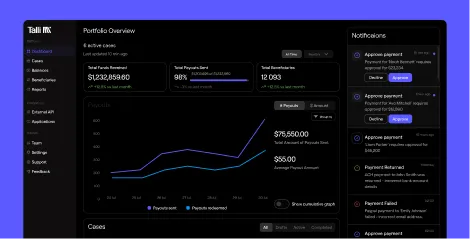
Modern disbursement dashboards provide comprehensive visibility:
Live Metrics
- Completion rates by payment method
- Geographic distribution of payments
- Processing stage for pending items
- Exception categories requiring attention
- Fund flow tracking from receipt to delivery
Stakeholder Access
- Controlled portals for courts, trustees, and counsel
- Role-based permissions limiting sensitive data
- Audit logging of all access and actions
- Automated status notifications
Talli's platform reduces settlement reconciliation time substantially through automated three-way matching with high auto-match rates.
Integrating with Existing Case Management Systems
Seamless integration eliminates duplicate data entry and synchronization errors:
Integration Capabilities
- API connections to case management platforms
- Webhook support for real-time status updates
- CRM synchronization for payment tracking
- Automated data validation on import
Implementation Efficiency
- Typical setup timeframes with vendor assistance
- Measurable ROI through reduced processing time
- Phased rollouts for testing before full deployment
For QSF trustees and claims administrators seeking to modernize disbursement operations, Talli's platform provides enterprise-grade capabilities with implementation support designed for legal settlement workflows.
Transforming Settlement Disbursement with Talli
Managing settlement disbursements requires balancing Rule 1.15 obligations, state-specific compliance requirements, and prompt client payments. Violations can carry career-ending consequences, while manual processes increase delays and risks.
Talli simplifies settlement administration through an automated digital disbursement platform offering:
- Automated compliance: Integrated OFAC screening, three-way reconciliation, and real-time audit trails.
- Flexible payments: ACH, prepaid cards, and digital wallets for faster disbursements and higher redemption rates.
- Fraud prevention: Fraud detection and institutional banking partnerships to protect settlement funds.
- Tax and court reporting: Automated tax reporting and court-ready accounting documentation.
- Real-time visibility: Live dashboards for tracking settlement distributions.
For law firms managing class actions, mass torts, and complex multi-party settlements, Talli streamlines traditionally weeks-long administrative processes while supporting regulatory compliance and better client experiences.
With institutional banking partnerships and high security standards, Talli helps attorneys fulfill their fiduciary and Rule 1.15 obligations confidently, allowing them to focus on legal work rather than payment logistics.
Frequently Asked Questions
What happens if my attorney doesn't disburse my settlement funds within the required timeframe?
If your attorney fails to disburse funds within state-mandated deadlines, you have several recourse options. In California, failure to disburse within applicable timeframes may create a rebuttable presumption of misconduct that the attorney must explain. You can file a complaint with your state bar association, which investigates trust account violations as a high priority. Document all communications with your attorney, note when you were informed funds were received, and request a written explanation for any delays. Legitimate delays include unresolved medical liens, disputed amounts, or check clearing, but these should be communicated proactively.
Can I request a specific payment method for my settlement funds?
Most law firms can accommodate payment method preferences, though options vary by firm capabilities and settlement size. Digital disbursement platforms enable ACH direct deposit, prepaid cards, digital wallets like PayPal and Venmo, and traditional checks. Discuss preferences with your attorney early in the settlement process. For large settlements, ACH typically offers the fastest and most cost-effective option. Unbanked recipients can request prepaid cards that arrive within days. Note that some payment methods may have small processing fees that reduce your net payment, so ask about any associated costs.
Why do municipal defendant settlements take longer to pay than private defendant settlements?
New York's CPLR 5003-a grants qualifying municipal defendants 90 days to issue settlement payments compared to 21 days for private parties. This extended timeline exists because municipal entities, cities, transit authorities, and school districts, face additional bureaucratic approval processes including budget office review, controller certification, and sometimes legislative authorization for larger amounts. Municipal checks may also face longer bank holds due to verification requirements. If you've settled a claim against a city bus, public hospital, or government agency, expect the payment timeline to extend substantially longer than comparable private settlements.
How do medical liens affect my settlement payment timeline, and can I speed up the process?
Medicare, Medicaid, and other medical reimbursement claims can significantly delay settlement payments, with resolution timelines varying by case complexity, documentation, and applicable recovery procedures. Before disbursing any funds, your attorney must verify and satisfy all valid liens to avoid personal liability. To potentially accelerate the process, gather all medical provider contact information early, provide your attorney with complete treatment records, authorize your attorney to negotiate lien reductions, and respond promptly to any information requests. Medicare's recovery process involves federal compliance verification that cannot be bypassed, but having documentation ready reduces back-and-forth delays.
How can I track the status of my settlement payment?
Your right to information about your settlement funds is protected by Rule 1.15, which requires attorneys to provide accountings upon request. Contact your attorney's office directly and request a status update including when the settlement check was received, the expected clearance date, any liens requiring resolution, and the anticipated disbursement date. Modern law firms using digital disbursement platforms may provide client portals with real-time tracking. If your attorney is unresponsive or evasive about fund status, document your requests and consider contacting your state bar's ethics hotline for guidance on your rights.